Can You Force-Charge a Battery from the Grid? What You Need to Know
Ever thought about getting a battery but worried your solar just wouldn’t cut it?
Maybe your roof’s partly shaded, or it doesn’t have enough space to fit the number of panels you’d need to power both your home and a battery. Your electricity consumption might also be unusually high — whether it’s from a large family, running a home office, or blasting the air con through summer.
If that sounds familiar, you’re not alone — and until recently, you might’ve been right to hesitate.
Fortunately, there’s now an alternative worth considering: force-charging.
At Lenergy, we have been discussing the viability of this option with clients every day. In this article, you’ll learn:
- What force-charging is and how it works
- When it makes financial and practical sense
- Which plans and batteries support it (including Sigenergy’s SigenStor)
- Why it’s a solid option even if your solar output is limited
- And what to consider before making it part of your setup
What Does “Force Charging a Battery from the Grid” Actually Mean?
Up until recently there has been only one source for charging a solar battery — through solar panels. With the recent changes in the grid a new option is becoming available: charging your battery using electricity from the grid, often referred to as force-charging.
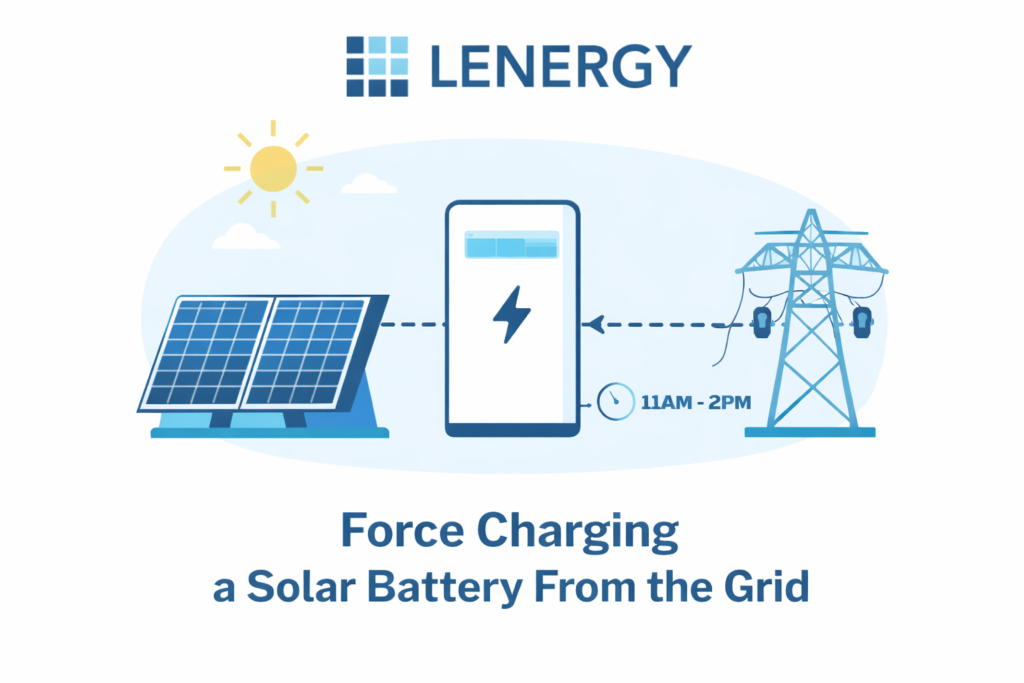
Force-charging means your battery is set up to draw electricity from the grid to charge your solar battery. It usually happens during a specific window in the middle of the day — typically 11am to 2pm — when there’s excess renewable energy flooding the grid. Retailers like OVO Energy and GloBird now offer plans that give you access to free electricity around these times, which you can use to charge your battery.
Rather than letting that clean energy go to waste, you’re capturing it and using it when it’s more valuable — like in the evening when power prices peak. This is especially useful if:
- Your solar system doesn’t generate enough to fill a battery
- You live in a shaded area or have limited roof space
- You want to offset your night time usage, but don’t have room to expand your solar
It’s called force-charging because it requires a battery that allows for controlled charging from the grid, not just passive solar input. Your system is configured to import and store energy on command, typically through a smart inverter or battery software that knows when the “free” window opens.
Why Would You Want to Charge Your Battery from the Grid?
Not everyone has the perfect setup for solar. Even if you already have panels, they might not produce enough energy to fully charge a battery — especially in winter, on cloudy days, or if your roof isn’t ideally placed. That’s where grid charging becomes a game-changer.
Here are the main reasons you might want to force-charge your battery:
1. You Use More Power Than Your Panels Can Produce
Some households simply use a lot of energy. If you’ve got a large family, a home business, a pool pump, ducted air con, or an EV charger — your energy needs might outpace what your panels can generate, even on a sunny day. Force-charging allows you to top up your battery using grid energy, so you’re not forced to buy expensive peak power later.
2. Your Property Doesn’t Get Enough Sun
Many Australian homes are affected by roof shading from trees, neighbouring buildings, or poor orientation. Some simply don’t have enough roof space to fit a large solar array. Force-charging means you’re no longer reliant on your own solar production — you can now take advantage of surplus grid energy instead.
3. You Want to Maximise Battery Value Without Expanding Solar
If you’re already producing enough solar to cover most of your daytime usage but not quite enough to fill a battery, adding more panels may not be practical or cost-effective. Force-charging lets you get more value from your existing system — by giving your battery another way to charge, without needing more panels.
4. You’re Preparing for Blackouts or Want Energy Security
Force-charging also means you can guarantee your battery is full before an expected outage, regardless of how much sun your panels are producing that day. For households in bushfire-prone areas (such as rural NSW & VIC), rural zones, or regions with frequent outages (QLD), this adds another layer of resilience.

One of the most common objections we hear at Lenergy is, “I’d love a battery, but I just don’t produce enough solar to make it worthwhile.” And — until recently, that was a valid concern. Force-charging changes that. It removes the reliance on your own solar generation and gives you another way to fill your battery — using excess energy from the grid during free midday windows. In other words, the grid becomes a second solar source, making battery ownership possible even for homes with limited production.
What Retail Plans Support Force-Charging in Australia?
If you’re going to charge your battery from the grid, you need the right electricity plan — one that allows force-charging, and ideally, rewards you for it. A small but growing number of energy retailers in Australia now offer dedicated force-charging windows, where electricity is either free or heavily discounted during the middle of the day.
Here are two plans that currently support this:
OVO Energy – The Free 3 Plan
OVO’s “The Free 3” plan gives you three hours of free electricity every day, usually from 11am to 2pm. This window aligns with the time when there’s often an oversupply of solar in the grid — meaning you’re helping stabilise the network while storing energy at no cost.
During this free window, you can run high-usage appliances (like washing machines or pool pumps) — and if your system allows, charge your battery at no cost. This energy can then be used later in the evening when prices are higher. The key is having a compatible battery that supports force-charging and a system setup that can take advantage of the window.
GloBird Energy – Zero Hero Plan
GloBird’s “Zero Hero” plan works in a similar way. It offers zero-cost electricity during a specified solar soak window — again, typically 11am to 2pm — allowing you to draw from the grid when there’s a surplus of renewable energy.
The idea is simple: instead of letting that excess solar go to waste, the plan gives you a way to use it — whether that’s for running appliances or force-charging your battery. The plan is part of a broader effort to support smarter energy use, reduce pressure on the grid, and reward customers for helping balance supply and demand.
These types of plans are expected to become more common — and they’re not just a passing trend. The federal government is actively encouraging this shift through its solar sharing scheme, which promises access to free three-hour energy plans for homes that participate. By offering these midday “solar soak” periods, the scheme aims to ease pressure on the grid and reward homeowners for storing or using energy when it’s most abundant.
What Batteries Can Be Force-Charged? (Example: Sigenergy SigenStor)
Not all batteries on the market can be charged from the grid — at least, not out of the box. To take advantage of a force-charging plan, you need a battery that supports controlled charging from external sources, not just from your rooftop solar. This capability is usually built into the battery’s software or inverter settings.
One of the best examples of a battery that supports force-charging is the Sigenergy SigenStor.

Some key features that make the SigenStor a good fit for force-charging:
- Smart scheduling: You can set it to only charge during specific hours (like the free three-hour windows).
- AI optimisation: It uses artificial intelligence to manage charging and discharging based on energy prices, solar availability, and usage habits.
- Full-cycle control: Unlike some systems that only allow passive charging from solar, the SigenStor gives you control over how and when energy is stored.
As force-charging becomes more common, we expect more battery manufacturers to add this functionality. If you’re installing or upgrading now, it’s worth confirming with your installer that your battery and inverter can support controlled grid charging — and that it’s configured correctly to make use of these free windows.
Does Force-Charging Hurt Battery ROI or Warranty?
If you’re charging your battery from the grid instead of just solar, will it wear out faster? Will it void the warranty? And is it still worth the investment?
Battery Lifespan and Charging Cycles
Most modern batteries, like the Sigenergy SigenStor, are designed for daily use and come with long warranties — typically covering up to 10 years or a set number of cycles (for example, 6,000 full charge/discharge cycles).
Whether your battery is charged by solar or by the grid doesn’t really matter — what matters is how often it’s cycled and how deeply it’s discharged. Force-charging during a free midday window is typically just one cycle per day, and in many cases, it’s replacing a solar cycle rather than adding to it.
This means the overall wear is no greater than using solar alone. In fact, force-charging can reduce strain on your system by ensuring your battery charges at a steady, controlled rate, even on cloudy days.
Warranties and Force-Charging
If you’re using a battery that’s built to handle controlled grid input — like the SigenStor — then force-charging won’t void the warranty. What’s important is that your system is installed and configured correctly by a Clean Energy Council (CEC)-approved installer and that it follows the manufacturer’s recommended operating settings.
If in doubt, always ask your installer to confirm in writing that force-charging is supported and covered under warranty. Batteries that aren’t designed for this purpose may require firmware updates or configuration tweaks to enable grid charging safely.
Is It Still Worth It Financially?
Absolutely — and even more so if you act soon.
Force-charging gives you the ability to fill your battery during free midday solar soak windows, instead of relying only on your own solar production. That means you’re storing energy that costs you nothing and using it when grid prices are at their highest — often 35 to 50 cents per kilowatt-hour during the evening peak. For homes with high energy usage or limited solar generation, this can significantly accelerate your battery’s return on investment.
And there’s another layer of savings: the federal battery rebate, which helps reduce upfront costs for eligible households. It’s important to know the rebate won’t stay at its current level. It’s set to scale down every six months until 2030, so the sooner you install a battery, the more you can save.
Together, force-charging and the federal rebate make battery storage not only viable, but financially smart — especially for households that previously thought they couldn’t make it work.
Will These Force-Charging Plans Last?
If you’re hearing about “free electricity” from retailers like OVO and GloBird, it’s natural to wonder: How long will this last? Is it just a promo? Will my force charging setup be redundant in a few years?
Backed by the Federal Government’s Solar Sharing Scheme
There is a long-term shift occurring in how the Australian energy market works. The federal government isn’t just aware of midday solar oversupply — it’s building policy around it. Through the solar sharing scheme, the government has explicitly promised to support the rollout of free three-hour plans (like those from OVO and GloBird) to households willing to participate. This isn’t about sales promotions — it’s about grid management.

Retailers Want to Avoid Paying Penalties
It’s also in the best interest of retailers. When the grid is flooded with excess solar, wholesale prices can crash — or even go into the negative. If too much energy is sent back to the grid, it costs retailers money. By offering free electricity during the day, they’re incentivising you to use or store that energy instead — which actually saves them money.
That’s why plans like these aren’t likely to disappear. If anything, more will emerge as battery uptake increases and grid pressures grow.
While electricity plans always change over time, force-charging is aligned with the future of Australia’s energy strategy — and it’s backed by both policy and market incentives. It’s not a short-term perk; it’s a structural shift.
Is Force-Charging Right for You?
Force-charging isn’t for everyone — but for a growing number of homeowners, it’s turning battery ownership from a “maybe later” into a “let’s do it now.”
Here’s who stands to benefit the most:
1. You use a lot of power, especially in the evenings.
If your daytime solar doesn’t stretch far enough to charge a battery and run your household, force-charging lets you top up your battery using free energy in the middle of the day— so you’re not stuck buying peak power at night.
2. You have limited roof space or shading.
Can’t fit a large solar system? Shaded roof sections reducing output? Force-charging provides an alternative way of filling up your battery — one that doesn’t rely on your panels doing all the work.
3. You want to take advantage of government-backed plans.
With federal support behind solar soak windows, and plans like OVO’s “Free 3” and GloBird’s “Zero Hero” already live, now is a smart time to act. These aren’t one-off deals — they’re part of a broader energy shift that rewards battery owners.
4. You want more control during outages.
Force-charging gives you the ability to guarantee your battery is full when you need it — even on cloudy days. That’s especially useful if you live in a rural area, face frequent blackouts, or want extra energy security.
Should You Make the Switch?
If you’ve held off on getting a battery because your solar output didn’t seem high enough, force-charging changes the equation. It allows you to store energy directly from the grid — often for free — and use it when it matters most.
This doesn’t just make batteries more flexible. It makes larger batteries more practical. The bigger your storage capacity, the more of that free midday energy you can soak up from plans like OVO’s Free 3 or GloBird’s Zero Hero — which means more evening coverage, better blackout protection, and greater savings.
Additionally, there’s another reason to act soon: the federal battery rebate is scaling down every six months until 2030. That means the earlier you install, the more you’ll save — especially if you’re investing in a larger battery that’s built to take full advantage of force-charging.
Still unsure? Reach out to us at Lenergy and speak with one of our Solar Specialists about whether force-charging could be an option for you.