GoodWe ESA Battery Review (2026): Is This New All-in-One Energy Storage System Right for Your Home?
Battery systems don’t look like they did three years ago. The old formula — inverter here, battery there, gateway box somewhere else — is being replaced by tall, integrated stacks. Modular. Expandable. Sleeker. It’s now the dominant design trend in Australian energy storage. The GoodWe ESA battery series is built for that new reality.
If you’re weighing up battery options in 2026, you’re likely comparing Tesla, Sigenergy, Alpha ESS or Sungrow. Now the ESA is entering that conversation. It’s CEC approved, it’s modular, and it’s positioned as a serious contender.
However, approval and a clean design only tell part of the story.
Here at Lenergy, we install a range of battery systems from many of the major brands in Australia. Seeing these systems up close — during installation and in real homes — gives us a practical perspective that goes beyond the marketing brochures.
With the launch of the GoodWe three phase option, we thought it was worth sharing our thoughts on what this new system brings to the table.
In this GoodWe ESA battery review, you’ll learn:
- How the ESA is built and what makes it different
- The real technical capabilities
- Single-phase vs three-phase options
- Backup and blackout performance
- Expandability and future-proofing
- Safety features and cold-weather performance
- And who this battery is — and isn’t — suited for
Why All-in-One Home Battery Systems Are Taking Over the Market in Australia
A couple years ago, most home battery systems looked like this:
- Solar inverter on the wall
- Battery mounted separately
- Backup gateway box
- Extra switchgear
- More cabling than most homeowners realised
It worked. But it wasn’t elegant.
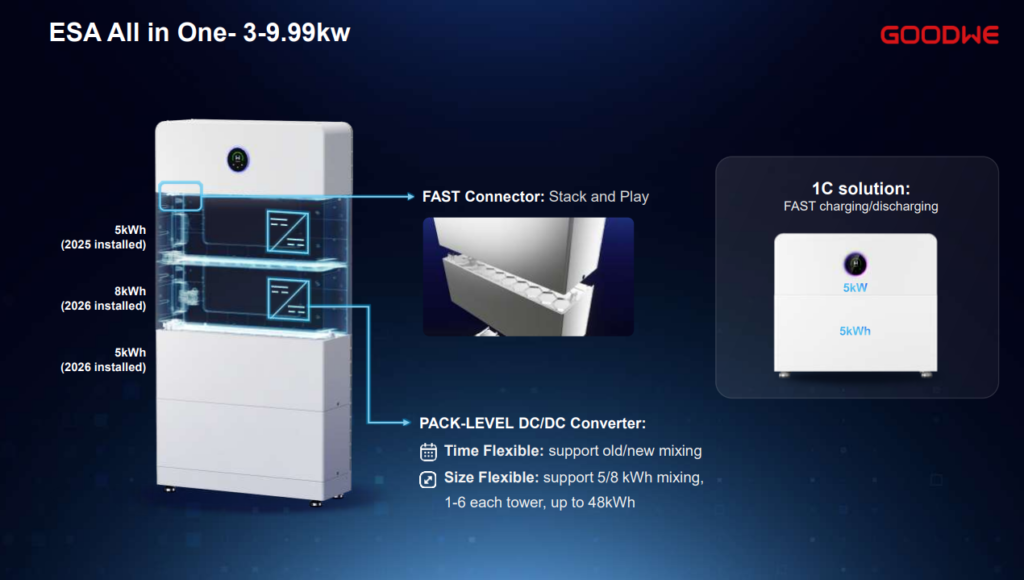
Fast forward to 2026, and the market has clearly shifted toward all-in-one systems — a vertical stack where the inverter sits on top and battery modules clip neatly underneath.
So why has the industry moved this way?
Rebates and the Shift Toward Modular Storage
Government battery incentives — both federal and state-based — have encouraged homeowners to install larger systems .
Instead of buying one fixed 10kWh box and being stuck with it, modular systems let you:
- Install a wide range of different sizes whether it be 10, 20, 30 or even 50kWh
- If you want even more your energy use grows you can add more modules later
That flexibility matters if you’re:
- Installing an EV charger later
- Adding ducted air conditioning
- Growing your household
- Planning to join a Virtual Power Plant
Tall, modular “columns” are simply easier to scale than older single-box designs.
Installer Preference for Integrated Battery Systems
From an installer’s perspective, all-in-one systems reduce:
- Wiring complexity
- Installation time
- Commissioning errors
- Missing components (like backup gateways)
If you remove extra boxes and cabling, you reduce labour and potential failure points.
The GoodWe ESA leans heavily into this philosophy:
- No external backup gateway
- Battery modules clip together
- Minimal interconnecting cabling
- Pre-wired internal architecture
Less complexity generally means fewer headaches later.
Aesthetic and Footprint Considerations
It may sound superficial, but batteries now often sit in:
- Garages
- Carports
- Side walkways
- Outdoor entertaining areas
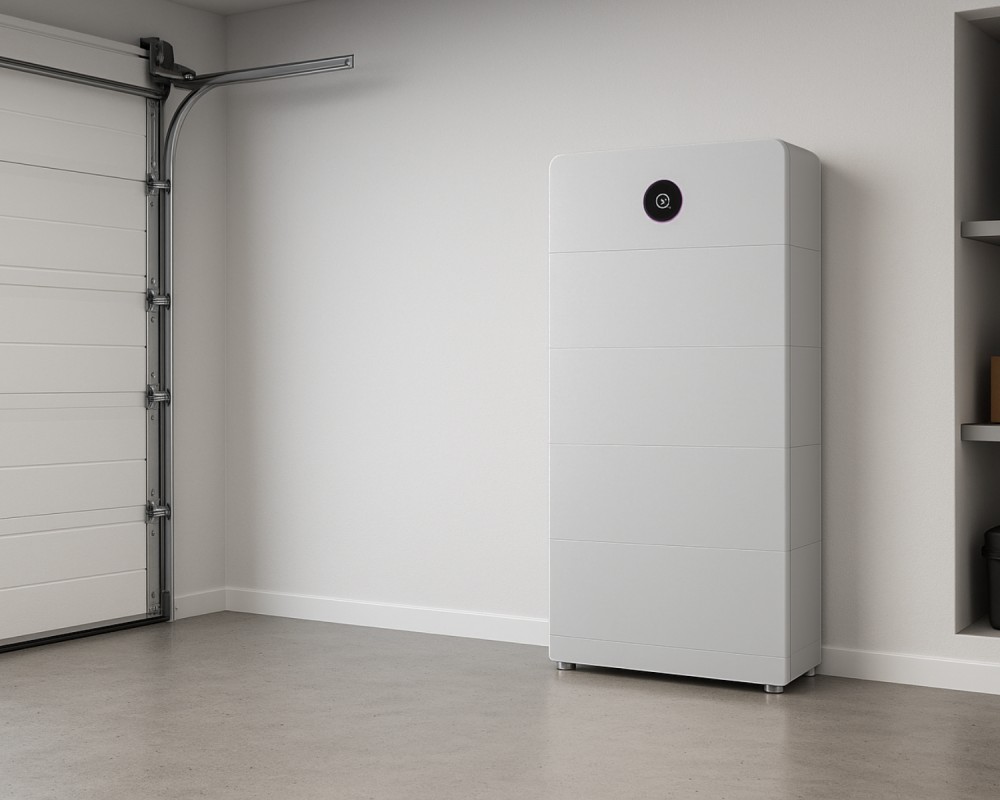
A tall, neat vertical stack looks cleaner than three separate wall boxes.
The ESA follows this modern “column” design approach, similar in concept to other modular systems now dominating the mid-to-premium battery market.
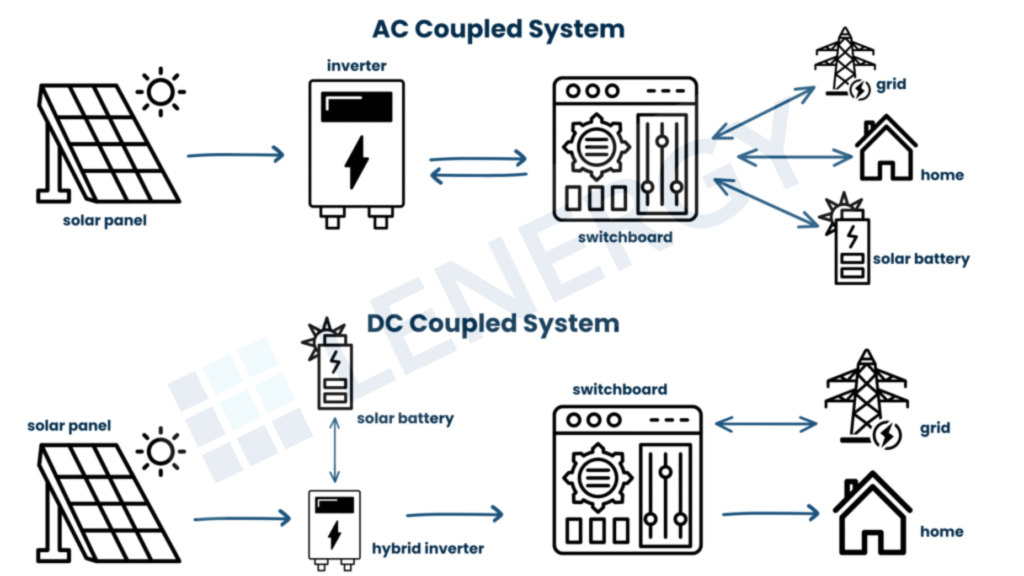
The Return of DC-Coupled Hybrid Architecture
Another major reason for the shift is technical.
Older systems often relied on AC coupling, which works well but can introduce extra conversion losses or charging bottlenecks in certain configurations.
Modern all-in-one systems like the ESA are typically:
- Hybrid inverters
- DC-coupled
- Designed to accept high PV input
- Capable of simultaneously exporting to grid and charging the battery
This architecture matters more now because solar arrays are getting larger — 10kW, 13kW, even 20kW residential systems are no longer rare. Homeowners want to use as much of that roof energy as possible.
If you are wanting to understand more about the difference between Ac and DC coupling, our article breaking it down can be found here.
What Is the GoodWe ESA Battery System?
At its core, the GoodWe ESA is an all-in-one hybrid inverter and modular battery system designed for residential solar storage.
That means instead of buying:
- A solar inverter
- A separate battery
- A separate backup gateway
- And sometimes additional control hardware
You get one vertically integrated unit that combines:
- Hybrid inverter (sits on top)
- Stackable battery modules (stacked underneath)
- Built-in backup functionality
- Internal switching and control hardware
It’s designed to simplify both installation and long-term operation.
Battery Chemistry: Lithium Iron Phosphate (LFP)
The ESA uses Lithium Iron Phosphate (LiFePO₄ or LFP) cells.
That’s now the dominant chemistry in residential batteries for three main reasons:
- Better thermal stability
- Longer cycle life
- Lower fire risk compared to older lithium chemistries
LFP is considered the safest mainstream battery chemistry for residential use.
Available Battery Module Sizes
Currently, the ESA supports two primary module sizes:
- ~5 kWh module
- ~8 kWh module
Future modules around 6 kWh and 9 kWh are expected.
One important detail:
The system supports mixing module sizes in the same stack.
So you could theoretically have:
- One 5 kWh module
- Two 8 kWh modules
- Add another later
This flexibility matters for long-term expansion and for replacing a single failed module without scrapping the entire stack.
Maximum total storage per stack is approximately 48 kWh (six modules plus inverter head).
Inverter Options: Single-Phase and Three-Phase
Single-Phase Models
Common inverter sizes include:
- 5 kW
- 8 kW
- 10 kW
The 10 kW single-phase model is typically the most common configuration in modern Australian homes with larger solar arrays.
Notably, the 10 kW single-phase model includes four MPPTs (four solar inputs), which allows:
- Multiple roof orientations
- Larger PV systems
- More design flexibility
Three-Phase Models
Three-phase models have recently been approved by the CEC and they range from:
- 5 kW
- 10 kW
- 15 kW
- 20 kW
- 25 kW
- 30 kW
This makes the ESA suitable for:
- Large residential homes
- Properties with three-phase ducted air conditioning
- Homes with large EV charging demand
- Small commercial sites
The same battery modules are used — only the inverter head changes.
Additionally, multiple inverters can be paralleled (up to four), allowing even larger system designs if required.
DC-Coupled Architecture Explained: Why It Matters
If you’ve been researching solar batteries, you’ve probably come across two terms: DC-coupled and AC-coupled systems.
The GoodWe ESA is primarily designed as a DC-coupled hybrid system, where the solar panels connect directly to the hybrid inverter that also manages the battery.
Solar panels produce DC electricity, which flows into the hybrid inverter. From there, the system decides how to use that energy.
It can either:
- send electricity to your home or export it to the grid, or
- store the energy in the battery
Because the battery sits on the DC side of the inverter, solar energy can move directly into the battery without first being converted into AC electricity and then back again.
This architecture is what allows the ESA to do something many homeowners care about: make better use of large solar systems.
In practical terms, the system can:
- power your home
- export solar to the grid
- and charge the battery
all at the same time when enough solar energy is available.
This becomes particularly useful for homes with larger solar arrays (10–20 kW) where solar production can exceed household demand during the middle of the day.
It’s also worth noting that the ESA can still be installed as an AC-coupled battery when retrofitting storage onto an existing solar system. In that case, a meter is typically used so the battery can monitor generation and decide when to charge or discharge. In simple terms, the ESA is flexible:
it can operate as a DC-coupled system for new solar installations, or AC-coupled when adding storage to an existing system
200% PV Oversizing & Simultaneous Output
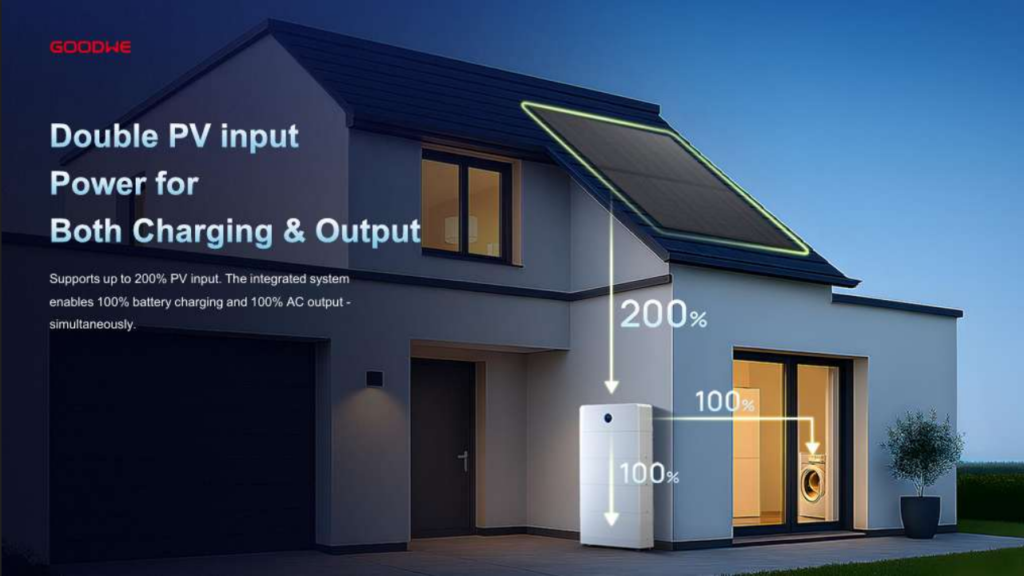
The ESA supports up to 200% PV oversizing.
On a 10 kW inverter, you could technically install up to 20 kW of panels (subject to network rules).
The integrated system enables:
- 100% battery charging capacity
- And 100% AC output capacity
- At the same time
In simple terms:
If you have a 10 kW inverter, the system can:
- Send 10 kW to your home or export to the grid
- While simultaneously sending up to 10 kW into the battery
This avoids a common issue in some lower-tier hybrid systems where charging the battery reduces available AC output, or vice versa.
On a strong solar day, this architecture allows you to:
- Power the house
- Export to the grid
- Charge the battery at full speed
All at once.
Performance Specifications
1C Charge and Discharge Capability
The GoodWe ESA supports what’s known as 1C charging and discharging.
In simple terms, “1C” means the battery can charge or discharge its entire capacity in about one hour.
For example:
- A 10 kWh battery can charge or discharge at up to 10 kW
- A 20 kWh battery can charge or discharge at up to 20 kW
(assuming the inverter allows that level of output)
Why does this matter?
Some batteries can store a lot of energy but can only release it slowly. Think of it like a large water tank with a narrow pipe — the storage is there, but the flow rate is limited.
A 1C battery allows much higher power flow, which has a few practical benefits.
1. Faster solar charging
On a strong solar day, the battery can fill quickly instead of slowly trickling energy throughout the afternoon. This is especially useful if you have a large solar system producing 10–15 kW during the middle of the day.
2. Stronger evening power output
In the evening when multiple appliances turn on — cooking, air conditioning, lights, appliances — the battery can deliver high power without hitting output limits.
3. Better suited to VPP and smart tariff programs
Some of the best energy programs for solar batteries involve frequent charging and discharging based on electricity prices. A higher charge and discharge rate allows the system to respond quickly when those opportunities appear.
In short, 1C capability means the battery isn’t just large — it’s powerful enough to move energy quickly when your home needs it.
MPPT Flexibility
The 10 kW single-phase model includes four MPPTs.
More MPPTs allow:
- East / West roof splits
- Complex roof layouts
- Greater design flexibility
Black Start Capability
If your battery goes flat during a prolonged outage, but solar returns the next morning, the ESA can restart itself using solar power — without grid assistance.
Backup & Blackout Capability: What “Whole-Home” Really Means
The ESA includes built-in backup switching.
No external gateway box is required.
Switchover Speed (~4 Milliseconds)
The system switches to backup in around 4 milliseconds.
In practical terms:
- TVs typically won’t flicker
- Lights stay on
- Electronics don’t reset
Whole-Home Backup Explained Realistically
The ESA allows up to around 63A pass-through wiring.
You can wire the whole house to backup.
However, output during blackout is limited by inverter size.
If you install a 10 kW inverter, during an outage you have up to 10 kW available.
You still need to manage loads accordingly.
Three-Phase Backup & Optimisation
Inverter sizing is often overlooked, but it can make a significant difference to how well a battery system performs — and this is where GoodWe’s broad inverter range becomes a real advantage.
Rather than offering only one or two fixed models, it offers 5 kW through 30 kW options.
Combined with paralleling capability, this allows system designers to better optimise output across all three phases in larger homes.
Instead of forcing the home to fit the inverter, the inverter can be sized to match the home.
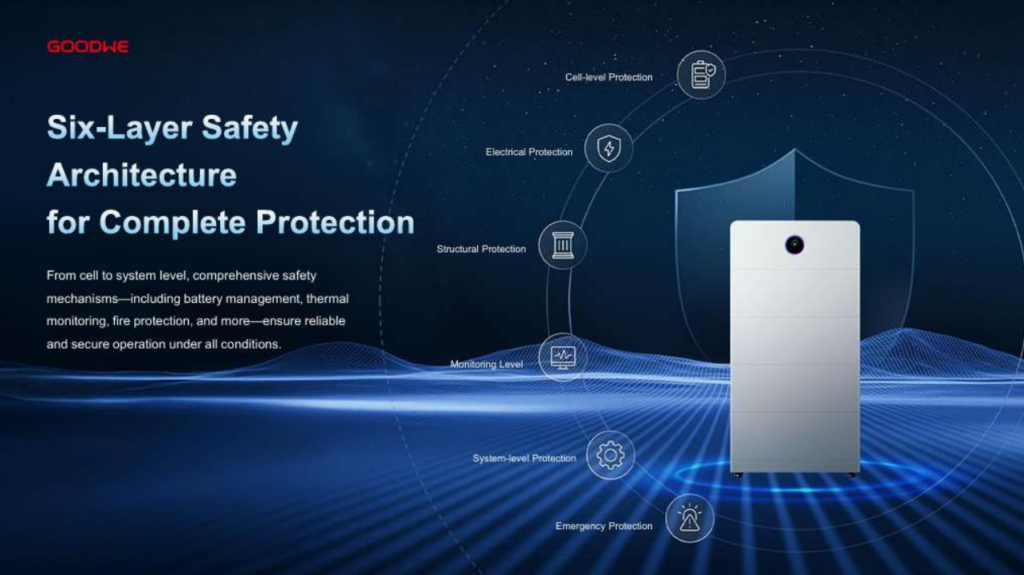
Safety Features: Six-Layer Protection System
When people think about battery safety, the first concern is usually fire risk. However, in colder parts of Australia, the opposite problem can also matter — batteries don’t perform well if they become too cold.
To address this, the ESA includes integrated heating pads that help keep the battery within its optimal operating temperature. This allows it to charge and discharge safely even in colder climates, down to around -20°C depending on the model.
In practical terms, this helps ensure the battery continues operating reliably whether it’s installed in a mild coastal garage or a colder inland region.
Temperature control is just one part of the ESA’s broader safety design. The system incorporates multiple layers of protection, including:
- LFP (Lithium Iron Phosphate) battery chemistry, known for strong thermal stability
- Cell-level monitoring of voltage, current and temperature
- Independent module optimisation, allowing the system to manage each battery module individually
- Integrated fire suppression measures
- Arc Fault Circuit Interruption (AFCI) to detect electrical arc faults
- Cold-climate heating pads for sub-zero performance
Another advantage of the modular design is resilience. If one battery module in the stack develops a fault, the remaining modules can continue operating while the affected unit is replaced, rather than shutting down the entire system.
Software, Monitoring & VPP Integration
The ESA integrates with GoodWe’s SEMS platform.
Features include:
- Real-time monitoring
- Historical data
- Time-of-use scheduling
- Push notifications
- Commissioning templates
Amber Electric integration is apparently coming..
Origin Loop compatibility is supported.
It’s worth noting that the ESA warranty still includes a cycle limit. GoodWe states that the system is covered for 10 years, with the battery cells warranted to retain 70% of usable energy or reach 6,000 full charge cycles, whichever comes first. That performance warranty applies only to the battery cells. Other parts of the system are covered separately under the product warranty.
Pros and Cons of the GoodWe ESA Battery
Pros
- Wide inverter sizing range (5–30 kW three-phase options)
- 200% PV oversizing capability
- Simultaneous full battery charging and AC output
- Modular expandable architecture
- Built-in backup (no gateway required)
- Black start capability
- LFP chemistry and layered safety
- GoodWe’s long-standing Australian presence (~15 years),
- Ecosystem integration (EV charger compatible)
Considerations
- Newer battery platform compared to long-established legacy models
- Tall stack height requires install planning
- Best suited to integrated solar + battery installs
Is the GoodWe ESA Battery Worth It in 2026?
The Australian battery market has matured significantly.
The GoodWe ESA doesn’t try to reinvent home energy storage. Instead, it focuses on practical strengths: scalable design, flexible inverter sizing, and efficient DC architecture that can make better use of large solar systems.
Its key advantages include:
- A broad range of inverter sizes
- High PV input capability
- Expandable modular storage
- Strong flexibility for three-phase homes
For larger modern homes — particularly those with three-phase power and higher electricity demand — it can be a technically strong option at a reasonable price.
That said, the right battery always depends on your specific situation. Factors such as your energy usage, solar system size, electricity tariff, phase supply, and how you plan to use the battery will ultimately determine what makes the most sense.
The GoodWe ESA is certainly worth shortlisting in 2026 — but it’s not the only option.
If you’re considering adding a battery to your home, the best place to start is by understanding which system actually fits your setup.
If you’d like help working that out, our team at Lenergy can walk you through the options and help determine whether the GoodWe ESA — or another system — is the right choice for your home.