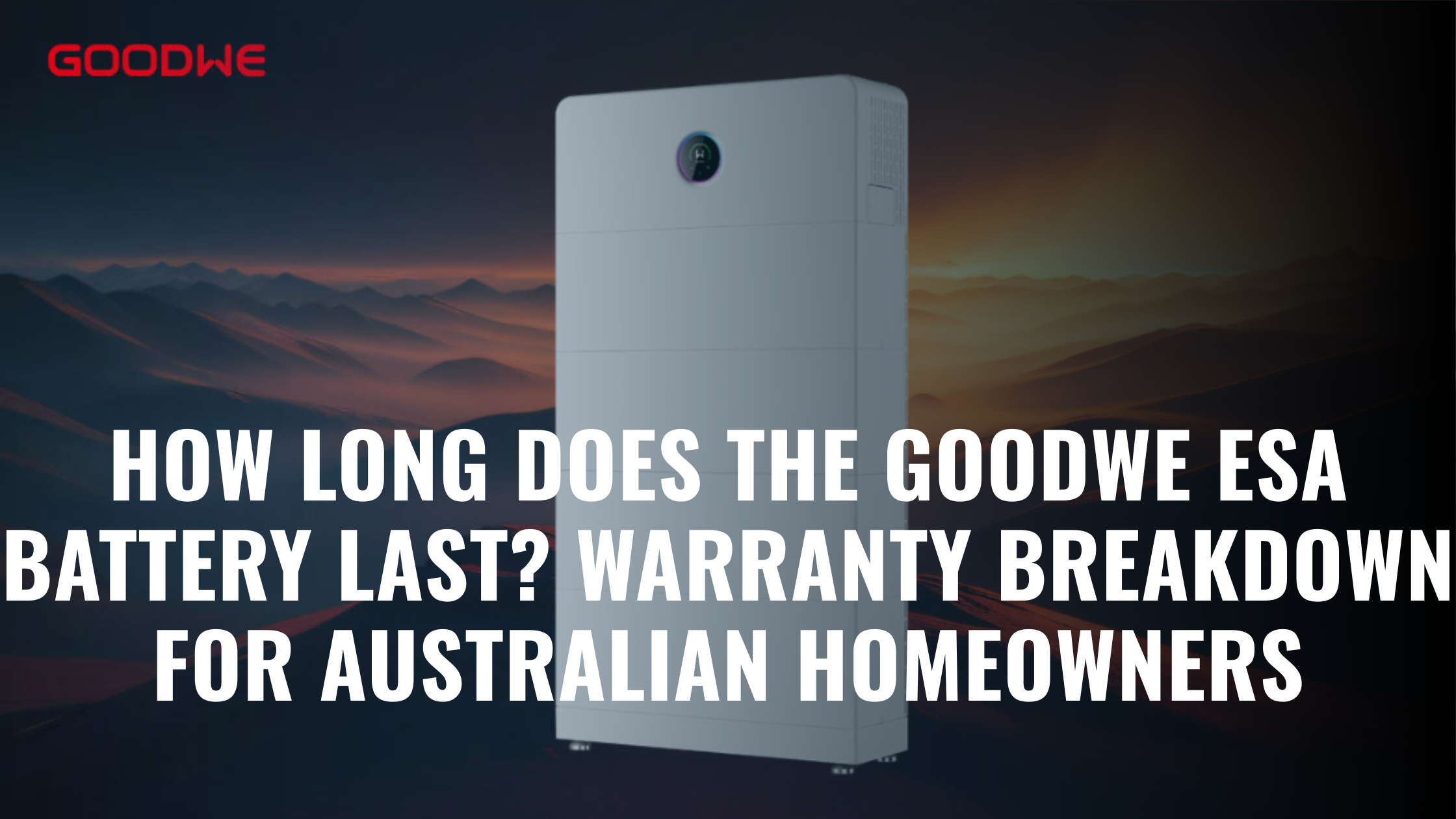
How Long Does the GoodWe ESA Battery Last? Warranty Breakdown for Australian Homeowners
The GoodWe ESA is a great battery for homeowners looking for an all-in-one battery solution for an affordable price tag, however, like any battery, the real question isn’t what it does on day one it’s how it holds up over time. That’s where the warranty matters. Like most systems, the ESA uses separate warranties for the inverter and battery. We’ve reviewed both official 2025 Australian documents to break it down clearly.
In short the GoodWe ESA comes with a 10-year inverter warranty, a 10-year battery product warranty, and a 10-year performance warranty, guaranteeing either 70% usable capacity or a minimum throughput of 3 MWh per usable kWh, whichever comes first. This is all pretty standard in the solar industry at the moment, however as always with warranty documents the devil is in the details.
In this article, you’ll get a thorough breakdown of how long you can expect the GoodWe ESA to actually last, what the warranty really covers, where the limits are, and how it compares to the Tesla Powerwall 3.
| Note: Two separate warranty documents apply to the GoodWe ESA. The inverter and battery modules each have their own warranty with different rules. Where they differ; on start dates, reporting windows, and labour coverage, will be identified explicitly. |
How Long Does the GoodWe ESA Battery Actually Last?
Short answer: around 10 years under typical household use. However, the warranty is built around two limits, not just a time period.
The battery performance warranty expires when either of these conditions is reached whichever comes first:
- 10 years from the warranty start date
- A minimum energy throughput of 3 MWh per usable kWh of battery capacity
For the two battery modules available in Australia:
| Battery module | Usable capacity | Min. throughput (total) | Equiv. daily cycles for 10 yrs |
| GW5.1-BAT-D-G20 / G21 | 5.0 kWh | 15.0 MWh | ~1 per day |
| GW8.3-BAT-D-G20 / G21 | 8.0 kWh | 24.0 MWh | ~1 per day |
The throughput figures are calculated under specific conditions per the warranty document: ambient temperature 10–25°C, an average of one cycle per day or fewer, and a maximum discharge current of 50A. If your usage differs significantly from those conditions, for example, if you join a Virtual Power Plant or cycle the battery more than once daily, you could reach the throughput limit before the 10-year mark.
After 10 years, the battery does not suddenly stop working. Performance continues to decline gradually beyond the warranty term, so realistically:
- 10 years = guaranteed performance under warranty
- 10–15+ years = possible continued lifespan, but with reduced output and no warranty coverage
What Does the GoodWe ESA Battery Warranty Actually Cover?
The GoodWe ESA warranty has three distinct layers, each with its own rules.
1. Battery product warranty — 10 years
This covers the hardware of the battery modules: the electronics, enclosure, battery cover, micro circuit breaker, and BMS circuit board. If a component fails due to improper workmanship or defective materials, GoodWe will at its discretion repair the unit, replace it with spare parts, or swap it for a new, refurbished, or functionally equivalent model.
2. Battery performance warranty — 10 years
GoodWe guarantees the battery will retain at least 70% of its usable energy for 10 years, or until the throughput limit is reached. To put that in practical terms: if your battery starts with 8.0 kWh usable, it is guaranteed to still deliver at least 6.4 kWh at year 10. The coverage that felt like a full evening’s electricity in year one may cover somewhat less by year ten, but the decline is gradual, not sudden.
One important distinction: the performance warranty only covers the battery cells. All other components in the battery module are covered by the product warranty, not the performance warranty.
3. Inverter warranty — 10 years
The ESA 3–10K hybrid inverter carries a separate 10-year product warranty. This covers faults and defects in the inverter hardware. Communication accessories; WiFi modules, LAN kits, 4G modules, and related accessories, carry only a 2-year warranty, so if the monitoring hardware fails after year two, that is an out-of-pocket cost.
| Comms kits: 2 years only The WiFi and 4G modules that connect your system to GoodWe’s SEMS monitoring app are only covered for 2 years. For a 10-year battery, plan accordingly. |
When Does the GoodWe ESA Battery Warranty Start?
This is where homeowners can unknowingly lose months of coverage. The two documents have different rules.
| Inverter warranty Starts from: installation date Or: 12 months after manufacture(whichever is earlier) | Battery warranty Starts from: original purchase date Fallback (if no proof of purchase): installation date or 6 months after manufacture(whichever is earlier) |
The battery warranty is tied to your purchase date, not your installation date. If you cannot provide adequate purchase documentation, the start date falls back to either the installation date or 6 months after manufacture. This makes keeping your invoice important — not just for paperwork, but because it is the reference point the warranty uses.

What Conditions Must You Meet to Keep the GoodWe ESA Warranty Valid?
Both warranty documents share a set of preconditions. Failing to meet any of these can result in a claim being denied.
Qualified installation
The battery must be installed by a professional installer qualified under local regulations. The inverter document specifies a “skilled person or 3rd party installer.” DIY installation voids both warranties.
No direct sunlight at the installed location
Both documents explicitly require that the battery not be exposed to direct sunlight at its installed location. This is a warranty condition, not just a recommendation. The installation site must also be ventilated in accordance with the user manual.
Fault reporting windows
This is one of the more consequential differences between the two documents:
| Inverter faults Must be reported within 1 month of appearance | Battery faults Must be reported within 2 weeks of appearance |
Miss the battery reporting window and GoodWe may treat the right to claim as waived. This is stricter than many competing batteries. If you notice any unusual behaviour such as unexpected shutdowns, capacity drops or error codes in the SEMS app report it promptly.
Keep the inverter connected to SEMS
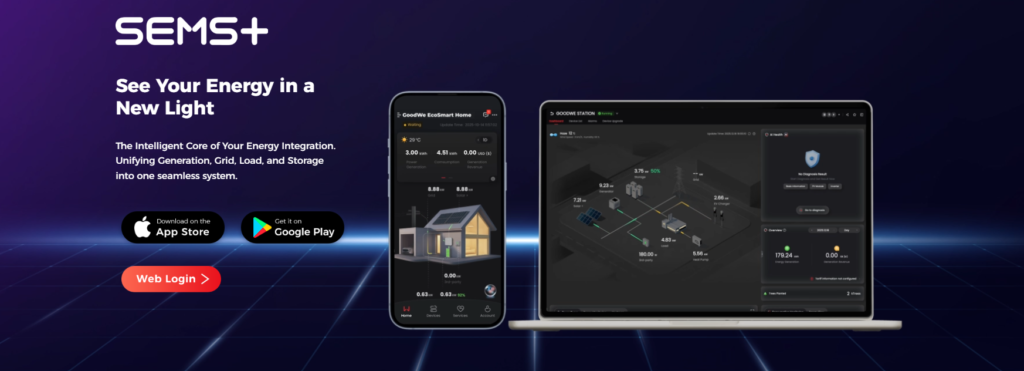
The inverter warranty document contains a firmware update clause that is easy to overlook. GoodWe states that if it is unable to perform remote firmware upgrades due to the customer failing to connect the inverter to the SEMS portal, the customer bears sole liability for any resulting issues and the standard warranty may not apply. Keeping your system online and connected is not optional from a warranty standpoint.
One cycle per day maximum for the performance warranty
The performance warranty is calibrated to one full charge/discharge cycle per day. Using the battery more intensively is outside the warranty scope and can shorten the time before you reach the throughput limit.
Coastal installations require prior written approval
| Important for coastal homeowners Both warranty documents explicitly exclude faults or damage caused by exposure to sea coasts or saltwater environments unless GoodWe’s written confirmation was obtained before installation. Given how many Australian homes are located near the coast, this is worth addressing with your installer before purchase. Get the approval in writing first. |
Use only approved batteries with the inverter
The inverter warranty excludes damage caused by combining the GoodWe inverter with a lead acid battery pack or any lithium battery not on GoodWe’s approved battery options list. If you are retrofitting the ESA inverter with third-party storage, check the approved list first.
What Does the GoodWe ESA Warranty Pay For (and What Doesn’t It Cover)?
Hardware replacement
Both warranties cover the cost of hardware required to get the device functioning again. GoodWe may repair, replace with spare parts, or replace the unit entirely with a new, refurbished, or functionally equivalent model.
Transport costs
Both documents cover outbound and inbound transport costs using standard ground transport, up to a cap. The exact cap is not published, GoodWe states “please contact GoodWe for the rate.” You are responsible for any excess or costs from using a different transport method.
Labour costs, this is where the two documents diverge
| Inverter document GoodWe may directly arrange and pay for on-site engineers. Or offer a rebate to the installer / electrician. More assertive that labour is within scope. | Battery document Labour is a discretionary rebate only. Requires the defective unit to be returned and confirmed faulty first. Rate and maximum are undisclosed. |
For both, the rebate must be claimed within 2 months of GoodWe authorising the site visit, and you must contact GoodWe before the visit to be eligible.
What is never covered
- Normal wear and tear
- Faults caused by unqualified installation
- Damage from not following the product manual
- Unauthorised repairs or modifications
- Acts of nature: storms, flooding, overvoltage, fire, lightning, pests
- Coastal/saltwater damage without prior written approval
- Lost electricity savings or revenue during downtime
- Indirect or consequential damages of any kind
- Battery faults not reported within 2 weeks; inverter faults not reported within 1 month
- Incompatible third-party batteries used with the inverter
- Failure to keep the inverter connected to SEMS for firmware updates
How Do You Make a Warranty Claim for a GoodWe ESA Battery?
The process is the same under both warranties:
- Contact your installer or distributor first. They are GoodWe’s default service channel and your first point of escalation.
- Escalate to GoodWe directly if needed via goodwetechnology.zendesk.com/hc/en-gb
- Have your documentation ready: proof of purchase, model number, serial number, installation date, failure date, PV panel details, and any error codes from the SEMS app.
- Report within the correct window: 2 weeks for battery faults, 1 month for inverter faults.
- If a replacement is issued: you must complete an RMA report before the replacement is dispatched, and return the defective unit within 4 weeks of receiving the replacement. Failure to return it means GoodWe can invoice you for the full replacement cost.
What Are Your Rights Under Australian Consumer Law (ACL)?
Both warranty documents include the following statement, as required by Australian law:
| Australian Consumer Law guarantees cannot be excluded Our goods come with guarantees that cannot be excluded under the Australian Consumer Law. You are entitled to a replacement or refund for a major failure and compensation for any other reasonably foreseeable loss or damage. You are also entitled to have the goods repaired or replaced if the goods fail to be of acceptable quality and the failure does not amount to a major failure. |
GoodWe’s liability under its own limited warranty is capped at the purchase value of the product. However, the ACL sits above and beyond the manufacturer’s warranty document and cannot be contractually excluded. If you feel a warranty claim has been unfairly rejected, the ACL is worth understanding as an alternative avenue.

How Does the GoodWe ESA Compare to Tesla Powerwall 3?
The most common comparison in the Australian market. The GoodWe ESA is generally more cost-effective; the Powerwall 3 has a simpler warranty structure. The main practical difference from a warranty standpoint:
| GoodWe ESA | Tesla Powerwall 3 | |
| Throughput limit | Yes — 3 MWh per usable kWh | No throughput cap |
| Warranty term | 10 years | 10 years |
| Capacity retention guarantee | 70% at 10 years | 70% at 10 years |
| Labour coverage | Discretionary (battery) / may arrange engineers (inverter) | Generally included |
| Fault reporting window | 2 weeks (battery) | Simpler process |
For households with typical usage patterns such as charge during the day, use at night, the throughput limit is unlikely to be reached before the 10-year term. Where it becomes a real consideration is if you plan to join a Virtual Power Plant, run the battery hard, or cycle it more than once daily. In those scenarios, Tesla’s uncapped warranty provides more flexibility.
Verdict: Is the GoodWe ESA Warranty Actually Good?
For the average Australian household, yes, with a few things to watch carefully.
The 10-year coverage across both the inverter and battery modules, combined with a 70% capacity retention guarantee, is competitive for the price point. The 3 MWh per usable kWh throughput figure aligns with roughly one cycle per day for 10 years, which is consistent with most household usage.
Where the warranty requires more attention is in the details: the 2-week battery fault reporting window is tighter than most competing products, the labour coverage for battery claims is discretionary, the SEMS connectivity requirement affects firmware warranty protection, and coastal homeowners need prior written approval before outdoor installation. None of these are dealbreakers, but they are things to understand and plan for before you sign.
The most useful question to ask your installer before purchase is straightforward: if the battery needs an on-site service call under warranty, what will it cost me, and will you back that with your own workmanship guarantee? Some installers offer their own parallel labour warranty, which can matter just as much as GoodWe’s document over a 10-year system life.
If you are ready to speak to a specialist about what battery is the right option for you, reach out to our staff at Lenergy to speak with one of our specialists.
Still deciding whether the Goodwe ESA is right for you? Have a look at our article Sigenergy SigenStor vs GoodWe ESA for a thorough breakdown of how it compares to the biggest All-in-one energy storage system in the market right now.
FAQ: GoodWe ESA Battery Lifespan and Warranty
How long will a GoodWe ESA battery last?
Around 10 years with warranty coverage under typical household use. The battery will continue to work beyond that but with reduced capacity and no warranty backing.
Does it have a cycle limit?
Not a strict cycle count, but a throughput limit of 3 MWh per usable kWh. For most households cycling once per day, this equates to roughly 10 years of use.
What does 70% capacity guarantee mean in practice?
If your battery module starts with 8.0 kWh of usable energy, GoodWe guarantees it will still deliver at least 6.4 kWh at the 10-year mark. Degradation is gradual, not sudden.
Can the battery last longer than 10 years?
Yes. The battery will continue operating after the warranty period with reduced output. Many households can expect 12–15 years of useful life, just without warranty protection in the later years.
What voids the warranty?
Key risks include unqualified installation, direct sunlight exposure at the installed location, failing to report battery faults within 2 weeks, not keeping the inverter connected to SEMS, and coastal installation without prior written approval from GoodWe.
Is GoodWe’s warranty better than Tesla’s?
They are broadly similar in length and capacity retention terms. Tesla’s warranty is simpler and has no throughput cap, which is an advantage for heavy users or VPP participants. GoodWe’s system is more cost-effective for typical household use.