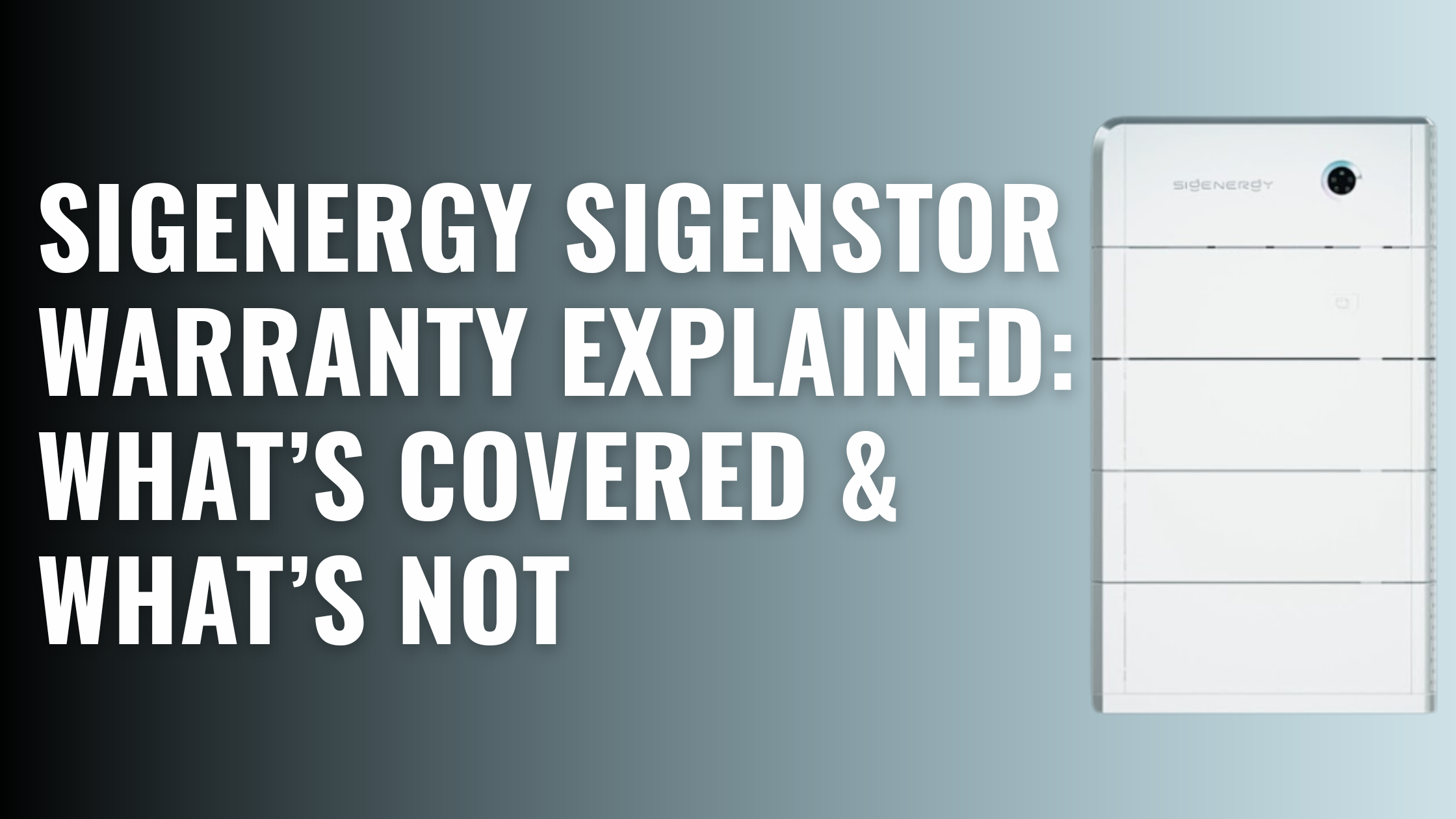
Sigenergy SigenStor Warranty Explained: What’s Covered & What’s Not
You’ve narrowed your shortlist down to the Sigenergy SigenStor. The specifications are strong. The modular design offers flexibility. The monitoring app is polished and intuitive. It’s also become one of the fastest-growing home battery systems in Australia.
At the same time, it’s a newer brand locally. That naturally raises questions about long-term reliability, warranty strength, and how issues are handled if something goes wrong. The recent recall has also prompted closer scrutiny of the fine print.
When you’re investing $10,000–$25,000 into a battery system, the warranty isn’t a minor detail. It’s your safety net. Understanding what’s covered — and what isn’t — is essential before signing a contract.
This article provides a straightforward breakdown of the Sigenergy SigenStor warranty, including warranty length, performance guarantees, operating limits, connectivity requirements, what can void coverage, and what we learnt from the recent recall.
- Sigenergy’s Growth in Australia: Why Warranty Scrutiny Matters
- Warranty Length and Performance Structure
- What About the Sigenergy Gateway Warranty?
- Operating Limits That Matter
- What Is Covered
- What Is Not Covered
- VPP Participation and Cycling
- The Sigenergy Recall: What Happened and What It Means
- Comparison to Tesla, Sungrow, BYD, Enphase and Alpha ESS
- Is It Strong Enough?
Sigenergy’s Growth in Australia: Why Warranty Scrutiny Matters
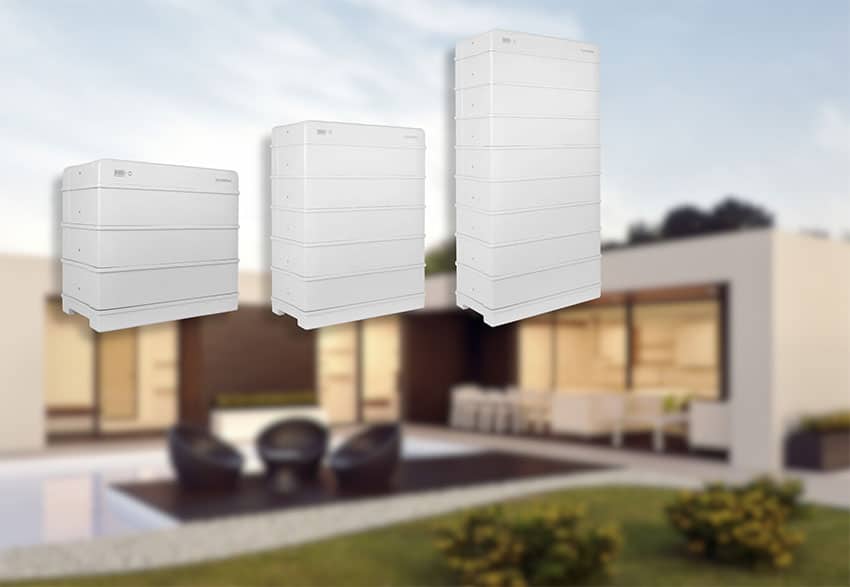
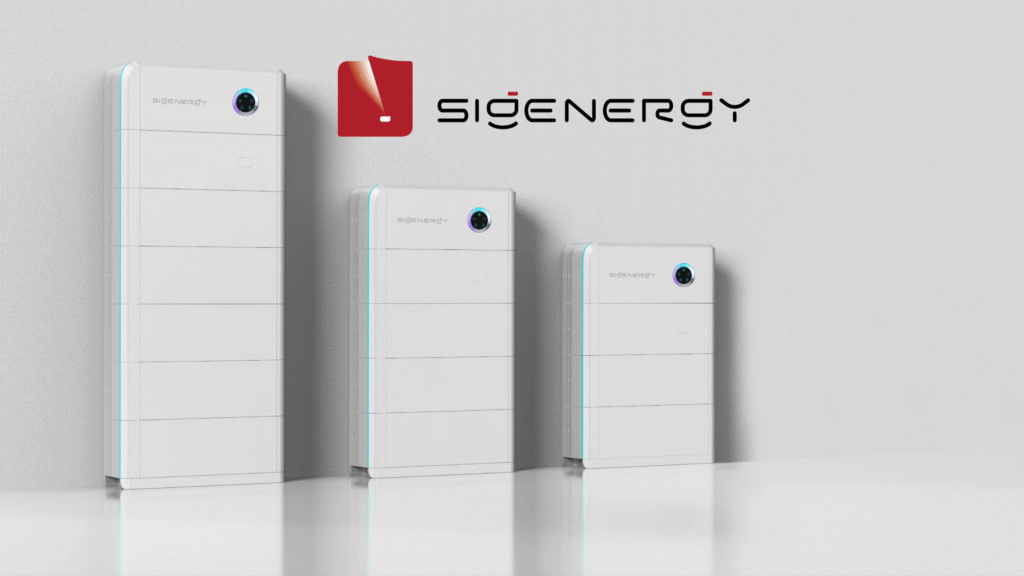
Sigenergy has expanded quickly across the Australian residential battery market. The SigenStor all-in-one battery system combines modular battery stacks, hybrid inverter functionality, EV charging integration, and advanced software controls in one platform. That integrated design has driven strong installer adoption.
Rapid growth isn’t inherently risky. However, it does mean new systems in the field and early real-world testing. With any newer brand, warranty clarity becomes more important.
Established players like Tesla, BYD, Sungrow, Enphase and Alpha ESS have longer Australian track records. Independent platforms such as SolarQuotes’ battery reviews show how different brands have performed over time. Sigenergy is building its dataset now. That doesn’t make it weaker — it just means transparency matters.
A home battery is built to last for years. The warranty tells you who’s responsible if issues occur.

Warranty Length and Performance Structure
Product Warranty
Sigenergy provides a 10-year limited product warranty covering:
- Battery modules
- Energy controller (hybrid inverter)
- Integrated supplied components
This aligns with the premium residential market standard for home energy storage systems.
If you’re unsure how hybrid systems differ from retrofitted options, our guide on AC-coupled vs hybrid battery systems explains the integration differences clearly.
Performance Warranty
The battery modules are covered by a minimum 70% retained usable capacity at Year 10, provided operating conditions are met.
For example, if someone installs a 24 kWh system, it must retain at least 16.8 kWh usable capacity at Year 10.
This 70% threshold is consistent with the Tesla Powerwall 3 warranty structure and several other premium lithium iron phosphate (LFP) battery brands.
Time vs Throughput Structure
Sigenergy primarily uses a time-and-capacity model rather than a strict published MWh throughput cap.
That means:
- The warranty runs for 10 years
- The battery must retain at least 70% usable capacity
- Operation must remain within defined limits
Some models from BYD and Sungrow define warranty performance more explicitly around total energy discharged. Sigenergy instead links performance to compliant operation within system safeguards.
What About the Sigenergy Gateway Warranty?
If your SigenStor system includes a Sigenergy Gateway for whole-home backup, that device carries its own warranty terms.
According to Sigenergy’s official documentation:
- The Gateway is covered by a 5-year limited product warranty as standard.
- Coverage applies to manufacturing defects and hardware faults under normal operating conditions.
- It does not include a performance retention component, as it is a switching and control device rather than an energy storage unit.
The Gateway manages:
- Grid isolation
- Backup switchover
- Circuit control during outages
If blackout protection is one of your main reasons for installing a battery, the Gateway is critical to that function.
What the Gateway Warranty Covers
- Internal switching components
- Control electronics
- Hardware faults under normal use
What It Does Not Cover
- Incorrect installation or wiring
- Damage caused by grid faults outside specification
- Environmental damage (flood, fire, impact)
- Unauthorised modification
Because the Gateway connects directly to your switchboard, correct installation by a licensed and accredited electrician is essential.

In a SigenStor setup, the overall structure typically looks like this:
- Battery modules → 10 years / 70% capacity
- Energy controller → 10 years
- Gateway (if installed) → 5 years standard
Operating Limits That Matter
Warranty eligibility depends on operating within manufacturer specifications.
Depth of Discharge (DoD)
The SigenStor system manages discharge automatically through its internal Battery Management System (BMS). Default settings are designed to protect longevity and prevent over-discharge. Tampering with reserve buffers or discharge limits can affect coverage.
Temperature Range
Typical operating range is approximately –10°C to 50°C, though the optimal range is narrower.
Sustained exposure to extreme heat, poor ventilation, or flood-prone environments may compromise eligibility. That’s why installation location matters — particularly in hotter parts of Australia. Our article Are Solar Batteries Safe outlines what considerations need to be made when identifying where to place a battery.
Internet Connectivity Requirement
Sigenergy requires systems to remain connected for monitoring and firmware updates.
If the system is offline for more than 90 consecutive days, warranty eligibility may be affected.
This clause exists to:
- Enable firmware safety updates
- Maintain operational logs
- Allow remote diagnostics
For most metropolitan homes with stable broadband, this is rarely an issue. It becomes more relevant in remote or seasonal properties. Short Wi-Fi dropouts do not trigger problems — extended, uninterrupted disconnection does.
What Is Covered
The warranty generally covers:
- Manufacturing defects
- Hardware faults
- Premature degradation below 70% within 10 years
- Energy controller failures under compliant operation
Repair or replacement is determined by the manufacturer.
Coverage applies to the product itself. Installation-related faults fall under installer responsibility, which is why choosing an installer that is currently accredited by Solar Accreditation Australia matters.
What Is Not Covered
Exclusions are standard for the industry and typically include:
- Incorrect installation or commissioning
- Unlicensed installation
- Flood, fire, lightning or physical damage
- Unauthorised hardware additions
- Firmware tampering
- Operating outside environmental limits
- Extended monitoring disconnection
- Forcing operation beyond manufacturer safeguards
Most void scenarios are linked to non-compliant installation or modification — not normal use.
If you’re unsure what separates reputable providers from risky operators it is best to seek out an independent reviewer such as SolarQuotes to check the quality of potential installers.
VPP Participation and Cycling
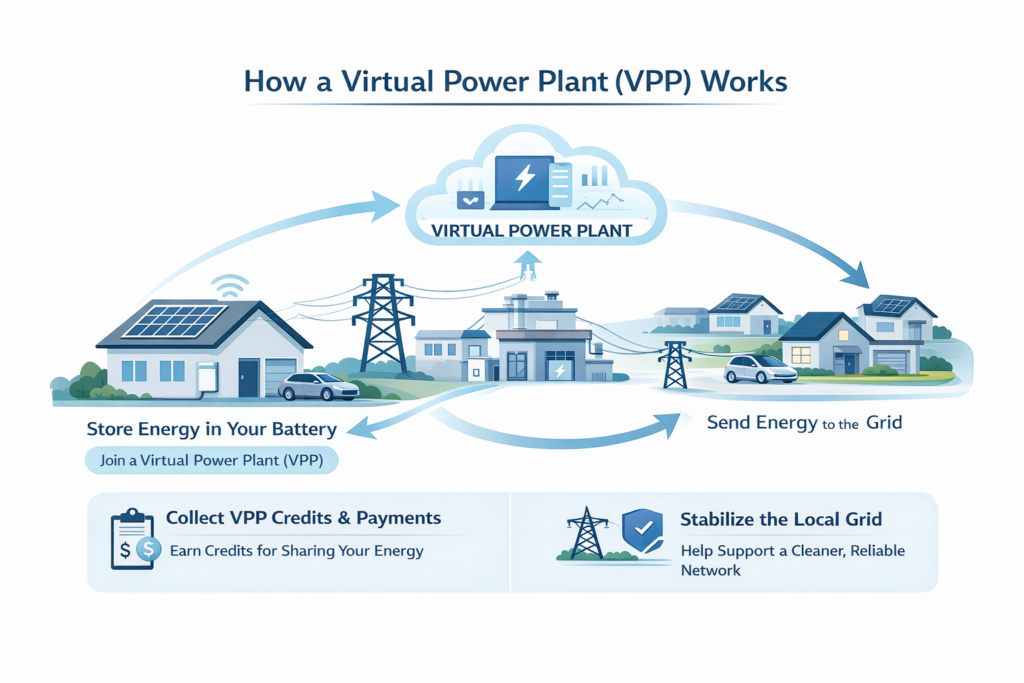
Virtual Power Plant participation does not automatically void the Sigenergy warranty.
The performance warranty is based on:
- A 10-year period
- Retention of at least 70% usable capacity
- Operation within manufacturer-defined specifications
Sigenergy does not publish a simple “maximum cycles per day” rule. Instead, compliance depends on whether the system is operated within its intended residential parameters and default protection settings.
If a VPP program operates within manufacturer-integrated settings and does not override system safeguards, it remains within warranty intent. Where risk may arise is if the system is deliberately pushed beyond its configured protections.
The Sigenergy Recall: What Happened and What It Means
Recalls happen, it is just the reality of any industry. What is important is to observe how brands respond when incidents occur. In late 2025, a voluntary recall was issued for certain Sigenergy single-phase 8 kW, 10 kW and 12 kW energy controllers used within SigenStor systems in Australia.
The recall related to the AC terminal plug connection within the energy controller. In some installations, the terminal connection could overheat if not properly terminated, creating a potential fire risk.
Regulatory coverage, including the ACCC recall notice, indicated that the issue was associated with the AC plug design and termination sensitivity — not the battery cells themselves.
Importantly:
- The recall applied to specific single-phase models
- The issue was component-specific
- There were no reports of serious injury
- The recall was conducted under Australian regulatory oversight
What Actions Were Taken
The response included:
- A firmware update to reduce sustained output while units awaited replacement
- Direct notification to affected customers
- Free replacement of impacted energy controllers
- Introduction of a revised AC plug design
- An additional 2-year warranty extension on replaced units
A recall does not void a product warranty. It is a corrective safety action. In this case, affected units were identified, mitigated, replaced where required, and provided with extended coverage.
Comparison to Tesla, Sungrow, BYD, Enphase and Alpha ESS
At a structural level, Sigenergy’s warranty aligns with the premium residential battery segment in Australia.
A 10-year product warranty is standard across Tesla Powerwall, Sungrow, BYD, Enphase, Alpha ESS and Sigenergy.
A minimum 70% retained capacity at Year 10 is common among premium LFP systems including Sigenergy, Tesla, Enphase and Alpha ESS.
Where differences begin to appear is in backup hardware. Tesla’s Backup Gateway typically aligns with its broader system warranty structure, while Sigenergy’s Gateway carries a 5-year standard product warranty. Other brands integrate switching differently within the inverter architecture.
The more meaningful distinctions between brands are not in headline duration but in:
- Brand tenure in Australia
- Installed base size
- Length of local service history
- Support infrastructure maturity
Sigenergy is newer and expanding rapidly, meaning long-term Australian field data is still accumulating.
Is It Strong Enough?
On paper, the warranty aligns with the premium residential segment. It is neither unusually short nor unusually generous.
The bigger factors influencing real-world protection are:
- Installation quality
- Operating compliance
- Monitoring connectivity
- Manufacturer support response
The recall demonstrated regulatory oversight and hardware replacement — which is how safety events should be handled.
For homeowners comfortable with a rapidly growing platform backed by structured warranty terms, the framework is defensible. For those prioritising longest-established brands, that preference is understandable.
The warranty itself is not the outlier.
If SigenStor is on your shortlist, the important thing isn’t just the headline 10-year warranty. It’s understanding how the entire system is covered — battery modules, energy controller, Gateway, monitoring requirements — and how that applies to your home.
Warranty terms only work properly when the system is:
- Designed correctly
- Installed to manufacturer specification
- Commissioned properly
- Set up with compliant monitoring
If you’re exploring whether the Sigenergy SigenStor is right for your home, Lenergy can walk you through the warranty structure, recall status, installation requirements and long-term considerations before you make a decision.
That way, you’re not just choosing a battery — you’re choosing a system that’s installed and supported correctly from day one.