

What the New PDRS Rules Means for Solar Batteries
The NSW battery rebate, the PDRS, just got easier to claim.
Bigger batteries qualify. No solar requirement. Apartments and businesses, finally in.
From July 1st, 2026. If you already own a battery or are still crunching the numbers on installing a new one? This one’s for you.
The Peak Demand Reduction Scheme, or PDRS is a rebate scheme. It rewards you for helping cut electricity demand at peak times. For batteries, that mostly means joining a virtual power plant, or VPP.
Here’s what’s in this article:
- What changed under PDRS on 1 July 2026
- Why existing battery owners come out ahead
- New options for apartments, small businesses and larger commercial sites
- Where new home battery buyers stand
- What’s next for EVs
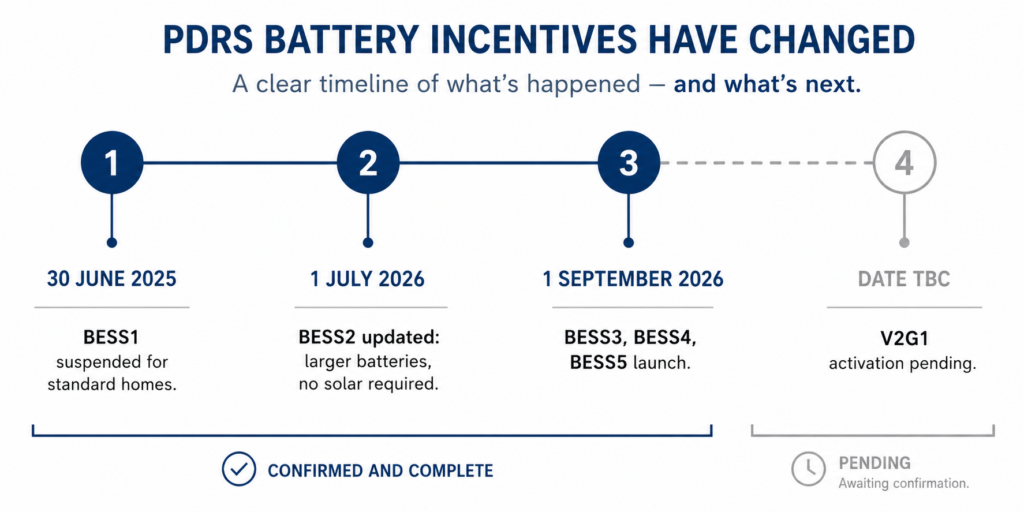
What actually is the PDRS?
PDRS is a NSW government scheme. It rewards you for helping cut electricity use at peak times, like a hot summer afternoon. It works through something called Peak Reduction Certificates, or PRCs. Your installer or VPP provider creates these certificates and sells them. The value gets passed back to you.
One thing to know. PDRS only works in NSW. Your home has to be connected to the NSW electricity grid.
Existing battery owners: the incentive just got better.
If you already own a battery, this update is good news.
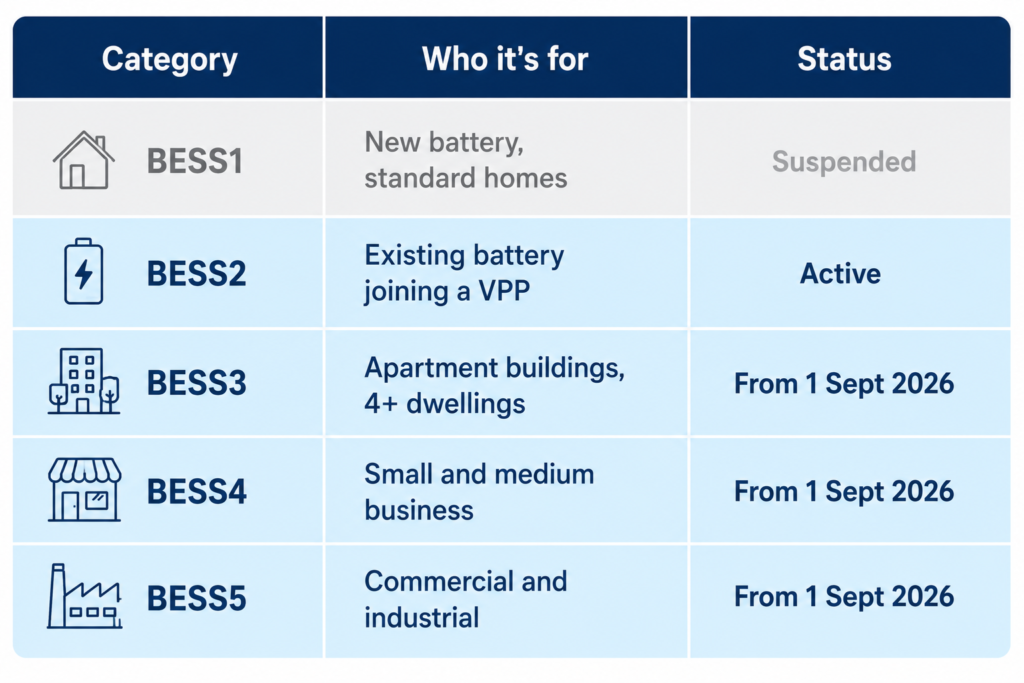
The rule that applies to you is called BESS2. It rewards you for connecting your battery to a VPP.
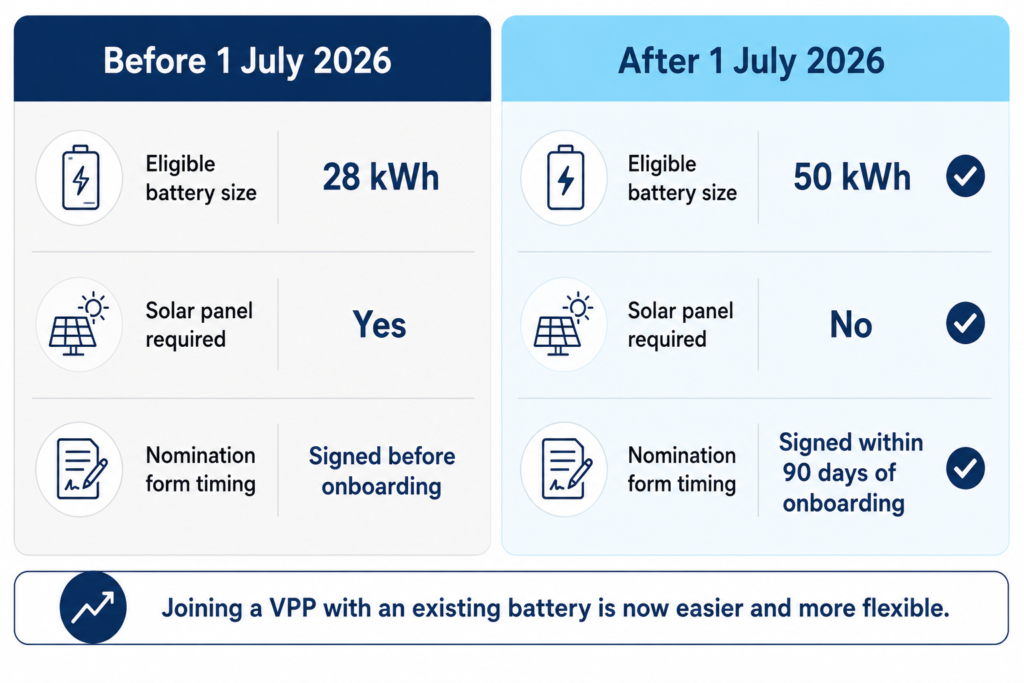
Three things changed on 1 July 2026:
- Bigger batteries can now join, up to 50 kWh, up from 28 kWh
- You no longer need solar panels to qualify
- You can now sign your paperwork within 90 days of joining, instead of before you join
One thing to know. Batteries up to 50 kWh can now join. But the payment is still worked out using only the first 28 kWh. So a bigger battery can join the scheme. It just won’t earn extra payment for the part above 28 kWh. If your battery isn’t connected to a VPP yet, now is a good time to look into it. Read more about the Best VPPs for Solar Batteries.
How much can you earn?
This depends on your VPP provider and the certificate price at the time.
As a guide, the government gives one example. In this example the owner of a 42 kWh battery joined the scheme. Only 28 kWh of that counted toward the payment. It would earn 616 certificates, worth $2,156 at a certificate price of $3.50. Exactly how you receive this payment varies depending on the provider, some give you credits on your bills and others provide cash payments.
Treat any number a provider quotes you as a rough guide, not a promise. Certificate prices change, and every provider charges a different fee.
Apartments, small businesses and larger sites can now access PDRS too.
Three new categories start on 1 September 2026. Together, they open the scheme to buildings that couldn’t use it before.
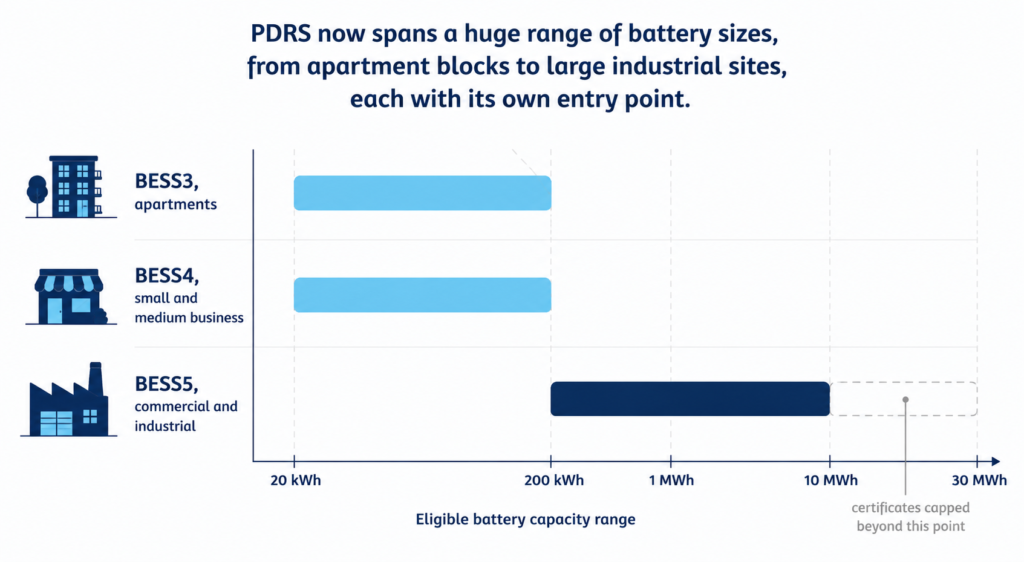
How does the new apartment battery incentive (BESS3) work?
BESS3 lets an apartment building share one large battery. Before this, each unit would have needed its own battery to take part.
To qualify:
- The building needs at least 4 apartments
- There can’t already be a battery on site
- The battery needs to be sized between 20 kWh and 200 kWh
- An SAA accredited installer has to fit it outdoors
- It must be installed on or after 1 September 2026
The more apartments in the building, the bigger the payment can be. Certificates are capped at 5 kWh per apartment. Adding new solar alongside the battery also increases the payment.
Here’s an example the government gives, for a 50 kWh shared battery:
| With new solar | Battery only | |
| System size | 25kW solar and 50kWh battery | 50kWh battery |
| Total cost pre-incentives | $65,000 | $40,000 |
| STC incentive value | $11,076 | $5,694 |
| PRC incentive value | $19,775 | $14,000 |
| Total cost post-incentives | $34,149 | $20,306 |
| Payback period post-incentives | 3.2 years | 4.6 years |
Read more about the The Problem with Solar for Strata.
How does the new small business battery incentive (BESS4) work?
BESS4 is for small and medium businesses. It doesn’t apply to homes or data centres.
To qualify:
- The site can’t have already used BESS4 or BESS5
- The battery needs to be sized between 20 kWh and 200 kWh
- An SAA accredited installer has to do the work
- It must be installed on or after 1 September 2026
The government’s example uses the biggest battery this category allows, 200 kWh:
| With new solar | Battery only | |
| System size | 100kW solar and 200kWh battery | 200kWh battery |
| Total cost pre-incentives | $190,000 | $125,000 |
| STC incentive value | $21,528 | $0 |
| PRC incentive value | $65,800 | $44,100 |
| Total cost post-incentives | $102,672 | $80,900 |
| Payback period post-incentives | 3.8 years | 5.8 years |
How does the new commercial and industrial battery incentive (BESS5) work?
BESS5 is for even bigger batteries, from 200 kWh up to 30 MWh. This one is built for large commercial and industrial sites, not homes.
To qualify:
- The site can’t be a home or a data centre
- The site can’t have already used BESS4 or BESS5
- The battery needs to pass a safety test called UL9540A
- It must be installed on or after 1 September 2026
Even if the battery is bigger, the payment only counts up to 10 MWh. The government’s example uses a 5 MWh system:
| With new solar | Battery only | |
| System size | 2.5MW solar and 5MWh battery | 5MWh battery |
| Total cost pre-incentives | $6,080,000 | $3,135,000 |
| PRC incentive value | $1,646,000 | $1,103,000 |
| Total cost post-incentives | $4,434,000 | $2,032,000 |
| Payback period post-incentives | 5.1 years | 6.5 years |
This size of battery is well beyond what a home would ever need. It’s included here so the article covers everything that changed.
Where do new home battery buyers stand?
One thing hasn’t changed. The rule for brand new home batteries, called BESS1, is still on hold. It’s been paused since 30 June 2025, when the federal Cheaper Home Batteries Program took over that role. However, the updates to this scheme do open it up to those considering larger batteries as they are now able to take advantage of the BESS2 as well.
BESS1 currently only applies to government-owned buildings and a few approved programs. For most homes, the federal rebate is the one that applies when you buy a new battery. The rebate is still around you can learn more in our article Have I Missed the Battery Rebate? What Changed in May.
What’s next for EVs?
There’s also a new rule called V2G1. It’s for connecting an electric vehicle to a VPP. It isn’t active yet. It’s waiting on car warranties and technical standards to catch up first. Once it does start, the estimated payment is around $1,700 per vehicle. Read more about how EV’s and solar here.

Frequently Asked Questions
What is the PDRS and how does it affect solar battery rebates?
PDRS is a NSW government scheme. It pays you for helping reduce electricity demand at peak times. For batteries, that mainly means joining a VPP.
Am I eligible for a PDRS rebate on a new home battery?
Not through the state rebate. That part of the scheme, BESS1, is on hold for regular households. If you’re buying a new battery, look at the federal Cheaper Home Batteries Program instead.
How much can I save with the updated PDRS incentives?
It depends on your VPP provider and the certificate price at the time. As a guide, a government example showed a battery earning around $2,156 in certificate value, before fees.
Do apartment buildings qualify for a battery incentive now?
Yes, from 1 September 2026. Buildings with at least 4 apartments can share one larger battery, under a new rule called BESS3.
Can small or medium businesses get a battery incentive?
Yes, from 1 September 2026, under a new rule called BESS4. It applies as long as the site isn’t a home or data centre.

