How to Get 3 Free Hours of Energy With AGL, Origin and Energy Australia
Free electricity between 11am and 2pm. The plan was to have all energy retailers providing the solar sharer offer by now but it’s all gotten very complicated and here’s why.
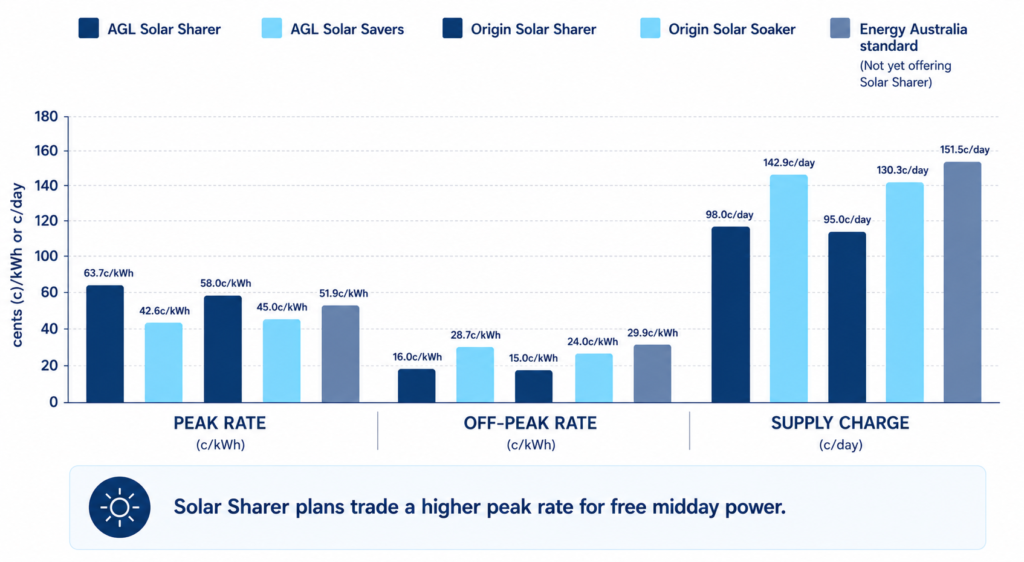
AGL and Origin have both launched Solar Sharer plans this year. Energy Australia hasn’t yet. The actual rate cards from AGL and Origin show a trade-off worth understanding before you switch. The free midday window comes with a peak rate around a third higher than their standard solar plans. That’s not automatically a bad deal, it depends entirely on whether your household can shift its biggest energy use into the middle of the day. If it can’t, you could end up paying more, not less.
There’s another factor worth knowing before you look at the numbers below. Supply charges across AGL, Origin and Energy Australia have all just gone up, with many customers reporting increases of around 30% in the past week or so. This has happened across standard plans and Solar Sharer plans alike, so it isn’t something switching to the free hours caused. The rates in this guide are current as of now, but treat them as a snapshot rather than a guarantee, and compare your own recent bill before switching plans.
Disclaimer: All the rates in this article a based on a household in Sydney. Rates can vary significantly according to location.
This guide covers:
- What the Solar Sharer Offer actually is
- Where it applies, and where it doesn’t yet
- How AGL and Origin’s Solar Sharer rates compare to their own standard solar plans
- What Energy Australia customers are paying right now, with no Solar Sharer plan live
- Whether the free hours are actually worth it for your household
What is the Solar Sharer Offer?
The Solar Sharer Offer (SSO) is part of the Default Market Offer (DMO) reforms. Retailers with more than 1,000 customers in DMO areas are legally required to provide it.
The core rules are the same everywhere it applies:
- Three hours of free daytime electricity, capped at 24 kWh per day
- Requires a smart meter
- No rooftop solar needed to qualify
- Open to renters, not just homeowners
- Not available on embedded networks (most apartment blocks and retirement villages)
The free window is fixed year round and doesn’t move with daylight saving.
Where does the free energy offer apply?
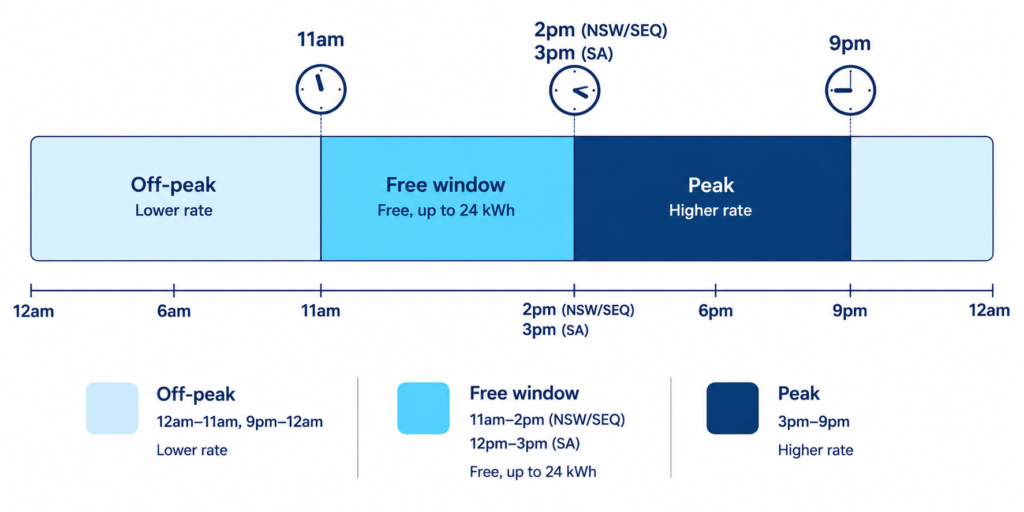
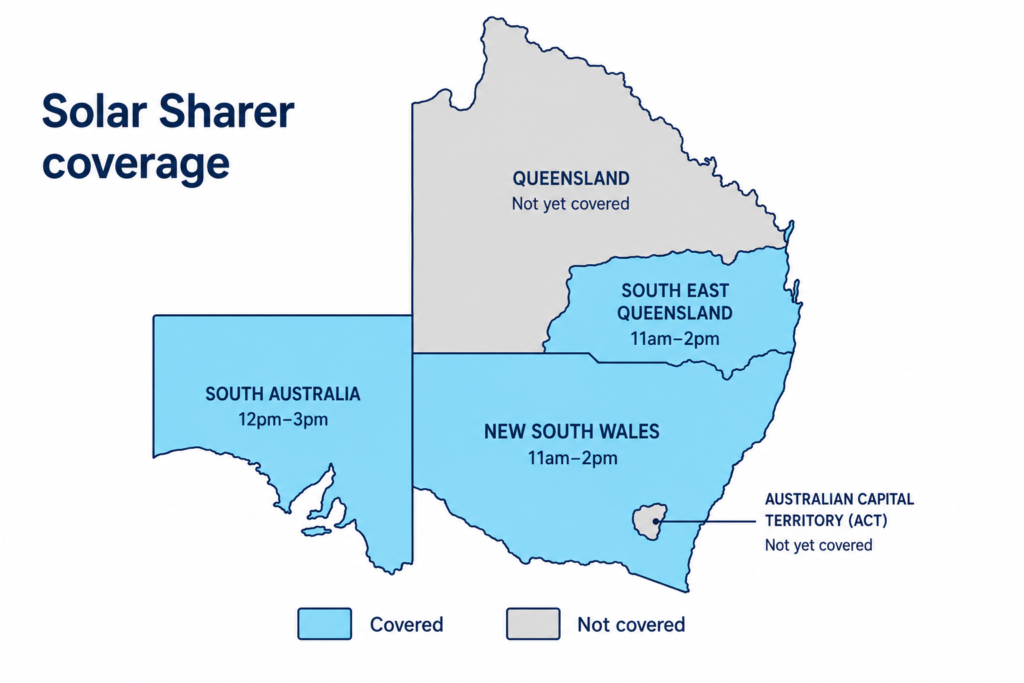
The SSO only applies in the states covered by the DMO: New South Wales, South Australia and South East Queensland.
- NSW and South East Queensland: free electricity from 11am to 2pm
- South Australia: free electricity from 12pm to 3pm
It doesn’t currently extend to the ACT, which sits outside the DMO framework and runs its own separate market arrangement. If you’re in the ACT, or in Queensland outside the South East corner, check with your retailer directly, as the standard SSO rules may not apply to you yet.
AGL: Solar Sharer vs its standard solar plan
AGL’s Solar Sharer plan gives you free power for the first 24 kWh used between 11am and 2pm. Peak rates apply 3pm to 9pm daily, but only during summer (1 November to 31 March) and winter (1 June to 31 August). Outside those hours and months, off-peak rates apply.
Here’s how it compares to AGL’s standard time-of-use plan for solar households, Solar Savers:
| Charge | AGL Solar Sharer | AGL Solar Savers (standard) |
|---|---|---|
| Midday window | Free, first 24 kWh/day | Not offered |
| Peak (3pm–9pm, summer/winter) | 63.7 c/kWh | 46.6 c/kWh (summer) / 47.1 c/kWh (winter) |
| Off-peak | 27.6 c/kWh | 35.7 c/kWh |
| Shoulder | Not applicable | 12.3 c/kWh |
| Supply charge | 176.2 c/day (~$1.76) | 185.1 c/day (~$1.85) |
| Solar feed-in tariff | 0.0 c/kWh | 8 c/kWh (first 8 kWh/day), 3 c/kWh after |
The free window looks great on paper. The catch is the peak rate. It’s around 37% higher on the Solar Sharer plan than on AGL’s standard solar plan. If your household uses a lot of power during the 3pm to 9pm peak, the Solar Sharer plan could end up costing more overall, even with three free hours included. It does have a lower off-peak rate and a slightly lower supply charge than the standard plan, so if most of your remaining usage falls off-peak or inside the free window, you may still come out ahead.
AGL’s Solar Sharer plan pays a 0 c/kWh feed-in tariff. If your household exports solar power, you won’t be paid for it at all on this plan, compared to up to 8 c/kWh on Solar Savers. For homes with solar panels, that’s a real cost stacked on top of the higher peak rate, and it’s worth weighing carefully before switching.
Origin: Solar Sharer vs its standard solar plan
Origin’s Solar Sharer plan follows the same shape. Free usage for the first 24 kWh in the midday window, then standard rates apply above that.
| Charge | Origin Solar Sharer | Origin Solar Soaker (standard) |
|---|---|---|
| Midday window | Free, first 24 kWh/day | 12.4 c/kWh, discounted but not free |
| Usage above 24 kWh in the window | 27.6 c/kWh | Not applicable |
| Peak | 63.7 c/kWh | 46.6 c/kWh (summer) / 47.1 c/kWh (winter) |
| Off-peak | 27.6 c/kWh | 35.7 c/kWh |
| Supply charge | 176.4 c/day (~$1.76), plus 4.7 c/day if on a controlled load | 185.1 c/day (~$1.85) |
| Solar credit | 3.0 c/kWh | 8.0 c/kWh |
The pattern is almost identical to AGL. Origin has opted to continue to provide some credit for exported energy, however, with a notably higher peak rate on the Solar Sharer plan, offset by a lower off-peak rate and a slightly lower supply charge. If you’re on a controlled load circuit, such as a separately metered hot water system, the Solar Sharer plan adds a small daily charge for that too.
Energy Australia: what you’re paying now, with no Solar Sharer offer yet
Energy Australia: what you’re paying now, with no Solar Sharer plan yet
Energy Australia hasn’t launched its Solar Sharer offer, but its own website confirms several details for anyone waiting on it. It’ll be a standalone plan, you’ll need to actively opt in and switch, it won’t happen automatically. The free window matches AGL and Origin: 11am to 2pm in NSW and QLD, and 12pm to 3pm in SA. A smart meter is required, and the daily supply charge and any controlled load charges will still apply on top of the free usage.
One detail is worth flagging now. Energy Australia’s 24 kWh cap won’t reset strictly every day, it’s averaged across your whole billing period. Its own example: using 14 kWh one day and 34 kWh the next still averages to 24 kWh a day, so both days stay within the cap.
Energy Australia hasn’t published usage rates for the plan itself, it says these will be available closer to launch. Here’s what its current standard rates look like, for context:
| Charge | Rate |
|---|---|
| Supply charge | 170.2 c/day (~$1.70) |
| Peak (summer Nov–Mar, winter Jun–Aug) | 55.6 c/kWh |
| Peak/shoulder (autumn Apr–May, spring Sep–Oct) | 27.5 c/kWh |
| Off-peak (year round) | 23.5 c/kWh |
| Dedicated circuit | 18.2 c/kWh |
| Solar feed-in tariff | 3.0 c/kWh (excl GST) |
Reports suggest Energy Australia’s launch may not happen until September 2026. Federal Energy Minister Chris Bowen has said he’s disappointed by the delay and reminded affected customers they have the right to switch to a retailer that already complies.
Should you switch, or wait and see?
Proceed with care rather than switching on the headline alone.
- Compare the full rate card, not just the free hours. On the plans above, the peak rate is the real cost driver, not the supply charge.
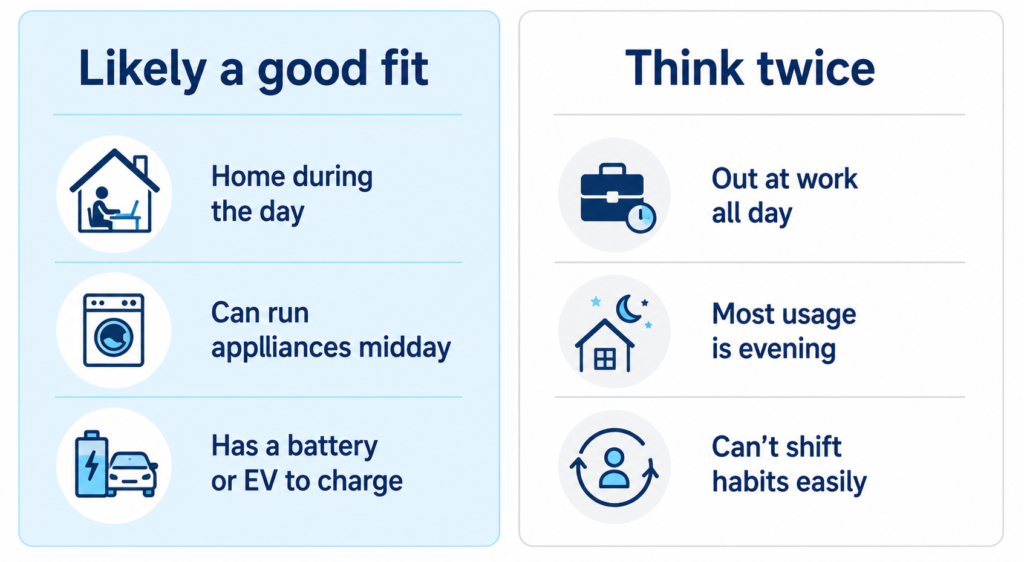
- Work out how much of your usage actually happens in the 11am to 2pm window right now, and how much happens during the evening peak. If your household is out at work all day and cooking dinner at 6pm, a higher peak rate could outweigh the free hours.
- A home battery changes the maths. Charging a battery, like the SigenStor, for free during the midday window and drawing on it during the expensive evening peak avoids the higher peak rate altogether, rather than paying it.
- If you already have solar panels, check the feed-in tariff too. AGL’s Solar Sharer plan pays 0 c/kWh for exported solar, against up to 8 c/kWh on its standard plan. That’s a genuine loss for solar-owning households, on top of the higher peak rate.
- Rates can move again, and recently already have. Supply charges rose across the board about a week ago. Treat today’s numbers as a snapshot, and recheck the current rate card before committing.
Read more on how to take advantage of this offer here.
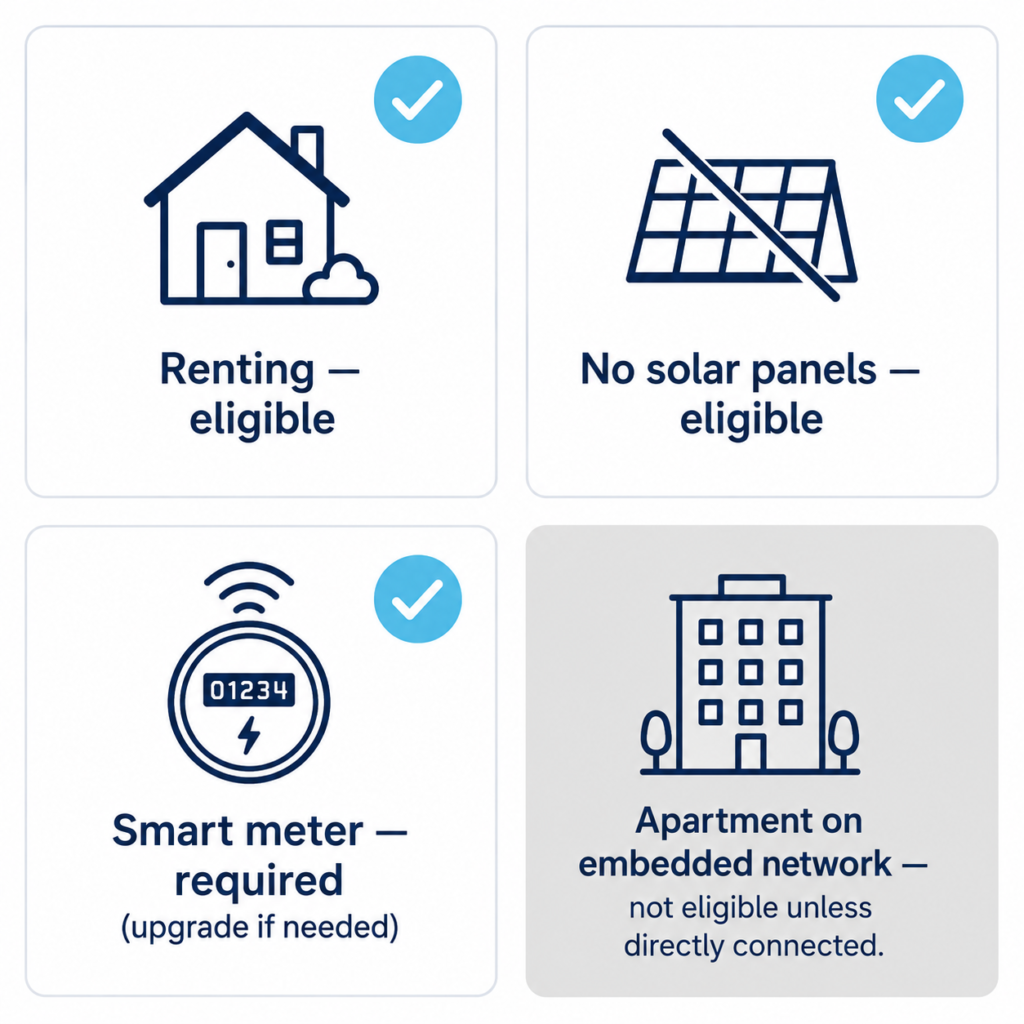
Am I eligible? Common blockers explained
- Renting? You’re still eligible. Solar Sharer doesn’t require you to own your home or your panels.
- No solar panels? That’s fine too. The offer isn’t tied to having rooftop solar.
- Basic electricity meter? You’ll need to upgrade to a smart meter first. Contact your retailer to arrange this.
- Living in an apartment or retirement village? If your building is on an embedded network (a private internal grid), you’re not eligible unless you have your own direct smart meter connection.
How do I sign up to the Solar Sharer Offer?
- Confirm you’re in an eligible area: NSW, South East Queensland or South Australia.
- Check you have a smart meter. If not, ask your retailer to arrange one.
- Get the full rate card for the Solar Sharer plan, not just the headline, and compare it against your current plan.
- Work out how much of your usage you can realistically shift into the free window.
- Opt in only if the numbers work in your favour. Some retailers apply the offer automatically, others need you to switch plans.
Frequently Asked Questions
What is the Solar Sharer offer and how does it work?
It’s a government mandated offer giving eligible customers three hours of free daytime electricity, capped at 24 kWh, in exchange for shifting usage away from the evening peak.
Am I eligible for the 3 free hours of energy offer with AGL, Origin, or Energy Australia?
You need to be in NSW, South East Queensland or South Australia, on a smart meter, and not on an embedded network. Solar panels and homeownership aren’t required.
When are the free energy hours available under the Solar Sharer program?
11am to 2pm in NSW and South East Queensland, and 12pm to 3pm in South Australia. AGL’s own plan currently runs the same hours but priced differently outside the window.
Will the Solar Sharer offer actually save me money?
It depends on your usage. On AGL and Origin’s current plans, the peak rate is around a third higher than their standard solar plans. If you can shift meaningful usage into the free window, or you have a battery to store it, you’re likely to come out ahead. If most of your usage happens during the evening peak and can’t move, you could end up paying more overall. Compare the full rate card before switching.