Mike’s Solar and Battery Savings Are $11,000 a Year
Mike Chapman’s power bills used to sit at about $12,000 a year. Now he pays $900. That’s close to $11,000 a year of solar and battery savings.
Mike runs a demanding home in Wildes Meadow, in the Southern Highlands, and he did his homework before he committed. Here is how the numbers stacked up.
This story covers:
- what Mike was paying before, and why his home used so much power
- why he chose Lenergy after looking at other providers
- the Sigenergy SigenStor system that now runs his home
- how automation squeezed even more out of the setup
- what his results suggest for other high-use homes
Why were Mike’s power bills so high?
Mike’s home is not a light user. He runs underfloor heating off a heat pump, two separate hot water systems, and two separate air conditioning systems. All of that adds up. In his words, “power bills were sitting at around $12,000 a year, now they are $75 a month.”
A home like this is where solar and battery savings can go furthest. The more power you use, the more there is to offset. A large, well-matched system has more room to pay for itself.

Why did Mike choose Lenergy?
Mike did not rush. “We had done a lot of research,” he said. He was introduced to other providers first, then came to Lenergy through local people he knew.
What won him over was how the quote was presented. “Their approach was fantastic in the video presentation, their transparency on all the quoting. We just felt extremely comfortable with what they presented.” He was given a number of options and picked the one that fit.
Mike was an early adopter of Sigenergy in the area. “I think we were the first in the Highlands to go with the Sigenergy batteries,” he said. He has been happy with the choice since, from the quoting and pricing right through to the install.
What system does Mike have?
Mike’s home runs on a Sigenergy SigenStor paired with AIKO panels. His setup is built for a high-demand household:
- 39 × AIKO Neostar 2S panels (455W each) with cell optimisation, totalling 17.745 kW of solar panels
- 9 × 8 kWh Sigenergy SigenStor battery modules, totalling 72 kWh of storage
- 2 x inverters, a 15 kW and a 20 kW
- 1 × Sigenergy Gateway
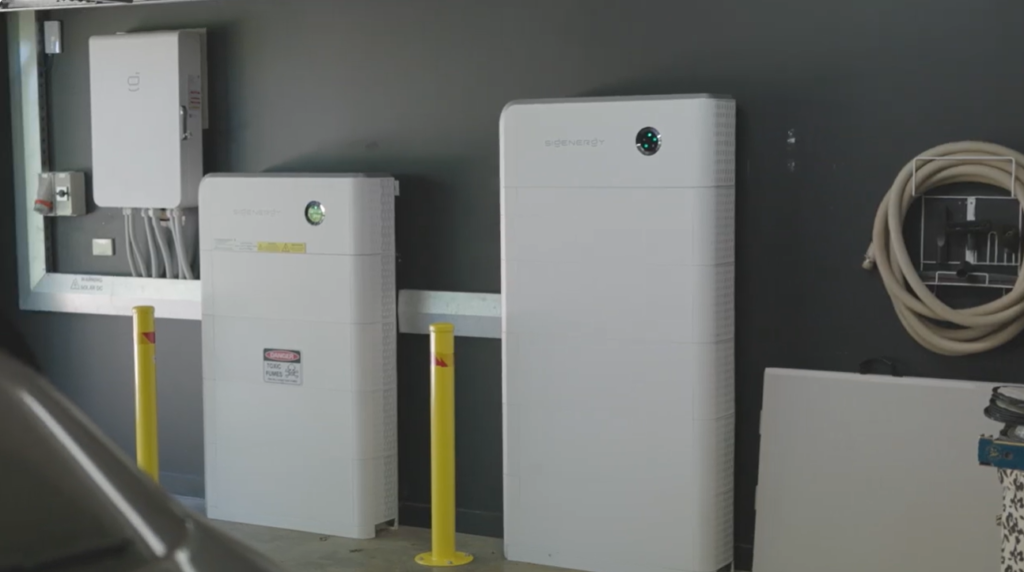
That is a large system, with plenty of solar to fill the battery and plenty of storage to draw on. It needs to be, given the loads Mike runs. His AIKO panels charge the battery through the day, and the battery carries the home through the evening when grid power costs the most. Working out how much storage a home actually needs is the step that makes a system like this pay off.
How does automation add to the savings?
The savings did not stop at the hardware. Winston, from Lenergy, introduced Mike to a local automation company. They worked together to automate the parts of the home that draw the most power, including the underfloor heating and the heat pumps.
“That again has made maximum use of the energy efficiency with the new panel and battery installation,” Mike said.
This is where the SigenStor earns its place. Automation works best when the battery can talk to the rest of the home and shift energy to the right moment. The SigenStor is built for that kind of smart control, which is a big part of why it suits homes that want to automate. Getting the timing right, charging when power is cheap and drawing stored energy at peak, is what turns a good system into a great one.
What do Mike’s results mean for other homes?
Mike’s numbers are his own, tied to his home and his usage. Your results will differ. Still, the shape of his story is common for high-use homes. Big bills leave big room to save. The right system, sized to the load, does the rest.
Mike now recommends Lenergy to others. “We’ve referred them to a number of friends,” he said. For a household that was paying $12,000 a year, dropping to around $75 a month is a clear result.
Notice he still pays about $75 a month. A solar and battery system trims your bills right down, though a small charge usually remains. Read next: Have I Missed the Battery Rebate? What Changed in May
Frequently Asked Questions
What factors affect how much you save with solar panels and a home battery?
Your savings come down to how much power you use, when you use it, and how well your system is sized to match. Bigger households with high daytime and evening loads, like Mike’s, have more to offset, so the savings tend to be larger. Your tariff, your solar generation, and how much you can shift into cheaper periods all play a part too.
Is a large battery worth it for a high-use home?
For a home running heavy loads like heat pumps, multiple hot water systems and air conditioning, a larger battery lets you store more of your own solar and lean less on the grid at peak times. Mike’s home uses a 72 kWh SigenStor, built from nine modules, for exactly that reason. The right size depends on your usage, so it is worth mapping your loads before you decide.
Why is there still a small monthly bill with solar and a battery?
Even with a well-sized system, most homes keep a small bill. Fixed daily supply charges still apply, and there are days when the home draws a little from the grid. Mike went from about $12,000 a year to around $75 a month, so the remaining charge is small next to what he was paying before.