Is Free Daytime Electricity Working?
Free daytime electricity is working. It is just not saving many people money yet.
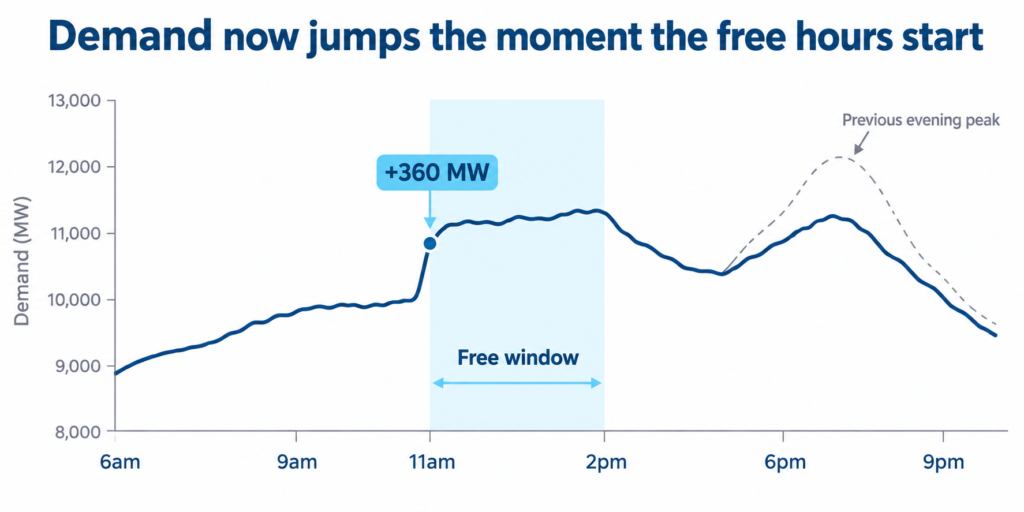
The Solar Sharer Offer has moved household electricity use into the middle of the day, exactly as designed. At 11am, demand across Australia’s main grid now jumps by about 360 megawatts. Every day. On some days it has jumped more than 700 megawatts inside half an hour.
Bills have not followed. The regulated offer is priced to save you nothing on its own.
Here is what we cover:
- What the free hours are and who can get them
- The evidence that household behaviour is shifting
- Why the regulated plan is priced to save you nothing
- What the free window is worth once you can shift load
- Who it suits, and who is better off staying put
What is free daytime electricity again?
Two schemes are running.
The Solar Sharer Offer started on 1 July 2026 in NSW, south-east Queensland and South Australia. Three hours of free grid power a day, 11am to 2pm in NSW and south-east Queensland, noon to 3pm in South Australia, capped at 24 kWh a day.
Victoria’s Midday Power Saver started on 1 October 2026 with the same 11am to 2pm window and the same cap.
Both are opt-in. Both need a smart meter. You do not need solar to join.
The ACT misses out, because it sits outside the Default Market Offer regions the federal scheme is built on.
For the full mechanics, read Free Daytime Electricity Is Coming. Here’s How It Actually Works.
Is the grid actually responding?
Yes, and faster than most expected.
AEMO’s chief executive confirmed in October 2026 that the 11am jump is now a daily event across the national grid, and that it keeps growing. AEMO estimates 15 to 25 per cent of home batteries now respond to price signals. More than 500,000 batteries have gone in under the federal battery rebate.
The wholesale market is feeling it. Analysis by energy analyst David Leitch found midday prices have lifted from near zero to $25 to $30 per megawatt hour over the past year, while the evening peak fell from around $130 to $95. He credits the growth in battery storage soaking up surplus solar rather than the free offers themselves.
So the grid side is working. Midday solar that used to be wasted is being stored and used, and the evening crunch is easing.
Are households actually saving money?
Here is the part the advertising skips.
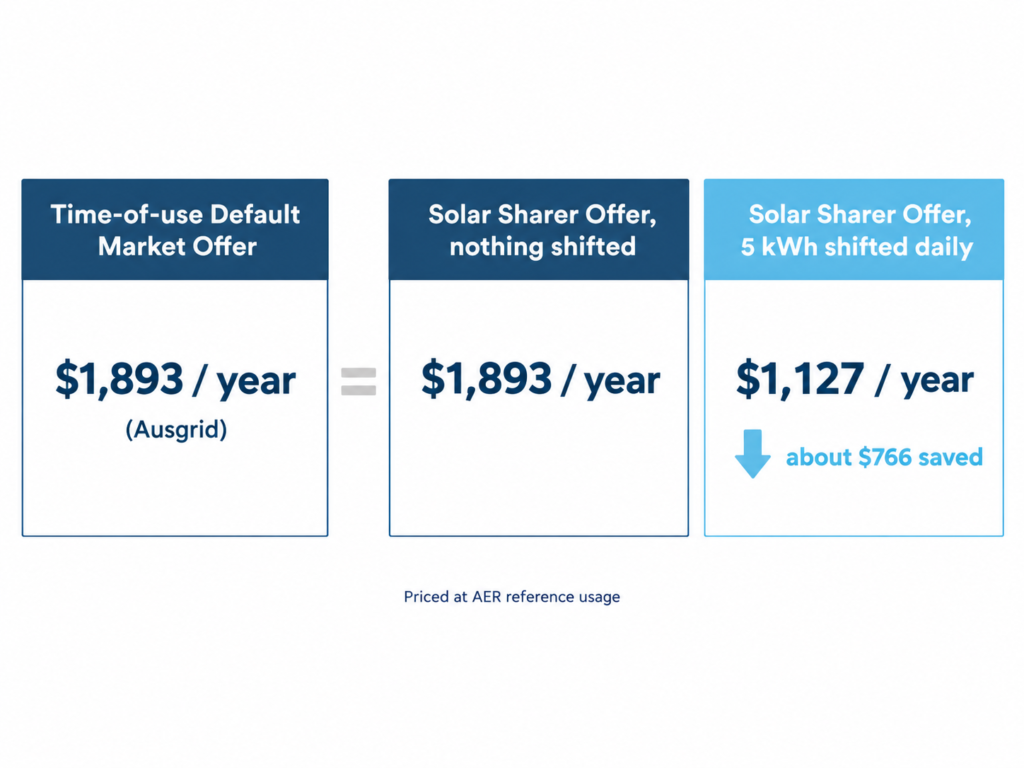
The AER priced the Solar Sharer Offer so that, at its reference usage, it costs the same as the time-of-use Default Market Offer. Ausgrid $1,893 a year. Energex $1,914. Essential Energy $2,530. The same money you were already paying.
It was priced on the assumption that you change nothing. Change nothing, save nothing.
Now, move some load. Shift 5 kWh a day out of the evening peak and into the free window on an Ausgrid plan and you are about $2.10 a day better off. That is roughly $766 a year.
What is the catch with free daytime electricity plans?
The free hours get paid for everywhere else on the bill.
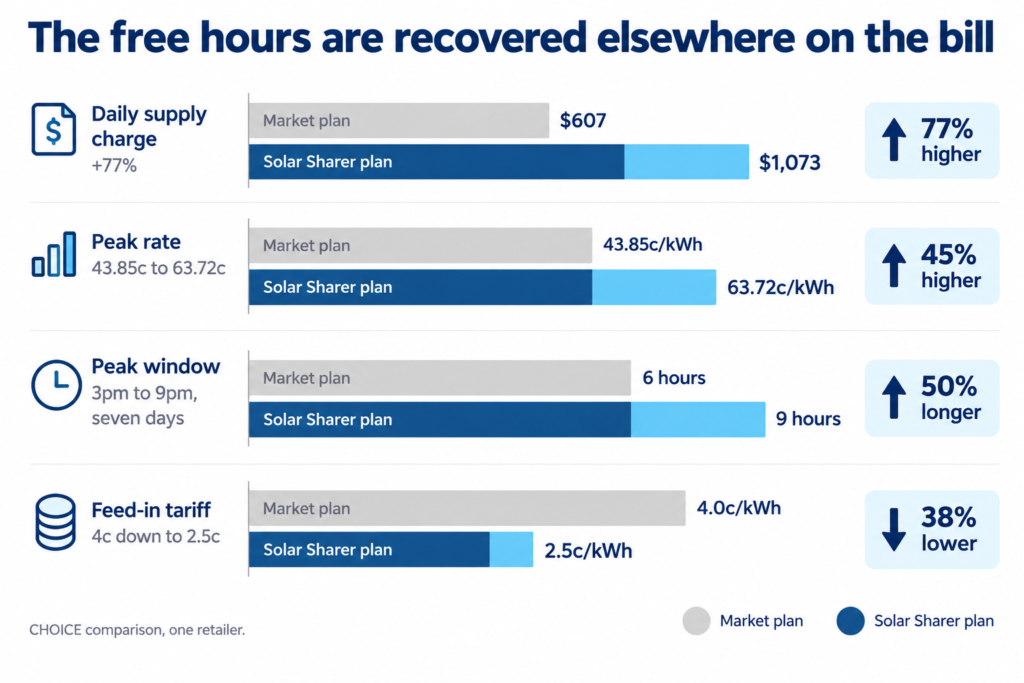
CHOICE compared one retailer’s Solar Sharer plan against that retailer’s own market plan. The daily supply charge was 77 per cent higher. The peak rate went from 43.85c to 63.72c, a 45 per cent jump. The feed-in tariff dropped from 4c to 2.5c. The peak window widened to 3pm to 9pm, seven days a week.
That feed-in cut stings if you have solar and you export during the day.
A few other limits worth knowing:
- The 24 kWh daily cap is generous, and very few homes get near it
- Controlled load hot water is usually excluded, which removes one of the easiest loads to shift
- No smart meter, no free hours
- Out of the house all day with nothing automated, and you will probably pay more than you do now
If the rate structure on your current plan is a mystery, start with Understanding Your Electricity Bill: What You’re Really Paying For.
Who does free daytime electricity actually work for?
IEEFA modelled what the free window is worth once a household can genuinely shift load:
| What you shift into the free window | Estimated annual saving |
| Electric hot water on a timer | $577 to $1,028 |
| One EV charged at midday | $731 to $893 |
| Two EVs | $1,341 to $2,257 |
| Apartment with a 5 kWh plug-in battery | $366 to $644 (not available in Australia) |
One note on that last row. IEEFA modelled an apartment running a plug-in battery, which is the obvious answer for renters and unit owners who cannot touch the switchboard. Plug-in solar and plug-in batteries are not legal to install in Australia yet. The electrical rules have not caught up with the hardware, so that saving is theoretical here for now. We have covered where the regulations sit and what the options are in the meantime in Plug-in Solar and Batteries in Australia: Why It’s Not Available Yet.
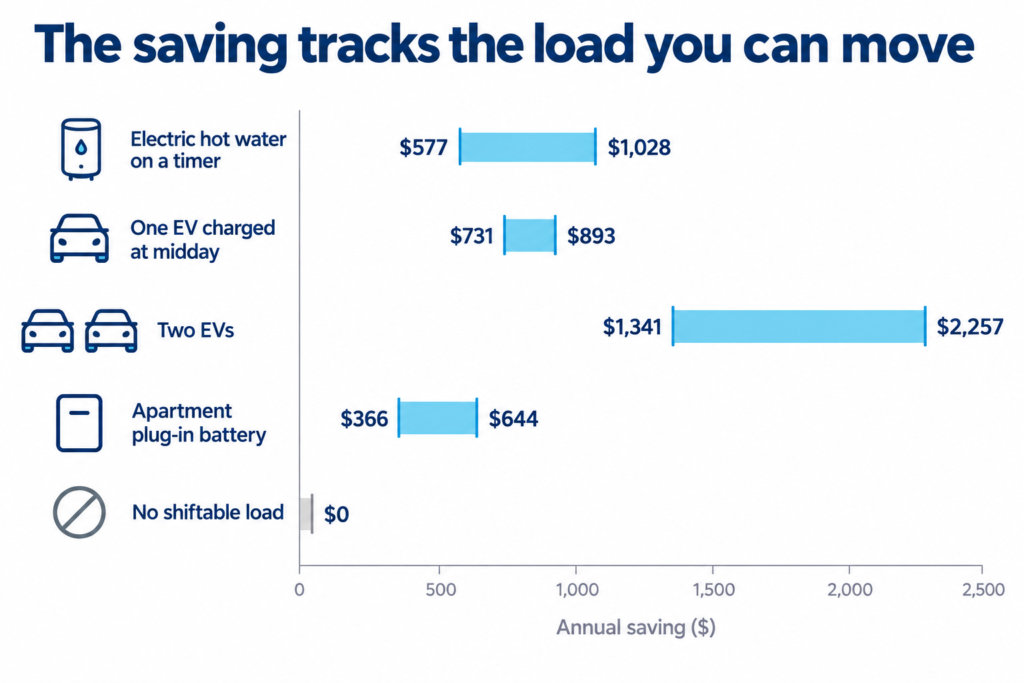
The pattern is obvious. The money sits with homes that have something big and flexible to move.
A battery is the cleanest way to do it. It fills during the free window, then runs the house through the evening peak, and you change nothing about how you live.
Quick check before you switch:
- Can you run hot water, the dishwasher or the washing machine between 11am and 2pm?
- Do you have an EV, or a battery, or a plan to add one?
- Is anyone home, or is anything automated, during the window?
- Can you live with a lower feed-in tariff on your solar exports?
Two or more yeses, and the free window is probably worth the switch. Mostly no’s, and you are better off on a sharper market plan. Sometimes, for some homes, it simply does not stack up, and that is a fine answer too.
So, is it working?
On the grid, clearly yes. Demand is shifting, batteries are soaking up surplus solar, and evening prices are falling.
On household bills, only where there is load to move. The scheme hands you the opportunity. It does not hand you the saving.
Read next: The 5 Best Ways to Take Advantage of 3 Free Hours of Energy
Frequently Asked Questions
What is the Solar Sharer Offer and how does it work?
It is a regulated electricity plan offering three free hours of grid power a day, capped at 24 kWh. It runs in NSW, south-east Queensland and South Australia, 11am to 2pm in NSW and Queensland. You opt in through your retailer and you need a smart meter. Retailers with more than 1,000 customers have to offer it.
Does free daytime electricity save money if I do not have a battery or an EV?
It depends on if you can shift loads into the set time frame. The plan is priced to match the time-of-use Default Market Offer at average usage, so the saving comes entirely from load you move. Hot water on a timer, pool pumps and daytime appliance runs can still get you there. Peak rates outside the window are higher, so a home that cannot shift much often goes backwards.
How does the Solar Sharer Offer compare with a market electricity plan?
The regulated offer is a floor, not the best deal going. Several retailers now run their own free-power plans with longer windows or higher caps, and some come in cheaper over a year than the regulated version. Compare the supply charge, the peak rate and the feed-in tariff, not just the free hours.