Plug-in Solar & batteries in Australia
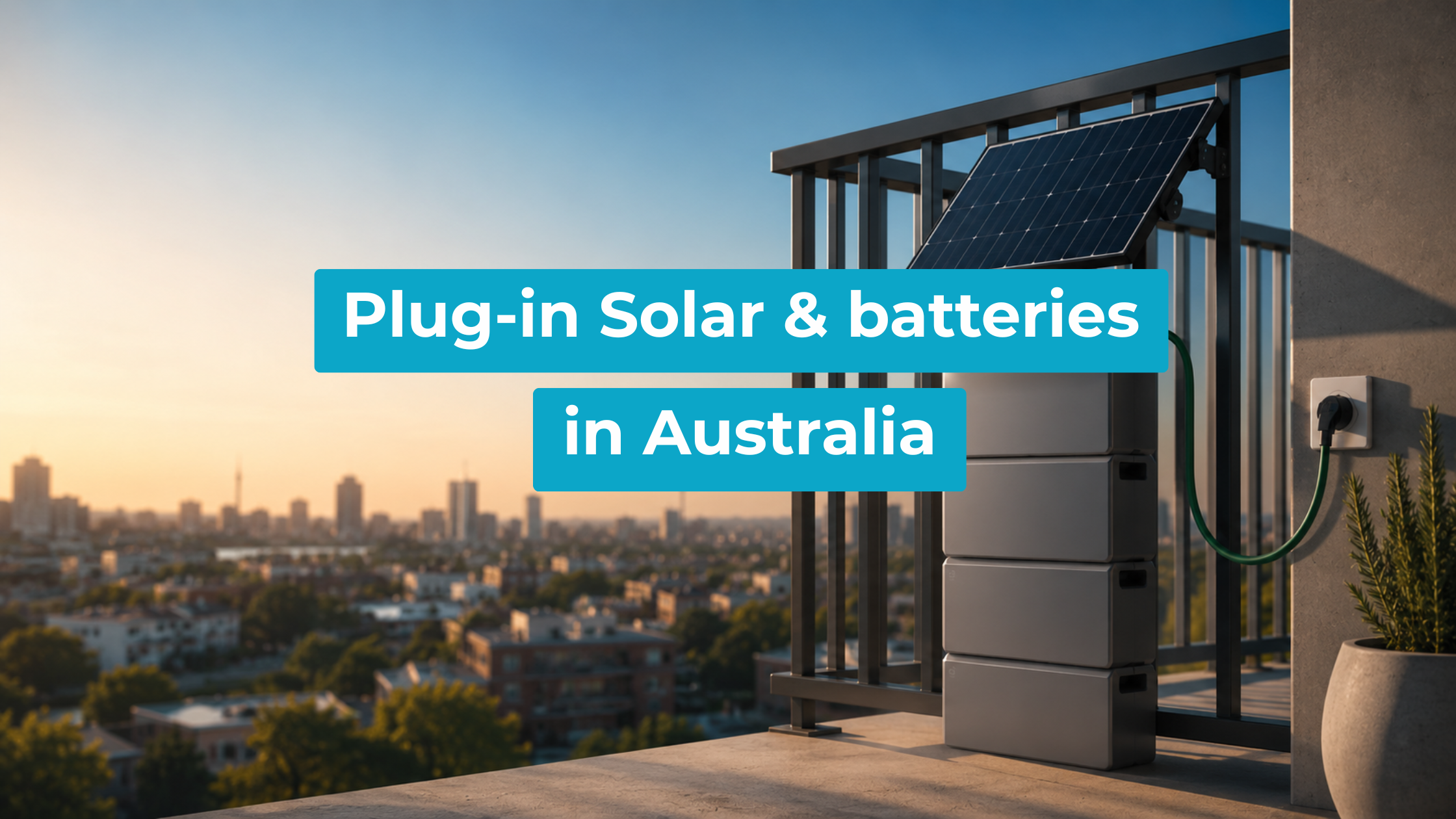
There’s are Solar and Battery systems you can plug straight into a wall socket, No electrician needed. Plug-in Solar is perfect for renters or someone who owns an apartment. It’s called the Sigenergy SigenMate 2700 Ultra which launched in July 2026 and people overseas are already buying them.
Sadly you can’t get one here in Australia.
Now, it’s not the technology. That part’s sorted.
So what’s actually stopping us from getting it?
Let’s have a look at exactly what’s blocking plug-in solar and batteries in this country and what you can legally do about it right now.
This article covers:
- What plug-in solar actually is
- Sigenergy’s SigenMate 2700 Ultra, and why it’s not for sale here
- The exact rules stopping it
- What you can legally do right now
- Whether that could change
What Are Plug-in Solar and Plug-in Battery Storage?
Plug-in solar, also called balcony solar or plug-and-play solar, is a compact panel and battery setup. No roof needed. No hardwiring. You mount a small panel, connect it to a battery-inverter unit, and plug it into a normal power point.
Germany simplified its rules for units up to 800W. Homeowners and renters there can buy one online and set it up themselves. It’s popular because it’s cheap, portable, and gives apartment dwellers a small slice of the solar savings that rooftop owners get.
Plug-in battery storage is a related idea, but it’s not quite the same thing. There’s no panel involved. A standalone battery plugs straight into a wall socket and charges from the grid instead of the sun, then discharges later to cover part of your evening usage or to keep essentials running through a blackout.
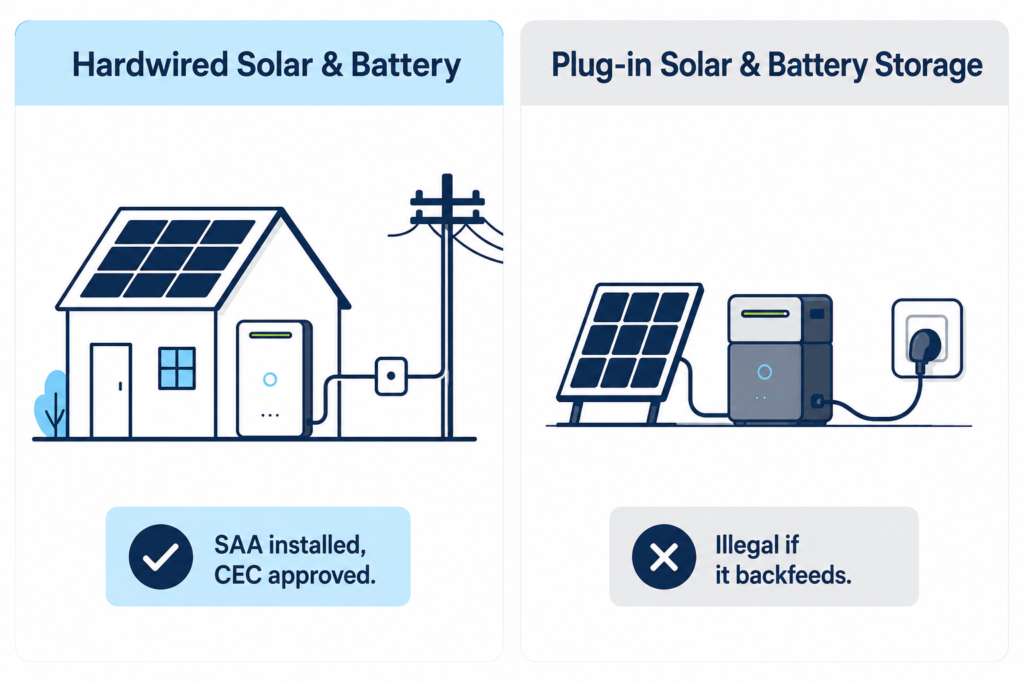
In Australia, both are treated the same way if they backfeed power into your home or the grid. Any battery or solar system that pushes power back through a standard power socket is illegal here, whether or not there’s a panel attached. All permanent or grid-connected systems must be hardwired and installed by a licensed electrician, so that they safely disconnect during an outage and don’t put line workers at risk. Grid-connected batteries also need to be Clean Energy Council-approved and installed by an SAA-accredited professional.
Sigenergy’s SigenMate 2700 Ultra: What Plug-and-Play Solar Looks Like Overseas
Sigenergy, the battery brand behind Lenergy’s SigenStor systems, launched the SigenMate 2700 Ultra at its Consumer Product Launch in Düsseldorf, Germany. It’s built to retrofit onto an existing solar system, working with mainstream microinverters, rather than needing a fresh install.
The battery runs in 2.68kWh modules. Stack up to six on one host and you get 18.8kWh. Run units in parallel and total capacity climbs to 56.4kWh. It takes up to 4kW of panel input across four MPPTs, and outputs 800W on-grid, up to 1400W off-grid for backup, and up to 3600W passthrough, with an 1800W burst for ten seconds to cover appliance start-up spikes.
It’s IP66-rated, built for -20°C to 55°C, and switches to backup power in 0 milliseconds, Sigenergy says, against an industry standard of 10 to 20 milliseconds. The mySigen app runs on SigenAgent, Sigenergy’s AI energy management layer, and the system supports VPP participation and dual time-of-use modes.
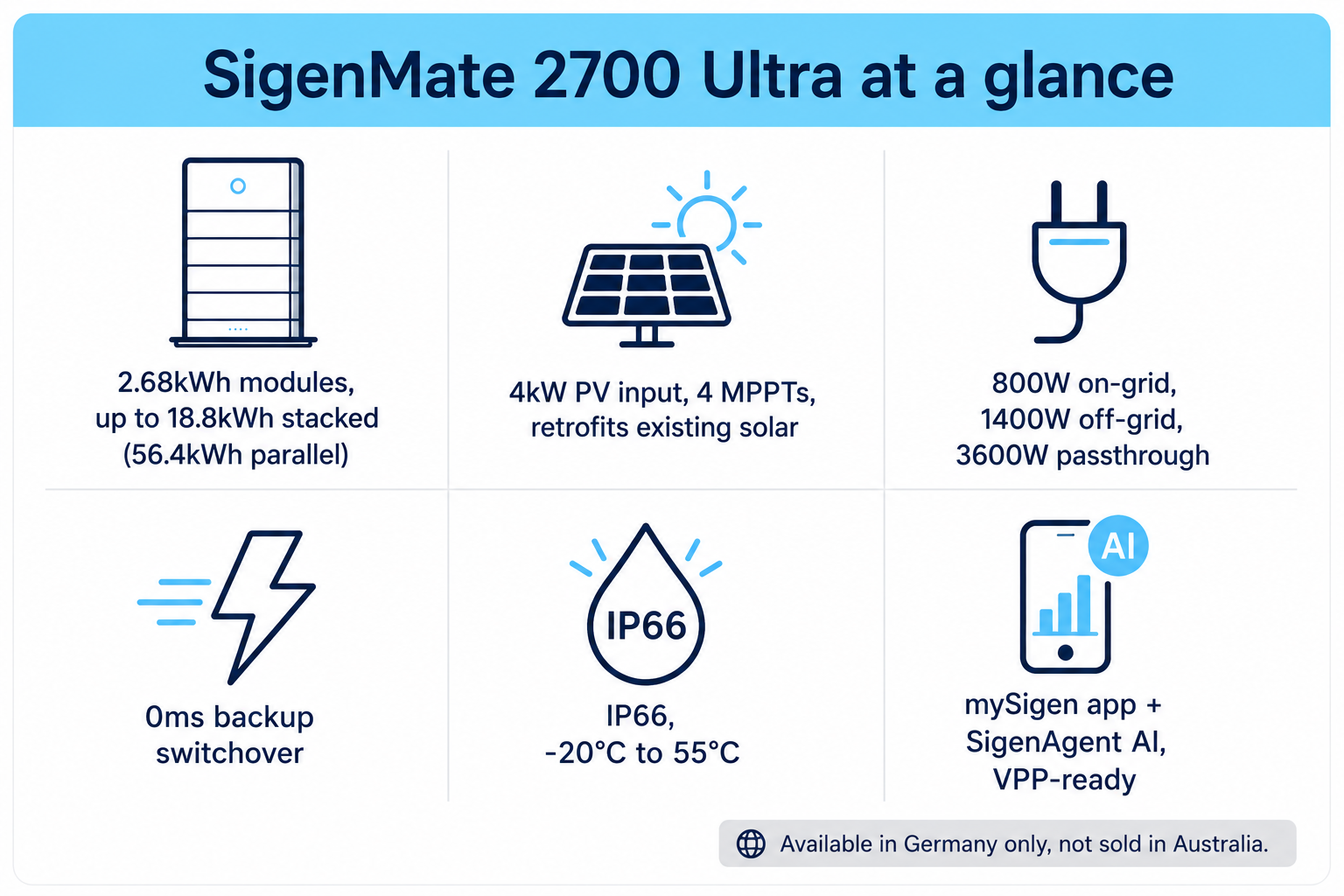
As of launch, the SigenMate 2700 Ultra is only available for pre-order in Germany, with wider EU pre-orders opening 18 to 31 August 2026. There’s no Australian release, and nothing announced pointing to one, but never say never.
Why Isn’t Plug-in Solar Legal in Australia?
Two standards get in the way. AS/NZS 4777.1 and 4777.2 govern grid-connected inverters, covering things like anti-islanding protection, which stops your system from feeding power into a “dead” line during a blackout and putting linesmen at risk. AS/NZS 5033 governs installation, requiring a SAA-accredited installer, proper cabling, earthing, and isolators.
A unit you plug into a wall socket bypasses all of that. Consequences for unapproved grid connection can include fines, forced removal, voided home insurance, and liability if it causes damage to the grid or a neighbour’s equipment.
The Clean Energy Council’s approved inverter list, which state rebates and network connections rely on, has no plug-in or balcony category at all. Every listed product assumes professional installation. The current governing standard, AS/NZS 4777.2:2020 Amendment 2:2024, took effect on 23 August 2025.
What Are Solar & Battery Options For Renters & Apartments Right Now?
You’ve got three real options while the rules stand as they are.
- Renting – Talk to your landlord about a solar and battery system. It’s not as far-fetched as you might think. I have dealt with many landlords that were happy to install solar & battery systems on their tenants property. With the current rebates and incentives available it is a great way for them to add value and future proof their investment property. You can read more about that here.
- Apartment Dweller – It can be challenging, however, it is possible for apartments to have a solar & battery system installed right now. There are even more incentives coming specifically for apartments this September, you can read more on that here.
- For those who can load shift switching to an offer like the Solar Sharer Offer can get more value out of your electricity plan, solar or not.
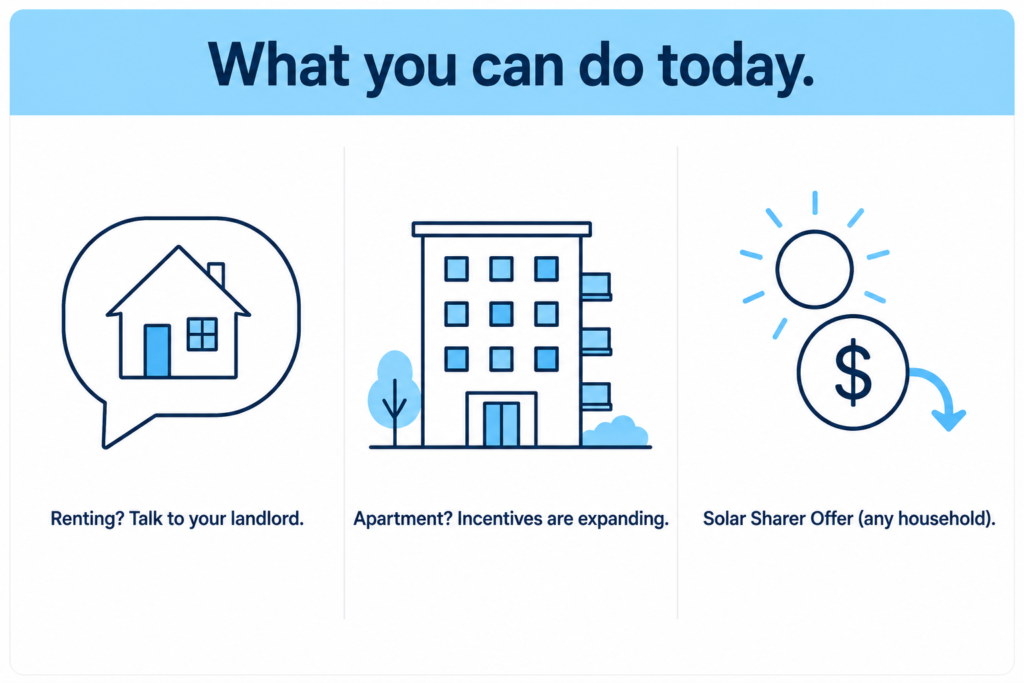
None of these are a straight swap for plug-in solar. Each one solves a different piece of the same problem, depending on whether you rent, own, or already have solar and just want a better deal on it.
Could Plug-in Solar Become Legal in Australia?
There’s no clear timeline for that right now. Standards do shift over time, and the Clean Energy Council has flagged upcoming changes to inverter communications and battery product specifications, so the settings that currently rule out plug-in solar aren’t necessarily fixed forever. However, there’s nothing on the table today that points to when, or whether, a compliant plug-in pathway will actually open up here.
Maybe some day we will get to see plug-in solar & batteries in Australian homes, just not today.
FAQ
Is plug-in solar legal in Australia?
No. Grid-connected plug-in units breach AS/NZS 4777.1/4777.2 and AS/NZS 5033, which require type-approved inverters and CEC-accredited installation.
Why can’t I buy a plug-in solar system in Australia?
The standards that govern grid-connected solar don’t have a plug-in category. Every approved product on the Clean Energy Council’s list assumes professional, hardwired installation.
What are the alternatives to plug-in solar for renters in Australia?
The Solar Sharer Offer.
Renting – talk to your landlord, you might be surprised.
Apartment dweller – there increased incentives coming, it could be worth starting the conversation now.
Read next: Can Renters Finally Access Solar? Queensland’s Supercharged Solar for Renters Rebate