Free Daytime Electricity Is Coming. Here’s How It Actually Works
From 1 July 2026, energy retailers in NSW, South Australia, and South-East Queensland must give households at least three hours of free electricity every day. No solar panels required. No need to own your home. You just need a smart meter and to opt in through your retailer to have access to free daytime electricity .
The scheme is called the Solar Sharer Offer. It works by passing on the benefit of cheap midday solar power, which has always existed on the wholesale market but never made it to your bill, directly to households. Since it was first announced in November 2025, one significant change has been made to the design. This article covers what that change is, how the scheme works in practice, and how to get the most out of it.
What Is the Solar Sharer Offer?
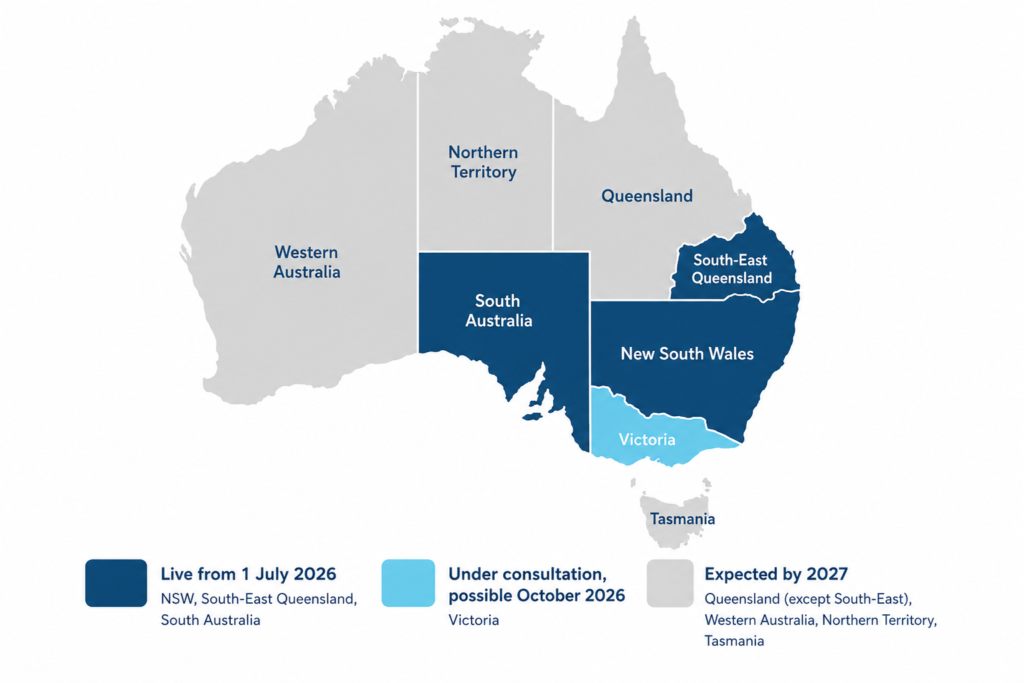
Australia has more than 4.3 million rooftop solar installations. On a clear midday, those systems push so much electricity into the grid that the market cannot absorb it at normal prices. Wholesale electricity rates go negative. However, households on standard tariffs never see any of that benefit.
The Solar Sharer Offer changes that. From 1 July 2026, energy retailers must provide at least three hours of free daytime electricity per day, timed to coincide with peak solar output. The free window will sit around midday, with the exact hours tailored to local conditions. As a rough guide, expect something like 11am to 2pm or noon to 3pm.
To access it:
- You need a smart meter (most Australian homes already have one)
- If you do not have one, most retailers will install it at no charge
- You opt in through your energy retailer when the scheme launches
Which States Are Included in the Solar Sharer Offer from July 2026?
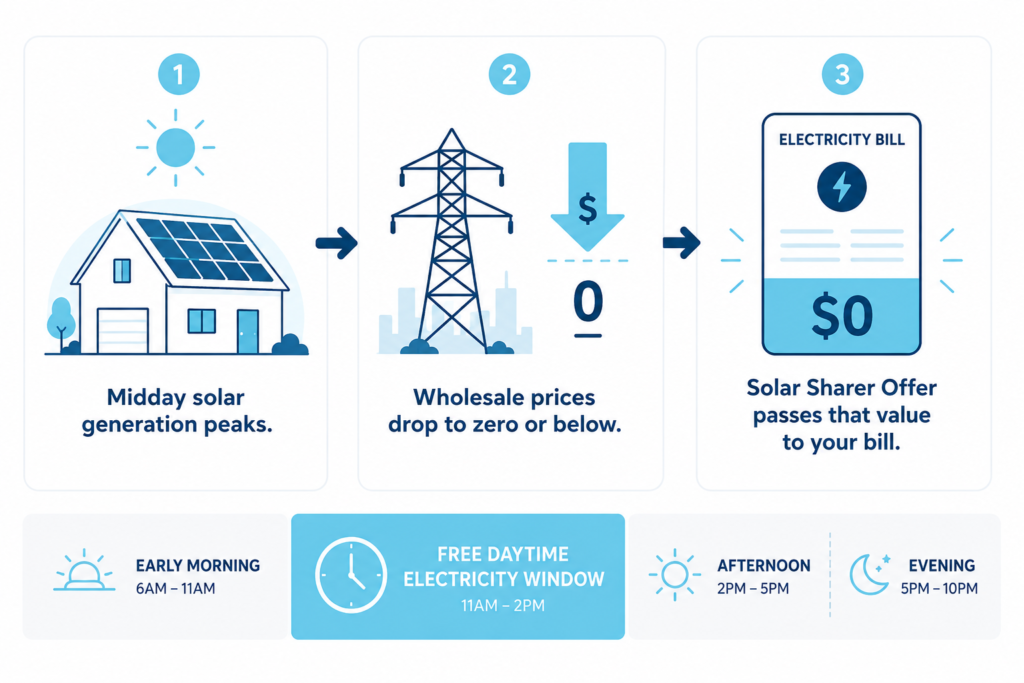
The July 2026 launch covers three states:
- New South Wales
- South-East Queensland
- South Australia
These are the states governed by the federal Default Market Offer framework. Victoria is under consultation, with some reports pointing to a possible expansion from October 2026. Other states are expected to follow by 2027.
If you are in Victoria, the ACT, or another state not yet covered, check with your retailer. Several retailers including AGL, Red Energy, GloBird Energy, and OVO Energy have already been offering similar free daytime electricity plans voluntarily, so an equivalent option may already exist on the market for you.
What Changed After the Public Consultation?
When the Solar Sharer Offer was first announced, the headline was simple: three hours of free daytime electricity every day, no strings attached. Then the government ran a public consultation from November to late November 2025, receiving 76 submissions from retailers, network businesses, consumer groups, and state governments. One significant change came out of that process.
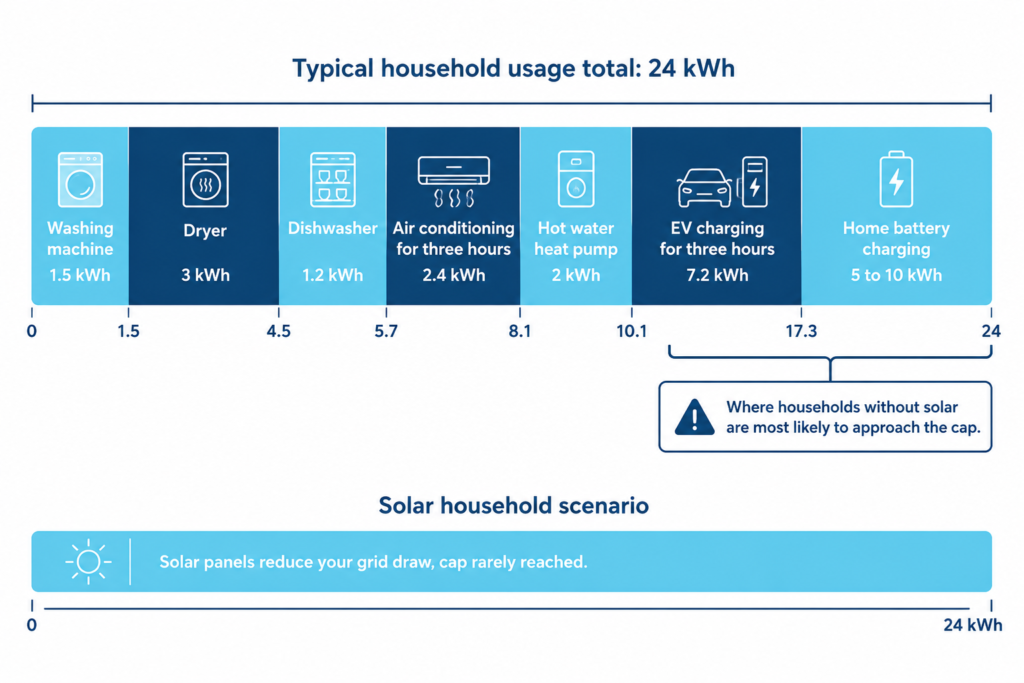
Per the Department of Climate Change, Energy, the Environment and Water (DCCEEW), a reasonable use cap of 24 kWh per day was added to the scheme. The government’s stated reason is to keep the Solar Sharer Offer financially sustainable for retailers and fair for everyone on the grid.
To put 24 kWh in perspective:
- It is roughly the total daily electricity use of an average five-person household, based on residential consumption benchmarks published by the Australian Energy Regulator (AER) in December 2020 and cited by DCCEEW in setting the cap level
- Running a washing machine, dryer, dishwasher, air conditioning, hot water, and more during the free window would get you close
- Most households will not reach it on a typical day
The regulations for the scheme were finalised and published on 5 March 2026 as amendments to the Electricity Retail Code.
Does the 24 kWh Cap Affect Solar Households?
For most homes with rooftop solar, the cap is not something you will notice. On a sunny day, your panels are already covering a big chunk of your midday electricity use, which means you are drawing less from the grid during the free window than you might expect.
The situations where you might approach the cap are:
- Cloudy winter days when your panels are generating less than usual
- Charging a large home battery and an EV from the grid at the same time
- Households with very small solar systems running high loads during the window
Even if you do exceed the cap, you just revert to standard daytime rates for the remainder of that period. You are not penalised, and daytime rates are still cheaper than evening peak rates, so shifting your load to midday is still worth doing.
For households without solar who were hoping to charge a large battery heavily during the free window, the cap matters more. The scheme was not designed for that kind of use, and the cap reflects that.
How Much Can Free Daytime Electricity Actually Save You?
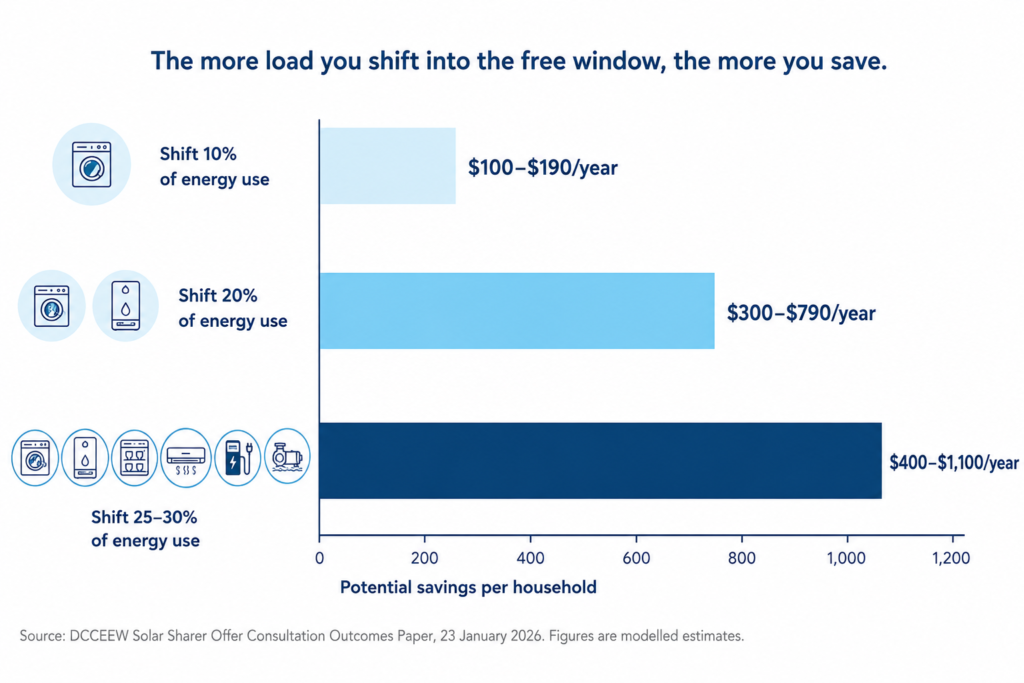
TThe DCCEEW published savings estimates in their consultation outcomes paper on 23 January 2026. The range depends on how much of your energy use you can move into the free window:
- Shift 10% of your energy use (one major appliance per day): save $100 to $190 per year
- Shift 20% (add a dryer or set your hot water to heat during the day): save $300 to $790 per year
- Shift 25 to 30% (also add a pool pump, EV charging, or dishwasher): save $400 to $1,100 per year
These are modelled estimates based on average tariff rates and household usage profiles. Your actual savings will depend on your current plan, your household size, and how consistently you can shift load into the free period each day.
What Does the Solar Sharer Offer Mean for Homes With Solar and Batteries?
This is where free daytime electricity becomes most useful for households that have already invested in solar and battery storage.
During the free window, you can charge your home battery from the grid at no cost. On days when your solar is not generating as much as usual, shorter winter days or overcast mornings, the Solar Sharer Offer lets you top up your battery without paying for it. That stored energy then powers your home through the late afternoon and evening, when grid electricity is at its most expensive.
For households with an EV, the free window is a straightforward charging opportunity. If your car is at home during the day, scheduling it to charge during the free daytime electricity period rather than overnight cuts a real cost out of your weekly routine.
Systems like the Sigenergy home energy platform can automate this scheduling so your battery and EV charging prioritise the free window without you having to manage it manually. That kind of automation is what makes the Solar Sharer Offer most powerful in practice.
Who Gets the Most Out of Free Daytime Electricity?
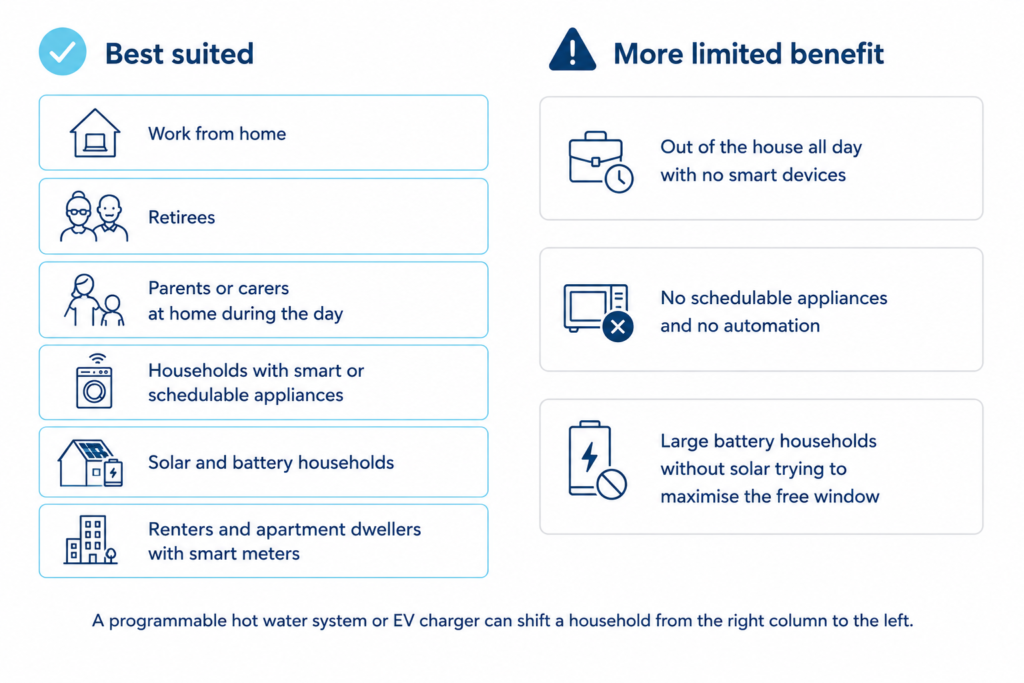
The scheme works best for people who are home during the day or who have appliances that can be set on a timer. That includes:
- People who work from home
- Retirees
- Parents or carers at home during the day
- Households with smart appliances that can be scheduled
If you are out of the house all day and have no smart devices, the benefit is more limited. Without automation, the free daytime electricity window passes without much use. A programmable hot water system or EV charger can still capture it while you are out, but you need that capability in place first.
Until now, renters and apartment dwellers have largely been locked out of the benefits of Australia’s solar boom. The Solar Sharer Offer changes that. You do not need panels on your roof or your name on a mortgage. Free daytime electricity is available to anyone with a smart meter who opts in through their retailer, which means renters and apartment dwellers can engage with the energy market in a meaningful way for the first time.
How to Sign Up and Make the Most of the Solar Sharer Offer
When the scheme launches on 1 July 2026, contact your energy retailer to opt in. Before then, do two things:
- Confirm your home has a smart meter. If it does not, contact your retailer now to arrange installation
- Check whether your high-draw appliances, hot water system, pool pump, washing machine, EV charger, can be set to run on a timer during the free window
Once you are enrolled, treat the free window as a daily resource. The households that save the most will be those who actively schedule their energy use around it rather than signing up and forgetting about it.
Here at Lenergy, we design solar, battery, and EV setups for Australian homes. If you want to understand how the Solar Sharer Offer fits into the picture for your place, whether you already have a system or are thinking about getting one, we can work through the numbers with you and tell you straight what makes sense. Getting the most from free daytime electricity is partly about the policy and partly about having the right setup in place to capture it. Send us a message and we’ll give it to you straight.

FAQ
How does the Solar Sharer Offer work for renters?
Renters can access free daytime electricity under the Solar Sharer Offer as long as their home has a smart meter. You do not need rooftop solar or to own the property. Contact your energy retailer to opt in once the scheme launches on 1 July 2026. The main practical limitation for renters is that smart appliances and schedulable devices, such as programmable washing machines or EV chargers, make a bigger difference than the scheme alone. Even without those, running high-draw appliances manually during the free window delivers real savings over a year.
Will the free daytime electricity window be the same every day?
The window will be at least three hours long each day and will sit during peak solar generation periods, typically around midday. Exact hours may shift slightly by season or region and will be confirmed by your retailer when you sign up. The design allows for adaptability over time per the DCCEEW’s stated principles, but the window is not expected to change frequently once established.
Is now a good time to invest in solar and batteries given the Solar Sharer Offer?
The Solar Sharer Offer strengthens the case for solar and battery storage rather than replacing it. Free daytime electricity covers part of the day. A solar and battery system gives you free or near-free electricity across a much larger portion of your day, and lets you use the free window to top up storage at no cost on low-generation days. If you were already considering solar and batteries, the Solar Sharer Offer adds another layer of value on top of what the system itself delivers.
What happens when I go over the 24 kWh daily cap?
Once you exceed the cap during the free window, additional electricity reverts to your standard tariff rate for that period. There is no penalty and no interruption to supply. The transition is seamless. For most households, particularly those with solar, reaching 24 kWh of free daytime electricity drawn from the grid within a three-hour window is unlikely on an average day.
Do I need to do anything before 1 July 2026 to be ready?
Two things are worth doing now. First, confirm whether your home has a smart meter. If it does not, contact your retailer to arrange installation ahead of the launch date. Second, if you have schedulable appliances, hot water systems, pool pumps, or EV chargers, check whether they can be set to a specific time window and familiarise yourself with how to do it. When the Solar Sharer Offer launches, you want to be capturing free daytime electricity from day one.