
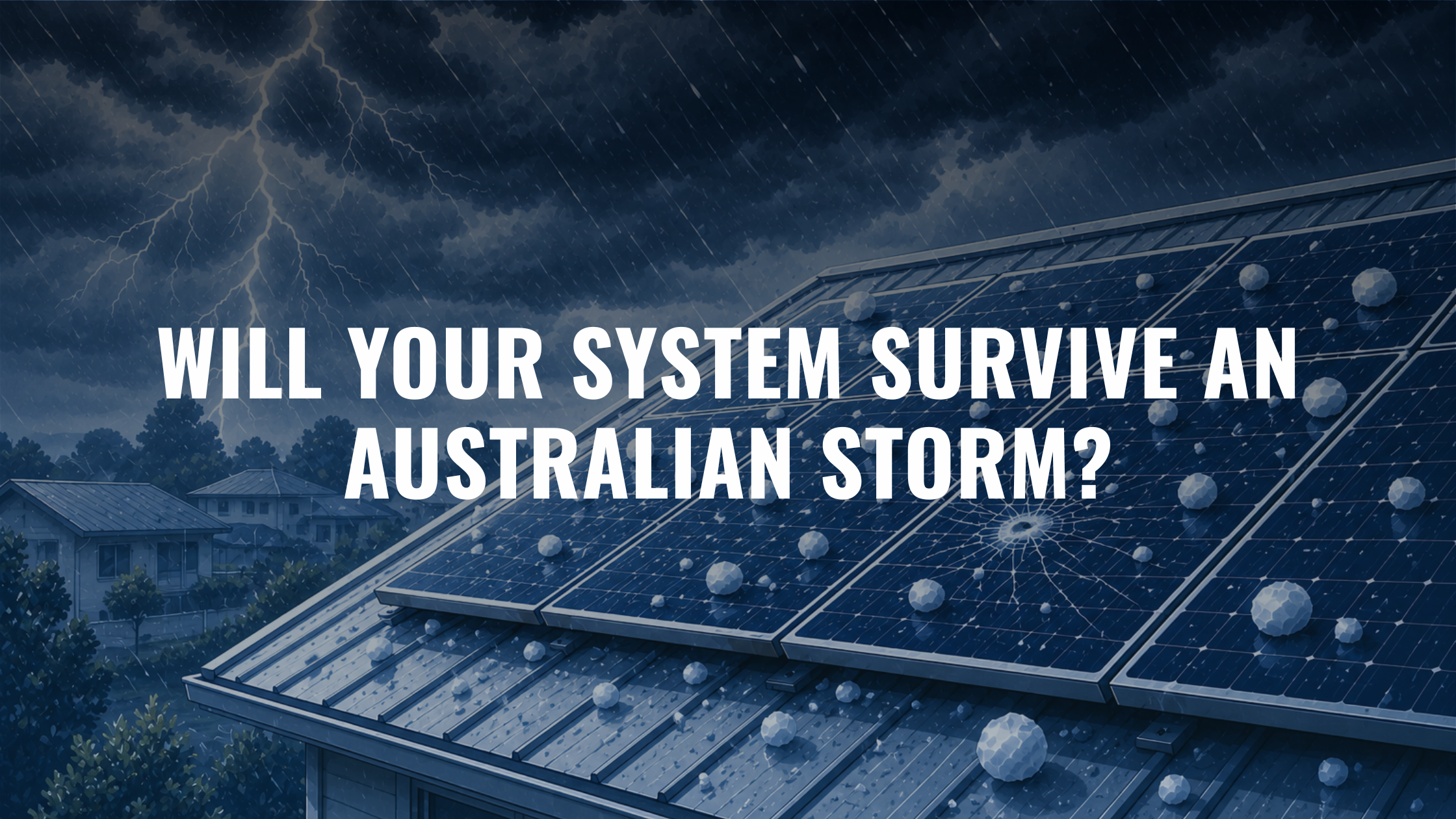
Solar Panels and Hail: Will Your System Survive an Australian Storm?
Australia’s hailstorms can and do destroy solar panels, but most systems come through storm season without any damage at all. The risk is real in certain parts of the country and at the more extreme end of the scale. With the right panels and a bit of forward planning, it is a risk you can manage before it ever becomes a problem.
If you live in southeast Queensland, inland NSW, or anywhere along Australia’s hail corridor, this is worth reading before storm season arrives.
This article covers what the Australian testing standards require, what real storms have shown about how panels hold up, why some hail damage does not show up for months, and what to do before and after a major event.
Do Solar Panels Have to Be Hail-Resistant in Australia?
Yes. Every solar panel sold in Australia must meet a standard called IEC 61215. This requires panels to survive being hit by 25mm hailstones travelling at roughly 83 km/h, across multiple points on the panel surface. A 25mm stone is about the size of a 50-cent coin. This has been thoroughly tested in real world situations and it means panels are built to handle the kind of hail most Australians see in a typical storm.
The problem is that some parts of Australia get storms that go well beyond that. In November 2025, two supercell storms hit southeast Queensland and produced hailstones up to 9cm across. According to ABC News, those two storms alone generated 28,250 insurance claims. In the town of Pratten near Toowoomba, nearly every property reported damaged solar panels.
Standards Australia has acknowledged that updating the national minimum standard is a multi-year process. Many manufacturers have not waited. They have moved ahead voluntarily by testing their panels to a tougher standard called the Swiss VKF HW4, which uses 40mm hailstones at significantly higher impact energy.
AIKO panels were among the first in the world to pass the VKF HW4 standard. They use 3.2mm tempered glass, compared to the 1.6mm glass in some standard panels. In a high-risk area, that extra thickness makes a real difference.

Where in Australia Is Hail Risk Highest?
Not every part of the country carries the same risk. The areas where severe hail is most likely include:
- Southeast Queensland, particularly the Darling Downs, Lockyer Valley, and Brisbane’s western suburbs
- Inland NSW, including the Hunter Valley, Central Tablelands, and the New England region
- Parts of Victoria, including Melbourne’s outer eastern and northern suburbs during spring and early summer
- The ACT, which recorded a damaging hailstorm in January 2020
The 2020 Brisbane event produced hailstones as large as 140mm. The November 2025 storms produced similar conditions.
If your home is in or near any of these areas, choosing panels that go beyond the IEC minimum is the sensible call.

What Happens When Hail Hits a Solar Panel?
The damage you can see
Large hailstones can crack or shatter the glass, break the solar cells inside, dent the aluminium frame, and in extreme cases rip panels off the roof entirely. If this happens:
- Turn off the AC isolator first, then the DC isolator
- Do not go up on the roof while the system is live
- Check for cracked or smashed panels from ground level only
- Call a licensed technician before doing anything else
Voltage can still be present in a damaged system and poses a real safety risk.
The damage you cannot see
This is the part most homeowners miss. When hailstones hit a panel hard enough, they can crack the solar cells inside without breaking the glass on the surface. The panel looks perfectly fine. The inverter might not show any fault for days or even weeks.
Over time, those internal cracks cause problems:
- Hotspots form, which are areas of concentrated heat in the damaged cells
- Power output drops gradually
- The backsheet can burn in serious cases
- Moisture can get in and speed up the deterioration
The only reliable way to find this kind of damage is through a specialist inspection called electroluminescence (EL) imaging, which shows the internal cell structure. A visual check from the ground will not find it.
If your area has been through a significant storm and your output has dropped in the weeks after, that is worth getting checked properly.

Does Home Insurance Cover Solar Panel Hail Damage?
In most cases, yes. Solar panels are generally treated as part of the building structure and covered under standard home and contents policies. That said, policies vary, so before storm season it is worth checking:
- That hail is listed as a covered peril in your policy
- What the replacement value limit is and whether it reflects current system costs
- Whether the policy pays full replacement cost or a depreciated value
Take photos of your panels before storm season. Write down the make, model, and serial numbers, and keep a record of your installer. A well-documented claim is a much faster and smoother process.
One thing insurance does not cover is gradual performance loss from microcrack damage that builds up over time. There is no single storm event to point to, so there is no claim to make. The protection against that kind of slow damage is choosing quality panels upfront and getting an inspection after any significant storm.
What Should You Do After a Hailstorm?
Right after the storm
- Shut the system down: AC isolator off first, then DC
- Do a visual check from the ground only
- Look for cracked or shattered panels
- If you see damage, call a licensed solar technician before anything else
- If the panels look fine, check your inverter for fault codes or error lights
Most modern monitoring apps show you exactly what the system is doing. The mySigen app for Sigenergy systems shows live output and flags faults directly.
In the days after
Keep an eye on your daily generation compared to what you were producing before the storm. Most apps give you a clear history. If output has dropped noticeably under similar weather conditions, that is a sign something needs a closer look.
If you experience an intense hailstorm and notice a significant drop in how much your solar system generates in the following days, it is worth booking a professional inspection even if everything looks normal. The cost of an inspection is well below the cost of finding out a year later that your panels have been silently degrading.

How Do You Choose Hail-Resistant Solar Panels?
In hail-prone areas, the question is not just whether a panel meets the IEC minimum. Every panel sold in Australia has to. The question is how much further it goes beyond that.
When comparing panels, look for:
- Certification to the Swiss VKF HW4 standard or an equivalent enhanced hail rating
- Glass thickness of 3.2mm or above
- Specific certification details on the panel model being quoted, not just the brand name
AIKO panels were among the first in the world to achieve VKF HW4 certification. For homes in southeast Queensland, inland NSW, and parts of Victoria, that level of certification provides real protection in the storms that matter.
It is also worth thinking about how panel resilience connects to the rest of your system. If you have a solar battery at home, its value depends entirely on your panels working. A storm that takes out your array also takes out your backup power.
Talk to Lenergy
Here at Lenergy we design solar, battery, and EV setups for Aussie homes. Not sure which panels are the right fit for your roof and your risk profile? Send us a message and we’ll give it to you straight.
FAQ
Will my solar panels survive a hailstorm?
Most panels handle typical hail without damage. Australian standards require all panels to survive 25mm hailstones at 83 km/h, and many modern panels perform well above that. The risk increases significantly above 35 to 40mm, and parts of southeast Queensland, inland NSW, and Victoria regularly see stones larger than that. In those areas, choosing panels certified to the Swiss VKF HW4 standard provides a meaningful step up in protection.
Can hail damage solar panels without cracking the glass?
Yes. Hailstones can cause microcracks in the silicon cells beneath the surface without breaking the glass itself. These are invisible to the eye and may not trigger inverter faults straight away. Over time, the cracks spread and form hotspots, reducing power output and in serious cases creating a fire risk. The only reliable way to detect this damage is through electroluminescence imaging by a qualified technician.
Does my home insurance cover hail damage to solar panels?
In most cases, yes. Solar panels are generally treated as part of the building structure and covered under home and contents policies. Check that your policy lists hail as a covered peril, confirm the replacement value limit reflects current system costs, and document your system with photos and serial numbers before storm season. Gradual performance degradation from microcrack damage is not covered by insurance claims.
Is now a good time to upgrade to hail-resistant panels?
If you are planning a new system or replacing an existing one, building in hail resistance from the start makes practical sense, particularly in high-risk regions. The cost difference between a standard-rated and a premium-rated panel is modest compared to the cost of replacing a system after a severe event. With federal battery rebates currently available, combining a quality panel with battery storage is worth looking at now.

