Are AGL, Origin & EnergyAustralia Prices Going Up July 2026?
If you’ve been worried about an AGL price increase in July 2026, or bracing for another energy price hike in Australia, here’s the good news: for most Australians, electricity prices are actually going down this July, not up. The Australian Energy Regulator (AER) confirmed its final decision on 26 May 2026, and benchmark electricity prices are falling in NSW, South East Queensland and South Australia. Victoria is also cutting prices. Western Australia is the one exception.
After several years of rising bills, this is a real shift. The main reason prices are dropping is that home batteries and large-scale battery storage have flooded the market, cutting the cost of electricity at the wholesale level. Renewables now make up more than half of Australia’s national grid generation.
This article covers exactly what’s changing from 1 July 2026 by state, by retailer, and in plain terms. You’ll learn why bills are falling in most places, what’s still going up inside your bill, what the new Solar Sharer Offer is, and whether going solar and battery is still worth it when prices are heading down.
Is There an AGL Price Increase in July 2026 — or Are Bills Actually Falling?
For most customers of AGL, Origin and EnergyAustralia, there is no electricity bill increase in July 2026. The opposite is true in most states.
These three retailers are required by law to cap their standard “standing offer” prices at or below the AER’s Default Market Offer (DMO), a benchmark price the regulator sets every year. When the DMO falls, their standard prices must follow.
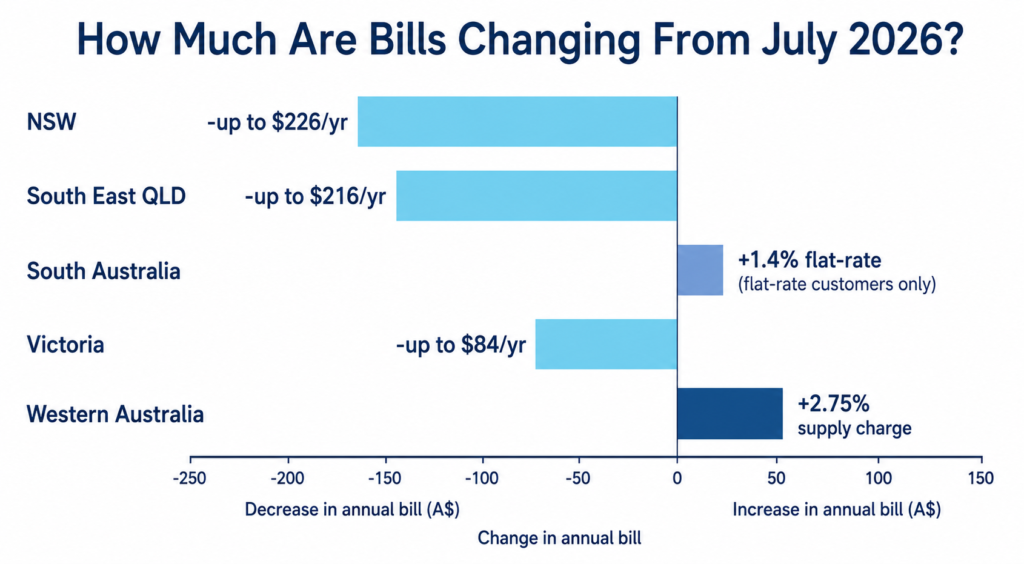
Here’s what’s changing by state from 1 July 2026:
- NSW: Bills falling by approximately $58–$226 per year depending on your area
- South East Queensland: Bills falling by approximately $216 per year, the biggest drop of any DMO state
- South Australia: Mixed. Flat-rate customers may see a small rise of around 1.4%. Time-of-use customers fare better
- Victoria: Bills falling by approximately $84 per year, set by Victoria’s own regulator rather than the AER
- Western Australia: Bills rising by 2.75% on the fixed daily supply charge, the one state going the other way
One important thing to know: fewer than 10% of households are actually on a standard standing offer. Most people are on a market offer, which is a competitive plan their retailer sold them. The DMO drop doesn’t automatically change what you pay, but it does reset the reference point retailers use to price their plans. If you haven’t reviewed your plan recently, now is a good time to compare energy providers in Australia and see if you’re getting a fair deal.
Why Is There No Major Energy Price Hike in Australia This Year?
The short answer: batteries and renewables have made electricity cheaper to produce.
Wholesale electricity, which is the raw cost of generating power before it reaches your home, fell 44% year-on-year in the final quarter of 2025. Renewable energy hit a record 51% of national grid generation in that same period. Large-scale batteries are now helping set the wholesale price in roughly one third of all trading intervals, replacing expensive gas and coal generators that used to run every evening when demand peaked.
Energy Minister Chris Bowen credited home batteries directly, saying they are “flattening the peak” by storing cheap solar power during the day and releasing it at night. That means gas and coal plants get called on less often, which saves everyone money.
So why did anyone think electricity rates in 2026 might go up? Because one part of your bill, network charges, did go up almost everywhere. Network costs cover the poles, wires and infrastructure that carry electricity to your home. They make up 39–54% of a typical bill. Here’s what network costs did in 2026–27:
- Ausgrid (NSW): up approximately 10%
- Endeavour Energy (NSW): up approximately 11%
- Energex (SE QLD): up approximately 12%
- SA Power Networks: up approximately 10%
- AusNet Services (VIC): down approximately 9%, the national exception
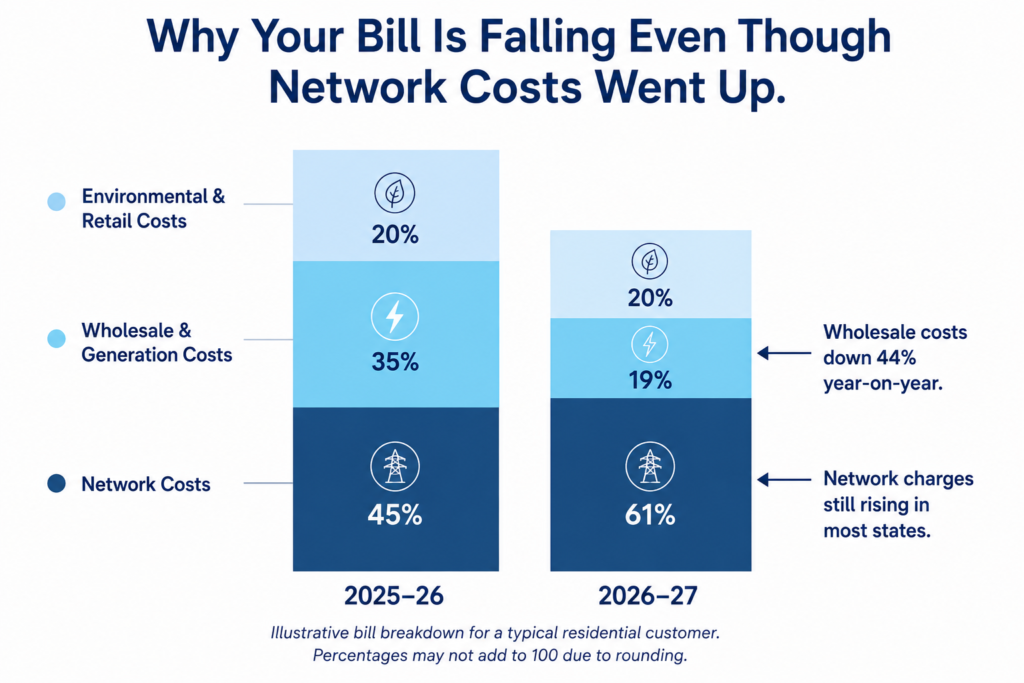
Network costs going up while overall bills go down sounds contradictory. It’s not. The wholesale price fell so sharply that it more than covered the network increases in most states. In South Australia, the network rise ate up more of the savings, which is why SA customers on flat-rate plans see a smaller benefit or a small rise.
The AER also changed the rules this year so the DMO must be based on “efficient costs”, meaning the lowest network tariffs available to retailers. That means retailers can no longer inflate the benchmark with padded estimates.
What Is the Solar Sharer Offer — and Should You Switch?
From 1 July 2026, AGL, Origin and EnergyAustralia are all required to offer a tariff called the Solar Sharer Offer to eligible customers. It’s opt-in, and you need a smart meter to access it.
Here’s how it works:
- Free electricity for three hours every day during peak solar generation hours
- In NSW and SE QLD: free from 11am to 2pm
- In SA: free from 12pm to 3pm
- 24 kWh daily cap on the free electricity, with normal rates applying after that
- Available to anyone with a smart meter, regardless of whether you have solar panels
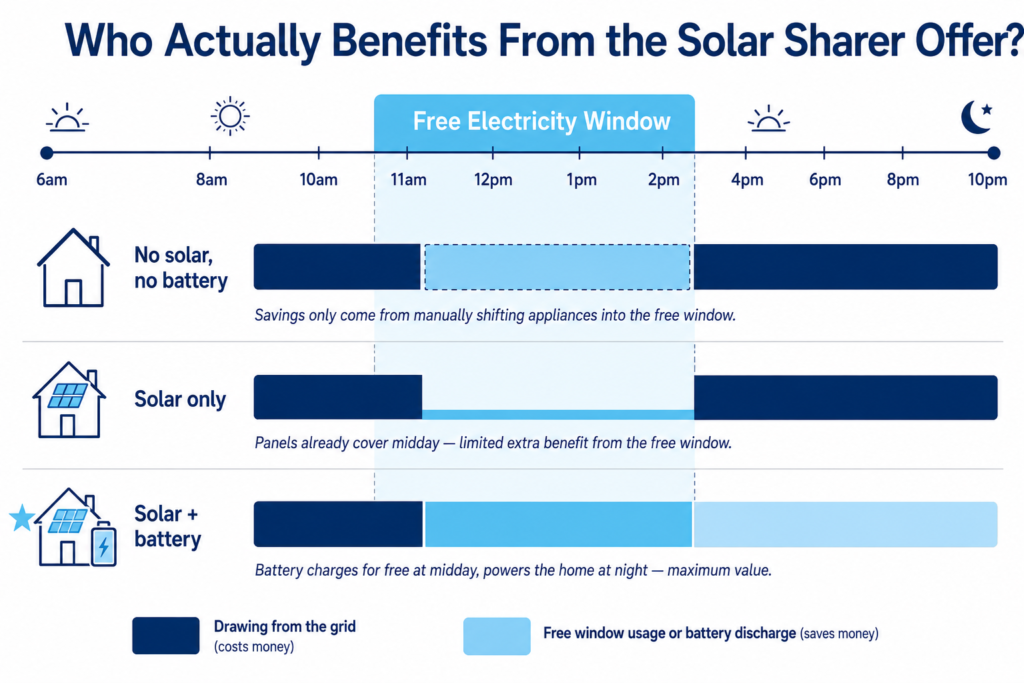
The catch is that this offer doesn’t save you money automatically. The savings only show up if you shift your usage into the free window by running your dishwasher, EV charger, air conditioner or hot water system between 11am and 2pm using an appliance timer.
For solar households without a battery, the benefit is limited. Your panels are already covering most of your midday power use, so the free grid electricity doesn’t add much. For households with a battery, it’s a different story. A battery can store up to 24 kWh of free electricity even on a cloudy day and discharge it in the evening when rates are higher. That’s where the real value is.
Victoria and WA don’t have the Solar Sharer Offer yet, but Victoria is expected to get it soon. Similar free-midday plans are already available in Victoria for smart meter holders who want to get started early.
What Other Changes Are Coming to Your Bill From July 2026?
Beyond the price changes and the new Solar Sharer Offer, several new consumer protections take effect from 1 July 2026 for all AGL, Origin and EnergyAustralia customers:
- Retailers can only raise prices once per year, with mid-contract increases no longer allowed
- Account establishment fees are being removed
- Special meter read fees and re-energisation fees are being eliminated
- Retailers must offer at least one free payment method
- New tariff caps have been introduced, limiting not just annual costs but individual line items like daily supply charges and usage rates
That last change matters if you want to compare energy providers in Australia. For the first time, you can compare AGL, Origin and EnergyAustralia on a like-for-like basis. Supply charge versus supply charge. Usage rate versus usage rate. Previously, the way retailers structured their pricing made direct comparison difficult.
If you’re thinking about whether to switch energy provider in Australia, the new tariff caps make it significantly easier to work out which plan is actually cheaper for your usage pattern. The government’s free comparison tool at energymadeeasy.gov.au is the place to start.
Should You Still Go Solar and Battery Even If Electricity Rates in 2026 Are Falling?
The Federal Cheaper Home Batteries Program currently provides approximately 30% off the upfront cost of an eligible home battery system. According to the Department of Climate Change, Energy, the Environment and Water (DCCEEW), the rebate works out to:
- $2,440 off a 10 kWh battery
- $4,438 off a 20 kWh battery
- $6,463 off a 30 kWh battery
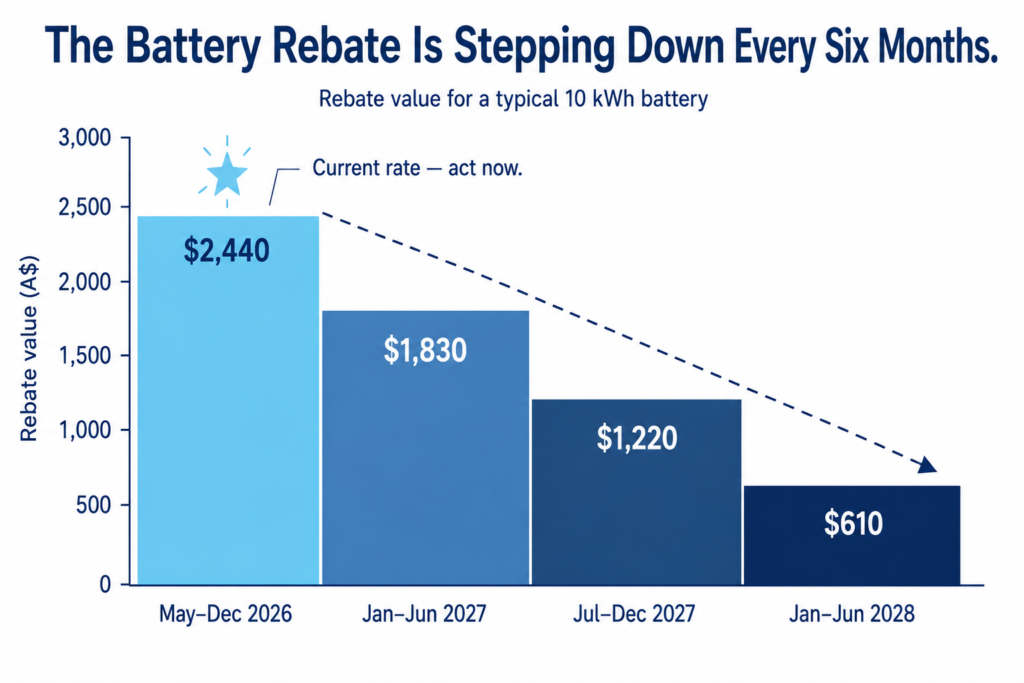
The scheme is uncapped and not means-tested. There’s no income limit and no national cap on how many systems can claim it. The rebate does decrease every six months though. The current rate applies from May to December 2026. From January 2027, the discount steps down so acting now means you will be able to get the highest discount possible.
Falling wholesale prices don’t make batteries less valuable. They make batteries more valuable, because the energy system is increasingly built around rewarding households that can store cheap daytime solar and avoid expensive grid power in the evenings. The new Solar Sharer Offer reinforces this by handing battery owners up to 24 kWh of free midday electricity every day to store and use later.
Here at Lenergy we design solar, battery and EV setups for Aussie homes. Wondering whether the battery rebate still applies at the full rate for your situation? Send us a message and we’ll give it to you straight.

Frequently Asked Questions
Is my power bill going up in July 2026?
For most Australians, no. Benchmark electricity prices are falling in NSW, South East Queensland, Victoria and, for many tariff types, South Australia. Western Australia is the exception, with a small increase to Synergy’s fixed daily supply charge. Whether you personally see a lower bill depends on your state, your tariff type, and which plan you’re on with your retailer. If you’re on a market offer that hasn’t been updated recently, your plan may not reflect the new lower benchmark automatically. That’s a reason to compare energy providers in Australia and check whether switching saves you more.
Why are electricity prices falling if I keep hearing that network costs are rising?
Both things are true. Network charges, which cover the cost of poles and wires, went up 10–12% in most states. But wholesale electricity costs fell 44% year-on-year as renewable energy hit record levels and large-scale batteries started replacing gas and coal in peak periods. The wholesale fall was large enough to outweigh the network rise in NSW, QLD and VIC. In SA, the network increase absorbed more of the savings, which is why flat-rate SA customers may see a small rise instead. The network cost pressures are real and ongoing. Households with solar and batteries reduce how much grid power they use, which insulates them from those rises regardless of what the headline rate does.
What is the Solar Sharer Offer and do I need a battery to use it?
The Solar Sharer Offer is a new tariff that AGL, Origin and EnergyAustralia must offer from 1 July 2026 to customers with smart meters. It provides three hours of free grid electricity per day, from 11am to 2pm in NSW and SE QLD and from 12pm to 3pm in SA, with a 24 kWh daily cap. You don’t need a battery to access it, but the savings are limited without one. If you have a battery, it can store up to 24 kWh of free electricity even on overcast days and use it in the evening when rates are higher. Without a battery, the benefit comes from shifting appliance use such as EV charging, hot water and dishwashers into the free window using timers.
Is the federal battery rebate still worth it when electricity prices are going down?
Yes. The rebate is based on the upfront system cost, not on the current electricity rate. It provides around $2,440 to $6,463 off a typical home battery depending on size. The discount decreases every six months, with the rate stepping down from January 2027. Only one rebate is available per property. Falling electricity prices and the new Solar Sharer Offer both increase the value of battery storage, because the grid now rewards households that store cheap daytime power and avoid peak-rate grid electricity at night. Acting in 2026 captures both the higher rebate and the better-structured tariff environment.
Is now a good time to switch energy provider in Australia?
It is worth reviewing your plan immediately. The AER’s own data shows that customers still on a standing offer could save up to 13% by moving to a competitive market offer. New tariff caps from July 2026 make it easier than ever to compare energy providers in Australia on a fair basis. Use the government’s free tool at energymadeeasy.gov.au to compare AGL rate changes against what Origin, EnergyAustralia and other retailers are offering in your area. If you haven’t reviewed your plan in the last 12 months, there’s a reasonable chance a better option exists.