The Commercial Solar Rebate Is Bigger. The Work Isn’t Done
From 1 October 2026, subject to the regulations landing, the commercial solar rebate cap lifts from 100 kW to 1 MW.
That is a great new policy for Australian businesses. The 100 kW line was arbitrary, and it had businesses putting 99 kW on roofs that could carry four times as much. Removing it is the most useful thing to happen to commercial solar in years.
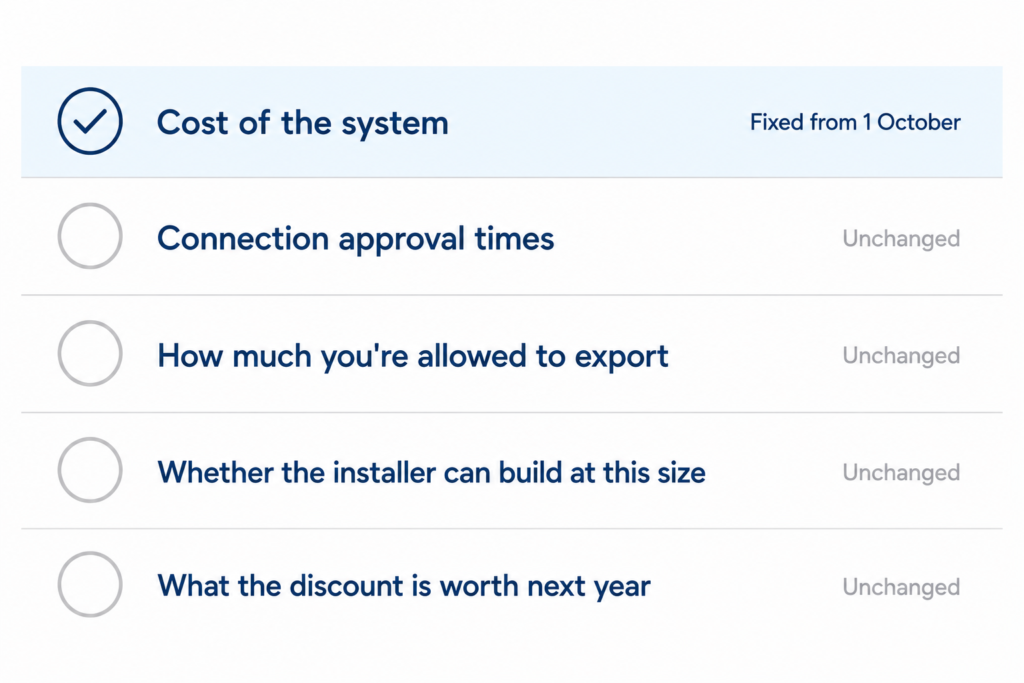
Whilst a step in the right direction cost is not the only factor that has been slowing commercial solar uptake. A rebate is not a connection approval. It is not permission to export. It does not tell you who should build the thing.
This article covers:
- How long it takes to get commercial solar approved
- Whether you can actually use what a bigger system generates
- Why the installer matters more at this size
- What a lot of new certificates does to the discount
What the expansion actually fixes
Cost, and only cost.
The discount is worth roughly 20 per cent off an install, and on a 250 kW system that is around $68,000. We covered the numbers, the eligible sectors and the start date in what the expanded commercial solar rebate is worth .
Whilst a great start to growing commercial solar there still a lot of red tape and other factors that need to be resolved to help this side of the industry boom.
How long does commercial solar approval actually take?
Longer than the rebate does, and the two are not connected.
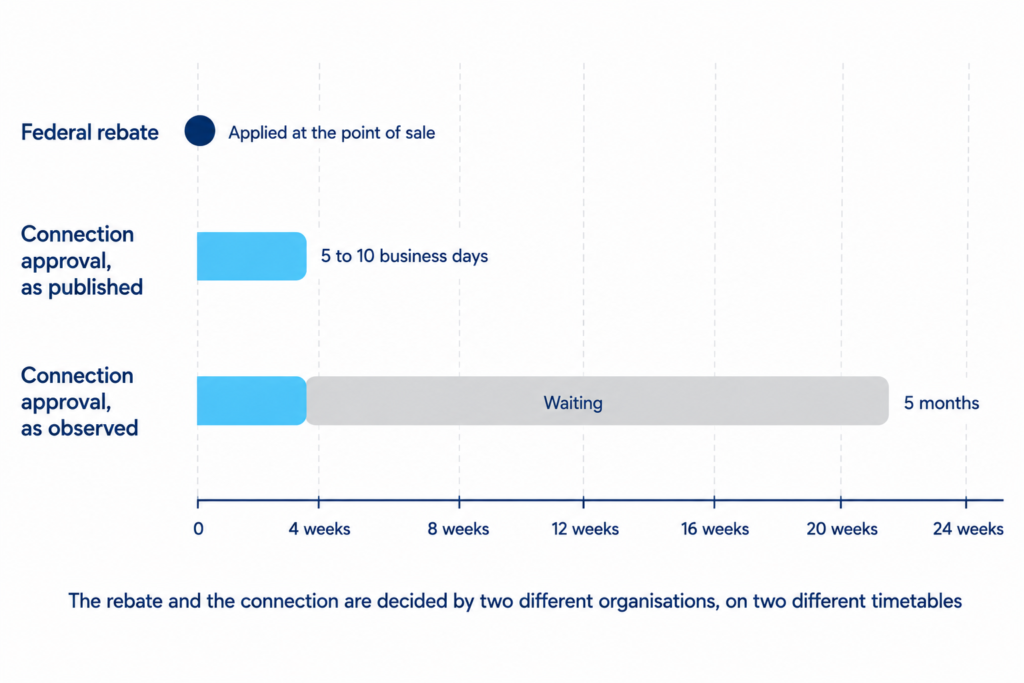
The rebate comes from a federal scheme with published rules and a known value. Your installer handles the certificates and the discount comes off the invoice. Permission to connect comes from your local distribution network, which sets its own requirements and its own timeframes. Neither waits for the other.
Seventy-one per cent of industry members surveyed by the Smart Energy Council named approval times as a leading barrier. One Victorian network told its regulator that a 200 kW approval takes five to ten business days. The same consultant watched compliant, paid-up jobs sit for five months waiting on it.
Requirements shift as well. A design that met the rules in March can need reworking by June, and you pay for the rework.
The government has said it will push for faster approvals on mid-scale solar. That work has not landed yet.
Is the grid ready for this?
Not entirely, and that is worth knowing before you size anything.
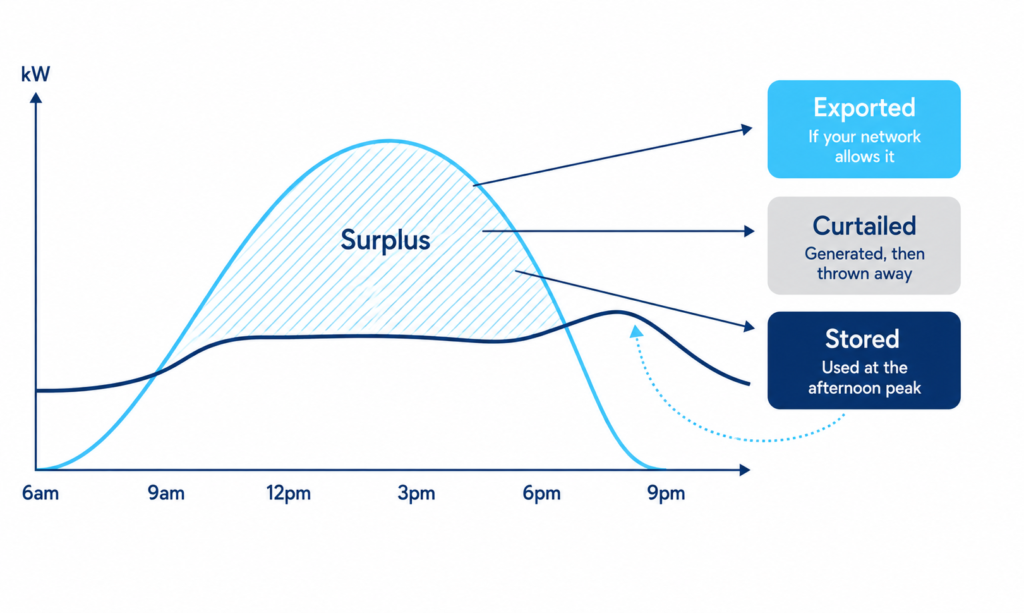
Every one of these systems generates at the same time. Middle of the day, all at once, across the same networks. That is already the part of the day when the grid needs the least power, and minimum daytime demand keeps falling.
So a lot of new generation is about to arrive exactly where the grid has the least room for it. The rebate was announced on its own. The connection rules that need to sit underneath it are still being asked for, not written, and that order has cost businesses money before.
Networks respond the way they always do. Where daytime solar is already heavy, new systems get a fixed export limit, a flexible one, or a zero export condition. Mechanisms also exist that can pause or restrict rooftop solar during rare but difficult grid conditions.
Which means the power you generate and do not use does one of three things. It gets exported, if your network allows it. It gets stored, if you have a battery. Or it gets curtailed, which is a polite way of saying generated and thrown away.
Export is worth less than it used to be as well. The Smart Energy Council documents a steel manufacturer with 1.5 MW of export capacity that was charged for exporting during periods of negative wholesale prices. They switched export off.
None of this sinks a project. It changes what the project is. A system that exports is selling power. A system that cannot export has to use it on site.
So the sizing conversation stops being how many panels fit on the roof and becomes how much you actually draw between 9 and 4. Half-hourly data. Weekends. Shutdown weeks. Seasonal swings.
It is also where a battery stops being an optional extra. Surplus you would otherwise throw away gets used late in the afternoon, which is exactly when commercial demand charges bite hardest.
Does it matter who installs it?
More than it did at the residential level.
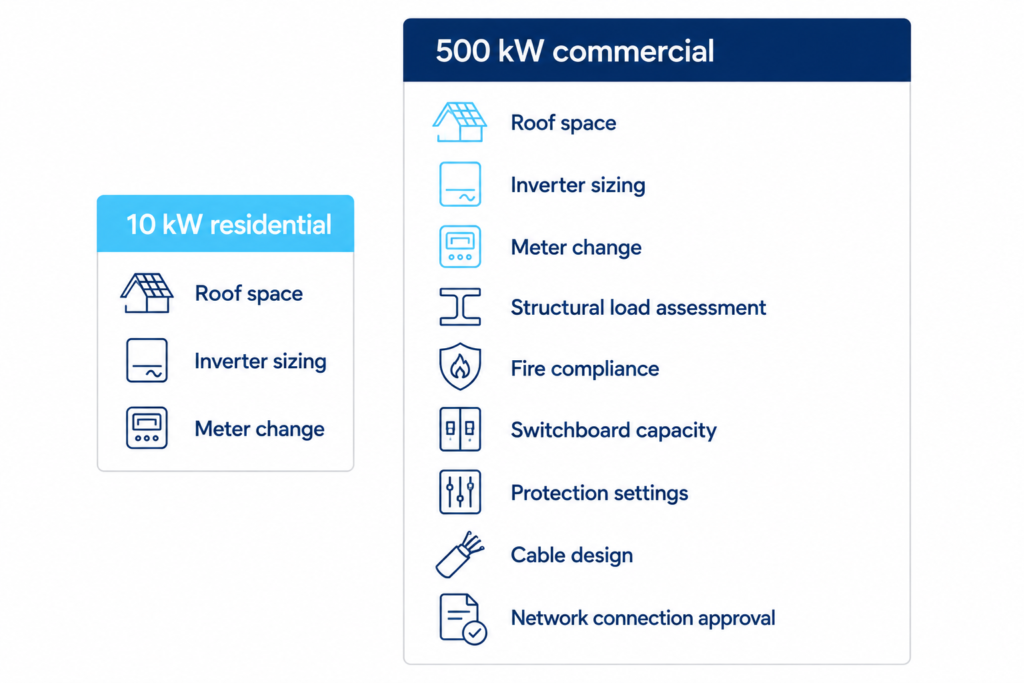
A 500 kW system is not a residential quote multiplied by fifty. Roof structure, fire compliance, switchboard capacity, protection settings and cable design all turn into engineering questions with real consequences.
A rebate this size attracts good operators. It also attracts people who have never built anything at this scale.
Check the installer is SAA accredited, and ask what they have actually delivered above 100 kW. A badly designed 500 kW system is not a big version of a small mistake. It is an expensive one sitting on your roof for the next twenty years.
What happens to the discount itself?
Worth understanding. Not worth panicking about.
The rebate runs on tradeable certificates. If a lot of commercial systems create a lot of certificates quickly, supply rises, and the price per certificate can fall. That would trim the discount for everyone, households included.
The government sets how many certificates must be surrendered each year, so it can steer this. Whether it steers quickly enough is a fair open question.
What it is not is a reason to rush. If someone tells you to sign today because the rebate is about to collapse, they are selling, not advising.
So what has actually changed?
The price, and nothing else.
The 100 kW cap was arbitrary and it did real damage. Businesses put 99 kW on roofs that could carry four times as much, for a reason that had nothing to do with their roof or their power bill. Removing that line is the most useful thing to happen to commercial solar in years.
What it does not do is shorten a connection queue. The rebate and the network approval are still decided by different organisations working to different timetables, one with published timeframes measured in business days and real ones measured in months.
It does not make room on a grid that already carries a lot of midday generation, and it does not settle how much any given site will be allowed to export.
It does not make a 500 kW system simpler to build, or make the people quoting on one more experienced than they were in September.
It does not guarantee the discount holds its value once a lot of new certificates start arriving.
None of that is an argument against the policy. The cost barrier was real and it is being removed. The rest of the barriers were always sitting underneath it, and they are still there.

Frequently Asked Questions
Does the bigger rebate mean I can install a bigger system?
It means you can claim the discount on a bigger system. Whether you can install and export one is a separate decision made by your local network, on its own timeline.
What is the new maximum system size for the commercial solar rebate?
1 MW, up from 100 kW, expected from 1 October 2026 and subject to the regulations.
Will the commercial rebate reduce the household solar rebate?
It could put downward pressure on the certificate price if commercial uptake runs ahead of forecasts. The government adjusts annual surrender requirements to manage this. Nobody should be using it as a reason to hurry you into signing.
Do I need a battery to make a large commercial system work?
Not always. It becomes much more important if your network limits your exports, because a battery lets you keep surplus generation instead of losing it. What the new PDRS rules mean for solar batteries covers where commercial sites now stand.
Read next: Government grants for sports clubs: up to $100,000 for energy upgrades in 2026