Have I Missed the Battery Rebate? What Changed in May
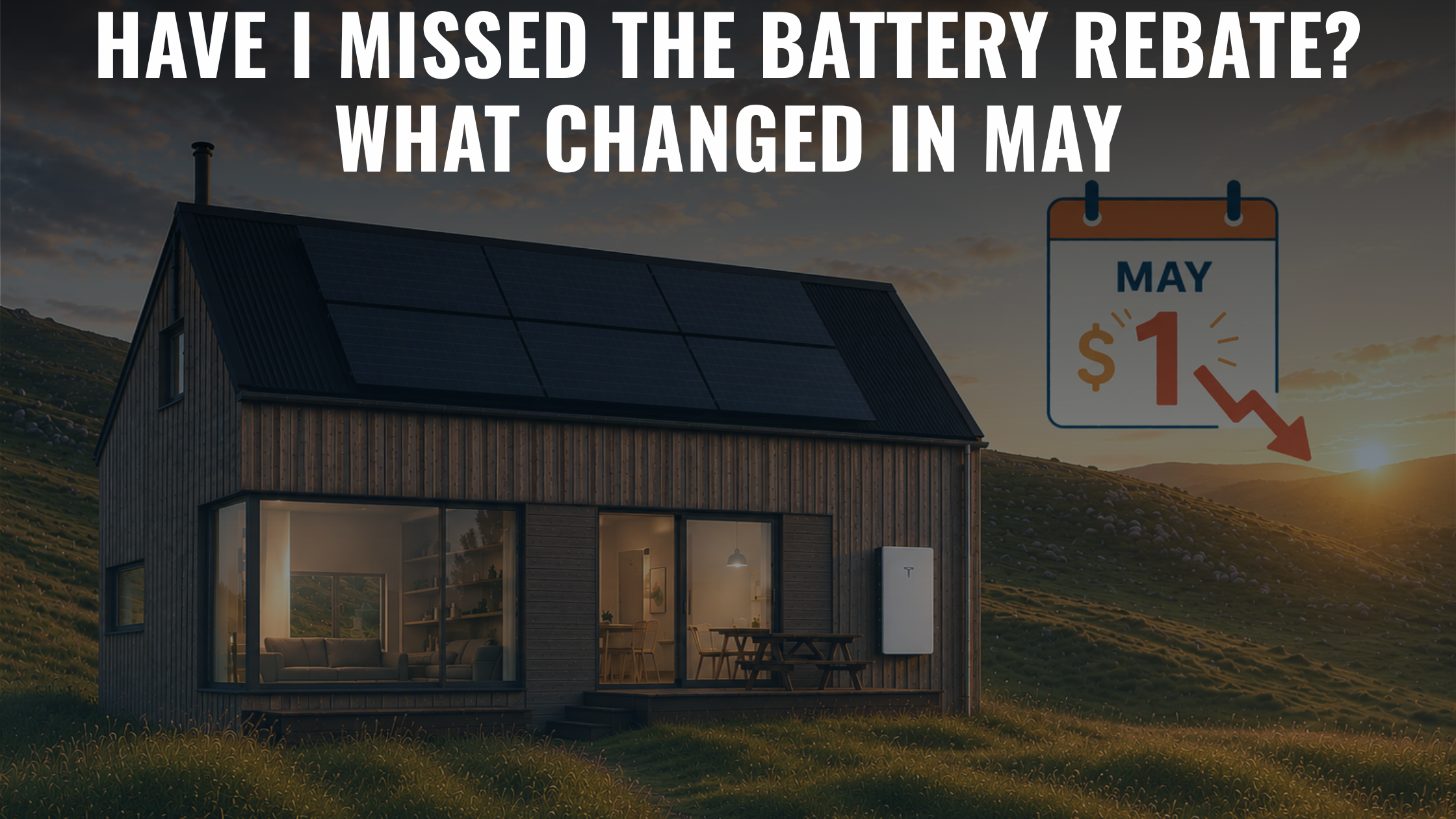
If you have been watching the solar battery rebate closely over the past few months, you already know the story: there was a scramble to get systems commissioned before 1 May 2026, and a lot of homeowners missed that window. Maybe your installer ran behind. Maybe stock ran short. Maybe you were still getting quotes when the deadline passed.
The rebate has dropped and the rules have changed. It is, however, still a substantial discount for homeowners who are done watching their electricity bills climb and want to do something about it.
In this article, you’ll learn:
- What changed on 1 May 2026 and why the government made the change
- How much the rebate is now worth in dollar terms for a typical home battery
- How the new tiered structure works and which battery sizes it favours
- Whether you can stack a NSW state incentive on top of the federal rebate
- Who is eligible and how the discount actually reaches you at purchase
- Whether this is still worth pursuing for your situation
What Actually Changed about the Battery Rebate on 1 May 2026
The federal solar battery rebate runs through the Small-scale Renewable Energy Scheme (SRES), which is administered by the Clean Energy Regulator. Under this scheme, eligible home batteries earn Small-scale Technology Certificates, or STCs, which are traded on the market and passed back to the homeowner as an upfront discount at the point of purchase.
Before 1 May 2026, each usable kilowatt-hour of battery capacity earned 8.4 STCs. After 1 May, that dropped to 6.8 STCs for the first 14 kWh of capacity. At an STC market price of around $37 per certificate (after admin costs), that shift reduced the rebate value from roughly $311 per kWh to around $252 per kWh — a reduction of about 19%.
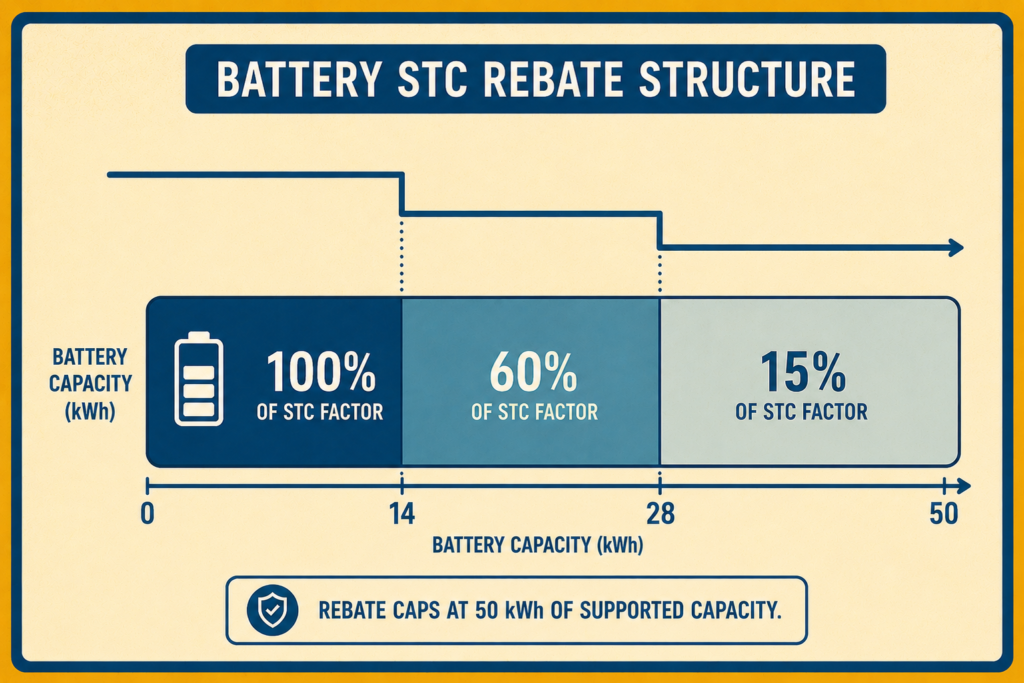
The government also introduced a tiered structure that reduces the STC factor for larger batteries:
- Battery capacity from 0 to 14 kWh earns 100% of the STC factor.
- Battery capacity from 14 to 28 kWh earns 60% of the STC factor.
- Battery capacity from 28 to 50 kWh earns 15% of the STC factor, and the rebate caps at 50 kWh usable capacity.
The reason for the change is straightforward. According to ABC News, the Cheaper Home Batteries Program launched in July 2025 and saw more than 266,000 home battery installations in under nine months. The original $2.3 billion budget was depleted in roughly six months, largely because the flat-rate rebate design encouraged homeowners to install the largest battery possible to maximise the discount. The government topped up the program with nearly $5 billion and redesigned the structure to favour smaller, appropriately sized systems and extend the scheme through to 2030.
What the Rebate Is Worth in Dollars Now
The post-May rebate still represents a meaningful reduction in upfront cost, and the amount you receive depends on which tier your battery’s usable capacity falls into.
Batteries up to 14 kWh receive 100% of the STC factor — the full rebate rate. At approximately $252 per usable kWh, a 10 kWh battery in this tier attracts roughly $2,520 off the upfront cost.
Batteries between 14 and 28 kWh receive the full rate on the first 14 kWh, then 60% of the STC factor on capacity above that. A 20 kWh battery, for example, earns the full rate on the first 14 kWh and 60% on the remaining 6 kWh, producing a combined discount of around $4,654.
Batteries between 28 and 50 kWh receive the full rate on the first 14 kWh, 60% on the next 14 kWh, and 15% of the STC factor on capacity above 28 kWh. The rebate caps at 50 kWh of supported capacity, and systems above 100 kWh are not eligible at all.
The STC factor that determines your rebate value declines every six months through to 2030. The table below shows the schedule and estimated value per kWh for the first tier (0–14 kWh), as published by the Clean Energy Regulator:
| Year | Period | STCs per kWh | Estimated value per kWh* |
| 2026 | Jan–Apr | 8.4 | $311 |
| 2026 | May–Dec | 6.8 | $252 |
| 2027 | Jan–Jun | 5.7 | $211 |
| 2027 | Jul–Dec | 5.2 | $192 |
| 2028 | Jan–Jun | 4.6 | $170 |
| 2028 | Jul–Dec | 4.1 | $152 |
| 2029 | Jan–Jun | 3.6 | $133 |
| 2029 | Jul–Dec | 3.1 | $115 |
| 2030 | Jan–Jun | 2.6 | $96 |
| 2030 | Jul–Dec | 2.1 | $78 |
*Estimated value per kWh applies to the first 14 kWh of usable capacity at full STC rate. STC market price fluctuates — figures are indicative only.
To see what your specific system would attract, use the Clean Energy Regulator’s official STC calculator.
To show how the tiered structure affects different system sizes, here are three examples based on the current May–December 2026 rate of $252 per kWh at full factor:
10 kWh battery — sits entirely within the first tier (0–14 kWh) at 100% of the STC factor. Estimated rebate: approximately $2,520.
30 kWh battery — the first 14 kWh attracts 100% of the factor ($3,528), the next 14 kWh attracts 60% ($2,117), and the remaining 2 kWh attracts 15% ($76). Estimated rebate: approximately $5,721.
50 kWh battery — the first 14 kWh attracts 100% ($3,528), the next 14 kWh attracts 60% ($2,117), and the remaining 22 kWh attracts 15% ($831). Estimated rebate: approximately $6,476.
Below are real examples of the change in the value of the battery rebate:
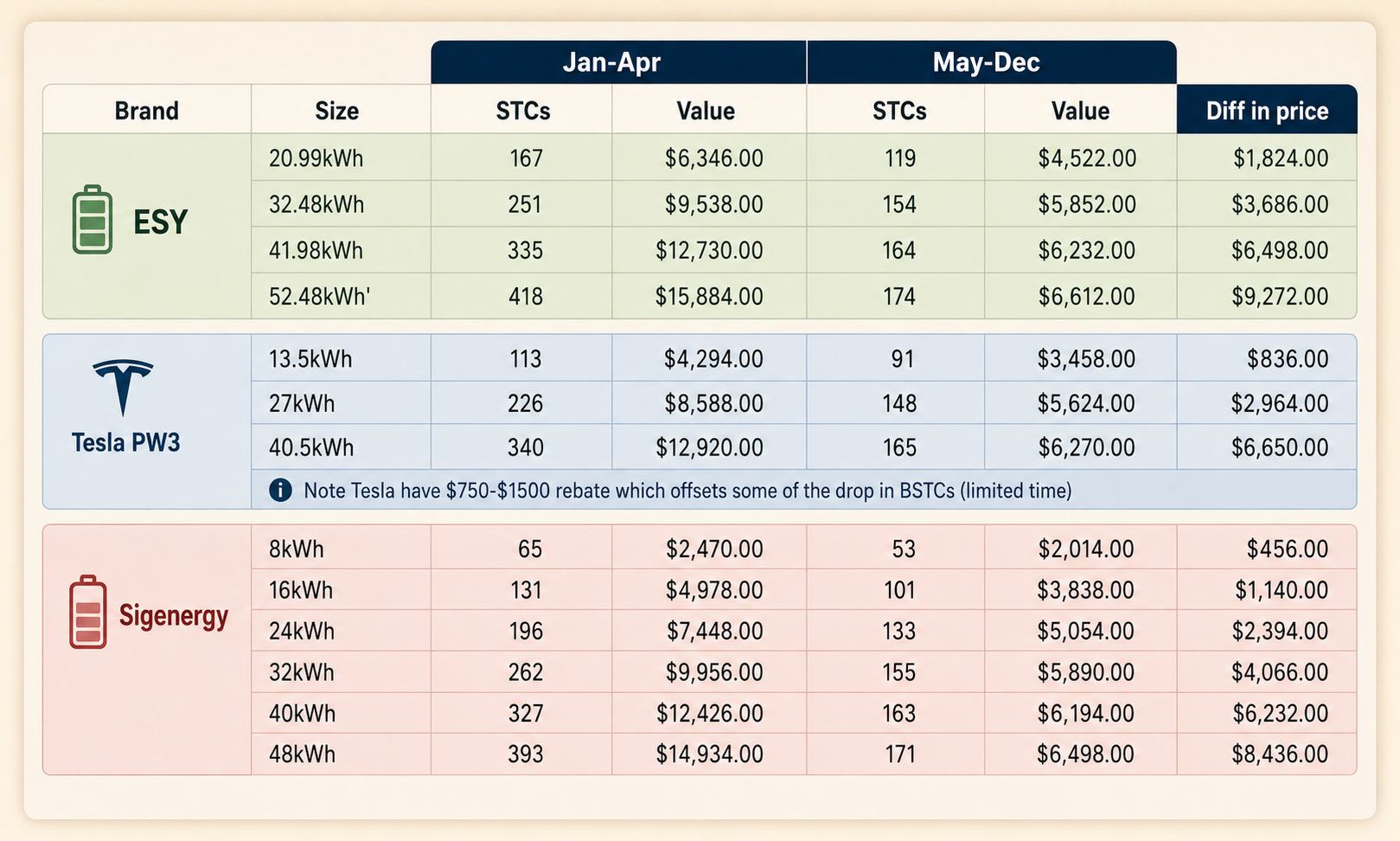
These figures are based on the current STC market price, which fluctuates. Your installer will confirm the actual rebate amount at the time of quoting.
If You Are in NSW: The VPP Incentive Can Stack on Top of the Battery Rebate
New South Wales residents have access to a separate state-level incentive through the NSW Virtual Power Plant (VPP) Incentive, administered under the Peak Demand Reduction Scheme. This is unaffected by the May federal changes.
When you connect a compatible battery to a VPP — a network of household batteries that can collectively supply energy to the grid during peak periods — you become eligible for an incentive payment worth up to around $1,500, depending on your battery size and the VPP provider you choose.
Participating providers include Globird, AGL, Amber, EnergyAustralia, Origin, and others. The incentive amount varies by provider and battery capacity, so it is worth comparing options before signing up.
Batteries must be between 2 and 28 kWh usable capacity to be eligible. The incentive is explicitly stackable with the federal rebate, meaning you can receive both. Claiming works in three steps: choosing a participating VPP provider, signing their contract and nomination form, and completing an online form during the cooling-off period to receive the payment.
The NSW VPP Incentive is separate from anything the federal government offers. If your battery was installed after June 2025, you are eligible to apply — the earlier version of the incentive (November 2024 to June 2025) cannot be claimed again, but the current version has no link to the federal May changes.
Who Is Eligible for the Federal Rebate
The federal Cheaper Home Batteries Program has no means test and no application process for the homeowner. Eligibility applies to:
- Homeowners, small businesses, and community facilities.
- Batteries that appear on the Clean Energy Council’s approved product list.
- Systems installed by a Clean Energy Council-accredited installer.
- Batteries with a usable capacity of 5 to 100 kWh.
- On-grid batteries that are VPP-capable at the time of installation (though enrolment in a VPP is not required).
- One battery per electricity meter (NMI).
The battery must be paired with a solar PV system — either a new system installed at the same time or an existing one already on your roof.
The discount reaches you through your installer. Your accredited installer claims the STCs on your behalf and applies the value as an upfront reduction on your invoice. You do not see the certificates or deal with the market — the rebate appears as a line item that reduces what you owe at the point of purchase.
What If You Were Caught in the Solar Battery Rebate Transition?
A number of homeowners had contracts or deposits in place before 1 May but whose systems were not commissioned by 30 April. The critical date for rebate assessment is commissioning, not when the contract was signed or deposit paid.
If your system was delayed past the cutoff, you receive the post-May rebate rate rather than the pre-May one. Supply shortages of certain battery brands were a contributing factor in many late completions, and some installers requested additional payments to cover the rebate shortfall.
A fixed-price contract generally holds regardless of timing delays, unless the contract includes a specific variation clause that accounts for scheme changes. If an installer has asked you to pay more than your original agreed price, it is worth reviewing your contract terms and, if needed, seeking advice from your state’s consumer protection agency.
Is It Still Worth Installing a Battery Now?
If the May drop has taught us anything, it is that rebate values do not stand still, and waiting rarely works in a homeowner’s favour. What matters is whether the rebate, combined with falling battery prices and rising grid costs, still produces a reasonable outcome for your household. Solar Choice estimates annual bill savings of $700 to $1,500 depending on usage patterns and location, and with the STC factor continuing to decline every six months through to 2030, installing sooner locks in more value than waiting.
A Note on Installation Quality
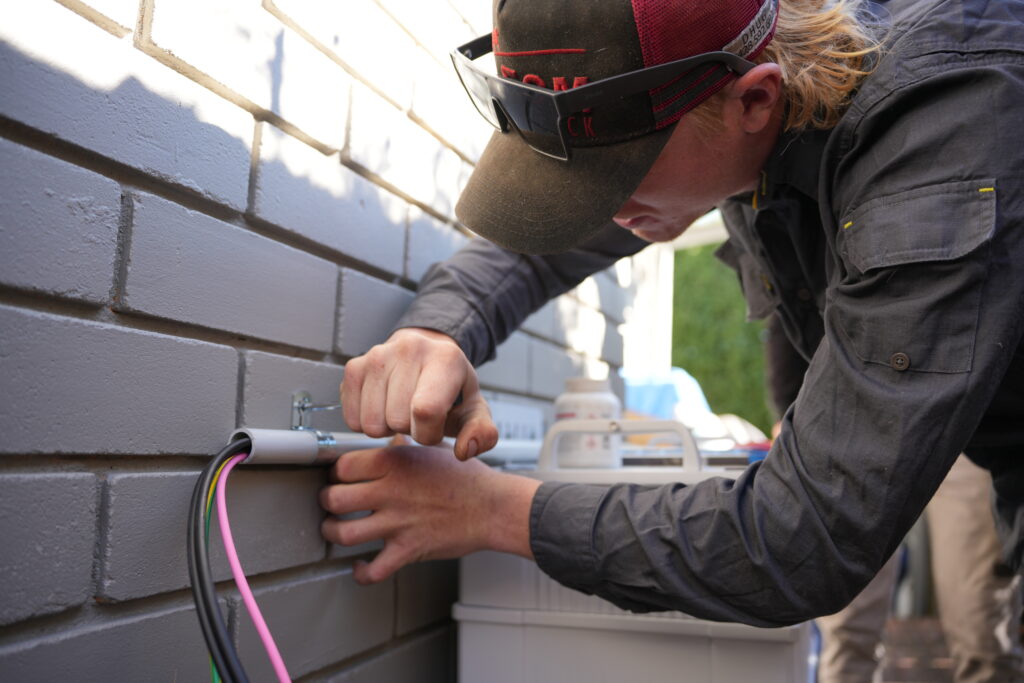
The Clean Energy Regulator inspected 1,278 solar battery installations following the initial rush and found that over 60% had workmanship issues, primarily with labelling. While most were not classified as unsafe, the finding is a reminder that the quality of the installation matters as much as the quality of the equipment.
Choose an accredited installer, ask for references, and verify the installer is accredited by Solar Accreditation Australia (SAA). Regulator warnings about substandard work have increased since the program launch, and the discount on your battery is worth nothing if the system is not installed correctly. For a comprehensive breakdown of these findings read more here.
Talk to Lenergy About Your Situation
Every household arrives at this decision from a different starting point. Whether you already have solar and are adding a battery, or you are considering a full system from scratch, the right setup depends on how you use energy and what you are trying to achieve.
The Lenergy team works with Australian homeowners to find systems that make sense for their actual situation, not just the best outcome on paper. If you would like to understand what the current rebate means for your home, and whether the economics stack up for where you are, reach out to the team at lenergy.com.au to start the conversation.

Frequently Asked Questions
Has the solar battery rebate ended? No. The federal Cheaper Home Batteries Program is still active and running through to 2030. The rebate dropped in value on 1 May 2026, but it remains open to eligible homeowners, small businesses, and community facilities.
How much is the rebate worth now for a typical home battery? For a 10 kWh battery, the rebate is approximately $2,520 off the upfront cost. For a 14 kWh battery, it is approximately $3,528. These figures are based on the current STC market price and will vary slightly at the time of installation.
What if my battery was installed after 30 April 2026? If your system was commissioned on or after 1 May 2026, it is assessed under the post-May rebate structure. The commissioning date is the relevant date, not when you signed the contract or paid a deposit.
Can I claim both the federal rebate and a NSW state incentive? Yes. The NSW Virtual Power Plant Incentive is explicitly stackable with the federal Cheaper Home Batteries Program rebate. The NSW incentive is worth up to approximately $1,500 depending on your battery size and VPP provider. Batteries must be between 2 and 28 kWh usable capacity to be eligible.
Do I need to apply for the federal rebate myself? No. Your accredited installer claims the STCs on your behalf and passes the value back to you as an upfront discount on your invoice. The rebate appears as a reduction in what you pay rather than a separate payment.
What battery size makes the most sense under the new rebate structure? The rebate is most generous for batteries up to 14 kWh, where the full STC factor applies. Between 14 and 28 kWh, the factor drops to 60%, and between 28 and 50 kWh it drops further to 15%. The right size for your household depends on your energy usage — the rebate structure is designed to align with typical residential needs rather than to incentivise oversizing.
Does the battery need to be connected to a VPP to be eligible for the federal rebate? No. On-grid batteries must be VPP-capable at the time of installation, but enrolment in a VPP is not required to receive the federal rebate. Connecting to a VPP is a separate step that unlocks the additional NSW state incentive if you are in New South Wales.
Will the rebate keep declining? Yes. The STC factor reduces every six months through to the end of 2030, when the program closes. The rate of decline is faster than it was under the original scheme design. Installing sooner locks in a higher rebate value, though falling battery hardware prices will partially offset the reduction over time.