60% of Solar Battery Installs Are Substandard: What the Numbers Actually Show and How to Make Sure Yours Is Not
A recent government audit has found that more than six in ten solar battery installations inspected in Australia have fallen short of the required standard. Some media coverage has run hard with that number, and on the surface it is easy to see why. The reality is more nuanced. There are genuine problems in how some systems are being installed, and they are worth understanding; however, there is also important context around what the numbers actually mean that tends to get lost in the headlines. Critically, the problems identified are almost entirely the result of poor workmanship rather than faulty products, which means they are preventable if you choose the right installer from the start.
In this article, you’ll learn:
- What the Clean Energy Regulator’s inspection data actually shows, including what “substandard” means in practice
- The specific installation faults that are showing up most often across the country
- What the risks are if these faults go undetected in your home
- How to vet an installer before you sign anything
- What to check after your system has been installed
- Where does the real risk in a solar battery installation come from, and how do you avoid it?
What Did the Clean Energy Regulator Actually Find?
The Clean Energy Regulator (CER) is the federal government body responsible for overseeing Australia’s renewable energy schemes, including the Small-scale Renewable Energy Scheme (SRES). As part of that role, it conducts physical inspections of solar battery installations across the country.
As of 20 March 2026, the CER had conducted 1,278 inspections of solar battery systems installed since 1 July 2025. Of those, 60.8% were rated substandard, meaning they had technical non-compliance issues but were considered safe to remain operating. A further 1.2% were rated unsafe and required immediate attention. Only 32.3% were rated adequate.
It is worth understanding what “substandard” means here. It does not mean the battery is about to catch fire or that the system is not generating value for the homeowner. It means the installation contains faults that do not meet Australian Standards or the CER’s inspection checklist, even if the system is currently functioning. These are faults that need to be rectified, and in some cases they create risks that are not immediately visible.
Importantly, the CER found no issues with the battery products themselves. Every fault identified came down to installation practices and workmanship, not the technology being installed.
Over 266,000 solar batteries have been installed nationally since July 2025, representing 7.7 GWh of capacity. Much of this growth has been driven by the federal government’s Cheaper Home Batteries Program, which provides roughly a 30% discount on installed battery costs. Demand has outpaced the program’s original estimates by a significant margin, and the speed of rollout appears to have put pressure on installation quality.
What Faults Are Coming Up Most Often?
The CER’s inspection checklist covers more than 90 items across Australian Standards, safety requirements, and installation guidelines. When inspectors reviewed over 70,000 individual checklist items across inspected systems, 93.1% complied, 5.5% needed improvement, and 1.4% required rectification. The catch is that even a small percentage of non-compliant items across a 90-plus point checklist is enough to push a whole system into the substandard category.
The most common issues fall into two broad categories.
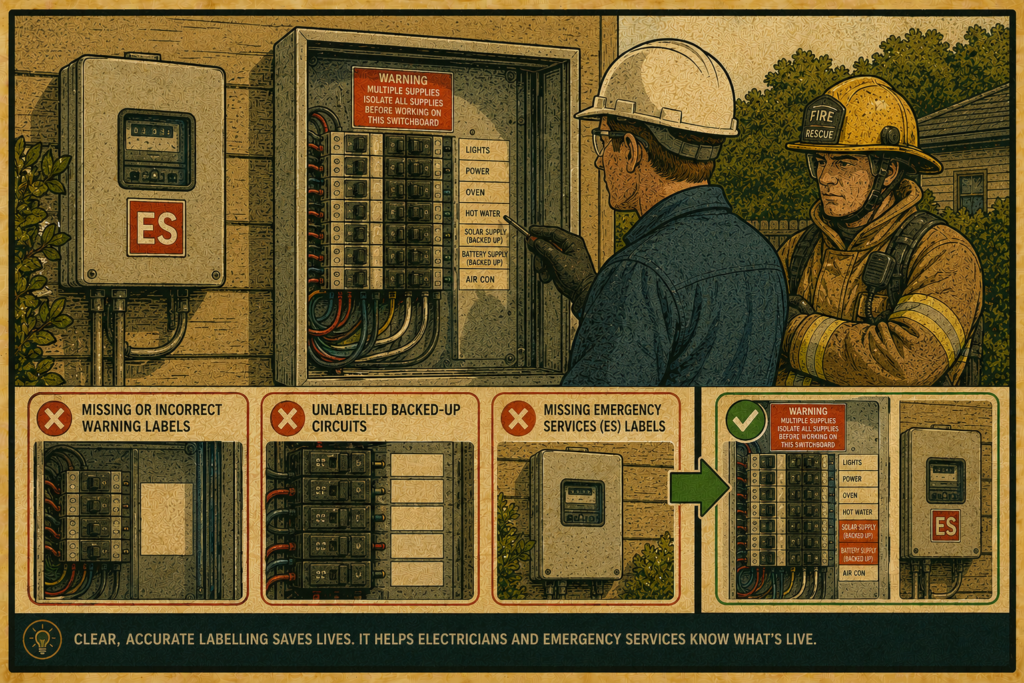
The first is labelling. Missing or incorrect warning labels at switchboards, unlabelled backed-up circuits that remain energised when the grid goes down, and missing emergency services (ES) labels on meter boxes are the most frequently cited problems. These might sound like insignificant oversights, but they are not. An electrician carrying out future work on your switchboard, or a firefighter attending your home in an emergency, needs to know which circuits remain live when the grid is down. An incorrectly labelled system creates real risk for the people who interact with it later.
The second category covers wiring and electrical protections. This includes loose connections, incorrectly configured or missing residual current devices (RCDs), insufficient mechanical or fire protection, overcurrent protection issues, and failures to maintain neutral continuity. The unsafe-rated installations the CER identified involved loose wiring with signs of heat damage in pre-assembled systems, electrical work not meeting Australian Standards, and failure to maintain neutral continuity for circuits on alternative supply. These are the faults that carry genuine risk of electric shock or fire.
Queensland has recorded notably higher rates of substandard installs over other states, though the issue is not confined to any single region. All five states included in the audit data have been affected.
What Are the Risks If These Issues Are Not Fixed?
The CER’s classification of 60.8% of systems as “substandard but safe to operate” is an important distinction. These are not systems on the verge of failure. They are systems with compliance gaps that need to be addressed, and in most cases the installer is responsible for doing that. Those gaps matter and they need to be fixed, but they are a different category of problem from the 1.2% of systems rated outright unsafe.
From a safety perspective, loose wiring connections that show early signs of heat damage can deteriorate further. Incorrectly configured RCDs may fail to trip when a fault occurs. Backed-up circuits that are not clearly labelled create hazards for any tradesperson or emergency responder who works on the system in the future, often years after the installation is forgotten.
From a financial and legal perspective, there are several compounding risks. Rectification costs are the installer’s responsibility, however if problems surface later and are difficult to attribute clearly, the resolution is not always straightforward. Faults that are not rectified could affect the validity of your home insurance, impact the manufacturer’s warranty on the battery, and affect the property’s value at the point of sale. Small-scale Technology Certificates (STCs) issued for non-compliant installations could also be reviewed under CER compliance powers.
From a performance standpoint, a substandard installation may mean your system is not operating at its designed capacity, reducing the financial return you expected from the investment.

How to Vet an Installer Before You Commit to a Solar Battery
The CER’s Executive General Manager Carl Binning has said publicly that “unsafe and non-compliant work will be identified, and we won’t hesitate to use our compliance powers.” The regulator has already demonstrated this, permanently suspending at least one trading entity from the SRES scheme. However, the most effective protection is not relying on enforcement after the fact. It is choosing the right installer from the start.
Here is what to look for and ask before you sign anything.
- Verify the installer is accredited by Solar Accreditation Australia (SAA). SAA accreditation means the installer has met a minimum standard of training and agrees to operate under a code of conduct. You can check accreditation status directly on the SAA website.
- Ask to see photos of previous installations. A clean install, with enclosed cabling, properly labelled switchboards, and neat conduit runs, is visible evidence of workmanship. An installer who is proud of their work will show you.
- Confirm that the battery product being installed is on the CEC-approved products list. This list is maintained by the Clean Energy Council and is a baseline requirement for STCs to be claimed.
- Get more than one quote, and treat any quote that is substantially cheaper than the others as a signal worth investigating rather than a bargain. The rapid growth in installations has unfortunately attracted operators who are chasing the rebate rather than building a legitimate business.
What to Check After Your Solar Battery Has Been Installed
Even with a reputable installer, it is worth knowing what a properly completed installation should include. The CER introduced mandatory photo requirements from 1 March 2026, requiring installers to submit geotagged, timestamped photos of mandatory labels as part of their claim. This is a layer of accountability, but the homeowner still benefits from knowing what to look for at handover.
At the point of handover, check that all labels are in place on your switchboard, meter box, and backed-up circuits. The labels should clearly identify which circuits remain energised when the grid is offline. Ask your installer to walk you through this before they leave.
Check the cable runs. Cables should be enclosed in conduit or metal ducting, not run loose along walls or through roof spaces without protection. Exposed cabling is both a fire risk and an indicator of workmanship quality.
Ask for your handover documentation, which should include the certificate of electrical compliance, the battery manufacturer’s warranty document, and any system monitoring login details. If your installer is reluctant to provide these, that is a problem worth addressing before the job is signed off.
If you have concerns about an existing installation, the CER’s Solar Battery Inspections Checklist is publicly available and gives you a clear picture of what an adequate installation looks like.
Where Does the Real Risk in a Solar Battery Installation Come From, and How Do You Avoid It?
The audit findings have been picked up by some media outlets as evidence that home batteries are a risky proposition. However, what the data shows is that homeowners need to be smart about how they choose their installer, not that the investment itself is flawed.
The CER is working with Solar Accreditation Australia (SAA) on installer education and is using its enforcement powers to remove non-compliant operators from the scheme. It has been a big year for the industry and it is under more scrutiny now than ever.
A home battery is a long-term asset, warrantied for ten years in most cases, and the installation quality on day one follows the system for its entire life. The CER’s findings are a reminder that the brand on the battery matters less than the hands that installed it. A properly accredited, quality-focused installer makes this a sound investment. Someone cutting corners on labelling, cable protection, or electrical safety makes it a liability. Whilst super cheap prices can be appealing up front the impact a low quality install can have is not worth the risk.
Speak to the Lenergy Team
Every home is different, and so is every installation. The right battery size, the right product, and the right approach to protecting your investment all depend on your specific situation, your existing solar setup, how your home uses power, and what you want to achieve.
The Lenergy team works with Australian homeowners and businesses to design and install solar, battery, and EV charging systems that are built to last. If you want to understand what a quality installation looks like, or if you have questions about an existing system, we’re happy to talk it through.
Reach out to the Lenergy team to start the conversation.

Frequently Asked Questions
What does “substandard” mean in the CER’s inspection results?
In the CER’s classification system, a substandard installation is one that has technical non-compliance issues but is considered safe to remain operating in the short term. The faults still need to be rectified by the installer, and they may create risks over time or in specific circumstances, such as when a tradesperson carries out future work on the system.
Are the batteries themselves the problem?
No. The CER’s inspection data found no issues with battery products. Every fault identified came from installation practices and workmanship. The batteries are performing as designed; the problems are in how they have been connected, protected, and labelled.
How many solar batteries have been installed in Australia since July 2025?
As of the CER’s March 2026 data, over 266,000 solar battery systems have been installed nationally since 1 July 2025, representing a combined capacity of 7.7 GWh. Much of this growth has been driven by the federal government’s Cheaper Home Batteries Program.
What are the most common installation faults?
The most common faults are labelling failures: missing or incorrect warning labels at switchboards, unlabelled backed-up circuits, and missing emergency services labels on meter boxes. The second most common category involves wiring and electrical protections, including incorrectly configured RCDs and insufficient mechanical or fire protection.
Can a substandard installation affect my home insurance or battery warranty?
It can. A non-compliant installation may affect the validity of your home insurance if a claim relates to the battery system, and could impact the manufacturer’s warranty depending on the specific terms. You should check the current version of your warranty documentation directly with the manufacturer, as terms vary and change over time.
What is Solar Accreditation Australia and why does it matter?
Solar Accreditation Australia (SAA) is the body responsible for accrediting solar and battery installers in Australia. SAA accreditation means the installer has met a minimum standard of training and agrees to operate under a code of conduct. Engaging an SAA-accredited installer is a baseline requirement for STCs to be claimed under the SRES, making it an essential credential to verify before you commit to anyone.
What should I receive at handover after a battery installation?
At minimum, you should receive a certificate of electrical compliance, the battery manufacturer’s warranty documentation, and system monitoring credentials. Your installer should also walk you through the labelling on your switchboard and explain which circuits remain energised when the grid is offline.