Which Way Should Solar Panels Face on an Australian Roof? A Guide to Getting Orientation Right
Ten years ago, the answer to which direction solar panels should face in Australia was simple: North. Today, with solar panels a fraction of the cost, feed-in tariffs too low to rely on, and batteries being a part of every new system, the goal has shifted from finding the perfect orientation to generating as much electricity as possible across your whole roof, within the limits of what your inverter can support. Here at Lenergy we want to make sure the system you get is right from the start as this will determine how much your system saves you for the next 25 years.
In this article, you’ll learn:
- Why self-consumption matters more than total output when it comes to reducing your bills
- How each solar panel direction affects generation throughout the day and which households each suits
- What tilt angle is right for your location and how much it actually matters
- How shading can silently destroy a system’s performance and what to do about it
- What your options are if your roof isn’t ideally oriented
- Whether the direction your solar panels face will meaningfully affect the value of solar for your situation
Why Covering Your Roof With Solar Panels Is Often the Best Starting Point
With current government rebates, solar panels account for only a small portion of the overall system cost. Because the price gap between small and large systems is minimal, it’s typically best to install the largest system your roof can handle as upgrading later costs more. With batteries now being included in almost every new system, whatever your solar panels generate gets used one way or another, so volume of generation matters most.
The practical limit on how many roof faces you can cover is your inverter. Most string inverters support two or more separate strings, and each string can face a different direction. The number of strings your inverter supports is the number of roof faces you can run simultaneously. More strings means more directions, which means more generation across the day. For a deeper breakdown read our article String Inverters vs Microinverters vs DC Optimisers.
The approach, then, is straightforward: prioritise North for your primary array, then add east, west, and south in that order as your roof space and inverter strings allow.
This Newcastle home has 23 AIKO 460W panels across four separate roof faces, totalling 10.58kW, paired with a 40kWh SigenStor battery.
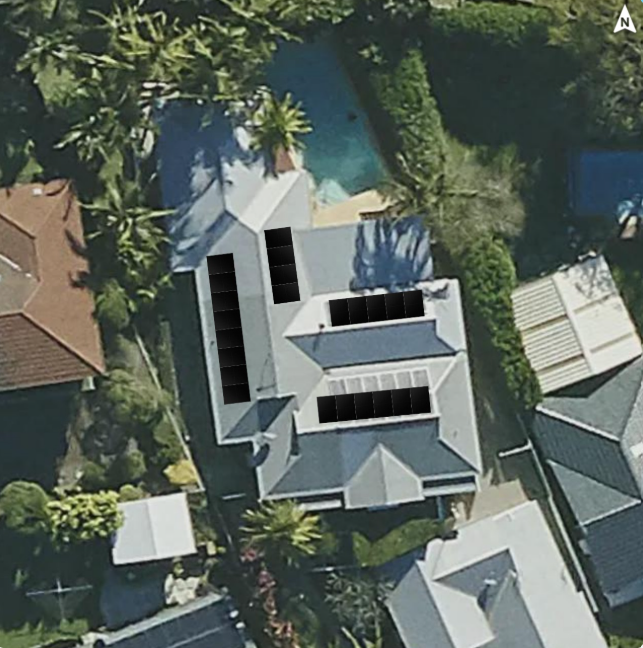
As you can see there are two arrays facing north, forming the backbone of the system and generating the strongest output through the middle of the day. The east-facing array picks up the morning sun, covering the household’s early demand before the north arrays hit their stride. The west-facing array extends generation into the afternoon, capturing energy that would otherwise be lost once the sun moves north. Each array runs on its own string, so no single roof face drags down the performance of the others. The battery stores whatever the household doesn’t use in the moment, meaning generation from every roof face gets used one way or another.
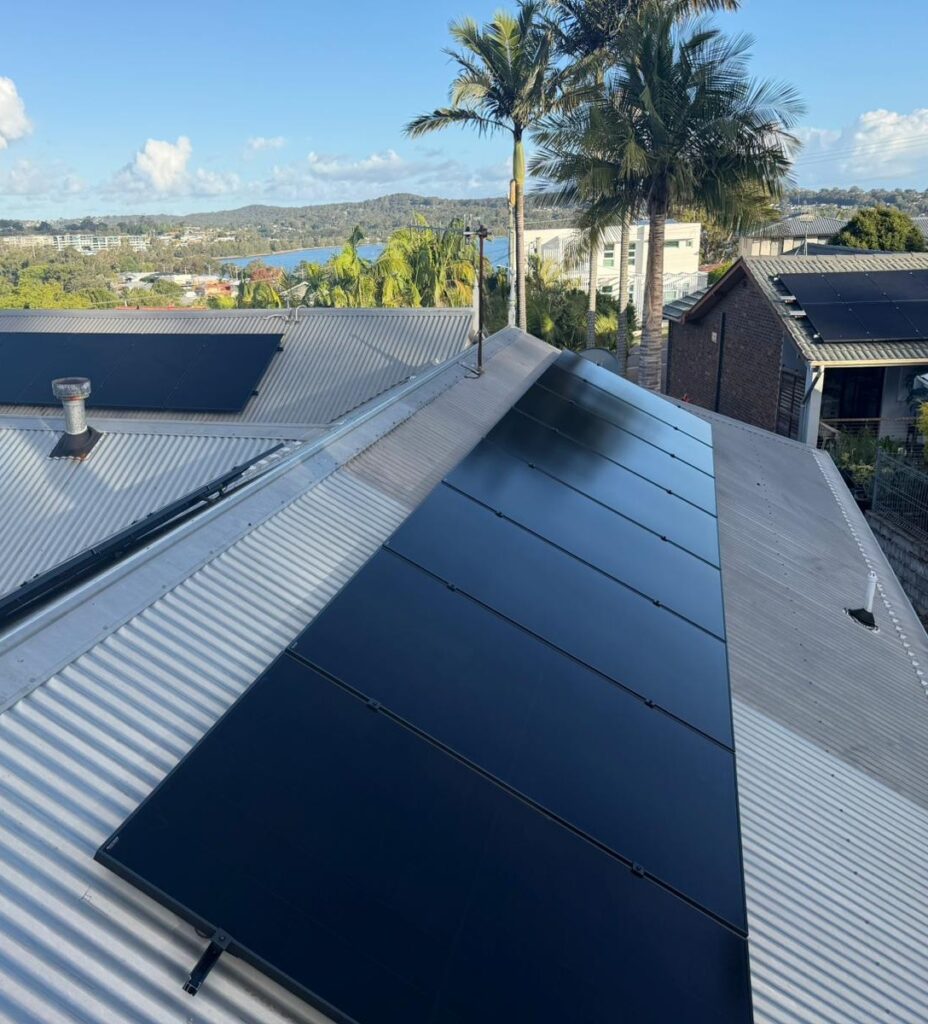
This system was recently installed by the Lenergy team and is a great example of how designing around every available roof face makes the difference between a system that reduces your bills and one that eliminates them.
Why Self-Consumption Now Drives the Direction Decision
In most Australian states, you’re now paid somewhere between 0 and 10 cents per kilowatt-hour for electricity you export to the grid, while paying 30 to 60 cents per kilowatt-hour to import it. Every unit of solar power your household uses directly is worth three to four times more than the same unit sent to the grid.
Self-consumption is the proportion of your solar generation that your household uses directly. The higher it is, the more retail-priced grid electricity you’re replacing with power that costs you nothing to generate. Solar panel direction affects self-consumption because different orientations produce electricity at different times of day, and how well that timing matches your usage patterns determines how much of your own generation you capture.
This is why the direction question doesn’t have a single right answer. It depends on when your household uses energy, what your inverter can handle, and how much roof space you have to work with.
Which Direction Should Your Solar Panels Face?
Here is how each orientation performs and which households it suits best.
North produces the most electricity overall. Output is strongest through the middle of the day and suits households where someone is home during those hours. With a battery, North is almost always the right choice for your primary array, the battery handles the timing, so orientation can focus on volume.
Northeast and Northwest each produce around 5 percent less than North. Their output sits between North and the respective East or West direction, slightly more morning-weighted for Northeast, slightly more afternoon-weighted for Northwest. Both are strong performers for a primary or secondary array.
East produces around 15 percent less than North overall, with stronger output in the morning. It suits households with higher morning energy use such as; early risers, households that run heating on winter mornings, or people who leave the house by midday.
West also produces around 15 percent less than North overall, but peaks roughly one to one and a half hours after noon. West suits households with high afternoon and evening demand, particularly those running air conditioning through summer afternoons. In some states, variable feed-in tariffs pay a higher rate for electricity exported in the late afternoon, which can make a west-facing array more valuable on certain retail plans.
East-west split produces around 15 percent less total electricity than an all-north array, but delivers a flatter and more consistent output curve across the day. The steeper the roof, the smoother that output becomes. It suits households where consumption is spread across both the morning and afternoon, or where the North face is limited or already full.
South is the least productive orientation and should be used last, once all other roof faces are accounted for. In Sydney, south-facing solar panels produce around 30 percent less energy than North-facing ones. Further North the gap narrows — in Darwin and Townsville, south-facing solar panels produce only around 15 to 17 percent less, and their higher summer output can actually improve self-consumption in households with strong summer air conditioning demand. South solar panels are worth including when your roof has the space and your inverter has the strings to support them.
What Tilt Angle Is Right for Your Location?
Tilt angle affects how much of the sun’s energy your solar panels capture across the year. The standard starting point is to match your tilt to your location’s latitude, which angles panels perpendicular to the sun’s average position and balances output across all seasons.
Using PVWatts, the National Renewable Energy Laboratory’s solar modelling tool, the figures for Australia’s capital cities are:
- Sydney (latitude ~34°): optimal tilt approximately 31°
- Melbourne (latitude ~38°): optimal tilt approximately 32°
- Brisbane (latitude ~27°): optimal tilt approximately 24°
- Perth (latitude ~32°): optimal tilt approximately 28°
- Adelaide (latitude ~35°): optimal tilt approximately 29°
- Canberra (latitude ~35°): optimal tilt approximately 30°
- Hobart (latitude ~43°): optimal tilt approximately 37°
- Darwin (latitude ~12°): optimal tilt approximately 18°
These figures sit a few degrees below each city’s latitude. Australian summers have longer daylight hours than winters, so a slightly shallower tilt captures more of that extended summer sunlight. Darwin is the exception — its wet season cloud cover means a steeper tilt better captures the clearer dry season sun.
Most Australian roofs sit between 20 and 30 degrees of pitch, which is close enough to the optimal range for most cities. Where tilt matters more is at the extremes. A flat roof in Melbourne at zero tilt generates only around 86 percent of its theoretical optimum. If your roof is very flat, a tilt frame angling panels to around 10 degrees is worth considering, it also helps rain wash dust and debris off naturally.
Tilt frames on standard pitched roofs are rarely worth the cost. The performance gain is too small to justify the expense. That money is almost always better spent on an extra panel or two. Also they are often not the most aesthetically pleasing.

How Shading Silently Destroys Solar Output
Shading is the most common cause of underperformance in residential solar, and its impact is far worse than most people expect.
In a standard solar array, panels are wired together in a series string and share a single inverter. Every panel in the string operates at the current level of the weakest panel. When one panel is partially shaded, the entire string is throttled down to match it, like a partial blockage in a water pipe that restricts flow through the whole pipe, not just past the blockage. Research from Renewable Energy and Efficient Electric Power Systems, a widely referenced solar engineering textbook, found that shading just one cell out of 36 in a single panel can reduce that panel’s output by up to 75 percent.
Aurora Solar’s analysis of shading losses in PV systems puts real numbers on this. Modelling a 3.12kW system near tall trees, a standard string inverter produced 2,585 kWh per year. The same system fitted with microinverters or DC power optimisers produced 3,033 kWh per year, a 17.3 percent improvement from addressing shading alone, without changing a single panel.
The better response to shading is to avoid it in the first place. A shading analysis during system design; covering trees, neighbouring buildings, chimneys, and roof features at different times of day plus across all seasons; should be part of every site assessment. SunSPOT, developed by UNSW for the Australian Photovoltaic Institute with Australian Government support, offers a free tool for assessing your roof’s solar potential, including LiDAR-based shading analysis in areas where council data is available.
Ask your installer for a shading analysis that covers the winter solstice. The sun sits lower in winter and shadows fall longer and in different directions than they do in summer. A roof that looks clear in November can have significant shading issues in June.
Also think ahead with vegetation. A tree that casts no shadow today may be a real problem in five years. Factor in how nearby trees will grow across the life of the system, not just what’s there on the day of the site visit. Below is an example of one of our clients Andrew who was able significantly increase his systems output by merely trimming back the surrounding vegetation.
Where shading is unavoidable, grouping shaded panels onto their own separate string prevents them dragging down unshaded panels. Where that’s not possible, microinverters or DC power optimisers decouple each panel from the rest of the array so a shaded panel affects only itself.
What If Your Roof Isn’t Ideally Oriented?
A non-ideal roof doesn’t mean solar isn’t worth it. It means the system needs to be designed around what your roof can actually offer.
The first step is understanding your roof’s condition. Age, material, and structural integrity all affect what’s possible. Corrugated steel is the most straightforward to work with. Tiled roofs require more care around penetrations. Roofs approaching the end of their life are worth repairing before solar goes on as removing and reinstalling a system to replace a roof underneath costs far more than doing the roof work first. Our recent blog, Whether your home is ready for solar panels covers this in detail.
Warning: To those galvanized roofs it is never possible to install solar panels on your roof as when it rains, the aluminium in the panels reacts with the galvanized roof causing rust. For some a ground mount is a potential alternative.
There are also physical constraints on where solar panels can go. Australian wind loading standards require at least a 20cm buffer from roof edges, because wind speeds are highest around the perimeter. Australia has four wind zones from A to D, with Zone D covering cyclone-prone areas of Western Australia. In higher wind zones, more roof attachment points are required per panel, which affects layout and cost.
Airflow under the panels matters too. Solar panels lose efficiency as they heat up, typically 0.3 to 0.5 percent for every degree above 25°C. Good clearance underneath keeps panels cooler and running more efficiently, particularly in hotter parts of the country.
If your roof presents constraints that can’t be designed around, such as wrong orientation with no workaround, heavy shading, or structural issues, a ground-mounted system is worth looking at. A ground mount can be positioned precisely for true North at the optimal tilt, unconstrained by your roof. Ground-mounted systems typically produce 10 to 25 percent more energy than an equivalent roof-mounted system, due to better orientation, improved airflow, and easier access for cleaning. The trade-off is higher upfront cost and land use. Rooftop vs ground mount solar covers the full comparison.
Does Direction Matter More in Cooler or Cloudier Parts of Australia?
For homeowners in Victoria, Tasmania, the ACT, and parts of regional New South Wales, orientation actually matters more than it does in sunnier parts of the country, because there’s less margin to absorb losses from a poorly positioned system when there are fewer peak sun hours to begin with. How solar panels perform in cloudy or cooler climates covers this in more detail.
Talk to Lenergy About Your Roof and System Design
The fundamentals apply everywhere in Australia. North first, fill the rest of your roof as your inverter allows, avoid shading wherever possible. However, every roof is different. The right system design depends on your specific orientation, pitch, shading profile, roof condition, and how your household uses energy. A system built around your actual site will produce more, pay back sooner, and hold up better over time than one sized from a generic template.
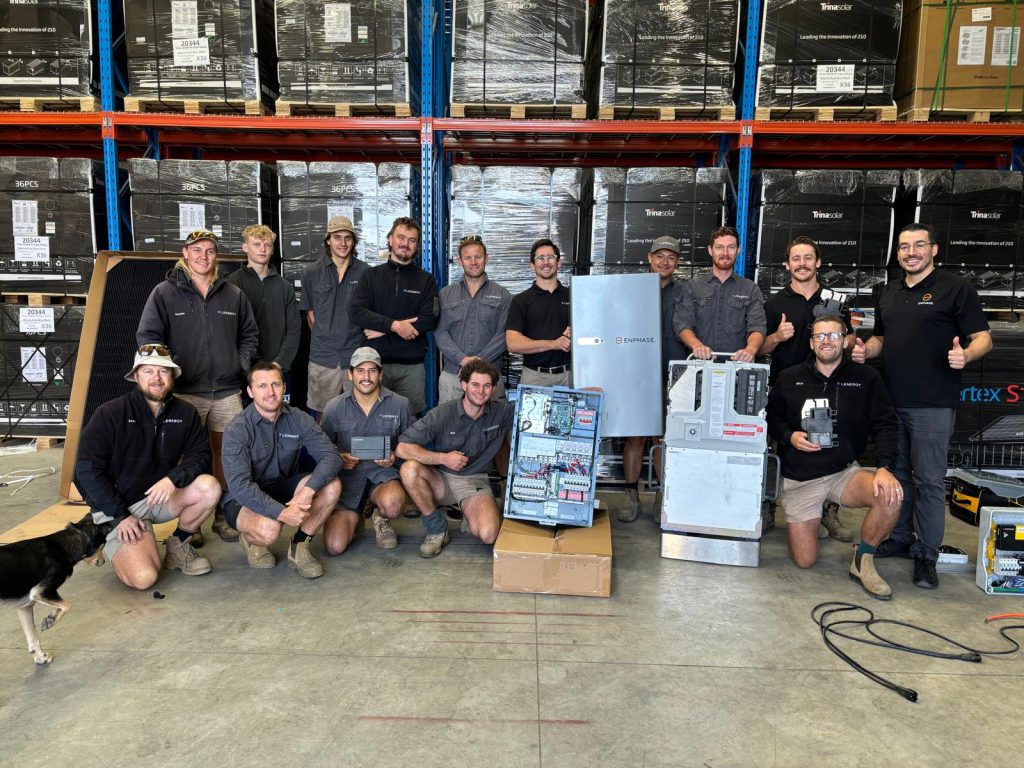
The Lenergy team works with Australian homeowners to assess their roof and design systems around real-world conditions. If you’re working through whether your home is a good candidate for solar, or want to understand what a well-designed system could deliver for your specific situation, reach out to the Lenergy team and start the conversation.
Frequently Asked Questions
Does my roof have to face North for solar to be worth it? No. North-facing is optimal in Australia, but Northeast and Northwest orientations perform at 92 to 97 percent of North-facing output. East and West-facing solar panels produce around 85 percent of North-facing output and suit specific household usage patterns well. With a battery and enough panels, most roofs can deliver strong results regardless of their primary orientation.
What tilt angle should my solar panels be at in Australia? A tilt roughly equal to your location’s latitude is a reliable starting point for balanced year-round output. The precise optimal tilt is typically a few degrees below latitude in most Australian cities, but the performance difference is small. Most Australian roof pitches fall close enough to the optimal range that tilt frames are rarely worth the added cost on rooftop installations.
How much does shading affect solar output? More than most people expect. In a standard string-wired array, partial shading on a single cell can reduce output across the whole string, not just the affected panel. A shading analysis during system design is essential. Where shading is unavoidable, microinverters or DC power optimisers allow each panel to operate independently and can recover a significant portion of lost generation.
Can I put solar panels on multiple roof faces? Yes, and for most homes it’s worth doing. Each roof face runs on a separate string of your inverter. The number of strings your inverter supports determines how many directions you can cover simultaneously. Microinverters remove this constraint entirely by making every panel independent.
What is an east-west split and when does it make sense? An East-west split places solar panels on both the east and west faces of your roof. It produces around 15 percent less total electricity than an all-north array but delivers a more consistent output across the day. It suits households with morning and afternoon consumption, and is a practical option when the North face is limited.
What is a ground-mounted solar system and when does it make sense? A ground-mounted system is installed on a frame on your property rather than your roof. It can be positioned for optimal North-facing output at the right tilt angle and typically produces 10 to 25 percent more energy than an equivalent roof-mounted system. It suits rural properties or homes where the roof is unsuitable due to orientation, shading, or structural issues.
How do I know if shading will be a problem for my roof? A site assessment from a qualified installer should include a shading analysis across different times of day and seasons. SunSPOT provides free online roof assessment and shading analysis using satellite and, in some areas, LiDAR data. Also consider how nearby trees will grow over the life of the system, not just their current height.
Does the direction my solar panels face matter more in southern Australia? Yes. In areas with less consistent sunshine, there’s less margin to absorb losses from poor orientation or shading.