How Much Does Shade Affect Solar Panels?
If there’s a tree near your roof, a chimney, or a neighbouring building that catches the afternoon sun, it’s reasonable to wonder whether this shade could undermine the value of investing in a solar system. The good news is that shading doesn’t have to be a dealbreaker. Factored in properly during the design process, most shading problems can be managed effectively. Left unaddressed, the same shading can cause solar panels to quietly underdeliver for the next 25 years.
In this article, you’ll learn:
- Why shading causes disproportionately large losses in a solar system
- The different types of shading and which ones cause the most damage
- How shading affects panels physically over time, not just electrically
- What technology options exist to protect your system’s output when shading can’t be avoided
- How to assess whether shading is a problem for your roof before you commit to a design
- Whether shading on your property is a reason to reconsider solar or simply a design challenge to solve
Why Does Shade Have Such a Big Impact on Solar Panels Output?
To understand why shading can be a problem, you need to know a little about how solar panels are wired together. Panels in a standard array are connected in a series string, which means the electrical current flows through each panel in sequence before reaching the inverter. The current through that entire string is limited by the weakest panel in it, the one receiving the least sunlight.
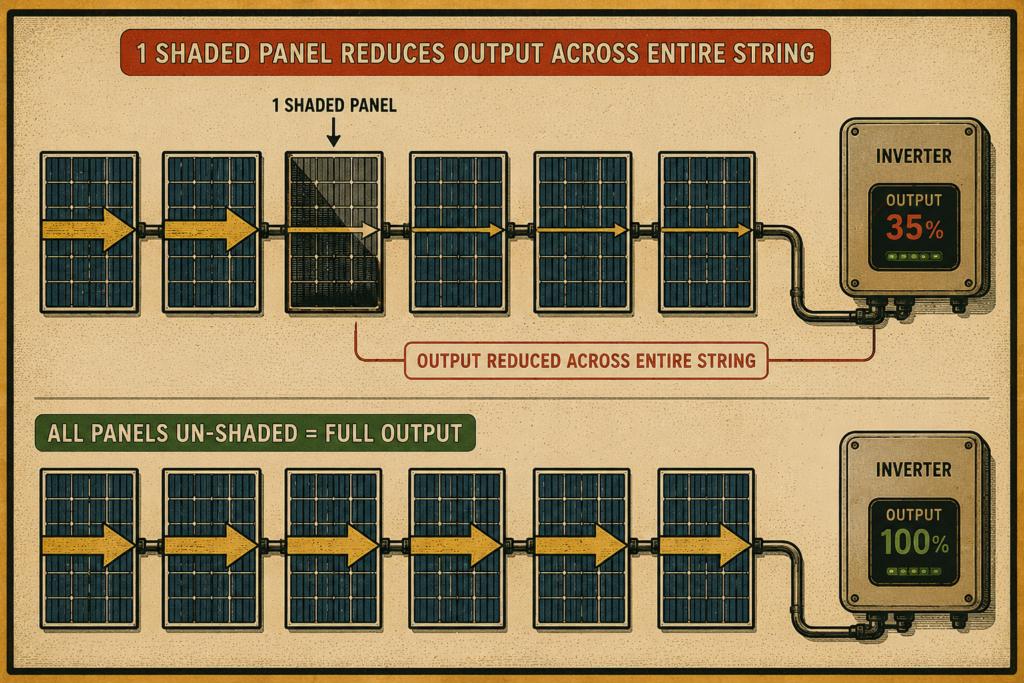
Think of it like a pipe carrying water. If you partially block the pipe at any single point, the flow through the entire pipe drops to match the blockage, not just the section past it. A shadow on one panel doesn’t just reduce that panel’s output. It reduces the output of every panel connected to the same string.
It gets worse at the cell level. A standard solar panel contains multiple cells wired together in the same way. Research from Renewable Energy and Efficient Electric Power Systems, a widely referenced solar engineering textbook, found that shading just one cell out of 36 in a single panel can reduce that panel’s output by up to 75 percent. In a string-wired system, that drag extends across the whole array.
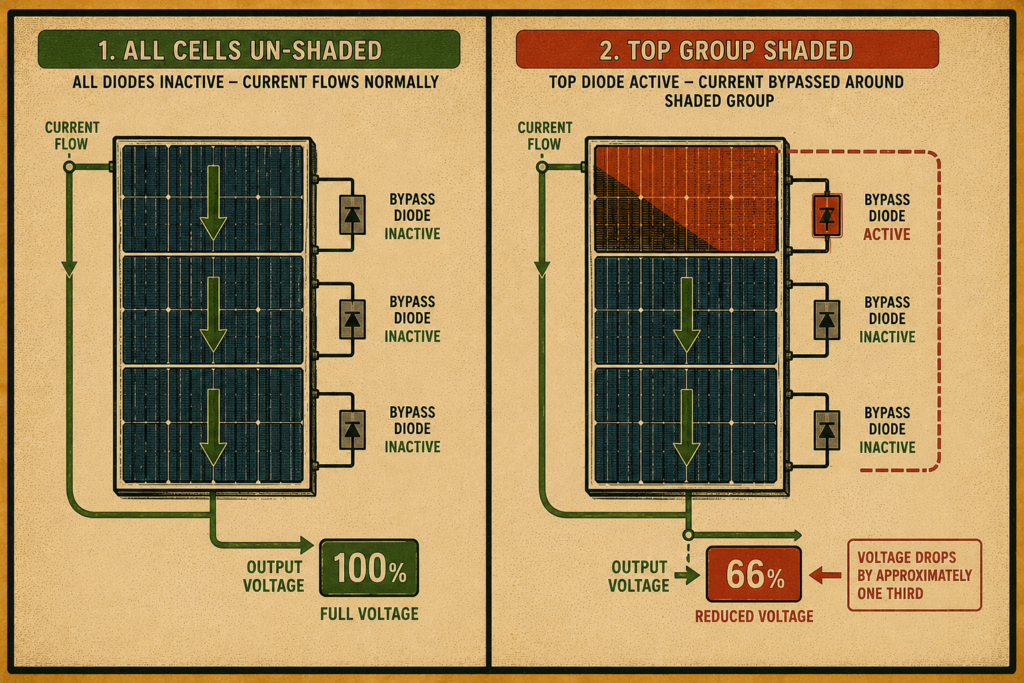
Modern panels include bypass diodes, typically three per panel, that help manage this problem. When a cell group is shaded, its bypass diode activates and routes current around it, preventing the shaded cells from bottlenecking the whole string. The trade-off is that the bypassed cell group stops contributing to output entirely, and the panel’s voltage drops by roughly a third for each diode that activates. It limits the damage, but it doesn’t eliminate it.
What Are the Different Types of Shading and Which Ones Cause the Most Damage?
Not all shading is equal. The source, duration, and intensity of shade all affect how much damage it does to your system’s output, and understanding the difference helps you know what to look for on your own property.
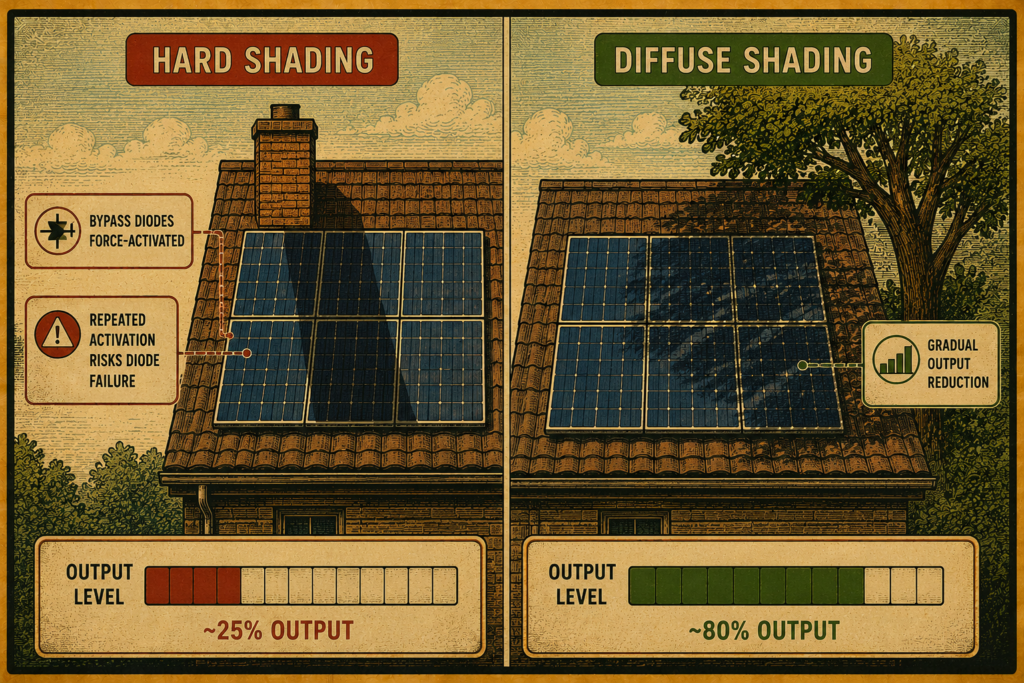
Hard shading comes from fixed, opaque objects like chimneys, evaporative coolers, neighbouring buildings, or raised roof features. It blocks sunlight completely and forces bypass diodes to activate. This type of shading tends to affect the same cells at the same time every day, which creates a problem beyond just lost output. Bypass diodes were designed to activate occasionally, not continuously. When a fixed obstruction forces a diode to work every sunny day, the heat generated by that repeated activation eventually causes the diode to fail. A failed diode can go one of two ways: it either causes a permanent partial loss of output from that cell group, or it short-circuits and creates a hotspot that poses a fire risk. In severe cases, sustained hard shading can void the panel manufacturer’s warranty entirely.
Diffuse shading comes from sources like tree branches, leaves, or light cloud cover. It reduces the amount of light reaching the cells without necessarily triggering bypass diodes, which means the losses are more gradual and spread across the panel rather than concentrated. It is generally less damaging than hard shading, but it still adds up over time, particularly in Australia where the irradiance lost to shading represents real generation that can’t be recovered.
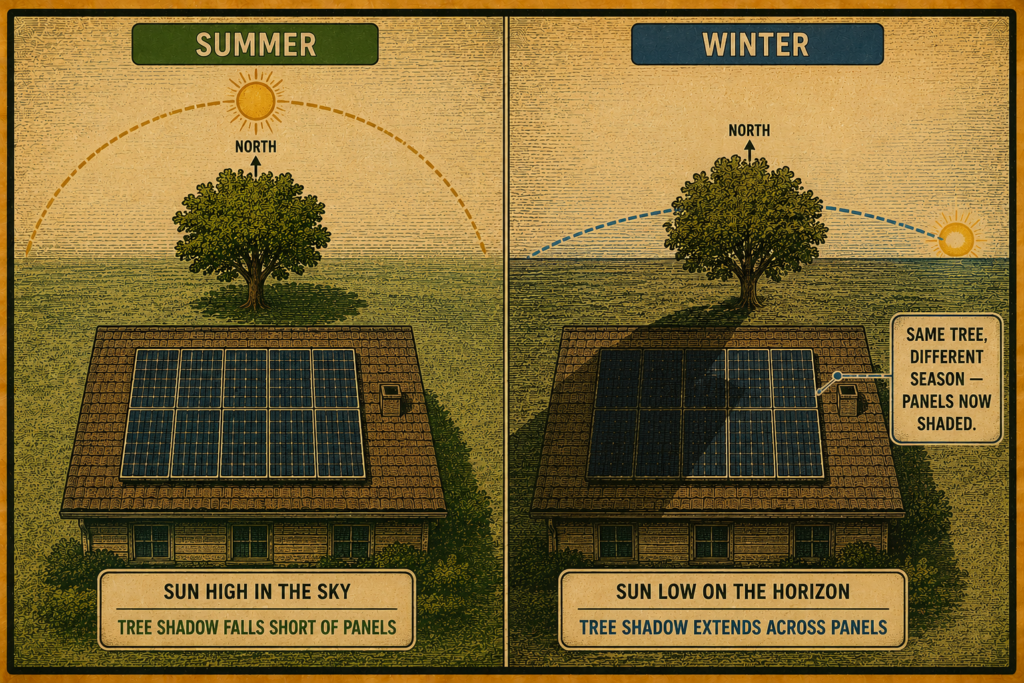
Seasonal shading is one of the most commonly overlooked problems at the design stage. The sun’s arc across the sky changes substantially between summer and winter. A tree or neighbouring roofline that casts no shadow on your panels in December may shade them heavily during winter mornings or afternoons when the sun sits lower in July. This type of shading is invisible during a summer site visit and requires deliberate analysis across the full year to identify.
Temporary shading from bird droppings, dust, leaves, or debris has a similar obstructive effect to hard shading at the cell level, however it can be addressed through regular cleaning. It’s worth factoring into your maintenance expectations, particularly in areas with high dust, coastal grime, or heavy tree cover.
How Much Output Can Shading Actually Cost You?
The figures are more confronting than most people expect. A shadow covering a hand-sized area of a single panel can reduce that panel’s output by 30 to 75 percent, depending on where it falls and how the panel’s bypass diodes respond. At the system level, shading-affected residential installations commonly see annual output reductions of 5 to 25 percent compared to what the same system would produce without shading.
The financial impact compounds across the life of the system. A 10 percent reduction in annual output on a well-sized residential system doesn’t sound catastrophic in isolation, however across 25 years it represents a significant amount of generation that never happened and savings that were never realised. In Australia, where solar irradiance is high and the gap between what you pay to import power and what you’re paid to export it continues to widen, every percentage point of lost output has real dollar value attached to it.
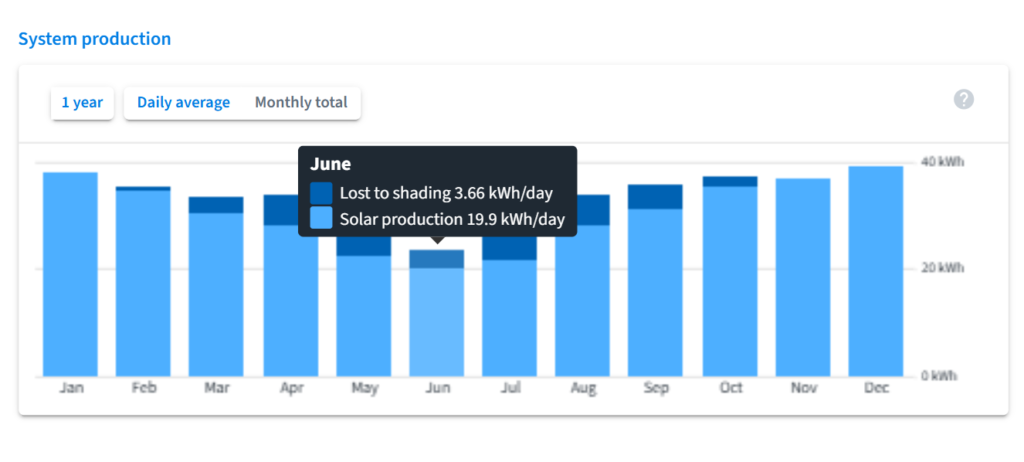
The chart below shows the estimated annual production from a real Lenergy client design. The homeowner came to us concerned that their existing solar system had stopped functioning properly, and after assessment we identified that a large tree to the west of the property had grown significantly since the original installation and was now casting shade across the array. This data was modelled using Pylon, the shading analysis software our team uses during system design, with the array positioned on the north-east face of the roof. To mitigate the impact of the shading, the system was oversized so that even with the losses accounted for, the household’s energy needs are still met. The dark blue section of each bar represents generation lost to shading each day, while the light blue section shows actual solar production reaching the inverter. In May, the system loses 3.66 kWh per day to shading against a production figure of 19.9 kWh per day, with the winter months showing the greatest losses as the lower sun angle extends the tree’s shadow further across the array. This is exactly the kind of analysis that turns a shading problem from something invisible into something you can design around.
If you want to see real data on how shading would affect a system designed for your property, reach out to the Lenergy team and we can model it for you.
What Technology Options Exist When Shading Can’t Be Avoided?
The first and best response to shading is to design around it. A thorough site assessment that models shade across different times of day and across all seasons should be a standard part of any installation process. Most professional installers will use their own shading software, such as Pylon, to model exactly how shade will affect the specific system they are designing for your roof. SunSPOT, developed by UNSW for the Australian Photovoltaic Institute with Australian Government support, also offers a free tool for assessing your roof’s solar potential including shading analysis if you want to do some initial investigation yourself. Where trees are the problem, trimming or removing the offending vegetation before installation is always preferable to managing the consequences after the fact.
When shading genuinely can’t be avoided, the design needs to account for it. The first step is grouping shaded panels onto their own separate string so they don’t drag down the output of unshaded panels connected to the same inverter. This won’t recover the lost output from the shaded panels themselves, but it protects the rest of the array from being affected.
Where that’s not sufficient, module-level power electronics are the solution. These are devices that attach to individual panels and allow each one to operate independently of the others, effectively eliminating the string bottleneck problem entirely.
Power optimisers, made by companies including SolarEdge and Tigo, attach to each panel and continuously adjust its output to maximise what that individual panel can produce regardless of what the panels around it are doing. They feed into a central string inverter, which keeps the overall system cost lower than a fully distributed approach. For most homes dealing with partial or seasonal shading, power optimisers recover the majority of lost generation at a cost that makes financial sense across the life of the system.
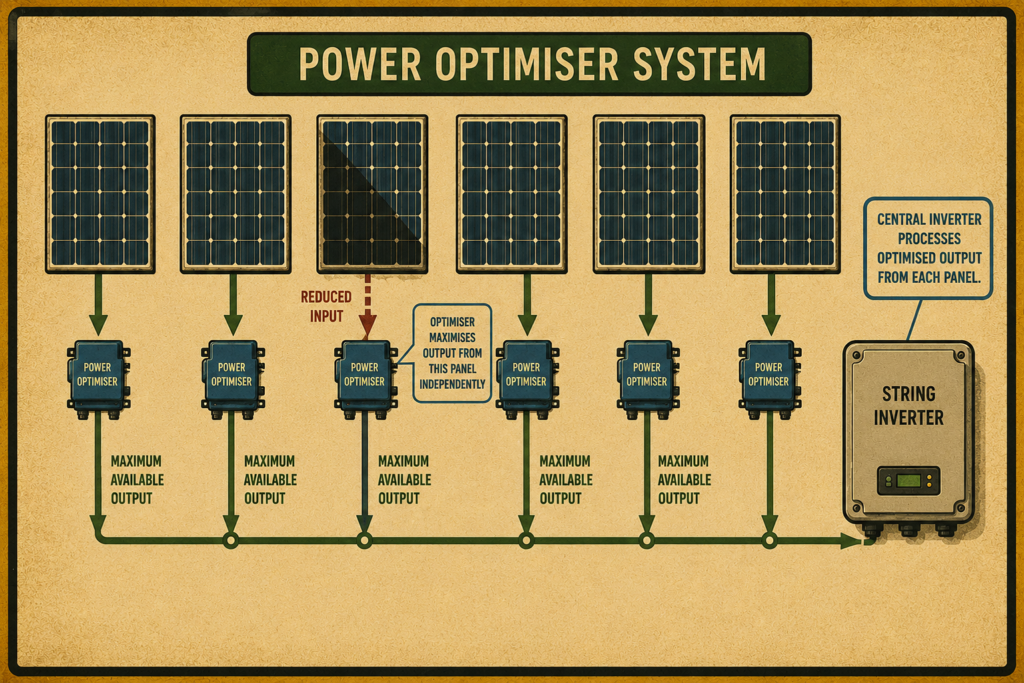
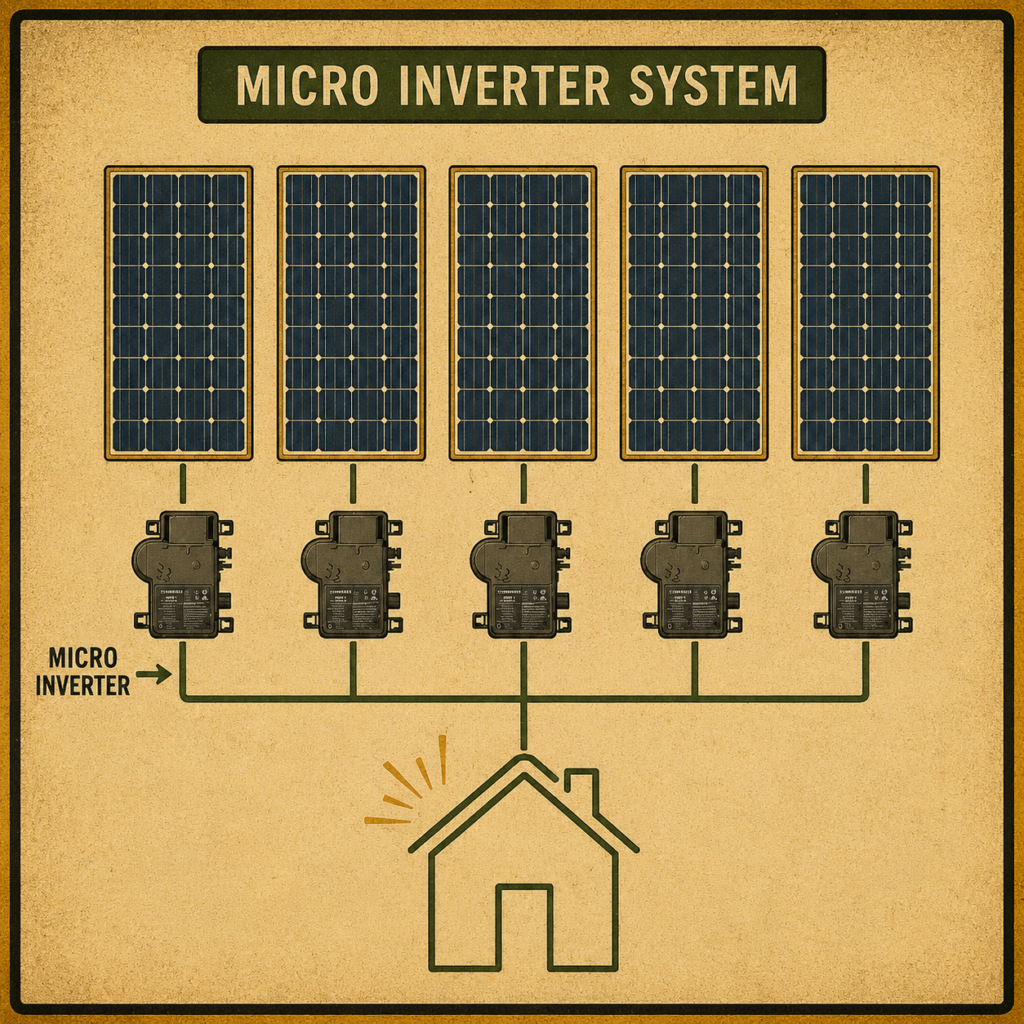
Microinverters, such as those made by Enphase, take a different approach by replacing the central inverter entirely. Each panel gets its own inverter, making every panel fully independent. The performance outcome is similar to power optimisers in most shading scenarios, but the hardware cost is considerably higher. For homes with severe or complex shading across multiple roof sections, the additional investment can be justified. For most residential shading situations, the performance difference between microinverters and power optimisers is small enough that the cost gap is difficult to justify on return on investment grounds alone.
The right choice depends on the severity and nature of the shading on your specific roof. Find out which is the right choice for you in our article, String Inverters vs Microinverters vs DC Optimisers.
How to Assess Whether Shading Is a Problem for Your Roof
The most important thing to understand about shading is that it changes across the day and across the year. A single site visit on a clear summer afternoon tells you very little about what your roof looks like in July when the sun is lower in the sky, shadows fall longer and in different directions.
When you’re getting quotes, ask every installer to provide a shading analysis that covers the winter solstice as well as current conditions. A reputable installer will do this using their design software. If a quote comes back without any shading assessment, that’s worth questioning.
Think carefully about trees. A eucalyptus or other large tree that currently sits clear of your roof line may not stay that way. Over a 25-year solar system lifespan, significant vegetation growth can create shading problems that didn’t exist at installation. If there are mature trees near your property that have room to grow toward your roof, raise it explicitly with your installer and ask them to model worst-case growth scenarios.
Also consider your neighbours. A single-storey home next door today may not stay that way. While you can’t design for every possible future change, understanding which parts of your roof are most exposed to potential shading from adjacent properties is useful context when deciding where to position your primary array.
Shading analysis is not an optional add-on to the quoting process. It is a core part of designing a system that performs as expected across its lifetime. A system designed without it is a system designed on assumptions, and those assumptions have a way of costing money over 25 years.
Is Shading a Reason to Rule Out Solar Panels?
For the vast majority of homes, no. Shading is a design consideration, not a disqualifier. The homes where shading genuinely makes solar unviable are those where the roof is so heavily and permanently shaded that no viable array position exists and a ground mount isn’t an option. That’s a small minority of properties.
For every other situation, the question isn’t whether shading rules out solar. It’s whether the system has been designed to account for it thoroughly. A home with a chimney casting a shadow across part of the roof, a neighbouring building that shades the western edge in the afternoon, or a large tree to the north can still host a well-performing solar system. It just needs a design that reflects those conditions rather than ignoring them.
The homes that end up disappointed with their solar systems are rarely the ones with obvious shading problems. They’re the ones where shading was visible during the site assessment and nobody modelled it properly, or where the installer positioned panels without accounting for where shadows fall in winter.
For properties where shading is severe enough to significantly limit solar generation, there is another option worth knowing about. Force-charging allows a battery to draw electricity directly from the grid during specific windows when there is an oversupply of renewable energy, typically between 11am and 2pm. Retailers including OVO Energy and GloBird currently offer plans that make this electricity free during those windows, meaning you can fill a battery at no cost even if your panels aren’t generating enough to do it themselves. For a heavily shaded home that previously couldn’t justify a battery on solar generation alone, force-charging changes the equation entirely. This solution is increasingly becoming the primary answer to the problem of shade, read more in our article: Can You Force-Charge a Battery from the Grid? What You Need to Know.
Getting this right is straightforward when you work with an installer who takes the assessment seriously. Ask to see the shading analysis. Ask what the modelled output looks like in winter versus summer. Ask whether the system design accounts for tree growth. Those three questions will tell you a great deal about the quality of the design you’re being sold.
Talk to Lenergy About Shading and Your System Design
Every property is different. The trees, structures, and roof features on your block create a shading profile that’s unique to your home, and the right system design depends on understanding that profile thoroughly before a single panel goes up.
The Lenergy team assesses shading as a core part of every system design, not an afterthought. If you’re wondering whether shading on your property is going to be a problem, or you want to understand what a system designed around your specific conditions could deliver, reach out to the Lenergy team and start the conversation.
Frequently Asked Questions
Does shade mean solar isn’t worth it for my home? In most cases, no. Shading is a design challenge, not a reason to rule out solar. A system designed with your specific shading conditions in mind, using the right technology and panel placement, can still deliver strong results. The key is making sure shading is assessed and accounted for before installation, not discovered afterward.
How much can shading reduce my solar system’s output? A shadow covering a small area of a single panel can reduce that panel’s output by 30 to 75 percent, depending on where it falls. At the system level, shading-affected installations commonly see annual output reductions of 5 to 25 percent. A useful working estimate is to assume 50 percent production loss for any period a panel is shaded.
What is a bypass diode and what happens when it fails? A bypass diode is a small component built into solar panels that routes current around shaded cell groups, preventing them from bottlenecking the whole string. When a fixed obstruction forces a bypass diode to activate repeatedly every day, the heat generated can cause it to fail. A failed diode either causes permanent partial output loss or creates a hotspot that poses a fire risk. Sustained hard shading can also void your panel warranty.
What is the difference between hard shading and diffuse shading? Hard shading comes from fixed opaque objects like chimneys or neighbouring buildings and forces bypass diodes to activate. Diffuse shading comes from sources like tree branches or light cloud cover and reduces output more gradually without necessarily triggering diodes. Hard shading is generally more damaging, particularly when it affects the same cells repeatedly.
What are power optimisers and how do they help with shading? Power optimisers attach to individual panels and allow each one to maximise its own output independently of the others, eliminating the string bottleneck problem. They feed into a central string inverter, keeping system costs lower than a fully microinverter-based approach. For most residential shading situations, they recover the majority of lost generation at a cost that makes sense across the life of the system.
Are microinverters better than power optimisers for shading? In most residential shading scenarios the performance difference is small. Microinverters make every panel fully independent and carry a higher hardware cost. Power optimisers achieve a similar outcome in most shading situations at a lower price point. For severe or complex shading across multiple roof sections, microinverters may be worth the additional investment. For most homes, the return on investment case for paying the premium is difficult to make.
How do I know if shading will be a problem for my roof? Ask your installer for a shading analysis that covers the winter solstice, not just current conditions. Most professional installers use design software such as Pylon to model exactly how shade will affect your system across the year. SunSPOT also offers a free online tool for initial assessment. Think carefully about trees and neighbouring structures, and how they might change over the 25-year life of your system.
Can I do anything about shading after my system is already installed? Yes. Adding power optimisers or microinverters to an existing system is possible in many cases and can recover lost generation from shading. Trimming or removing offending vegetation is often the most cost-effective first step. A solar monitoring service like Solar Analytics can help you understand exactly how much output you’re losing and where before deciding on the best course of action.