Should I Electrify My Home? What It’s Worth in NSW and the ACT
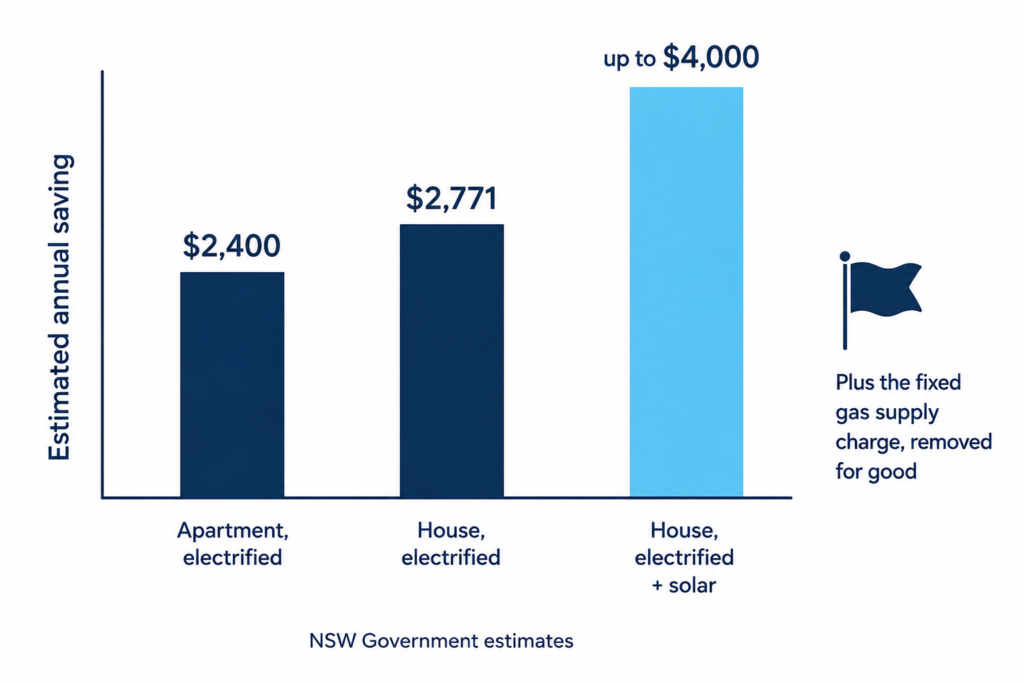
NSW Government figures say an all electric home can save you up to $2,771 a year. Add solar and that saving climbs towards $4,000.
So, should you electrify your home? If you’re in NSW or the ACT and still on gas, then yes. For most homes, it’s worth it.
There’s one catch: the order you do things in. That’s where most people go wrong and it’s exactly what we’ll walk you through in this article.
What this article covers:
- What electrifying your home is worth in NSW and the ACT
- Why the generation side comes first
- The loans, discounts and rebates in each
- The order to do the work in
Is home electrification worth it in NSW and the ACT?
For most homes still on gas, however, be ready for the upfront cost and plan it right.
NSW Government figures show an electrified house can save up to $2,771 a year. With solar, potential savings move toward $4,000. Apartments can still save around $2,400.
Most of that comes from two places. Hot water is about 29% of an average NSW energy bill. Heating and cooling is about 27%. Those are the biggest gas users in the house, so that is where the savings sit.
There is a third saving people forget. The fixed gas supply charge. You pay it every quarter whether you burn gas or not. Remove the connection and it goes.
Emissions drop by around 2,120 kg a year for a NSW house. In the ACT the effect is larger, because ACT electricity is already 100% renewable.
The air inside the house improves as well. Gas appliances burn fossil fuels indoors and release pollutants while they run. Several NSW councils have banned new gas connections on health grounds. Reverse cycle systems also cover heating and cooling in one unit, which suits NSW summers and Canberra winters.
Why does NSW say to do solar and a battery first?
Because electrifying your home does not remove your energy use. It moves it.
Every gas appliance you replace becomes an electricity load. Hot water, heating, cooking, eventually the car. Electric appliances are far more efficient, so total energy use drops. A heat pump uses around 30% of the energy of a conventional electric hot water system. You are still buying that electricity from somewhere.
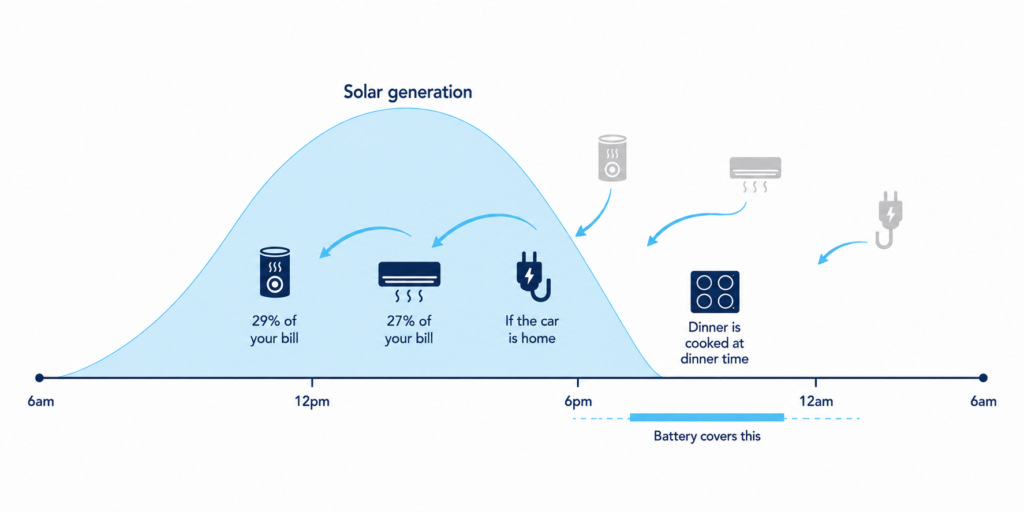
Get the generation in first and a lot of that load costs you nothing.
Hot water is the easiest win. It is about 29% of an average NSW energy bill, and a heat pump on a timer can run at midday on your own solar. Heating and cooling is another 27%, and much of that can shift too. Run the reverse cycle hard through the afternoon while the sun is up, and the house holds that temperature into the evening. EV charging shifts as well, if the car is home during the day.
Some loads will not move. Dinner is cooked at dinner time. Heating a Canberra house through a July night is not a midday job. That is what storage is for. A SigenStor system holds the day’s surplus and runs the house on it after dark, or you can use it to profit off of through a vpp, instead of sending it to the grid for a feed in rate that no longer covers much.
The order is the point. Solar and storage first, then the appliances arrive into a house that can already power them.
What support can you get in NSW and the ACT?
Support comes in three layers, and they stack.
Federal first. Small-scale technology certificates cut the cost of rooftop solar for every household in Australia. They apply automatically. Your installer claims them and the discount comes off the quote, so there is nothing to apply for.
The discount shrinks every year. It is worked out from how many years are left before the scheme ends on 31 December 2030. Install in 2026 and you get five years’ worth. Wait until January 2027 and you get four. Same system, smaller discount, every year you wait.
The Cheaper Home Batteries Program works the same way, taking around 30% off an eligible battery installed by an SAA accredited installer. Two things to know. The discount now steps down every six months rather than once a year. It also tapers by size: the full rate applies to the first 14 kWh of usable capacity, 60% of the rate to the next 14 kWh, and far less above that.
That taper matters when you size the system. On a 24 kWh battery, the first 14 kWh attracts the full rate and the remaining 10 kWh attracts 60% of it. The rebate still applies. It just does not scale evenly.
State support sits on top.
| NSW Home Energy Saver | ACT Sustainable Household Scheme | |
| Type | Zero interest loan, plus discounts | Loan at 3% interest |
| Amount | Up to $15,000 over 10 years | Up to $20,000 over 10 years |
| Income test | Household income up to $210,000 | No income test, property value limits apply |
| Extra support | Discounts up to $4,000 for incomes up to $80,000 or concession card holders | Up to $5,000 in rebates for concession card holders |
| Solar panels | Eligible | Not covered for most households |
| Batteries and EV chargers | Eligible | Eligible |
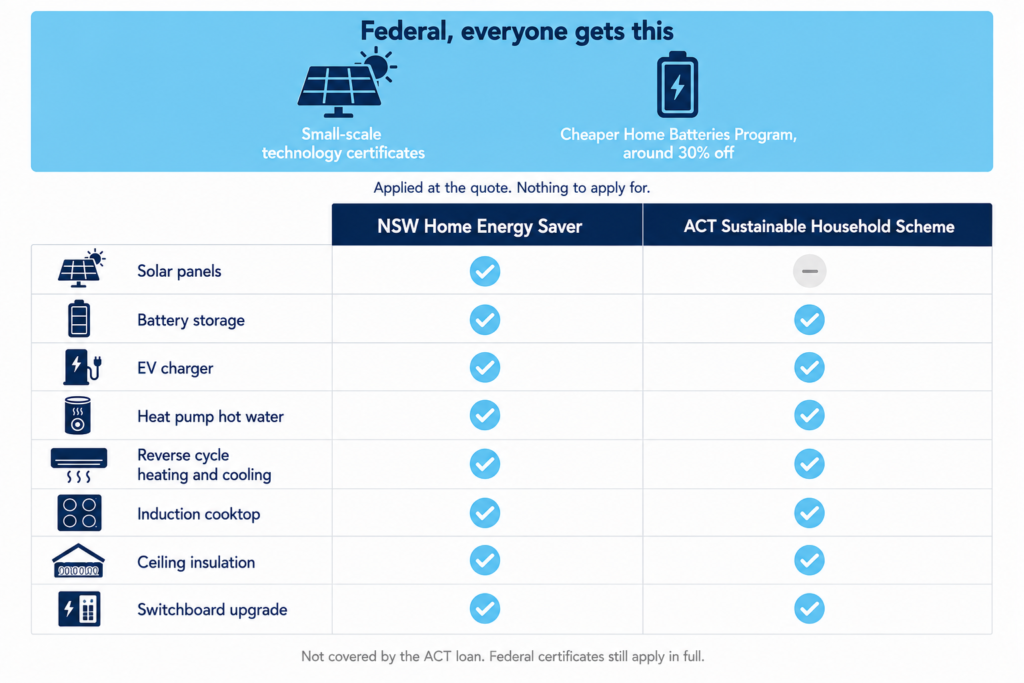
Two things the table does not show.
In NSW, if you qualify for both the discount and the loan, apply for the discount first and use the loan for the balance. The other way round costs you.
In the ACT, rooftop solar is no longer covered under the loan for most households. Canberra readers sometimes read that as solar being unsupported. It is not. Federal STCs still apply in full, exactly as they do in NSW. The ACT loan simply covers the rest of the job instead.
How do you transition to an all electric home?
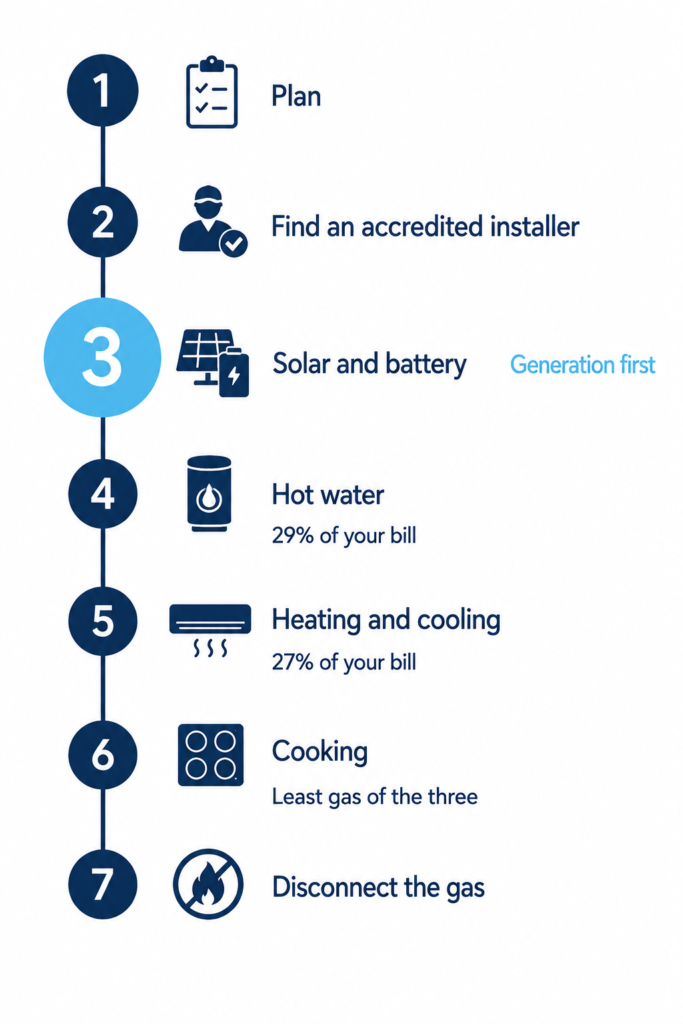
NSW publishes the order. It works for ACT homes too.
- Plan. Check your bills and work out which appliances are near end of life. Replacing something with years left in it could waste money.
- Find a tradesperson. Use an SAA accredited installer with a good history of reviews for solar and battery work.
- Solar and battery. The generation side first, for the reasons above.
- Hot water. The biggest gas user in most homes. A heat pump replaces it.
- Heating and cooling. Reverse cycle covers both.
- Cooking. An induction cooktop is the last appliance, not the first. It uses the least gas.
- Disconnect the gas.
Two practical notes. Older switchboards sometimes need upgrading before the load increases, and that upgrade is eligible under the NSW loan. Home EV charging is the logical next step once the house is electric, and both schemes cover it.
Electrification only pays when you use power at the right time of day. Our article on free daytime electricity explains how the new free power windows change that maths.
Frequently Asked Questions
What does it mean to electrify your home?
It means replacing gas appliances with electric ones. Hot water, heating, cooking, and often the car. The last step is dealing with the gas connection itself. Disconnection is temporary and reversible. Abolishment is permanent, with the meter and service line removed. Only abolishment removes the fixed supply charge for good.
How much does home electrification cost in Australia?
It depends on how many appliances you replace and whether you add solar and a battery. Most households stage the work over several years rather than doing it at once, which spreads the cost. NSW covers up to $15,000 with a zero interest loan and the ACT up to $20,000 at 3%, which covers the core of the job for most homes.
What are the benefits of switching to an all-electric home?
Lower bills, no fixed gas supply charge, lower emissions, better indoor air quality, and one energy bill instead of two. Reverse cycle systems also give you heating and cooling from the same unit.
Are there government rebates for home electrification in Australia?
Yes. NSW runs the Home Energy Saver program. The ACT runs the Sustainable Household Scheme, plus a fully funded Access to Electric Program for eligible low income homeowners who agree to permanent gas disconnection. The federal Cheaper Home Batteries Program applies nationally. Renters can request upgrades but cannot authorise them, since the decision sits with the property owner.
Is home electrification worth it without solar panels?
You will still save, because heat pumps and reverse cycle systems use far less energy than gas, and losing the fixed supply charge helps. The savings are noticeably smaller. Without solar you are buying every unit from the grid, often at peak rates in the evening when an all electric home uses the most. Solar and a battery are what turn a modest saving into the $4,000 figure NSW quotes.