Where Can You Install a Solar Battery in 2026?
The Definitive Australian Guide to Battery Location Rules, AS/NZS 5139 Compliance, and Smart Placement
Battery installations across Australia are booming.
With electricity prices rising and rebates making storage more accessible, more homeowners than ever are adding batteries to their solar systems. However, with that growth has come a much needed renewed focus on compliance.
Recent clarification around battery location rules in NSW, particularly involving garage installations, has sparked fresh discussion.
With compliance and safety being a top priority for us here at Lenergy we decided to break down exactly what’s allowed under Australian Standards in 2026, without the technical jargon.
By the end, you’ll understand:
- What regulations govern solar battery installation in Australia?
- Why battery location rules exist
- NSW garage door proximity: what actually changed
- Clearance & separation requirements
- Restricted Locations
- Best places to install a solar battery in 2026 (compliance + longevity + cost)
- What happens if a battery is installed in the wrong location?
- The 2026 bottom line: where should you put your battery?
What regulations govern solar battery installation in Australia?
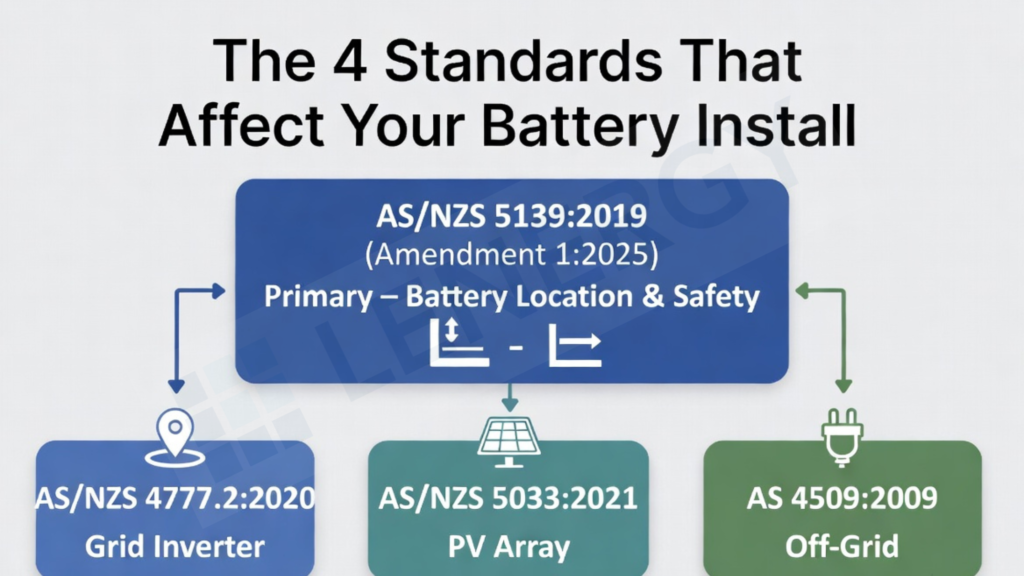
Battery placement in Australia is primarily governed by Australian Standards (national), plus state-based enforcement and network requirements.
Primary standard: AS/NZS 5139:2019 (Amendment 1:2025)
This is the key document for where batteries can and can’t be installed and what “safe” looks like (clearances, restricted locations, barriers to habitable rooms, signage, etc.).
Other standards that commonly apply
- AS/NZS 4777.2:2020 — grid-connected inverter requirements (commissioning, protection settings, anti-islanding).
- AS/NZS 5033:2021 — PV array installation (panels, DC isolators, wiring).
- AS 4509:2009 — stand-alone (off-grid) power systems (where relevant).
Why battery location rules exist
It’s tempting to treat battery rules like annoying red tape, it is important to recognise that they are designed for the good of the consumer.
Solar batteries are safe when installed correctly, especially modern LFP chemistry systems, but they still store a large amount of energy in a compact enclosure. Location rules exist to reduce risk if something goes wrong and to keep people safe during an emergency.
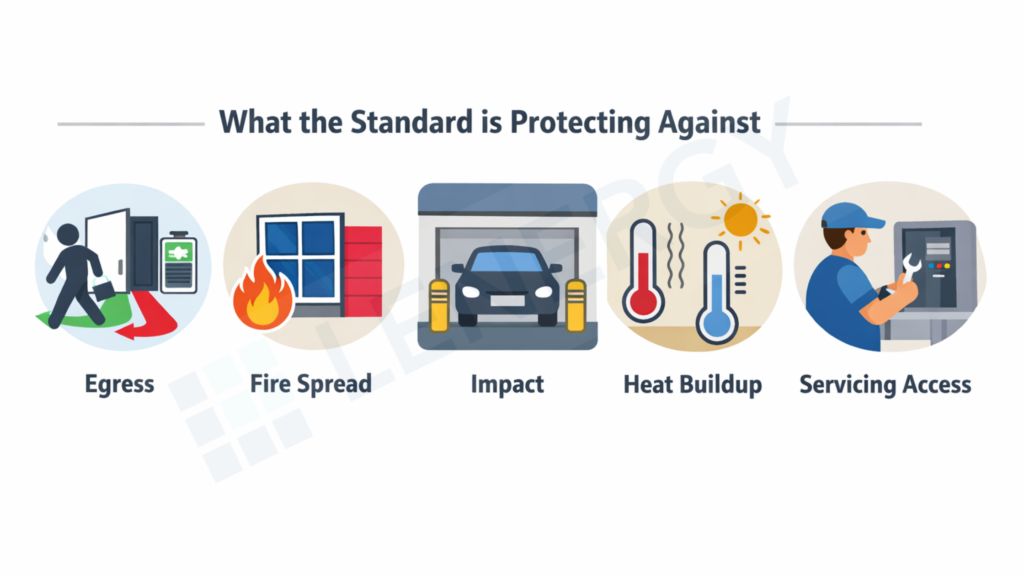
AS/NZS 5139 is trying to ensure:
- A battery fault doesn’t turn a doorway or window into a fire pathway
- You can still exit safely (egress) without squeezing past a hazard
- Fire risk to bedrooms/living areas is managed (habitable room barriers)
- Batteries aren’t installed in places where heat builds up, impact is likely, or emergency access is poor
- Installations remain serviceable for the next 10–15+ years (not just “it fits today”)
This is also why reputable installers take time during the design stage. A “quick slap it on the wall” approach is where problems (and rework costs) come from. This is exactly why compliance-first installers conduct thorough site inspections not just guess that the location complies.
NSW garage door proximity: what actually changed
Garages have always been the best option when picking a location for a battery. The issue in NSW was the restriction on how close a battery could be to a garage opening.
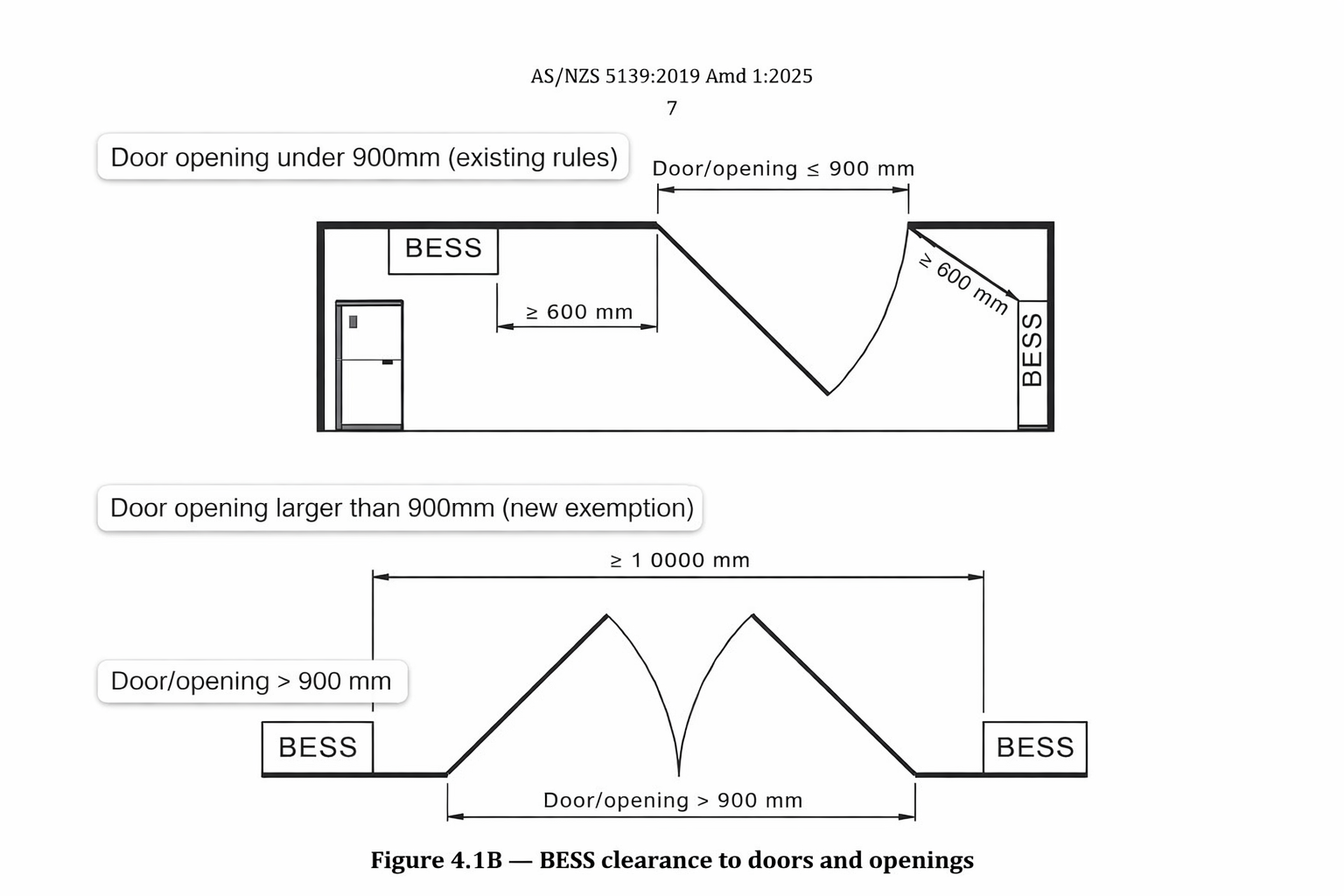
Amendment 1:2025 to AS/NZS 5139 added a clear exception for exits larger than 900mm (e.g. a garage opening), permitting installation within 600mm provided safe egress is maintained and clearance is no less than 1m from the front/side a person could need to pass.
This is NSW adopting the pragmatic interpretation used elsewhere, allowing batteries within 600mm of garage door openings in appropriate cases.
What this means for you
- A battery can be installed closer to a wide garage opening if it doesn’t compromise safe exit space.
- Installers must still design for walk-through clearance, not just “distance to the opening.”
Clearance & separation requirements
There is no single “one rule” like “always 900mm above” that applies to every battery in every scenario.
Instead, separation requirements depend on what the battery is near.
Openings: doors, windows, and other building openings
A commonly encountered requirement is maintaining separation from openings (often referenced as 600mm) in typical cases to reduce risk of fire spread via openings and preserve escape routes.
For large garage openings (>900mm), the amendment clarifies when closer installation can be permitted, as long as egress remains safe and at least 1m clearance is preserved where a person may need to pass.
Why this exists
Openings are weak points in fire separation. They’re also where people move during an emergency.
Egress: keeping exit pathways usable
Egress is a safety principle, not just a spacing rule. The real question is: in the event of an emergency, can someone exit without hesitation or obstruction? With this in mind it can be poor practice if it:
- narrows a pathway
- forces people to squeeze past
- blocks access around doors/garage openings
Restricted Locations
AS/NZS 5139:2019 clearly defines restricted locations where battery energy storage systems (BESS) must not be installed unless specific additional requirements are met.
The Electrical Regulatory Authorities Council (ERAC) Battery Energy Storage System Guideline (Feb 2021) reinforces these restrictions and provides clarity around enforcement expectations.
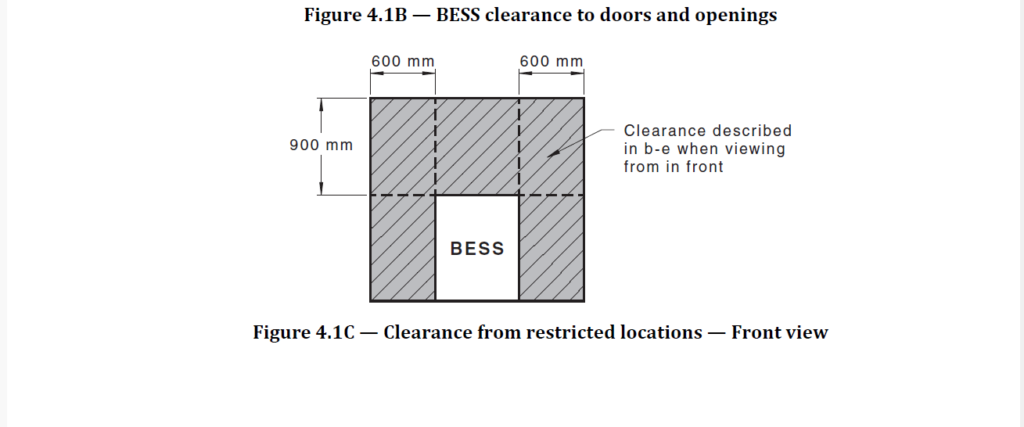
Under AS/NZS 5139:2019, batteries cannot be installed in the following restricted locations:
- Any restricted location as defined for switchboards under AS/NZS 3000
- Within 600mm of any exit or entry
- Within 600mm of any vertical side of a window, or any building ventilation opening into a habitable room
- Within 600mm of any appliance
- Within 900mm below items listed above (where applicable)
- In ceiling spaces
- In wall cavities
- On roofs
- Under stairways
- Under access walkways
- In an evacuation route or designated escape route
- Within a habitable room
Why These Locations Are Restricted
These restrictions exist to reduce risk in three key areas:
- Fire spread pathways (openings into habitable rooms)
- Safe evacuation access
- Heat accumulation or impact risk
For example:
- Installing within 600mm of a doorway can compromise safe egress.
- Installing in a ceiling cavity increases heat build-up and reduces emergency access.
- Installing under stairs can turn an escape path into a hazard.
Habitable vs non-habitable rooms (and when fire-resistant backing is needed)
This is where compliance becomes conditional, as the room behind the wall can change the installation requirements entirely.
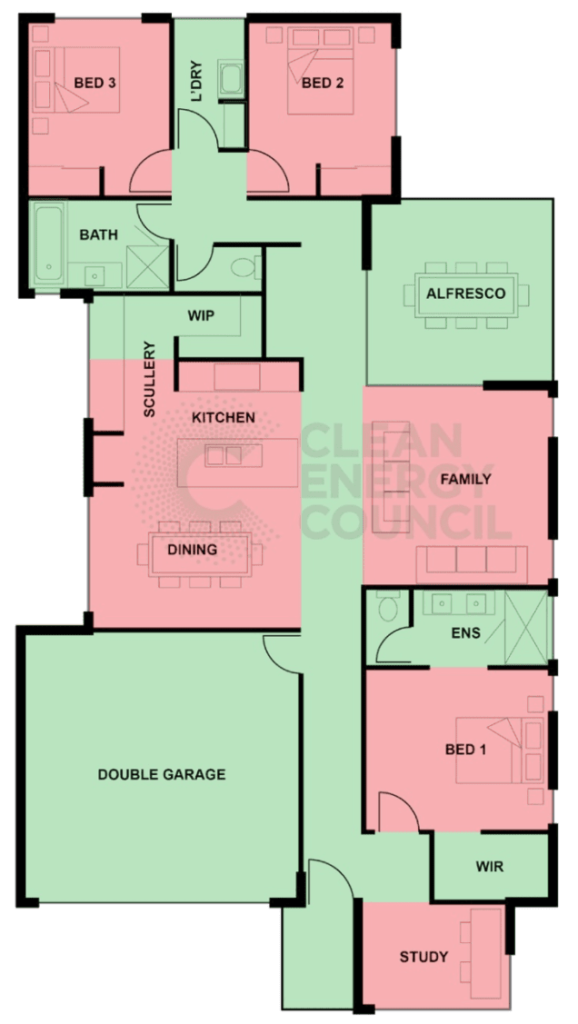
What’s a habitable room?
Habitable rooms are living/sleeping areas such as bedrooms, living rooms, dining rooms, studies. (Some guidance also treats kitchens similarly as a living-use area; classification can matter in edge cases.)
Non-habitable examples:
- garage
- laundry
- storage room
- utility area
Why habitable rooms change the requirements
If something goes wrong, the standard aims to reduce risk to sleeping/living spaces and reduce fire spread.
So, if the battery is on a wall that backs onto a habitable room, installers may need to add a non-combustible barrier / fire-resistant sheet depending on wall construction and the battery system.
For installers, this is where risk assessment and the relevant barrier requirements come into play. If you are concerned about battery fires read our article Are Solar Batteries Safe? Will My Battery Catch on Fire? For a full break down of the real risk batteries pose to home safety.
Best places to install a solar battery in 2026 (compliance + longevity + cost)
This is where compliance meets practicality and where understanding the trade-offs makes all the difference.
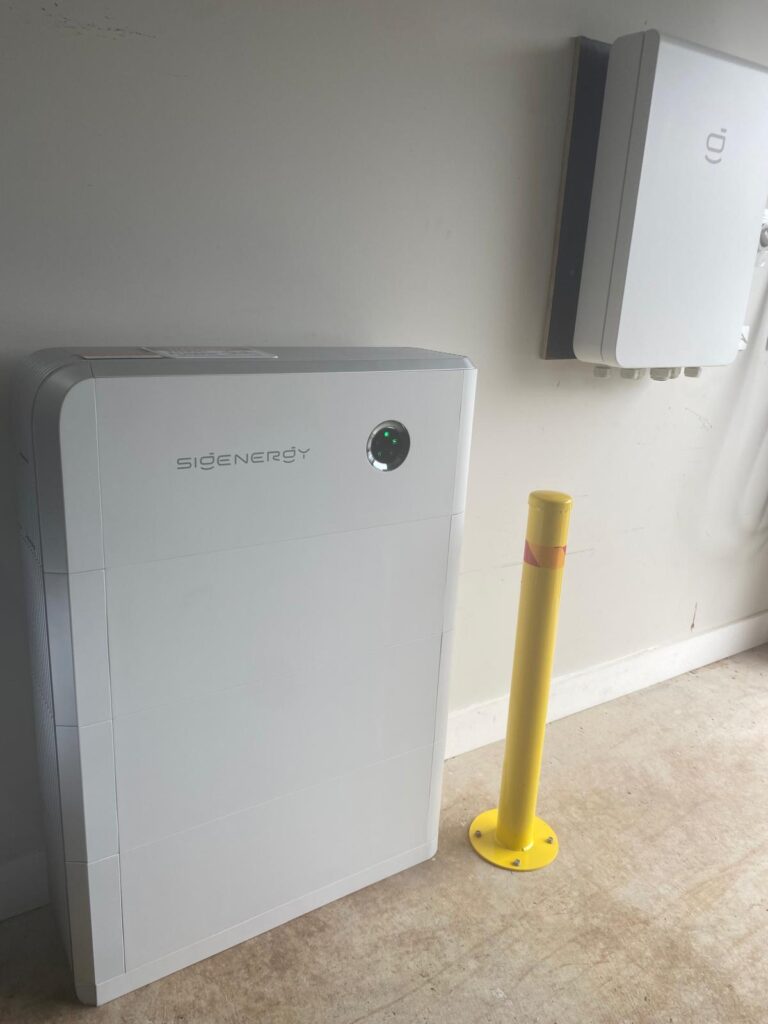
The garage (often ideal)
Why garages work so well:
- usually non-habitable
- protected from weather
- often shaded (better for battery lifespan)
- often closer to the main switchboard (lower install cost)
- easier servicing access than external walls in some homes
What to watch:
- car impact zones
- narrow side doors / egress choke points
- crowding by storage shelving
- proximity to ignition sources (varies by layout)
- Will need a bollard
Outdoors (good when designed properly)
Outdoor installs are common and can be excellent, but the biggest placement mistake is forgetting the impact of heat.
Heat and direct sun exposure can:
- reduce performance on very hot days
- contribute to faster long-term degradation
- conflict with some manufacturers’ installation requirements if not protected (varies by brand)
Shaded/south-facing walls (in Australia) often make more sense than north/west walls. Sometimes the only solution is to install a battery cover which comes at an additional cost. The CEC breaks down more on where a battery should be installed in their guide on household battery storage systems.
Close to the main switchboard
The battery placed away from this switchboard is not the end of the world, however if it is it can mean:
- longer cable run
- more conduit
- more labour
- often higher cost
- more complexity routing through roof/under floors/around finishes
If two locations are both compliant, the closer location is often the best value.
Accessibility for Installation and Servicing (Don’t Create a Future Headache)
Battery placement isn’t just about where it fits — it’s about whether it can be installed, accessed, and maintained safely over the next 10–15 years.
Before installation even begins, technicians need safe, practical working space to:
- Mount the battery securely
- Route and terminate cabling correctly
- Install isolators and protection devices
- Maintain required clearances
- Commission and test the system safely
After installation, the battery may need:
- Periodic inspection
- Firmware updates
- Replacement of ancillary components (such as communication modules or breakers)
- Warranty assessment
- Isolation access during a fault or emergency
If a battery is squeezed into a tight corner, boxed in by shelving, or mounted where safe working access is restricted, even simple servicing can become difficult or unsafe.
Good placement allows:
- Clear standing space in front of the unit
- Unobstructed access to isolators
- Safe panel removal
- Straightforward fault isolation
- Room for future expansion if additional storage is added
Batteries are reliable but access matters when something goes wrong. Designing for safe access now prevents bigger problems later. That’s why proper site assessment considers not just compliance on paper, but long-term serviceability in practice. Accessibility is an important part of a responsible design.
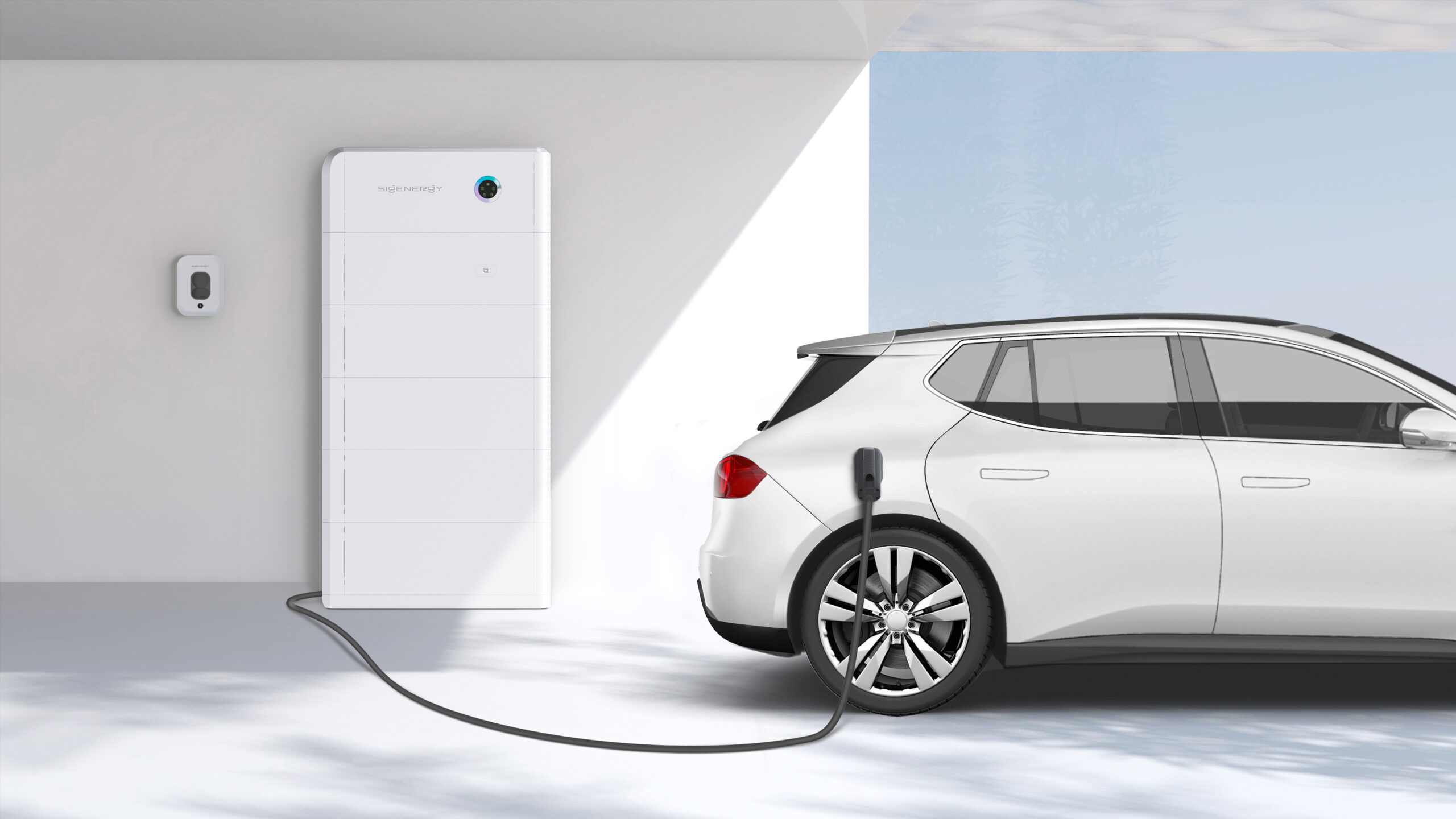
Future-proofing (space for expansion and EV charging)
Many homeowners add:
- a second battery later
- an EV charger
- a larger inverter
Leave physical space and consider where future equipment might go. If you are considering installing a battery read our guide Mistakes to Avoid When Buying a Solar Battery, to make sure you get the most out of your battery.
What happens if a battery is installed in the wrong location?
Most non-compliant installs don’t create drama. They cause additional costs and delays.
Failed inspection / rework
- relocation
- wall patching
- re-certification
- delays to commissioning
Rebate and incentive complications
Incentives generally require:
- accredited installer
- compliant installation
- correct paperwork
If compliance issues are found, it can delay approvals and in some cases require rectification before incentives can be finalised. With the rebate dropping soon it is important to get it right the first time.
Insurance complications
Insurers typically expect compliance with relevant standards; non-compliance can complicate claims assessment.
Warranty issues
Warranties between different batteries such as the Powerwall 3 and the Sigenstor have a standard of around 10 years but it is important to recognise that all battery manufacturers can reject claims if installation requirements weren’t followed (heat exposure, ventilation, mounting substrate, etc.).
Reduced lifespan
Heat + poor ventilation + poor placement = faster degradation over time.
Most modern lithium batteries used in Australian homes (particularly LFP chemistry) include built-in thermal management and protection systems. They are designed to operate safely in a wide range of conditions.
However, “safe to operate” and “ideal for long-term lifespan” are not the same thing.
Lithium batteries degrade gradually with use. That degradation accelerates when:
- Ambient temperatures are consistently high
- The battery is exposed to direct afternoon sun
- Heat cannot dissipate due to poor airflow
- The battery is installed in confined or enclosed spaces
In Australia, summer ambient temperatures can exceed 40°C. A north-facing wall in direct sun can push surface temperatures significantly higher. Even if the battery protects itself by throttling performance, repeated heat stress over years can:
- Reduce usable capacity more quickly
- Increase internal cycling stress
- Shorten the effective lifespan of the system
Ventilation matters for the same reason. Batteries generate heat during charging and discharging. If that heat cannot escape for example, in a tight cupboard or enclosed cavity internal temperatures rise, even if external temperatures are moderate.
Most manufacturers specify operating temperature ranges in their installation manuals. While the battery may continue to function within those limits, consistent exposure to the upper end of the range can impact long-term performance.
This is why shaded locations, garages with airflow, or south-facing walls often make more sense in Australia than exposed north- or west-facing external walls.
Good placement doesn’t just keep the battery compliant.
It protects the investment over its full service life.
The 2026 bottom line: where should you put your battery?
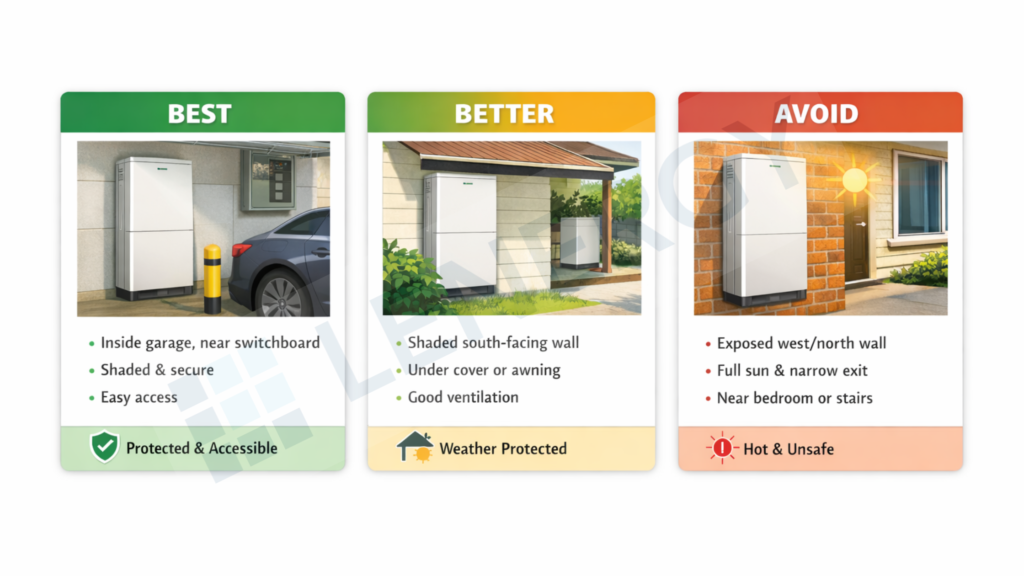
Best case (most homes)
- Garage or shaded utility area
- compliant with opening/egress requirements
- not backing onto habitable room (or with a fire proof barrier installed correctly)
- protected from direct west sun
- close to switchboard
- accessible for servicing
- out of impact zones
Also good
- Shaded external wall with appropriate weather/UV protection (A cover can be added in some cases but is normally not the best option)
- properly assessed for heat, flooding, and salt exposure (where relevant)
Needs careful assessment
- walls backing onto bedrooms/living rooms
- near narrow exits
- North and West-facing exposed installs
- under stairs / confined spaces / cupboards
Considering a battery in 2026?
A solar battery is a long-term investment.
Where it’s installed affects safety, lifespan, warranty, rebates, and resale value.
There is a lot to take into account when it comes to picking a battery location so often it is best to speak with a specialist. Reach out to us at Lenergy for a compliance-first site assessment and clear guidance on where your system should be installed.