Can You Power Your Home With Your EV? The Real Cost of Vehicle-to-Home Charging
Powering your home with your EV is now legal, but is it actually the right move?
We will break down how it works, roughly how much it might cost and whether it’s the right option for you:
- What vehicle-to-home charging is, and how it differs from vehicle-to-grid and vehicle-to-load
- What a real V2H setup costs to buy and install in Australia right now
- How much you could actually save, and why two respected estimates disagree by a wide margin
- Whether the payback period makes sense for an average home in 2026
- What you can do today if you want cheaper EV charging, without the price tag
What is vehicle-to-home charging, and how does it work?
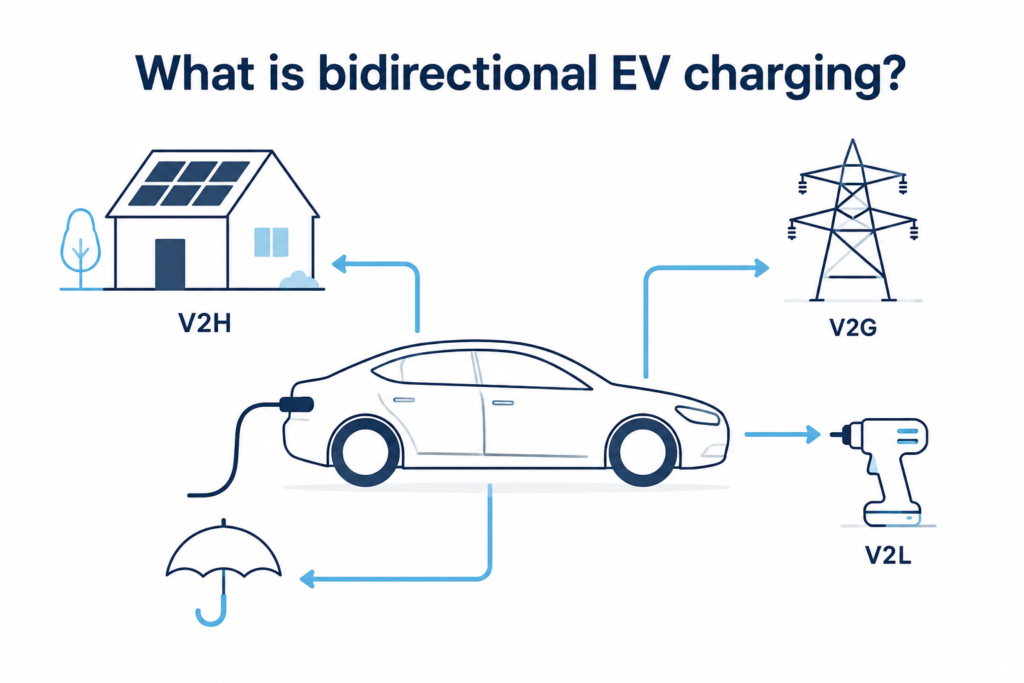
Vehicle-to-home charging, or V2H, lets your EV send power back into your house. A bidirectional charger sits between the car and your switchboard. It charges the EV’s battery from solar or cheap off-peak power during the day, then reverses the flow when you need it: overnight, during a blackout, or whenever grid power gets expensive.
V2H is one branch of a bigger family. Vehicle-to-grid (V2G) exports power to the grid itself, sometimes for a payment. Vehicle-to-load (V2L) is the simplest version, running individual appliances straight off the car with no home integration at all.
There’s also a hardware split worth knowing. Standard AC chargers rely on the EV’s own onboard inverter, and in most homes that means one-way only. DC chargers, like the SigenStor module, convert power externally through a direct DC-to-DC link that skips that onboard step. Sigenergy quotes efficiency above 97 percent on that link, with less energy wasted than a typical AC setup. It’s also what makes genuine V2H and V2G possible in the first place.
The regulatory blocker is gone. The national wiring standard, AS/NZS 4777.1:2024, now permits bidirectional charging across Australia. That’s a genuine milestone. It doesn’t mean every EV, or every household, is ready to use it.
How much does a vehicle-to-home charging setup cost in Australia?
Here’s where the excitement usually meets the invoice.
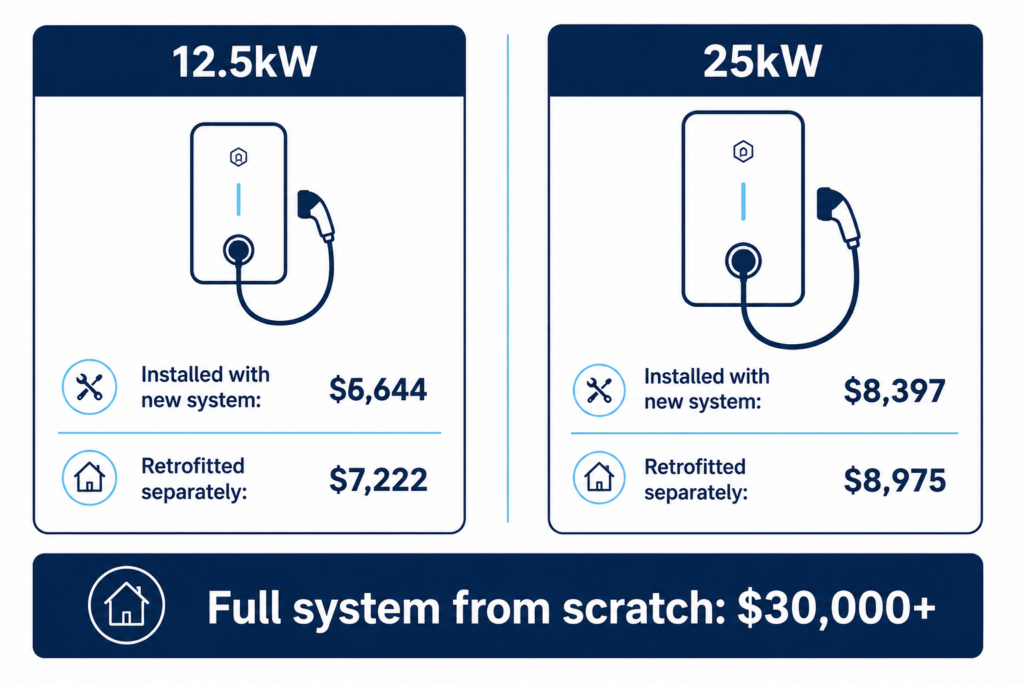
The SigenStor DC EV Charger, the true bidirectional option Lenergy installs, isn’t a standalone box. It only works as an add-on module to an existing or new SigenStor battery and inverter system, so the pricing below assumes that system is already part of the picture.
| Model | Installed alongside a new SigenStor system | Retrofitted separately |
| 12.5kW (adds ~75km range per hour) | $3,769 | $4,349 |
| 25kW (adds ~150km range per hour) | $4,899 | $5,469 |
A full SigenStor system built from scratch, battery, inverter, backup gateway and charger together, still lands around $30,000 or more once everything’s included. Other bidirectional chargers are reaching the Australian market too. Wallbox’s Quasar 2 is DC and bidirectional but currently limited to 7.4kW and isn’t widely available here yet. Numbat and StarCharge have entered the market as well, though none currently match the SigenStor unit’s combination of power and confirmed compatibility.
For scale: a typical SigenStor home battery runs around 24kWh usable. Most EV batteries dwarf that, at 60 to 100kWh or more. That’s the appeal of V2H. It’s also why the hardware to manage all that energy safely doesn’t come cheap.
How much could vehicle-to-home charging actually save you?
This is where sources disagree, and by a lot.
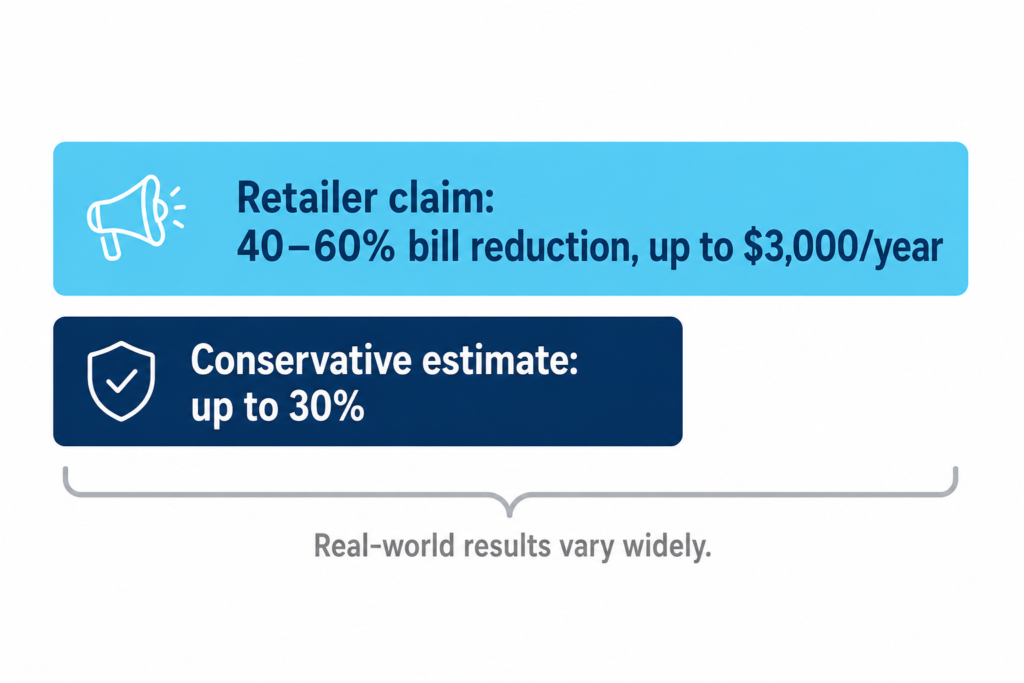
Amber, the energy retailer running one of the country’s largest V2G trials, claims early adopters are cutting bills by 40 to 60 percent, with one EV in the trial potentially unlocking around $3,000 a year.
More conservative independent analysis puts the realistic ceiling closer to 30 percent, and frames that as a best case, not a guaranteed outcome. Outlier events do happen. One of Amber’s clients reports making $700 in a single afternoon. That’s a real result. It’s an outlier, not a Tuesday.
Does the payback math on vehicle-to-home charging actually work?
Run the numbers, and the honest answer for most households is: not yet.
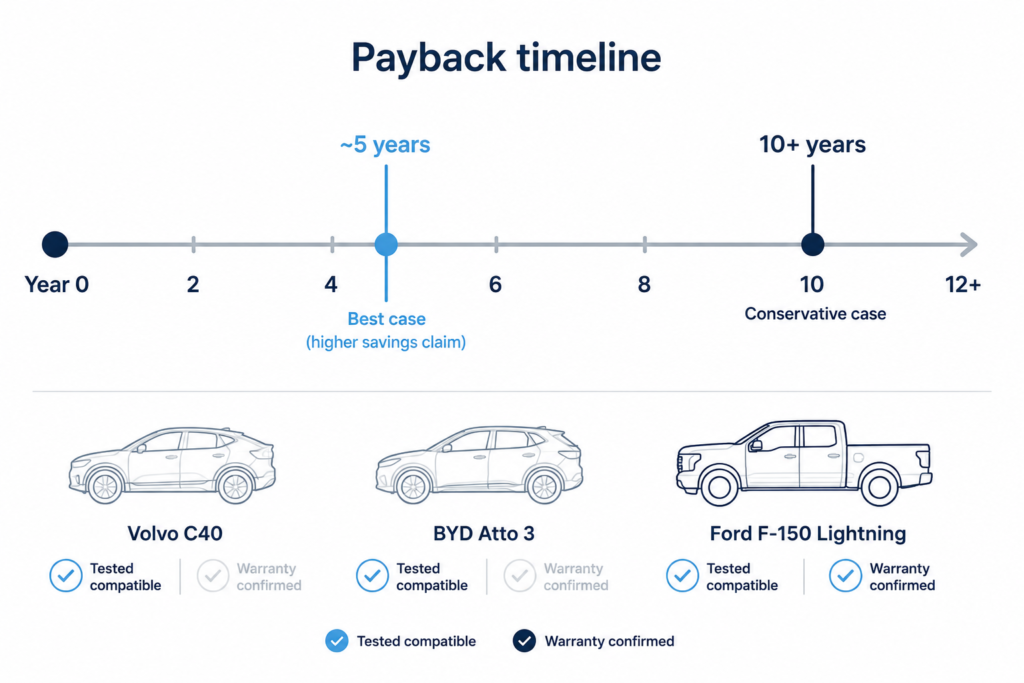
Take a mid-range install at $15,000 fitted. Even at Amber’s higher savings claim of $3,000 a year, that’s a five-year payback, before finance costs or battery wear are factored in. At the more conservative 30 percent ceiling, payback stretches well past a decade for a lot of homes.
Then there’s compatibility and warranty risk, and both are real. Sigenergy has confirmed the SigenStor DC charger working for both charging and discharging on three EVs: the Volvo C40 Recharge, the BYD Atto 3, and the Ford F-150 Lightning, and only once the car’s firmware is updated to the tested version. Models like the Hyundai Ioniq 5, Ioniq 6, and Kia EV6 are expected to join, but weren’t confirmed at time of writing.
Ford’s F-150 Lightning remains the only one of those three with a manufacturer-confirmed warranty covering V2G/V2H use in Australia. Technically compatible and manufacturer-approved are two different things, and right now, most owners fall outside both.
Add in distributor network approval, which varies by area, and vehicle-to-home charging in 2026 sits closer to an early-adopter project than a mainstream upgrade. If backup power during outages is the real driver for you, [what happens during a blackout with solar] is worth reading before you spend $30,000 chasing it through your car.
What can you do today, without the $30,000 price tag?
Now, here’s the good part. You don’t need bidirectional discharge to charge your EV smarter, or cheaper.
The Sigenergy Sigen AC EV Charger handles the other half of the job well, and it’s available now. It’s a smart, solar-aware charger in 7kW, 11kW or 22kW models, suited to single-phase or three-phase homes. Choose 100% PV, Solar Boost, or Fast mode, depending on how quickly you need the car ready and how much sun is on the roof.
Paired with a Sigen Power Sensor, it manages your home’s load automatically through Dynamic Load Management, so charging the car never trips your supply, even with the oven, the aircon and the car all drawing power at once. You can also check usage through the [mySigen app, the same one used to manage your SigenStor battery], if you already have one.
It won’t run your house in a blackout. It will make sure your EV is charging from sunshine instead of the grid, which for most homes is the saving that actually shows up on the next bill.
Lenergy supplies and installs the Sigen AC EV Charger across NSW, the ACT and Queensland. Our SAA-accredited installers size it to your switchboard, your driving pattern and your existing solar, with a fixed, transparent quote before any work starts.

Frequently Asked Questions
Which electric vehicles support vehicle-to-home charging in Australia?
Very few, officially. On the SigenStor DC charger specifically, Sigenergy has confirmed the Volvo C40 Recharge, the BYD Atto 3, and the Ford F-150 Lightning, with more models expected as manufacturers update firmware and testing expands. Of those three, only the Ford Lightning currently carries a manufacturer-confirmed warranty covering V2H/V2G use.
How long can an EV power a house during a blackout?
A large EV battery, 60 to 80kWh, could theoretically run an average Australian home for three to four days. Actual runtime depends on the vehicle, the charger and how much the household is using at the time.
Does V2H charging damage my EV battery?
Frequent charge and discharge cycling adds wear over time, though modern EV batteries are built to handle it reasonably well. The bigger practical risk right now is warranty voidance, not battery health.
Is vehicle-to-home charging worth it for homeowners right now?
For most households, not yet. The regulations allow it, but the combination of setup costs, a short confirmed-compatibility list, warranty risk on every EV except the Ford Lightning, and a wide gap between savings claims means the payback period is long for most homes. A solar-optimised AC charger delivers real savings today without that risk.
Read next: [How Kim’s solar powers his EV for $50 a month]