Do Solar Panels Increase Your Home Value? What the Australian Data Shows
“Solar will increase your home value by $23,000.”
That’s the headline.
If you’re about to spend $8,000–$15,000 on a system, you don’t want a headline — you want clarity.
Does solar genuinely increase resale value? And if so, by how much?
Solar isn’t a small purchase. A standard 6.6kW system in Australia typically costs between $6,500 and $10,000. Add a battery and that can climb well beyond $15,000.
So the real question is simple:
Is solar just a bill-saving feature — or does it materially strengthen your property’s value?
The good news is we now have credible Australian data.
In September 2025, property analytics firm Cotality released its national report “Watt’s It Worth?”, analysing residential sales data across Australia.
Their key finding:
Homes with solar panels sell for an average of 2.7% more than comparable homes without solar.
Nationally, that equates to roughly $23,100 in added value.
That’s where the headline comes from.
However, headlines only tell part of the story.
In this article, we’ll break down what the data actually shows — how solar impacts property values across Australia, why the uplift varies by location, and what factors like system size, warranties, and energy efficiency mean for resale.
What Increase Your Home Value By 2.7% Actually Means
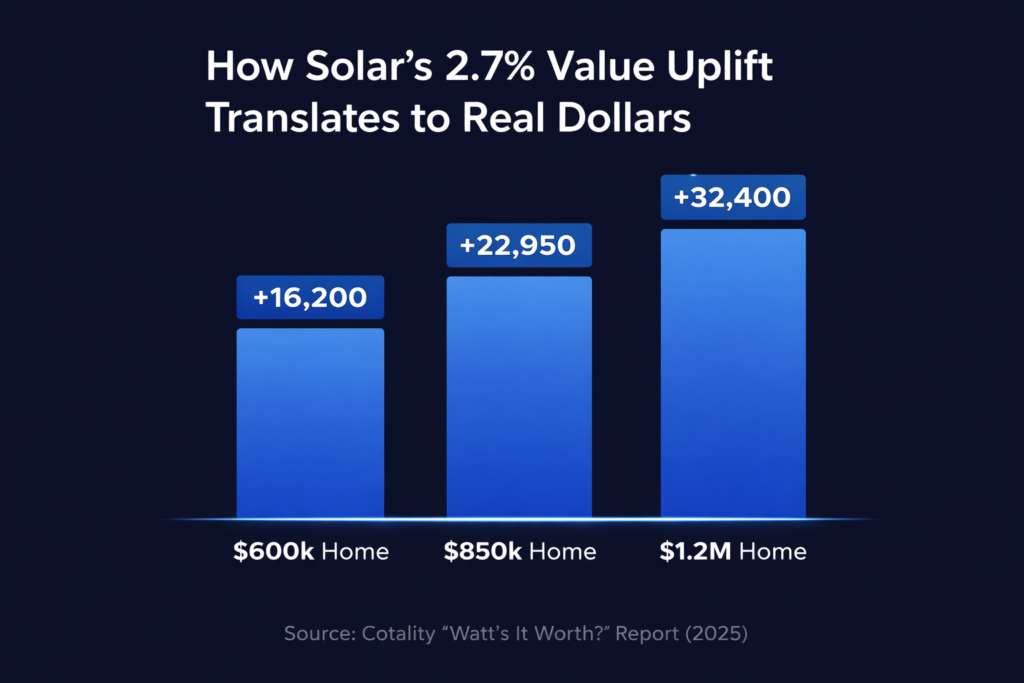
The Data shows that the uplift tends to be percentage-based — not a flat bonus. Meaning that the higher value of the home the more value returned when it is sold, for example:
- $600,000 home → ~2.7% = $16,200
- $850,000 home → ~2.7% = $22,950
- $1.2M home → ~2.7% = $32,400
The $23,100 figure is simply the national average across price brackets.
Importantly, Cotality’s modelling compares like-for-like homes, meaning the uplift isn’t just because “better homes happen to have solar.” It reflects actual sale price behaviour in the market showing exactly how having solar will increase your home value.
That doesn’t mean every system adds exactly 2.7%.
It means that statistically, homes with solar are achieving stronger sale prices.
Why Some Cities See Bigger Gains
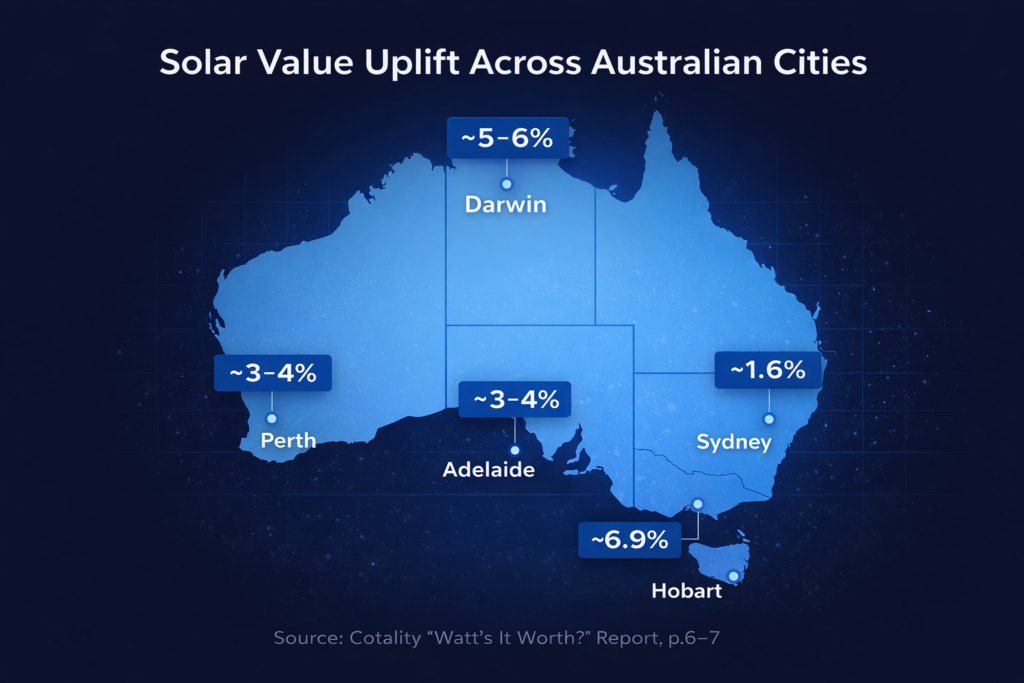
Exactly how much solar will increase your home value varies by location.
For example:
- Hobart: ~6.9% uplift
- Darwin: ~5–6% uplift
- Adelaide & Perth: strong gains
- Sydney: ~1.6% uplift
Why the variation?
- Electricity prices vary by state
- Climate and cooling loads differ
- Solar penetration rates differ
- Buyer expectations differ
In markets with high power prices or strong sun exposure, solar carries more financial weight.
In premium Sydney suburbs, solar may be increasingly expected — protecting value rather than dramatically increasing it.
Bigger Systems Tend to Carry More Weight
When it comes to resale value, size matters.
A small legacy 3kW system on a four-bedroom home doesn’t carry the same impact as a system that materially reduces electricity bills.
Today:
- 6.6kW is entry-level standard
- 10–13kW systems are common on larger homes
- Homes with pools, ducted air-conditioning, or EV charging often benefit from even larger systems
How does investing in a solar system really save you money?
Depending on location and usage:
- A 6.6kW system may save $1,200–$1,800 per year
- A 10–13kW system may save $1,800–$3,000+ per year
Over five years:
- $1,200/year = $6,000
- $2,500/year = $12,500
While Cotality doesn’t break uplift down by system size, it’s reasonable to infer:
The stronger the real-world financial benefit, the stronger the perceived contribution to value.
Solar isn’t just panels on a roof.
It’s lower future household expenses.
The bigger the reduction, the more weight it tends to carry.
Longevity Builds Buyer Confidence
Modern solar panels aren’t short-term assets.
Most reputable panels now come with:
- 25-year product warranties
- 25–30 year performance warranties
If your system is only five years old, it likely still has 20 years of manufacturer coverage remaining.
That matters at resale.
Buyers aren’t just inheriting savings — they’re inheriting long-term infrastructure backed by transferable warranties.
Where Solar May Add Less Value
Solar doesn’t guarantee uplift in every situation.
Value may be limited if:
- The system is 10–15+ years old
- It’s undersized for the home
- Documentation is missing
- Installation quality is poor
- The buyer intends to renovate or rebuild
In these cases, solar may protect competitiveness — but not drive premium pricing.
What About Batteries?
Battery uptake has increased significantly in recent years, driven by:
- Falling feed-in tariffs
- Rising electricity prices
- Federal and state incentives
Under the current Federal Cheaper Home Batteries Program, the rebate reduces every six months. Early adopters receive larger subsidies, lowering effective system costs.
This stepped reduction may influence how buyers perceive recently installed batteries in coming years.
However, large-scale resale modelling hasn’t yet caught up.
The Cotality report isolates solar panels, not battery systems. There isn’t yet strong national data showing a defined percentage uplift tied directly to batteries.
That doesn’t mean they add no value.
It means the data is still maturing.
Solar has been mainstream for over a decade.
Battery adoption is only now entering that phase.
Over the next 3–5 years, clearer resale patterns are likely to emerge.

NatHERS and the Bigger Energy Story
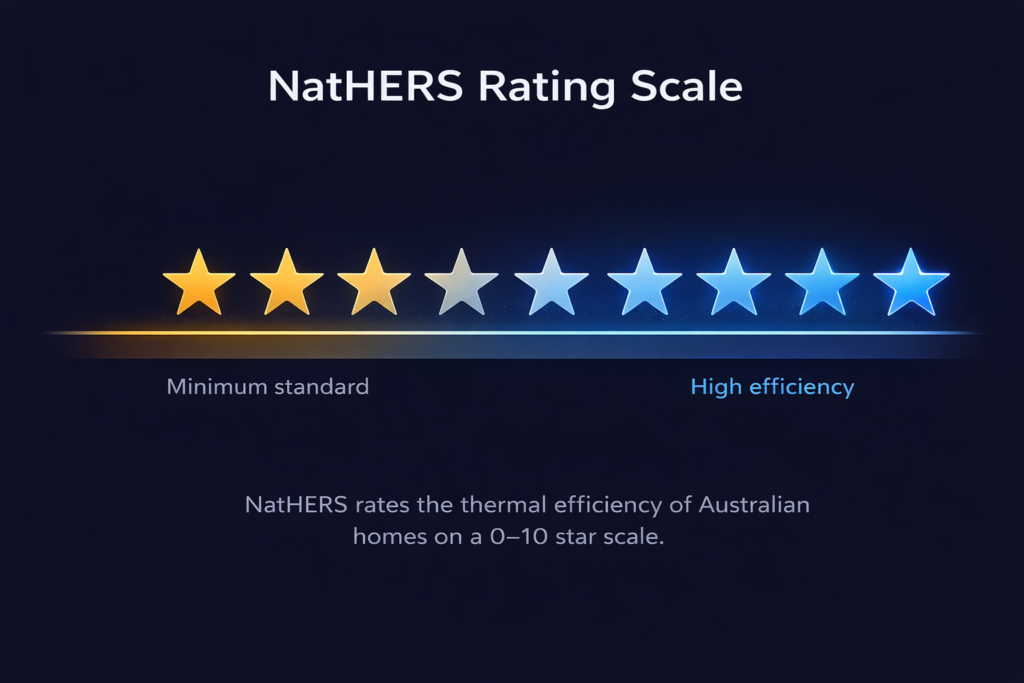
NatHERS (Nationwide House Energy Rating Scheme) rates homes on a 0–10 star scale based on thermal efficiency.
It assesses:
- Insulation
- Glazing
- Orientation
- Building materials
While solar itself isn’t what NatHERS measures, energy-efficient homes are increasingly outperforming less efficient ones.
Solar strengthens the broader narrative of lower running costs.
As energy disclosure becomes more prominent in Australian property markets, efficiency is likely to play a larger role in valuation.
Does solar increase your home’s value?
Based on the strongest Australian data available:
Yes — on average, by around 2.7%.
However, solar works best when viewed as more than a resale play.
It’s a way to:
- Reduce your electricity bills
- Protect yourself against rising tariffs
- Improve comfort and energy resilience
- Strengthen your home’s long-term appeal
If you install solar, benefit from years of savings, and then decide to sell, any resale uplift becomes an added bonus — not the sole justification for the investment.
In most cases, the larger and more effective the system, the stronger that overall value story becomes.
Want to Know How much Solar Could Increase Your Home Value?
Every property is different.
Location, electricity rates, roof space, system size — they all influence both savings and potential resale impact.
If you’re considering solar and want to understand:
- What size system makes sense
- What you could realistically save
- How it may influence your home’s value
Reach out to us at Lenergy to speak with one of our specialists and start with a proper assessment of your home and usage.
When you understand the numbers clearly, the decision becomes much easier.