Tesla VPP VS Amber: Which Suits Your Battery?
Tesla VPP vs Amber: same battery, same grid, two very different deals. One caps your risk and clips your earnings. The other hooks you up to the full market, meaning more potential savings but more exposure to losses.
Tesla is currently testing a new energy plan called Tesla Electric Dynamic for the Powerwall 2 or 3 today. It provides an interesting solution to the risks solar and battery systems that engage with the wholesale market, such as Amber, often encounter and could eventually be open to more than just the Tesla products.
- Who can join each plan today
- How each one prices power in and power out
- What the rates look like for an outer Sydney home
- Who controls your battery
- What to check before you switch
Can you even join the Tesla plan?
The plan is called Tesla Electric Dynamic. Tesla sells the power itself through its own licensed arm, Tesla Energy Ventures Australia, and you sign up in the Tesla app.
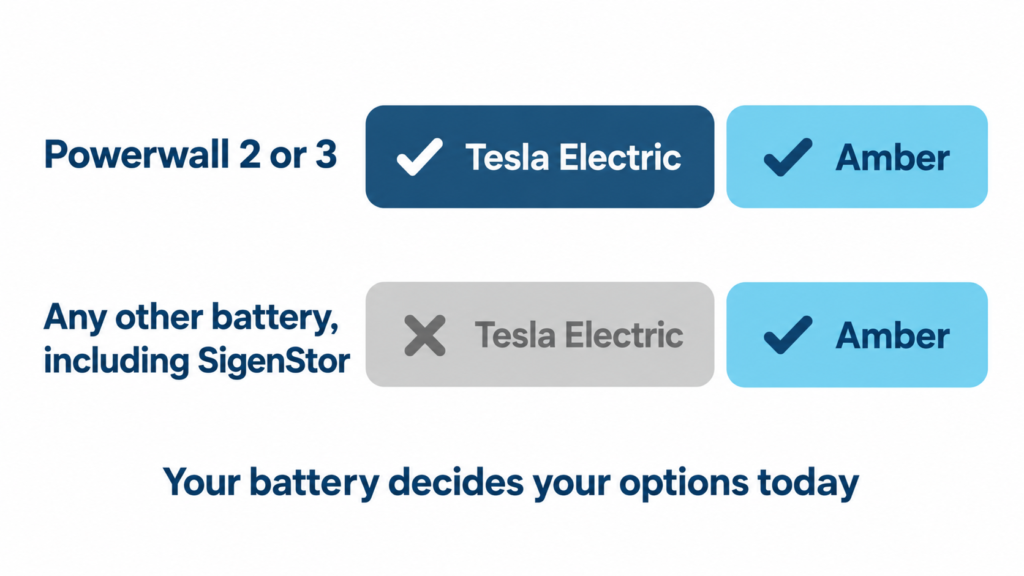
The entry requirements are specific. A Powerwall 2 or 3. The Tesla app. A Tesla Wallet set up for direct debit. A smart meter. Your site has to be approved to export, with Tesla verifying your connection agreement with the distributor, the business that owns the poles and wires in your area. Your Powerwall has to stay online at least 95% of the time. You cannot have it signed up to anyone else’s virtual power plant.
There is also a question over whether you can join at all yet. One report has the plan live. Tesla’s own fact sheet describes it as by invitation only and offers a $100 credit for taking part in a pilot.
Amber has no hardware gate of that kind. It supports a wide range of batteries, including Sigenergy, Tesla, SolarEdge AlphaESS, BYD, Sungrow, FoxESS, Enphase, GoodWe and many more. It operates in NSW, the ACT, south-east Queensland, Victoria and South Australia. Learn how vpp’s work here.
How does each plan price your power?
This is the real difference, and it is not about who pays more.
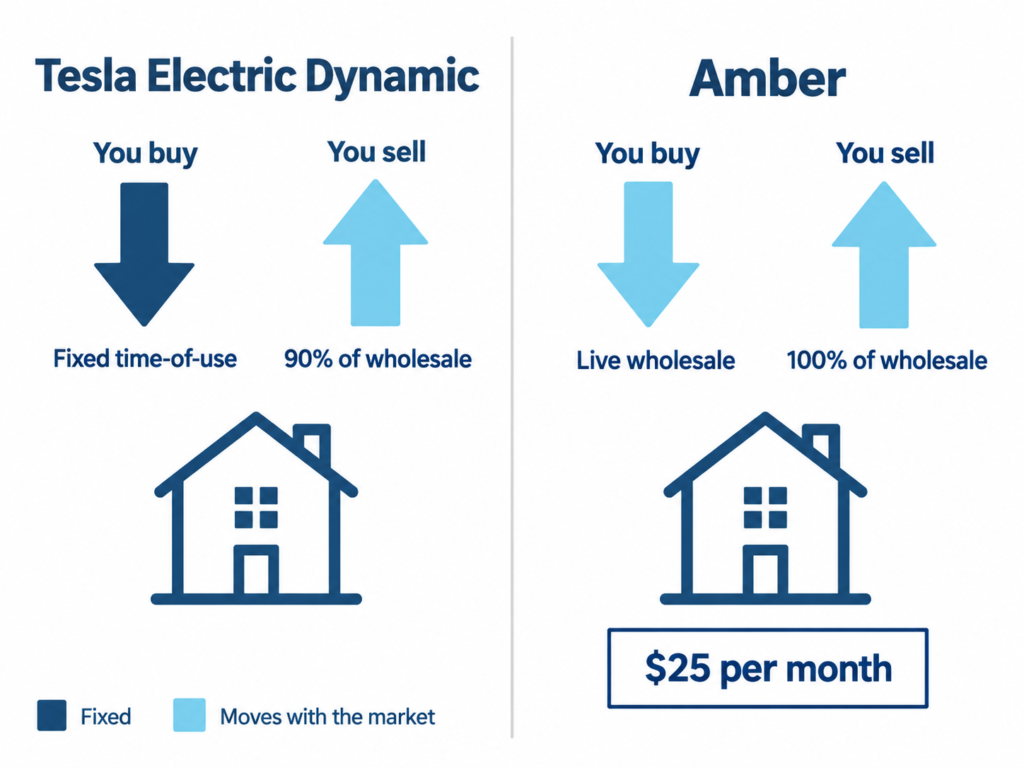
Tesla fixes one side and floats the other. What you pay to import is an ordinary time-of-use tariff, set in advance and reviewed periodically. What you earn for exporting floats, at 90% of the real-time wholesale price published by AEMO every five minutes.
Amber floats both sides. You pay the wholesale price on the way in, which can spike above $1/kWh on a bad evening, and you keep 100% of the wholesale price on the way out. Amber takes no margin on the energy and charges a flat $25 a month instead.
| Tesla Electric Dynamic | Amber | |
| Batteries | Powerwall 2 or 3 only | Wide range, including SigenStor |
| Imports | Fixed time-of-use | Live wholesale |
| Exports | 90% of wholesale | 100% of wholesale |
| Grid services pay | “Dynamic”, no rate published | Not applicable |
| Fee | None stated | $25/month |
| Who runs the battery | Tesla | SmartShift, with your override |
| Exit | No exit fee | 14 days’ notice |
So Tesla caps your downside and takes a 10% clip of your upside. Amber hands you the full upside and leaves your downside open.
There is a second Tesla payment on top, the Grid Services Credit, for when your Powerwall is called on to help balance the grid second by second. Tesla has not published a rate, a formula, or the share it passes on. Treat it as unknown income, not expected income.
One more unknown worth noting. Wholesale prices regularly fall below zero in the middle of the day, and it is not confirmed what happens to your export credit when they do, which could be a problem.
What do the rates look like in outer Sydney?
Here are the two plans as quoted for an outer Sydney address.
| Tesla Electric Dynamic | Amber SmartShift | |
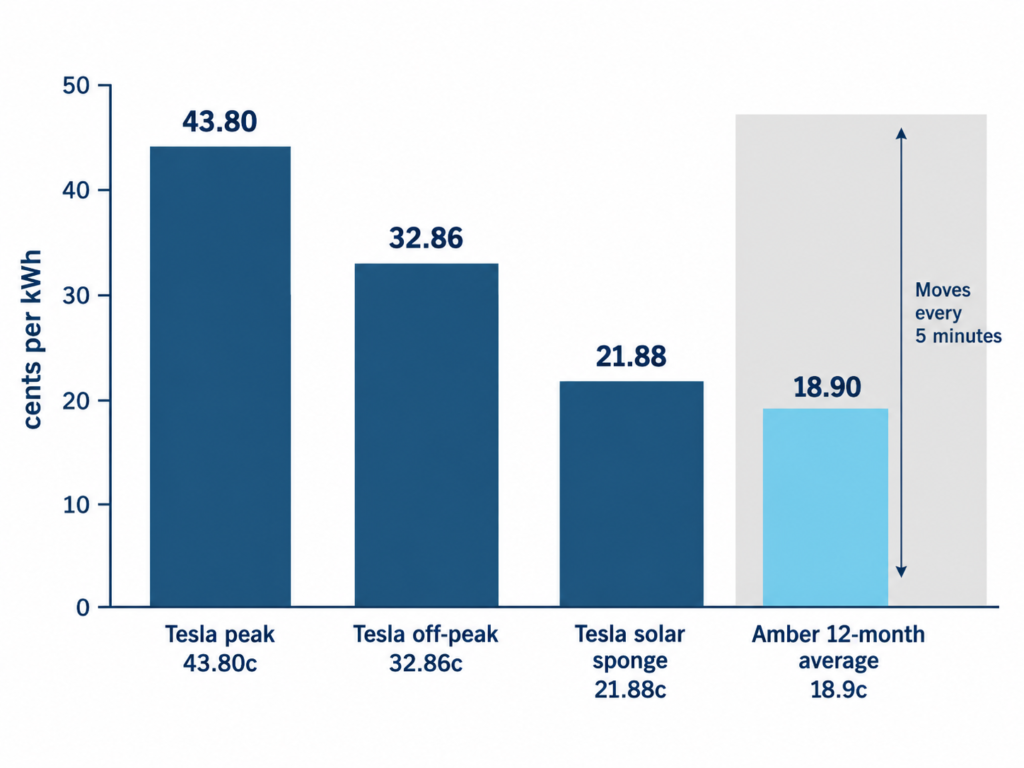
| Peak | 43.80c/kWh, 4pm to 8pm | No fixed blocks |
| Off-peak | 32.86c/kWh, 2pm to 4pm and 8pm to 10am | No fixed blocks |
| Solar sponge | 21.88c/kWh, 10am to 2pm | No fixed blocks |
| Average import | Not applicable, rates are fixed | 18.9c/kWh over 12 months |
| Export | 90% of the real-time market price | 20.4c/kWh average over 12 months |
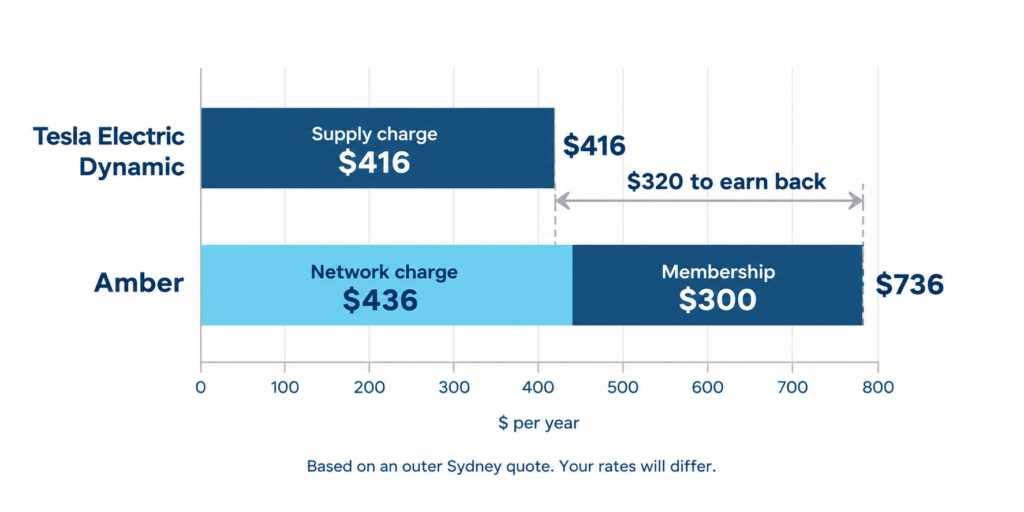
| Daily charge | $1.14/day | 119.6c/day network charge |
| Membership | None | $25/month |
Two things jump out.
First, the fixed costs. Tesla’s supply charge works out at about $416 a year. Amber’s network charge plus the $25 membership comes to roughly $736. That is about $320 a year Amber has to earn back before it is even level.
Second, the usage rates. Amber’s 12-month average import rate of 18.9c/kWh sits below Tesla’s cheapest block. Not below the peak rate, below the solar sponge rate. On that average, Amber claws the difference back quickly. The catch is that an average is not a price. Amber’s import rate moves every five minutes, so the evening you really need the grid is the evening it costs the most.
Don’t understand what all these rates mean? Read our article on how to understand your electricity bill.
Amber’s quote for that home put the estimated annual bill at $539, which it says is 21% under the comparison price set by the regulator, including up to $697 in estimated export credits.
Who actually controls your battery?
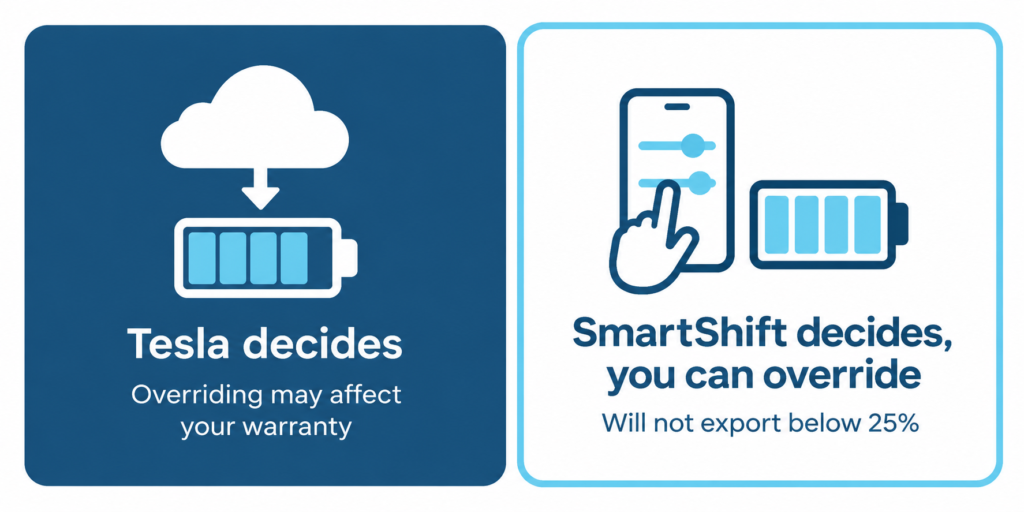
With Tesla, Tesla’s software decides when your Powerwall charges and discharges. This is the simpler option, what Tesla is doing with this new plan is providing a protection against the normal concerns that hopping on a VPP exposes you to. The catch lies in the plan terms, which warn that you “may affect your manufacturer’s warranty” if you don’t frequently update or if you manually override Tesla’s control of your Powerwall.
With Amber, SmartShift plans the day using forecasts of your usage, your solar and wholesale prices, then re-plans every five minutes. You can override it in the app at any time. It will not automatically export below 25% charge. An Amber user stands to potentially make more but is also at a higher risk of losing more as you are exposed to the whims of the market.
Sometimes, for some homes, neither plan is worth the switch. If you are not going to look at the app and you want a quiet bill, a plain retail plan does the job. Read next: Best VPPs for Solar Batteries.
Frequently Asked Qestions
Is Tesla’s Energy Plan still available in Australia?
No. The old Tesla Energy Plan ran through Energy Locals, paid up to $220 a year in virtual power plant credits, and closed on 30 September 2025. Customers who did nothing were moved to a standing offer. Tesla Electric is the replacement, sold by Tesla directly.
Can I use Amber with a battery that isn’t a Powerwall?
Yes. That is the main practical difference between the two today. Tesla’s plan is Powerwall-only, so a SigenStor owner cannot join it.
How much can I earn by joining a VPP or wholesale plan in Australia?
It depends on your battery size, your state and how volatile wholesale prices get. The outer Sydney quote above showed up to $697 in estimated export credits over a year with Amber. Tesla does not publish an equivalent estimate, because its grid services credit has no published rate.