Top 6 Ways to Lower Your Electricity Bill
You can lower your electricity bill without buying solar panels, without buying a battery, and in some cases without using less power at all.
We install solar and batteries for a living, so you would expect us to say solar is the answer to every high bill. For a lot of homes it is the biggest solution available and provides the most freedom. It is not the first thing to look at.
Here is what this article covers:
- Why solar and battery sits at number one, and why we are parking it
- Getting off a bad energy plan
- Heating and cooling, the biggest single load in most homes
- Hot water, the one people underestimate
- Shifting usage into cheap and free windows
- Finding the appliances actually driving the bill
1. Should you start with solar and a battery?
Eventually, probably yes. Rooftop solar still attracts an upfront STC incentive, and the federal battery program provides around a 30 percent discount on eligible batteries. Combine those incentives with the savings and a suitable payment plan, and the monthly cost of a system can land below what you are already paying the retailer.
That is not true for every home. It needs to be modelled properly.
If you want to know whether it stacks up for your place, we can run the numbers against your actual usage rather than an average.
The rest of this article is the other five levers, and several of them cost nothing.
2. Are you on a bad electricity plan?
This is the easiest win on the list.
Do not assume your retailer rewards loyalty. Rates creep up. New offers come around and existing customers rarely get told.
The government’s Energy Made Easy site shows the gap between the cheapest and most expensive plan can run to hundreds of dollars a year for an average household.
You may not even need to switch. Call your retailer and ask what the cheapest plan is for the way you actually use energy. Then check it independently on Energy Made Easy, which covers NSW, the ACT, Queensland, South Australia and Tasmania.
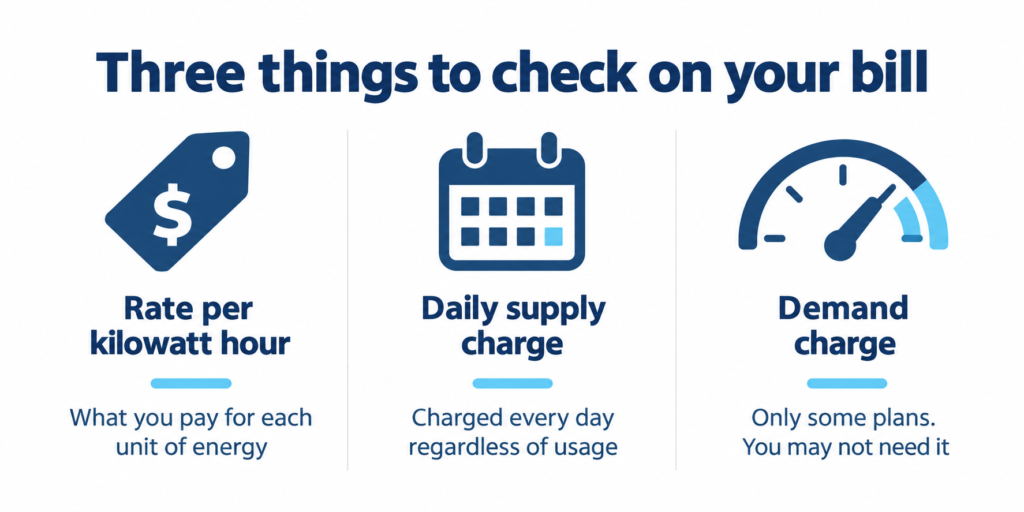
Do that once a year. Look at three things: the rate per kilowatt hour, the daily supply charge, and whether you are paying a demand charge you do not need.
3. Where does heating and cooling money go?
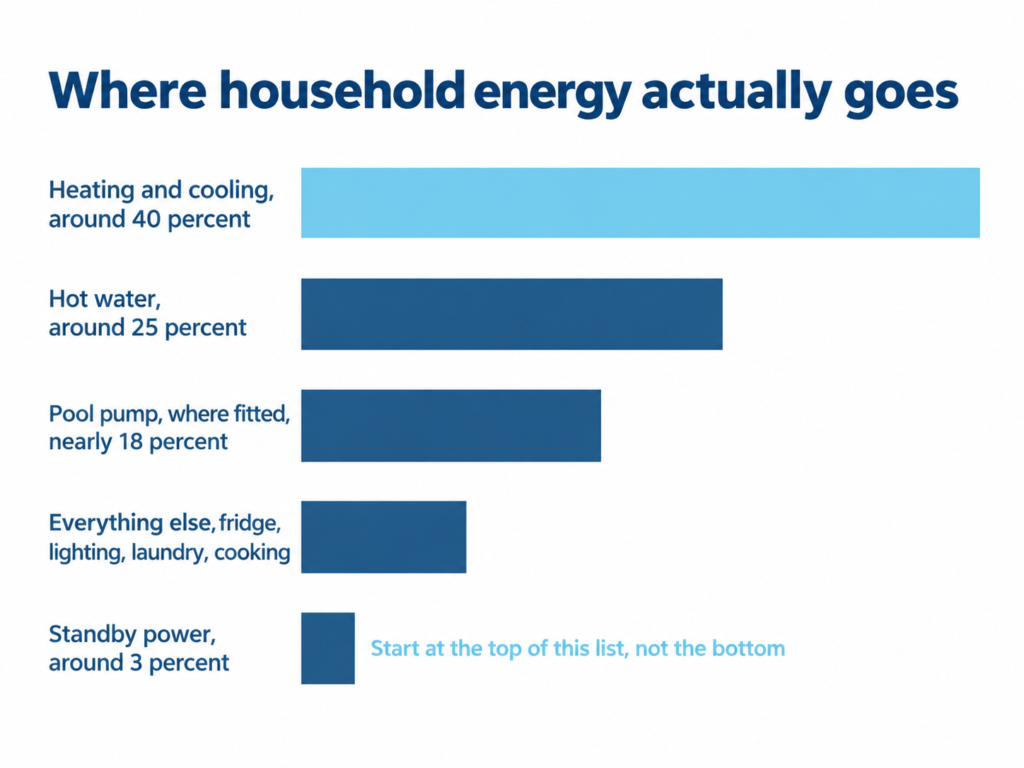
Heating and cooling can account for roughly 40 percent of household energy use. Nearly half the bill.
The fix is usually how you run the system, not replacing it.
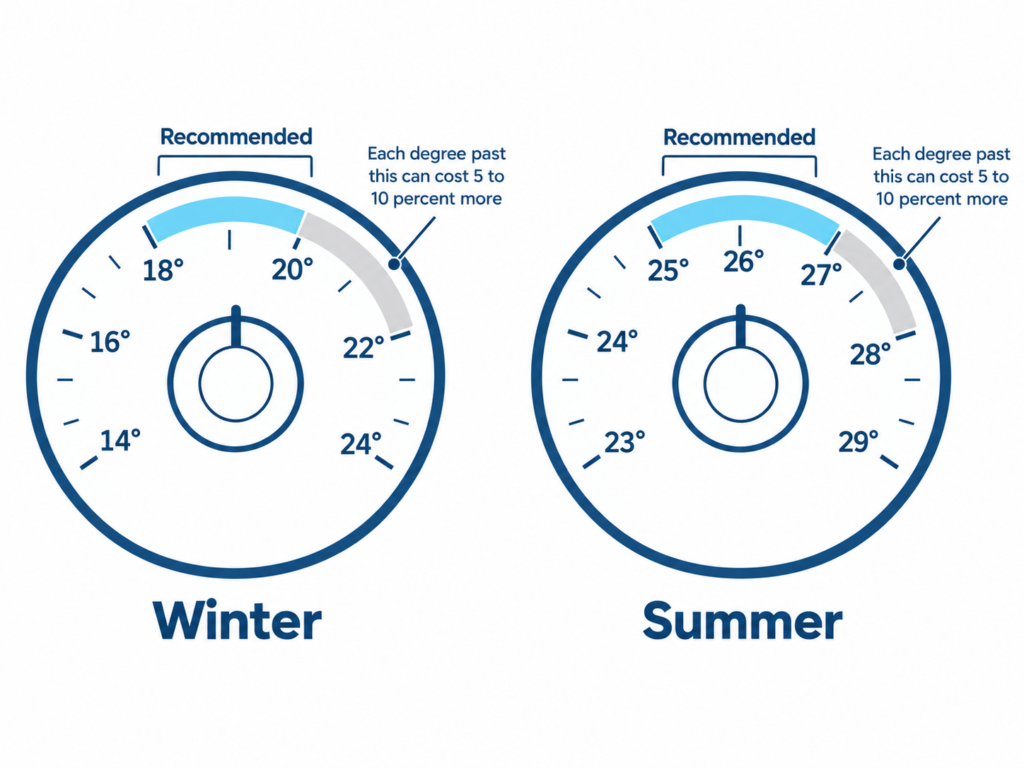
- Set heating to 18 to 20 degrees in winter, cooling to 25 to 27 in summer
- Every degree you push past that can cost 5 to 10 percent more
- Heat or cool only the rooms you are in, and close the doors
- Seal draughts around doors, windows and skirting boards, which government guidance says can cut energy use by around 25 percent in the right home
- Use fans before the air conditioner
- Close curtains and blinds
Setting the air con to 21 on a summer afternoon costs real money for a small amount of extra comfort.
4. How do you cut hot water costs?
Hot water is around a quarter of household energy use.
Four people taking long showers every day adds up fast. Shorter showers are the obvious answer, though that depends who you live with.
A four-star shower head is the cheap fix. Government estimates put the saving at around $315 a year for a family of four on water alone, before the energy saved heating it.
Wash clothes in cold water. Hot washes can use 50 to 85 percent more energy than cold.
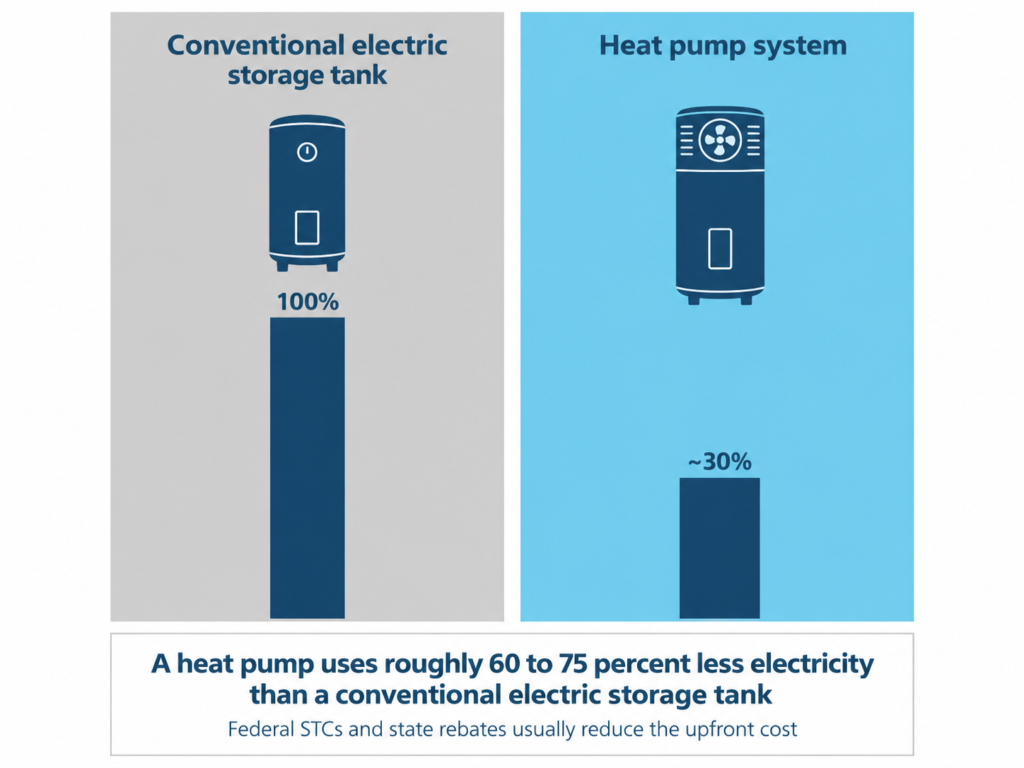
If your electric tank is near the end of its life, look hard at the replacement. A heat pump system uses roughly 60 to 75 percent less electricity than a conventional electric storage tank. Federal STCs and state rebates usually bring the upfront cost down. You can also run hot water on an off-peak controlled load if that is available to you.
5. Can you get free electricity during the day?
A unit of energy no longer costs the same at every hour.
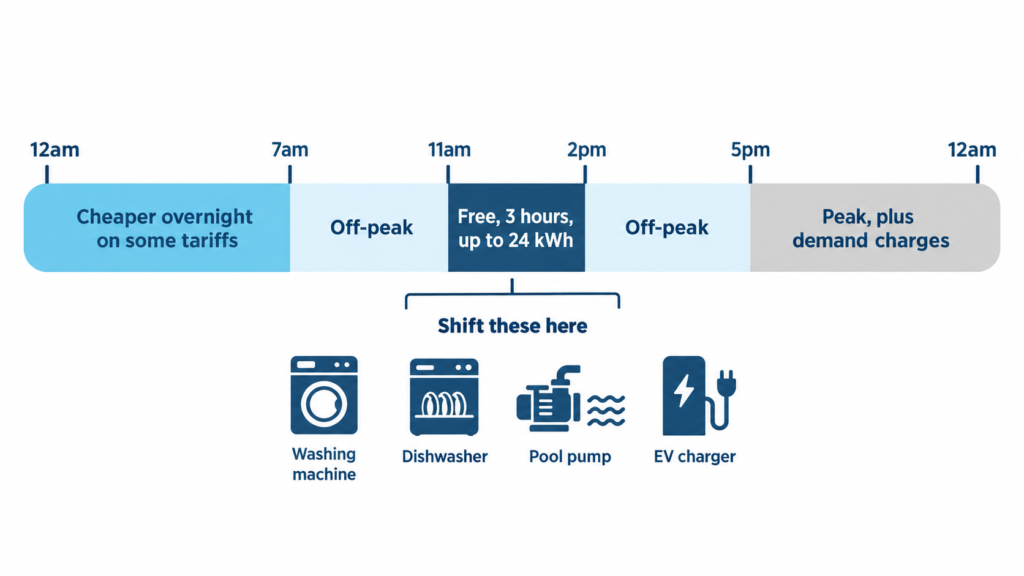
If you are on a time of use tariff, power is cheaper during the day and more expensive in the evening, which is also when demand charges usually hit. Some tariffs give you cheap overnight rates as well.
From 1 July 2026, the regulated Solar Sharer Offer gives eligible households in NSW and south-east Queensland three hours of free electricity a day, from 11am to 2pm, capped at 24 kWh. Some tariffs have no cap at all.
Shift the flexible loads into that window. Washing machine, dishwasher, dryer, pool pump, EV charging, hot water on a timer.
This is incidentally why batteries get interesting. A battery moves energy from the cheap part of the day into the expensive part. Charge for free, discharge at dinner time.
6. Which appliances are actually driving your bill?
Most people hunt the small loads and ignore the big ones.
Standby power is real, though it is only around 3 percent of total energy costs. Start with anything that runs for hours.
A pool pump is the clearest example. The Australian energy rating program puts a swimming pool pump at nearly 18 percent of the electricity used in an average Australian home with a pool. Check the timer. Check how long it actually runs. If it needs replacing, look at the energy rating, not just the purchase price.
Second fridges, old electric heaters and clothes dryers are the other usual suspects. Check the energy rating label on anything you replace, and consider a plug-in energy monitor on the high-use items.
Where that leaves you
Get on the right plan. Control the heating and cooling. Cut hot water. Move usage into cheaper and free windows. Find the big loads.
Once that is done, the real question is whether you keep renting the rest of your energy from the retailer at their rates. For some households the sums work. For others they do not. The only way to know which one you are is to model it properly.
Read next: how the free daytime electricity window actually works.
Frequently Asked Question
What is the fastest way to reduce my electricity bill in Australia?
Checking your plan. It takes a phone call and can save hundreds a year without changing anything about how you use power.
Are there government rebates available for electricity in Australia in 2026?
Yes. Rooftop solar attracts STCs, eligible batteries attract a federal discount, and heat pump hot water systems attract STCs plus state rebates in some areas. Eligibility varies by state. More detail here: what changed with the battery rebate.
What appliances use the most electricity in Australian homes?
Heating and cooling first at roughly 40 percent, then hot water at around a quarter. Pool pumps, second fridges and dryers are the common surprises.
Do I need solar to use the free electricity window?
No. The Solar Sharer Offer is a retail tariff. Anyone eligible can use it.
Is a battery worth it if I already shift my usage?
Often more so, because a battery lets you store the free and cheap energy instead of only using it live. Here is how battery sizing actually works.