Will Solar Rebates Drop in 2027?
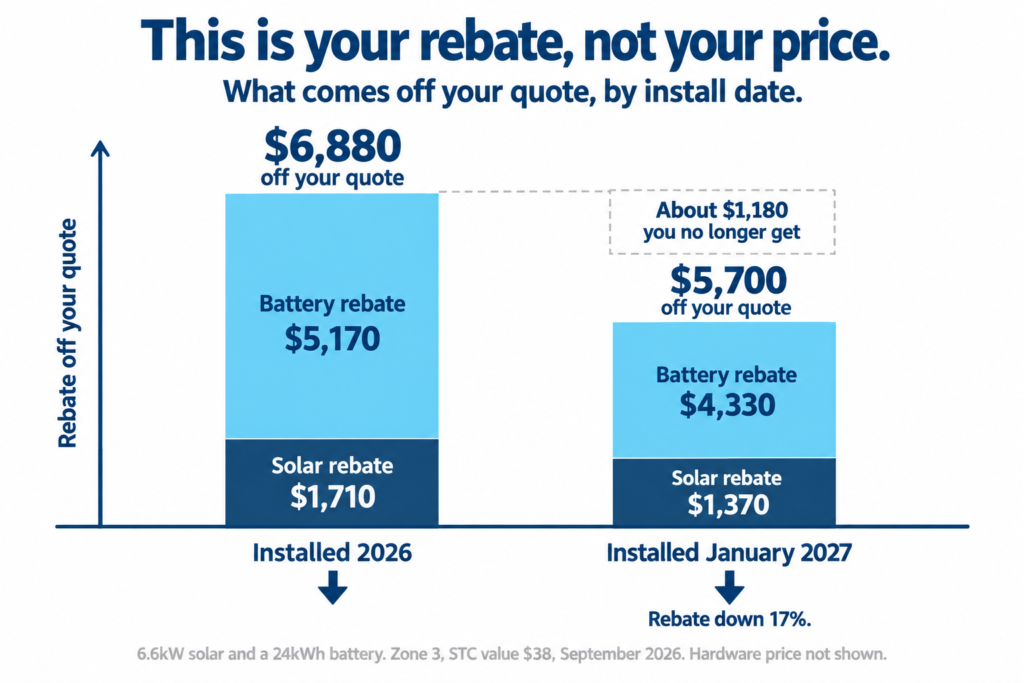
If you wait until January, a typical solar and battery install costs you about $1,174 more. The solar panel rebate drops on 1 January 2027. The battery rebate drops on the same day, then drops again on 1 July.
Nothing is being cancelled, the support just shrinks on a published schedule that runs to 2030. But wait for a larger system, or into the second half of 2027, and the loss can climb into the thousands.
Installers are booked at least a month out, so time is tight if you want a system installed this year.
Here is what it costs.
- How much the solar rebate falls in January
- What the drop is worth on a typical 6.6kW system
- The two battery step-downs coming in 2027
- What a full solar and battery system stands to lose
- Which date actually locks your rebate in
How much does the solar panel rebate drop in 2027?
The solar rebate is not a cash payment. It is a discount funded by small-scale technology certificates, or STCs. Your installer claims them and takes the value off your quote.
The number of STCs you get comes down to three things: system size in kW, your postcode zone rating, and the deeming period.
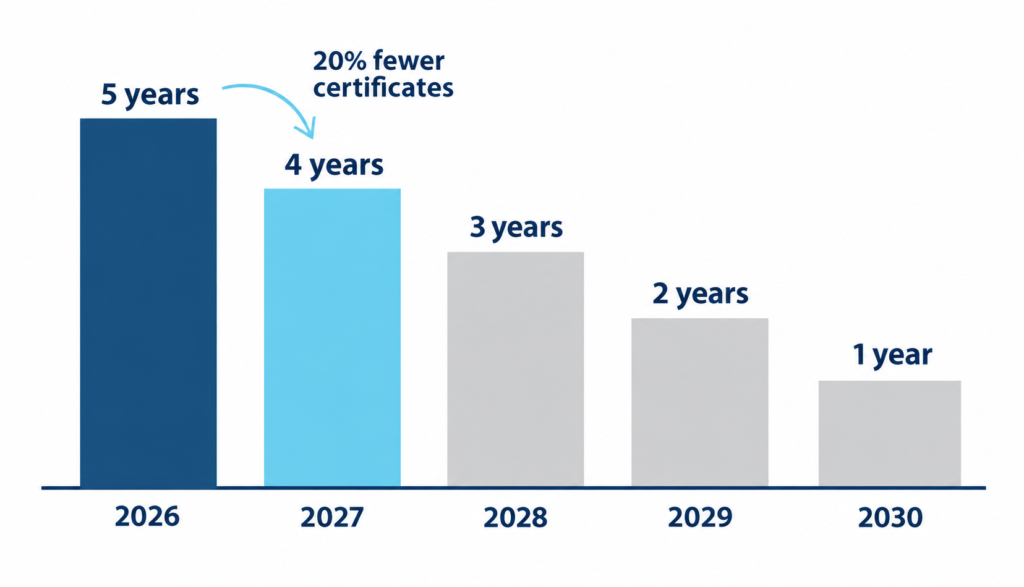
The deeming period is the bit that changes. It is the number of years of future generation the government counts upfront. In 2026 it is 5 years. In 2027 it falls to 4.
That is a 20% cut to your certificate count. Same system, same roof, fewer STCs.
This is not a one-off. The deeming period drops by a year every January until the scheme ends in 2030.
What does the solar drop look like in dollars?
Say you are putting 6.6kW on a Sydney, Canberra or Brisbane roof. Those sit in Zone 3, with a rating of 1.382.
At an STC value of around $38:
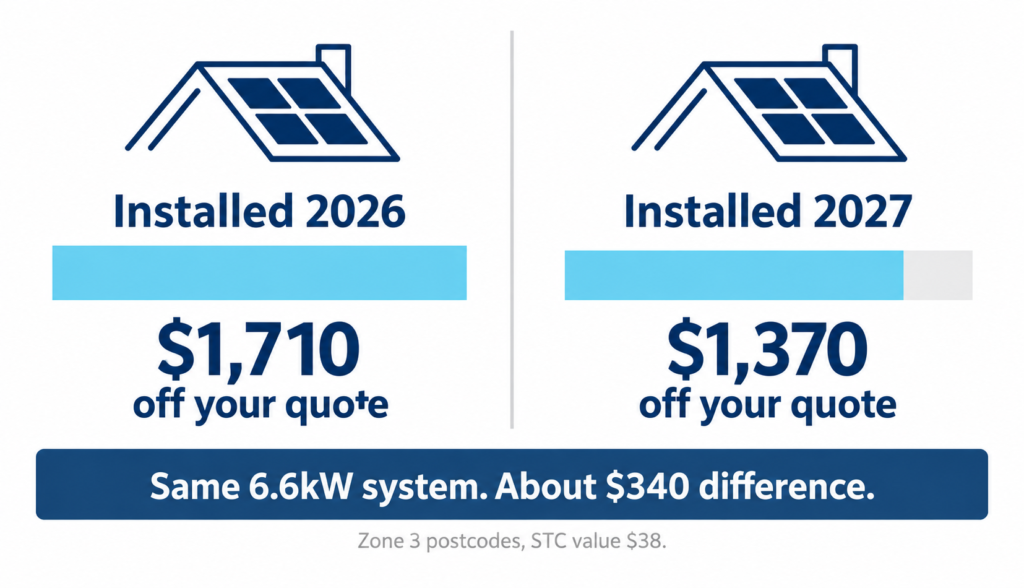
- 2026, 5 year deeming: 45 STCs, roughly $1,710 off your quote
- 2027, 4 year deeming: 36 STCs, roughly $1,370 off your quote
A difference of about $340 on the same system.
Zone ratings vary by postcode, and some parts of NSW rate higher or lower than this example.
Bigger systems lose more. A 10kW system loses closer to $530 on the same maths, and a 20kW system loses over $1,000.
Will the battery rebate drop in 2027 too?
It drops twice.
The Cheaper Home Batteries Program runs through the same STC system. Every kWh of usable battery capacity earns certificates, set by an STC factor. That factor used to move once a year. Since 1 May 2026 it moves every six months, and it falls faster than it used to.
- May to December 2026: 6.8
- January to June 2027: 5.7
- July to December 2027: 5.2
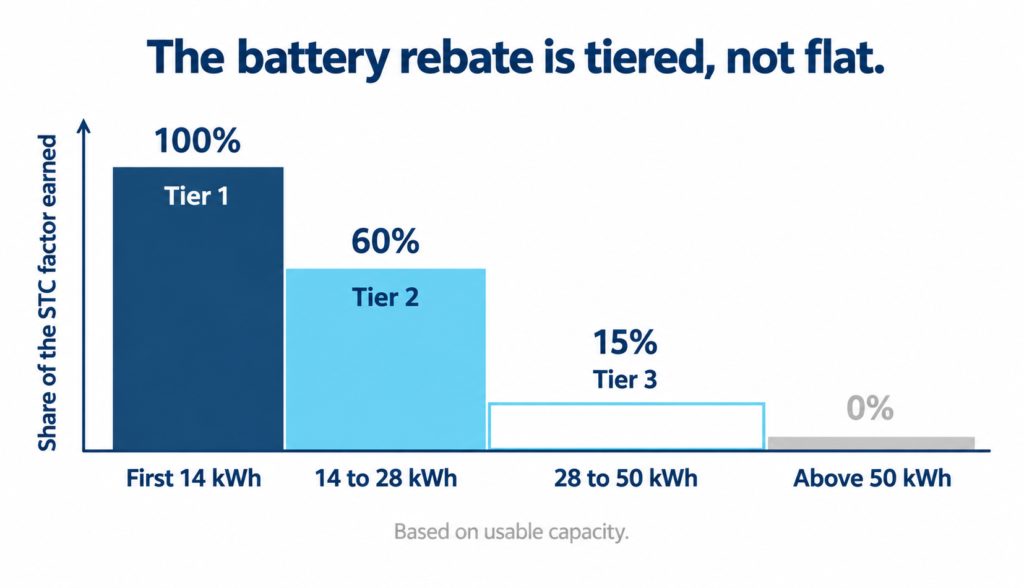
The rebate is also tiered. Your battery is paid in bands, and each band earns less than the one before it.
- First 14 kWh: 100% of the factor
- 14 to 28 kWh: 60%
- 28 to 50 kWh: 15%
- Above 50 kWh usable: nothing
So a larger battery still earns more in total. It just earns less per kWh as it grows.
How much less is your battery rebate worth in 2027?
| Battery | Size | May–Dec 2026 | Jan–Jun 2027 | Difference |
| Tesla PW3 | 13.5 kWh | ~$3,460 | ~$2,890 | ~−$570 |
| Tesla PW3 | 27 kWh | ~$5,620 | ~$4,710 | ~−$910 |
| Tesla PW3 | 40.5 kWh | ~$6,270 | ~$5,240 | ~−$1,030 |
| SigenStor | 8 kWh | ~$2,050 | ~$1,710 | ~−$340 |
| SigenStor | 16 kWh | ~$3,910 | ~$3,270 | ~−$650 |
| SigenStor | 24 kWh | ~$5,170 | ~$4,330 | ~−$840 |
| SigenStor | 32 kWh | ~$5,930 | ~$4,980 | ~−$950 |
| SigenStor | 40 kWh | ~$6,230 | ~$5,210 | ~−$1,030 |
| SigenStor | 48 kWh | ~$6,540 | ~$5,470 | ~−$1,060 |
Estimates only, rounded to the nearest $10. Based on an STC value of $38.00 as at 30 September 2026, and STC factors of 6.8 for May–Dec 2026 and 5.7 for Jan–Jun 2027. Support tapers by capacity: 100% of the factor to 14 kWh, 60% from 14 to 28 kWh, 15% from 28 to 50 kWh, and nil above 50 kWh. Your own figure will vary with the certificate price on the day and your battery’s usable capacity.
A 24kWh SigenStor, which is the size we use as a common reference for a family home, loses about $840 of rebate by moving from December to January.
Then it drops again on 1 July 2027.
Does the contract date or the installation date set your rebate?
The installation date. Nothing else.
Not the date you sign. Not the date you pay a deposit. Not the date the panels land on your driveway.
Your rebate is set by the date the system is installed and certified. A system commissioned on 31 December 2026 claims 2026 rates. The same system commissioned on 1 January 2027 claims 2027 rates.
This catches people out every year. A quote signed in November means nothing if the install slips past New Year.
If you are weighing this up, ask your installer for a commissioning date in writing, not a contract date. Read about mistakes to avoid before signing here.
So is it worth rushing?
Look, it depends on your situation.
If you were already planning a system for early next year, moving it forward a few weeks is worth a few hundred dollars for a typical solar install, and closer to a thousand on a decent battery. That is real money for the sake of scheduling.
If you are not ready, forcing it is the wrong call. A system that is not sized to suit your usage will cost you more over ten years than the rebate difference ever saved you. Learn how to size a solar battery to your household usage here.
Sometimes, for some homes, the numbers do not stack up yet. That is a fair answer too.
The rebate is not going away. It is stepping down on a schedule you can plan around. Install when your home is ready, and know what the date is worth.
Read next: Sigenergy vs GoodWe Battery: The Key Differences
Frequently Asked Questions
How much will the solar rebate drop in 2027?
The deeming period falls from 5 years to 4, which cuts your certificate count by about 20%. On a 6.6kW system that is roughly $340 less off your quote.
Does the contract date or the installation date determine my solar rebate?
The installation and certification date. Signing a contract in 2026 does not protect you if the system is commissioned in 2027.
Will the Cheaper Home Batteries rebate also drop in 2027?
Twice. The STC factor falls from 6.8 to 5.7 on 1 January, then to 5.2 on 1 July.
Are the rebates ending in 2027?
No. Both schemes run to the end of 2030. The support reduces each year until then.