Sigenergy vs GoodWe Battery: The Key Differences
Sigenergy vs Goodwe, the two biggest battery brands on the market right now. They look similar, but every day I have clients asking me what are the actual differences between them.
Here at Lenergy we prefer Sigenergy. This article will break down exactly what the real differences are and how they will actually impact your user experience.
- How the two platforms differ once you look past the casing
- The warranty number that separates them most clearly
- What the software does to your bills over ten years
- Why the installer matters more than either badge
What is the difference between Sigenergy and GoodWe batteries?
Both are all-in-one home energy storage systems. An inverter or energy controller sits on top of a stack of battery modules. Both offer whole-home backup, app control and the option to add capacity later. Both use lithium iron phosphate cells, the safer chemistry for a home.
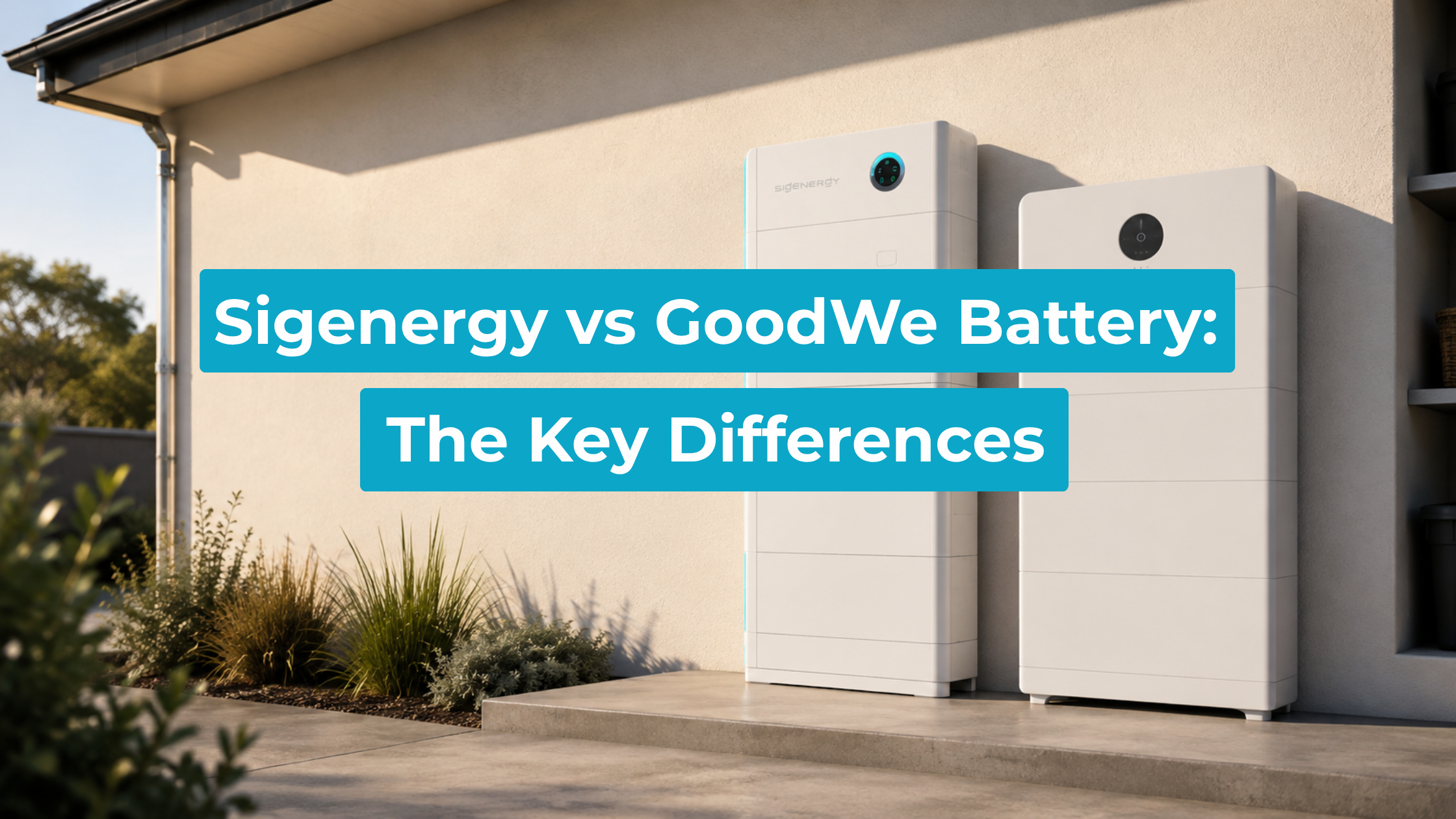
The Sigenstor stormed the market when it was first introduced and has set the standard for batteries since with its innovative all-in-one design. Some say Goodwe was copying Sigenergy’s homework when designing their battery and it certainly looks like it. However, once we get into what’s underneath the differences are clear.
Copying a shape is the easy part. Rebuilding the engineering and the software behind it takes years.
How do the Sigenergy and GoodWe specs compare?
| Sigenergy SigenStor | GoodWe ESA | |
| Usable capacity per module | Around 9 kWh | Around 8 kWh, 8.32 kWh total |
| Cell format | 314 Ah class, fewer and larger | More cells, smaller format |
| Cycle rating | 10,000 | 8,000 |
| Warranted throughput | ~3.7 MWh per usable kWh | ~3.0 MWh per usable kWh |
| Backup transfer time | 0 ms | Around 4 ms |
| Integrated DC EV charging | Yes, 25 kW module | No equivalent |
| V2G and V2H hardware pathway | Yes | Not currently |
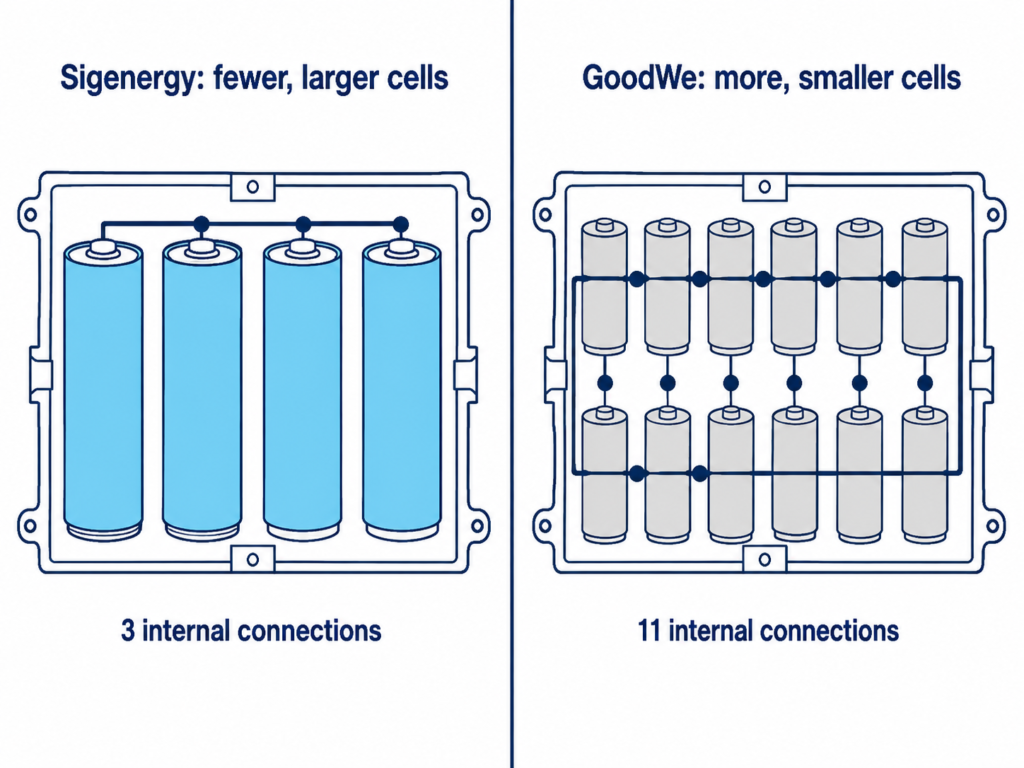
Amp hours (Ah) measure how much charge a single cell holds. A 314 Ah cell stores about 1 kWh on its own, so a 9 kWh module needs around nine of them. Smaller cells mean you need more of them, and more internal connections to join them up.
Fewer, larger cells means fewer internal connections. Fewer connections means fewer places for something to go wrong across fifteen years. That does not guarantee a longer life on its own. Cell quality, thermal management and the battery management system all matter too. It is simply a design choice we are more comfortable with.
Does the warranty difference actually matter?
This is the clearest measurable gap, and it is worth a minute of your time.
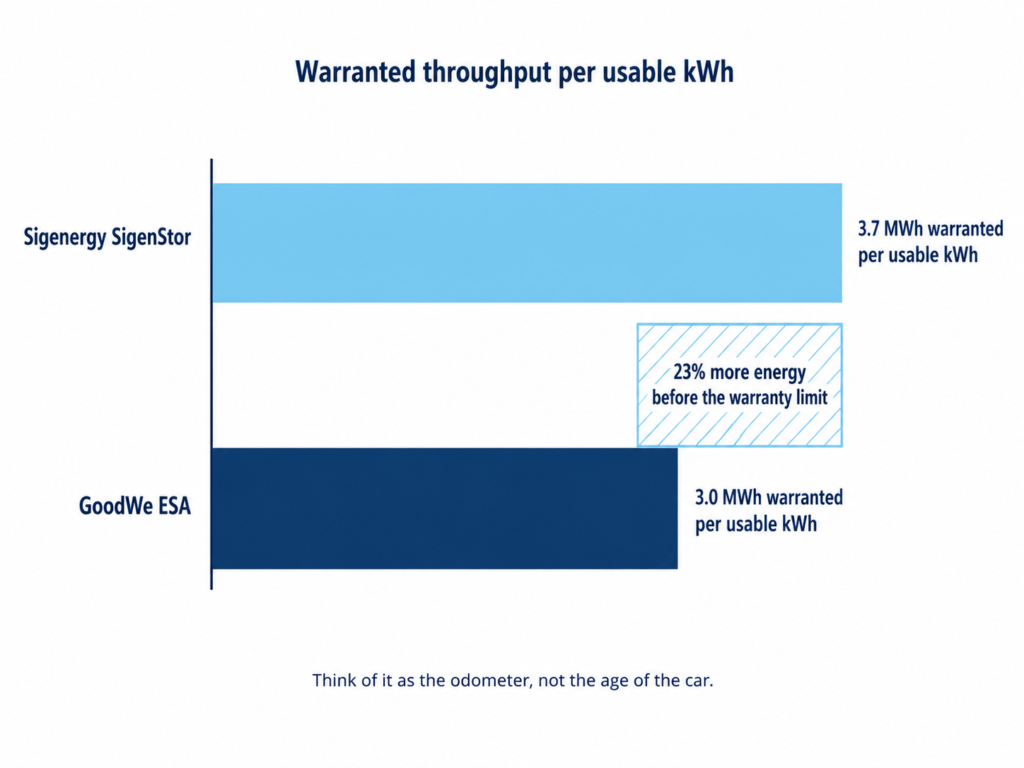
Throughput is the total energy a battery can pass through before the performance warranty limit is reached. Think of it as the odometer rather than the age of the car.
Sigenergy’s Australian warranty lists around 3.7 MWh of warranted throughput for every usable kWh of capacity. GoodWe’s lists around 3.0 MWh. On a comparable capacity basis, that is roughly 23% more energy through the battery before the guarantee runs out.
Whether that matters depends entirely on how you use it.
Say your battery does one gentle cycle a day. Solar fills it, the house empties it overnight. Neither battery will get near its limit inside ten years.
Now say you are on a time-of-use tariff. You charge from solar through the middle of the day. You discharge into the evening peak. You charge again on cheap overnight rates. You join a VPP and the battery discharges when wholesale prices spike. That is two or three cycles a day, and the odometer climbs quickly.
For that household, 23% more headroom is not cosmetic. It is the difference between a warranty that lasts the distance and one that runs out early. As the electricity grid becomes increasingly dynamic this is becoming a more important spec for batteries.
What does the battery software actually do for you?
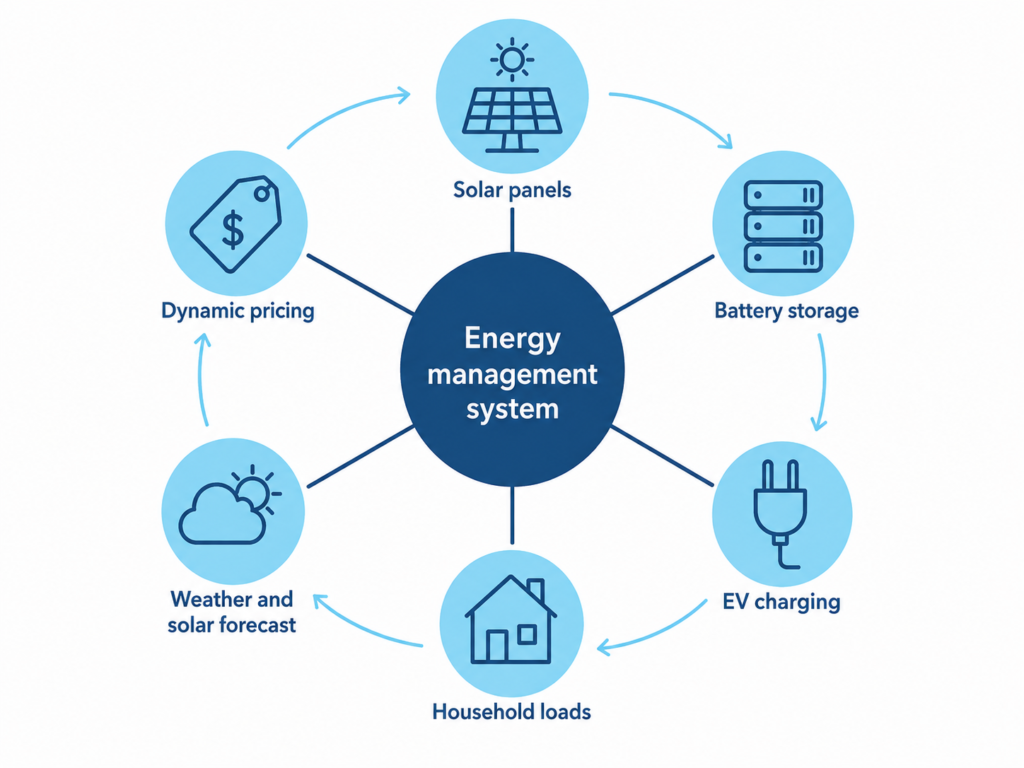
Software is one the bigger differences, Sigenergy built its ecosystem around one coordinated system from the start. Solar, battery, inverter, gateway, smart loads and EV charging all talk to each other. The mySigen app pulls in your household consumption, solar forecasts and weather data, then works out when to charge and when to discharge.
GoodWe has added AI scheduling, dynamic pricing support and its SEMS platform. The features exist. The platform is less mature.
Now, here is why we care about this more than the spec sheet.
Your electricity bill is getting more complicated, not less. Feed-in tariffs keep falling. Time-of-use pricing is spreading. VPP payments and dynamic tariffs all reward a battery that can think about timing.
A battery that cannot respond to that is not ready for the increasingly dynamic trajectory of the Australian grid.
Is Sigenergy better than GoodWe if you drive an EV?
Yes, and this is one of the clearer gaps between them.
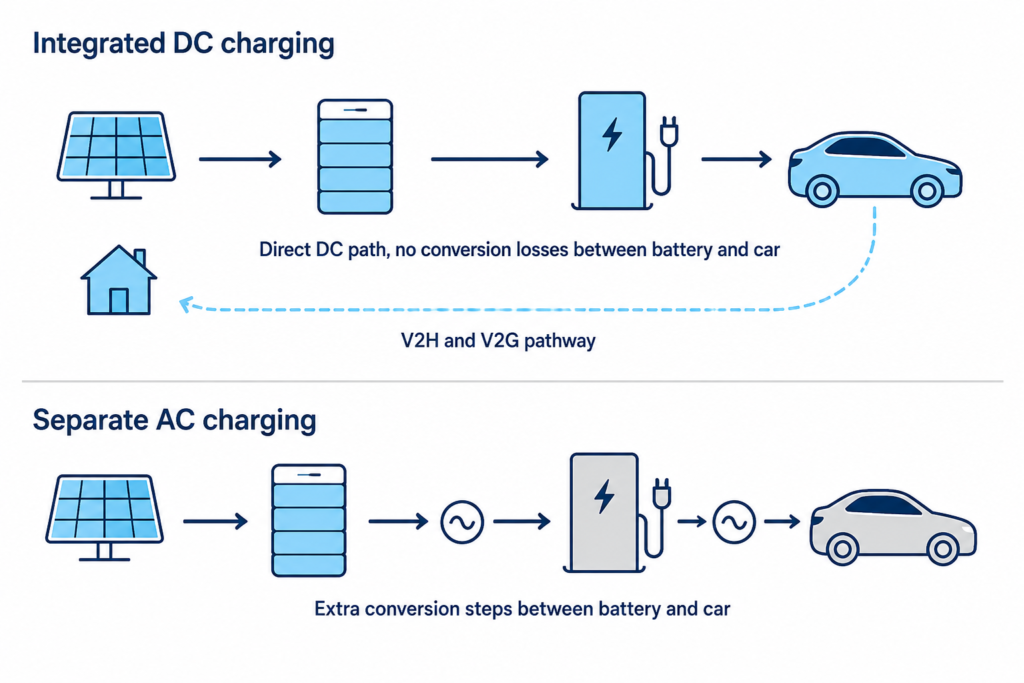
Sigenergy offers an integrated 25 kW DC EV charging module that sits in the same tower. It draws directly from solar, battery or grid. It is also built for vehicle-to-home and vehicle-to-grid, so your car’s battery can eventually support the house.
GoodWe sells EV chargers. It does not currently offer an equivalent integrated DC module or the same bidirectional readiness.
If an EV is in your plans over the next five years, this is worth real money. If it is not, skip past this one. It does not apply to you.
Can you avoid running a cable to the switchboard?
With Sigenergy, often yes. Your battery needs to know how much power the house is drawing, and a sensor at the switchboard reports that back. Normally over a data cable that has to be physically run between them.
Sigenergy offers a wireless kit that does the same job without the cable. It works to around 200 metres and handles walls and electrical noise well. GoodWe does not currently offer an equivalent official kit.
On a straightforward install this will not matter. On a property where the switchboard and battery sit far apart, or where running cable is difficult and expensive, it removes a common headache and keeps everything inside the one system.
Which differences impact you less than you might think?
| Difference | On paper | In your home |
| Safety design | Sigenergy uses five protection layers including aerogel insulation and internal fire suppression. GoodWe uses LFP cells, aerosol suppression, heating and multiple electrical safeguards | Neither is unsafe. Sigenergy’s package is the more considered design. |
| Backup switchover | 0 ms against roughly 4 ms | A technical win for Sigenergy but your appliances will barely notice either one |
| Mixing old and new modules | Sigenergy did it first with per-module optimisers. GoodWe now offers similar flexibility | Gap closed. Both let you expand later |
What is the risk of the cheaper batteries?
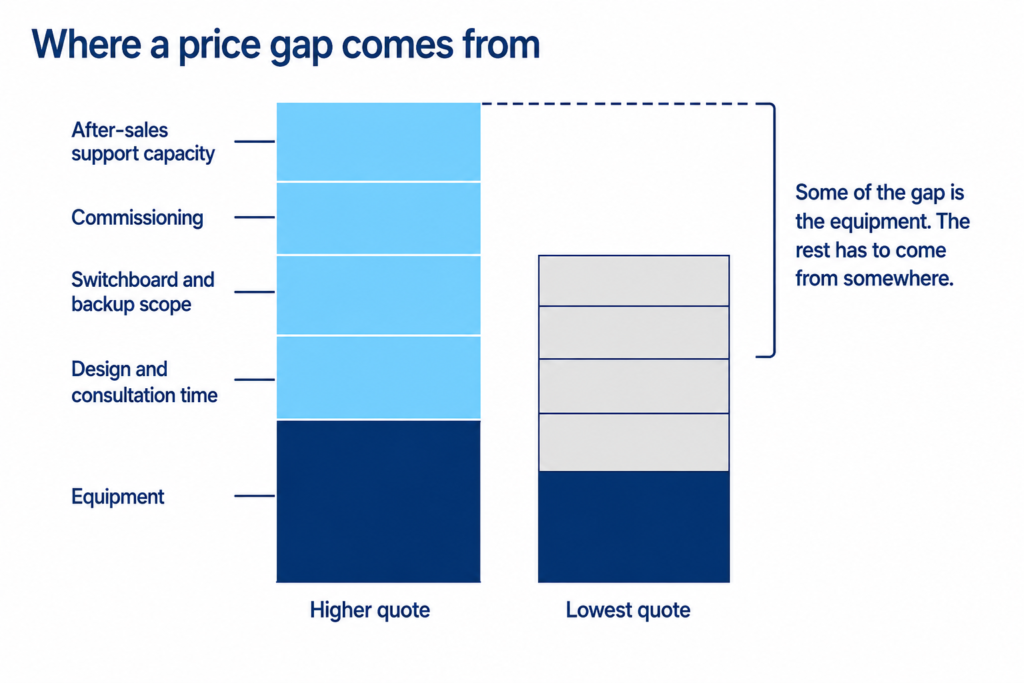
The GoodWe is a good battery. However, you have to be careful about what a low price tends to attract. A quote that competes purely on price has to find that money somewhere. Some of it is the equipment, which is fair enough. The rest can come out of design time, consultation, backup scope, switchboard compliance work, commissioning, or the margin that pays for someone to come back when something needs attention in year six.
So compare what is actually included. Two quotes carrying the same battery can be very different jobs.
Sigenergy vs GoodWe: which battery should you buy?
We prefer Sigenergy, and we will say it plainly. Stronger architecture, more warranted throughput, more mature software, a clearer EV pathway. Across ten to fifteen years we think the extra cost comes back.
What matters most when considering a battery is who installs it.
Both batteries are a significant investment into your home and you are entering into a relationship with the company that installs it. If all goes well this could be for 10-15 years, at the end of the day you want a company that will still be there for you.
Check the installer holds SAA accreditation. Check the ABN history, read the reviews, and pay attention to how the company replies to the negative ones. Ask for public liability and professional indemnity cover.
This is probably the largest electrical upgrade your home will ever have. Take the time to get it right.
Read next: The problem with cheap home battery quotes
Frequently asked questions
What are the main differences between Sigenergy and GoodWe batteries?
Cell architecture, cycle rating, warranted throughput, software maturity and EV integration. Sigenergy leads on all five. GoodWe comes at a lower price. The differences that matter most to you depend on how hard you plan to work the battery.
Is Sigenergy or GoodWe more compatible with existing solar systems?
Both are all-in-one systems designed around their own inverter rather than bolted onto an existing one. If you already have solar, either can be retrofitted, though the design work differs depending on your current inverter, its age and your switchboard. This is a question for a site assessment rather than a spec sheet.