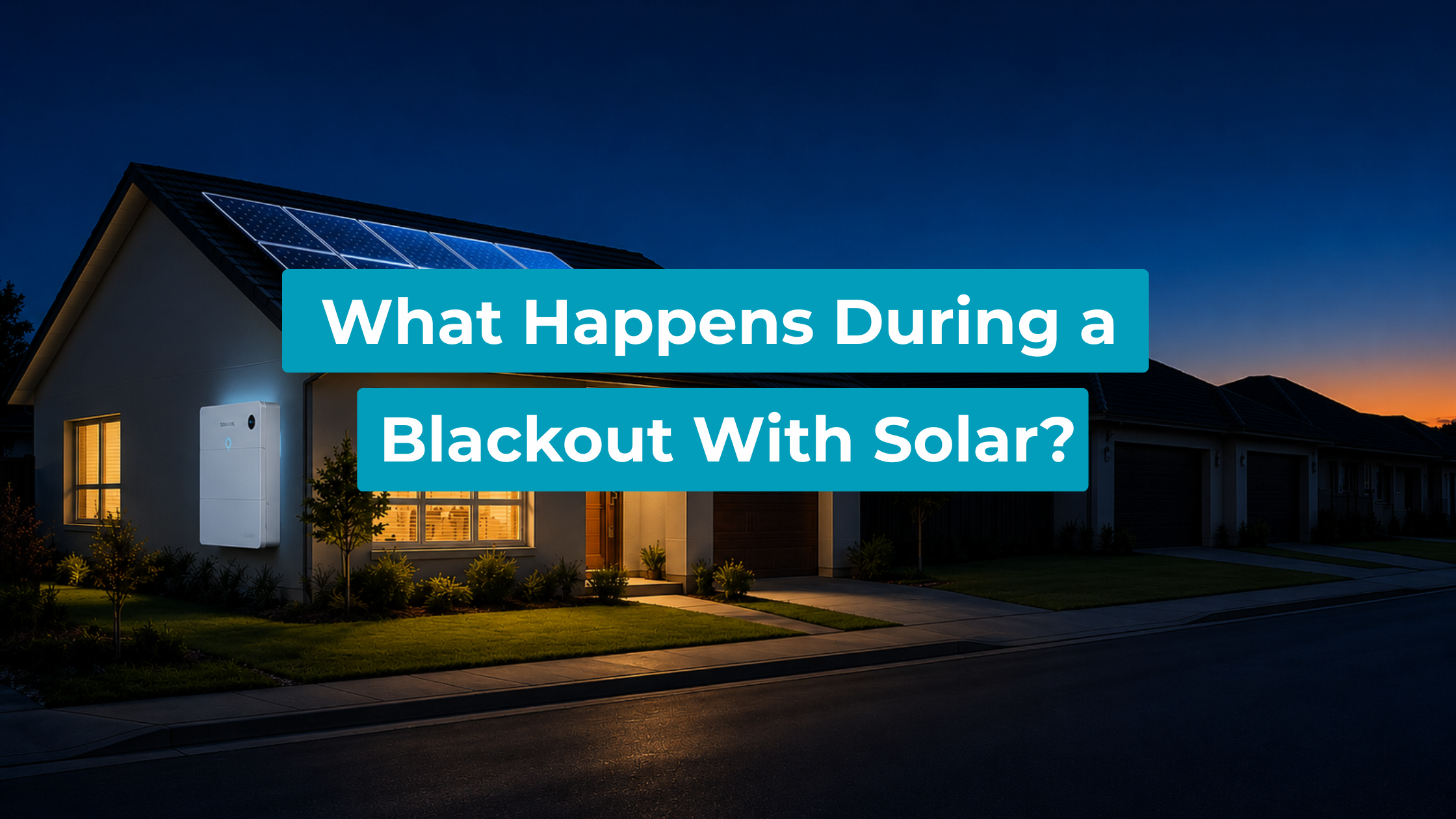
What Happens During a Blackout With Solar?
Most Australian homes with solar go dark during a blackout. Even on a sunny day. Even with panels on the roof. Here’s why that happens, and exactly what it takes to keep your power on when the grid fails.
The short answer: standard solar alone will not save you.
This article walks through what your solar system actually does during a power outage, why it shuts off, what types of systems can keep running, and what you should be asking before your next upgrade.
Do Solar Panels Still Generate Power During a Blackout?
Yes, and this is the part that surprises most people. Your solar panels are generating DC electricity whenever there is enough sunlight.
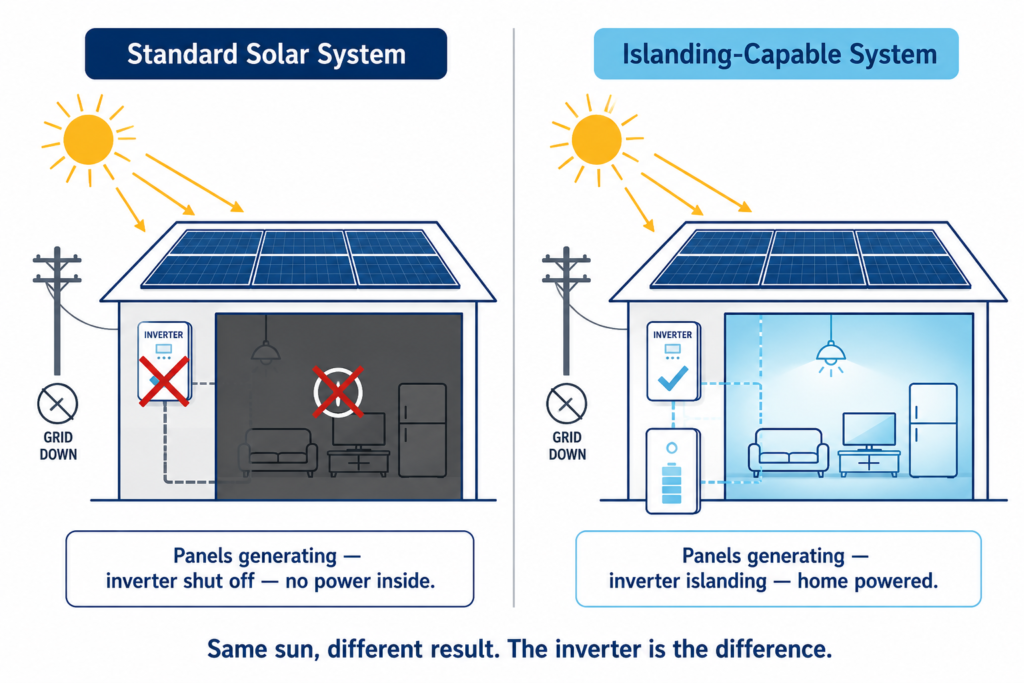
The problem is not the panels. It is what happens next. That DC electricity has to pass through your inverter before it becomes usable AC power for your home. During a blackout, most inverters in Australia shut themselves off completely. The energy your panels are generating has nowhere to go.
So yes, your panels are working. No, that does not mean you have power.
Why Does My Solar System Turn Off When the Grid Goes Down?
The vast majority of solar systems installed in Australian homes are grid-tied. When the grid fails, these systems shut down immediately.
This is called anti-islanding protection or backfeed protection, and it is required by Australian Standard AS/NZS 4777.2. Every grid-connected inverter sold in Australia must comply with it.
Why the Shutdown Exists
When there is a blackout, the power lines running down your street are de-energised. Network crews go out to work on those lines to restore supply. If your solar system kept pushing electricity back into those lines while someone was on them, it could kill them.
Your inverter detects the loss of grid power and cuts the connection automatically.
The result: even on a bright sunny day, your panels keep generating and your inverter does nothing with it. Lights out, appliances off, same as your neighbours who have no solar at all.
When Can Solar Keep Working During a Power Outage?
There are certain inverters that are capable of what is called islanding. Islanding is when an inverter safely disconnects from the grid, forms a self-contained power network just for your home, and keeps supplying power from solar and battery.
Grid-Following vs Grid-Forming: The Core Difference
A standard grid-tied inverter is what engineers call grid-following. It needs the grid’s AC signal as a reference to operate. When that signal disappears, the inverter has nothing to follow and shuts itself down. It is both a hardware and a software limitation, not a setting you can change.
An islanding-capable inverter is grid-forming. It generates its own stable voltage and frequency without needing the grid as a reference. When the grid drops, it disconnects from the street, forms its own micro-grid for your home, and keeps solar running through it.
How fast this transition happens depends on the inverter. Most hybrid systems switch over in under 30 milliseconds, which most people will not even notice. Some brands are considerably slower. Fronius, for example, can take up to 30 seconds to switch over, which is enough time for lights to go out and electronics to reset. Sigenergy is on the other end of the scale, with a changeover described as instant, effectively 0ms, so there is no interruption at all.
This is one of the reasons switchover speed is worth asking about directly when comparing systems. A 30 second gap is the difference between an unnoticed blip and your fridge resetting, your router dropping out, and anything running off a small motor needing to restart from scratch.
What Types of Inverter Can Do This?
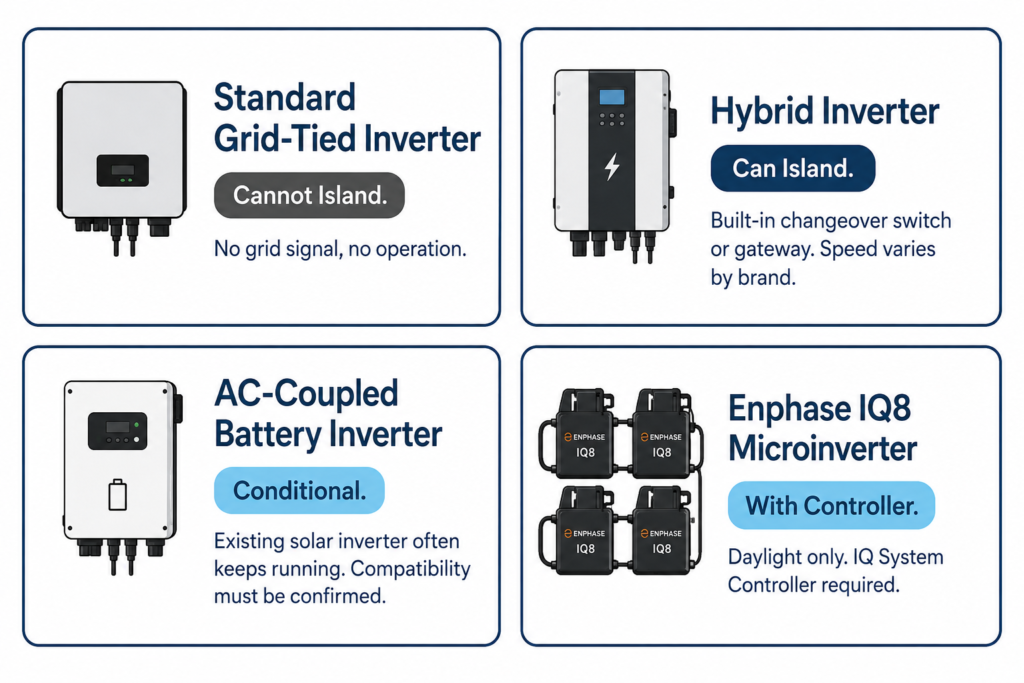
Not all inverters are equal when it comes to blackout capability. Here is how the main options stack up:
| Inverter Type | Can Island? | Notes |
| Standard grid-tied string inverter | No | Cannot island under any circumstances. Hardware limitation, no workaround. Covers most Australian homes. |
| Hybrid inverter (integrated) | Yes | Most common solution. Built-in automatic changeover switch, or a separate gateway that handles the changeover. Grid-forming capability. Switchover speed varies by brand, from instant (0ms) to as long as 30 seconds. |
| AC-coupled battery inverter (retrofit) | Yes, with conditions | A hybrid (multi-mode) system on the backup side can island, and your existing solar inverter often keeps running through it. Compatibility must be confirmed. See below for how this works. |
| Enphase IQ8 microinverter | Yes, with system controller | Can island on solar alone during daylight hours without a battery. Requires IQ System Controller to enable backup mode. |
The takeaway: it is the inverter, not the panels, that determines whether your solar system can keep you powered during a blackout. Your panels are fine either way. The electronics managing them are what matter.
Adding a Battery Without Replacing Your Solar Inverter
If you already have solar, you can often get blackout protection without replacing your existing inverter. A hybrid (or multi-mode) battery system handles this on the backup side, and your original solar inverter keeps contributing during the outage. The short version:
- When the grid drops, the hybrid inverter grid-forms its own clean AC signal for your home
- Your existing solar inverter cannot tell this apart from the real grid, so it keeps running or switches back on automatically
- As the battery nears full charge, the hybrid throttles your solar inverter back via frequency shifting, so the battery is not overloaded
Whether this works smoothly depends on the specific hybrid and solar inverter combination, so compatibility needs to be confirmed before you commit. For the full explanation of how this works, we go into it in detail in our other article on How a Solar Battery Protects You During a Blackout.
What Are the Practical Realities for Australian Homes?
Three-Phase Homes
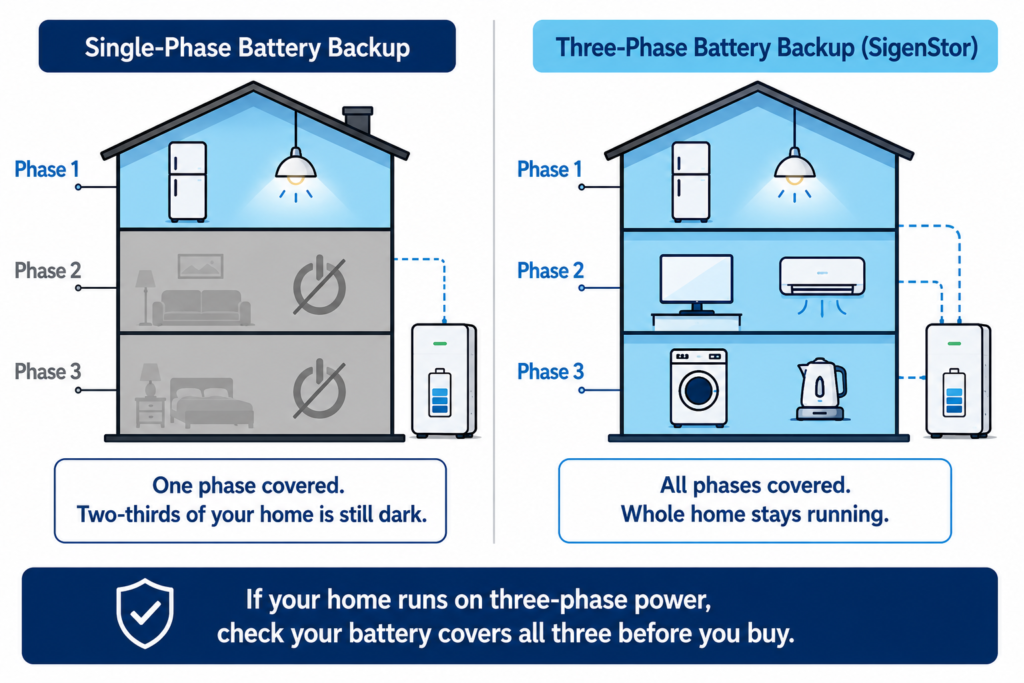
Three-phase power is common in Australian homes, particularly newer builds and properties with large appliances, ducted air conditioning, or EV chargers. Many backup systems only protect a single phase during an outage, which means two-thirds of your home stays dark regardless of what solar or battery you have.
If your home runs on three-phase power, you need a system that supports three-phase islanding. The Sigenergy SigenStor handles this. It supports both single-phase and three-phase homes and maintains backup across all phases during an outage.
Do You Need a Battery for Solar to Keep Running?
In most practical setups, yes. A small number of advanced inverters can operate on solar alone during daylight without a battery, but they are the exception. Without storage, your solar output has to match your home’s demand in real time, and any variation in generation or load can cause the system to become unstable.
A battery absorbs that variation and gives you a buffer to draw from at night or when cloud cover reduces generation. Most homes that want reliable emergency backup power pair an islanding-capable inverter with battery storage to cover both day and night. Not all solar & battery systems have this capability.
How a Solar Battery Keeps Your Home Running
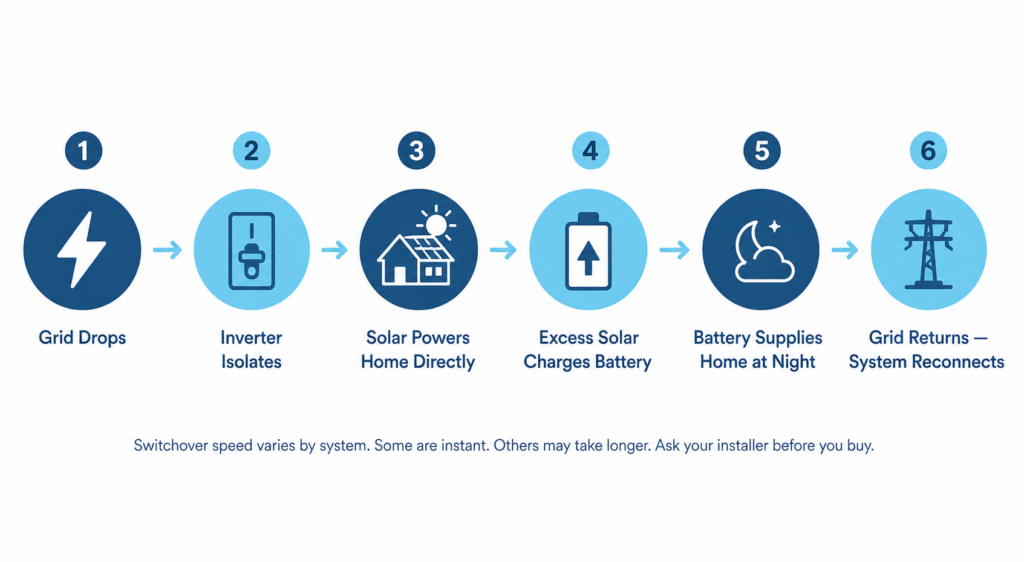
A battery is what makes solar battery blackout protection possible. Here is how a well-configured system handles a blackout from start to finish:
- The grid drops. The inverter detects this in milliseconds and disconnects your home from the street network
- The system switches to island mode. This experience varies significantly according to the battery system installed, some are instantaneous and some have to be manually switched over.
- During the day, solar panels continue generating and power your home directly
- Excess solar charges the battery in real time
- At night, or during cloud cover, the battery takes over and supplies the home
- When the grid returns, the system reconnects automatically and returns to normal operation
The Sigenergy SigenStor
The SigenStor combines a hybrid inverter, battery storage, and an Energy Gateway into a single integrated system. During a blackout it detects grid failure automatically, switches to island mode, and keeps solar generating and charging the battery throughout the outage. Capacity is scalable, so the system can be sized to cover just your critical circuits or your whole home depending on what you need.
The three-phase support is worth highlighting again here. A lot of batteries on the market back up one phase. The SigenStor can back up all three, which is the difference between your fridge and a few lights staying on versus your whole home running normally.
What Should You Actually Do?
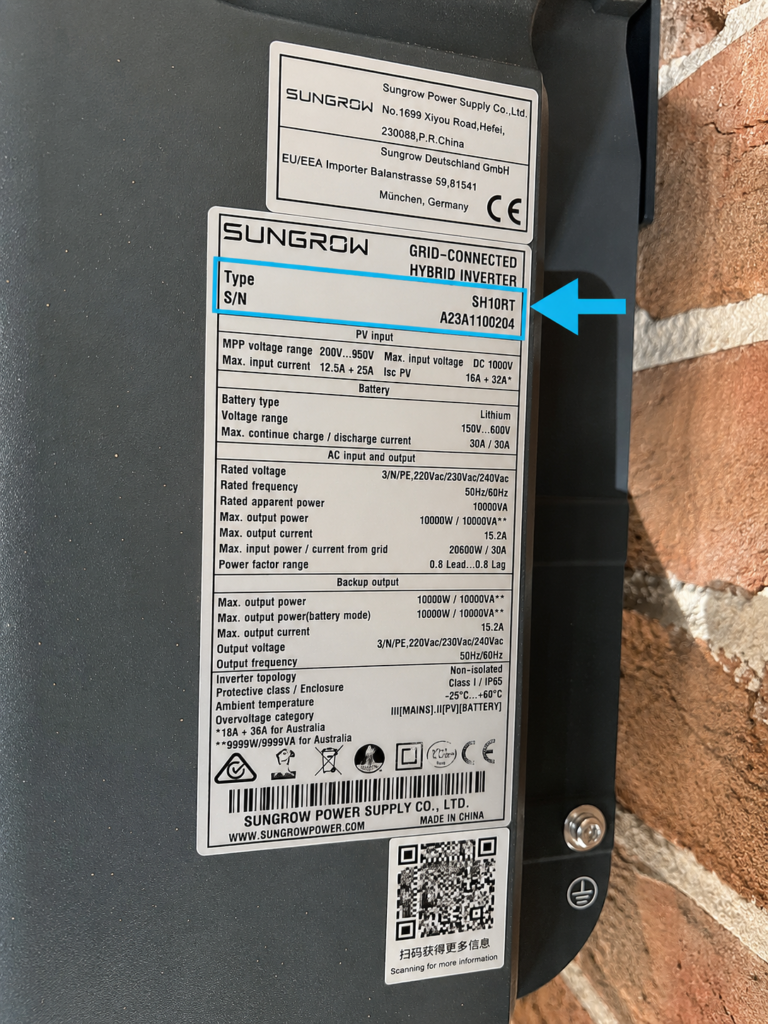
Start by finding out what inverter you have. If you already have solar, look at the unit on your wall, find the model number, and check whether it has islanding or backup capability. If you are not sure, call your installer and ask directly: does my system allow solar generation to continue in island mode during a blackout? The answer tells you exactly where you stand.
If you are getting solar for the first time, build blackout protection into the brief from day one. Tell your installer it matters to you and ask which inverter makes it possible. It is a much simpler conversation before equipment is selected than after.
Work Out Your Critical Loads First
Think about which appliances matter most during an outage and group them into these categories:
- Critical loads: fridge, lights, phone charging, medical equipment, internet router
- Comfort loads: air conditioning, electric cooking, hot water
- High-draw loads: EV charging, pool pumps, workshop equipment
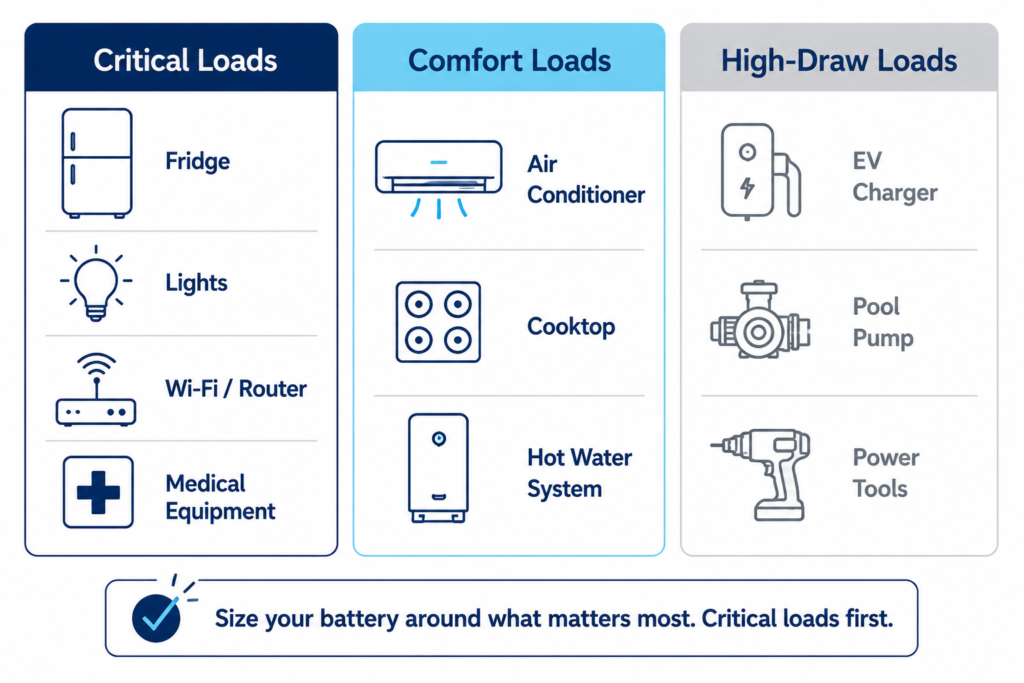
A system sized around critical loads is considerably smaller and cheaper than one designed to run the whole home. Knowing your priority upfront makes the design conversation much simpler and keeps the quote realistic.
Once your system is installed, use the manufacturer app to monitor it. During an outage, real-time visibility tells you how much battery you have left, whether solar is topping it up, and how long your supply will last at current usage.
Talk to Lenergy
Here at Lenergy we design solar, battery and EV setups for Aussie homes. If you want to know whether your current system has any blackout protection, or you want to understand what a battery upgrade would actually give you, we can walk you through it. Send us a message and we’ll give it to you straight.
Frequently Asked Questions
Why does my solar system turn off during a blackout if the sun is still shining?
Your inverter shuts down automatically because of a safety requirement called anti-islanding protection or backfeed protection, mandated under Australian Standard AS/NZS 4777.2. When the grid goes down, the power lines in your street are de-energised and network crews go out to work on them. If your solar system kept pushing electricity into those lines, it would be dangerous for anyone working on the network. The inverter detects the loss of grid power in fractions of a second and disconnects. It is not a fault in your system. It is the law.
Can I add a battery to my existing solar system to get blackout protection?
In many cases yes. Whether you get genuine blackout protection depends on the hybrid, or multi-mode, inverter you choose. When the grid drops, a multi-mode inverter switches to off-grid mode and grid-forms, meaning it generates its own clean AC signal for your home. Your existing solar inverter has no way of knowing this isn’t the real grid, so it typically keeps running or restarts on its own. This means you can often keep your existing solar inverter and still get blackout power, without replacing it.
There is a catch. With no grid to export excess power into, the battery will eventually approach full charge, and something needs to stop your solar inverter from overproducing at that point. The hybrid inverter handles this through frequency shifting, sometimes called frequency curtailment, where it nudges the AC frequency slightly out of range to signal your solar inverter to throttle down. Not every hybrid and solar inverter combination supports this cleanly, so compatibility needs to be confirmed before you commit. If you are starting fresh or replacing your inverter anyway, an integrated hybrid inverter gives you everything in one unit and is the simpler path to full blackout protection.
What size battery do I need to power my home during a blackout?
It depends on which appliances you need to run and for how long. A fridge, some lights, phone charging, and your internet router can typically be covered by a 10 kWh battery for 12 to 24 hours. If you want to run air conditioning, electric cooking, or an EV charger during an outage, you will need considerably more capacity. The right approach is to work out your critical loads first, then size the battery and solar system around that. Lenergy can work through this with you based on your actual energy usage.
Is now a good time to add a battery for blackout protection?
Battery prices have come down considerably over the last few years and continue to drop. State-based rebate programs in some parts of Australia also reduce the upfront cost. That said, the right timing depends more on your situation than the market. If you are in a high-risk area for outages, rely on power for medical or work reasons, or simply want to stop being dependent on the grid, the case for acting sooner is clear. Getting a quote now at least gives you a baseline to work from.
Does a solar battery work during a blackout when it is cloudy?
Yes. Once the battery is charged, it supplies power to your home independently of what the sun is doing. Your panels will still generate some electricity on cloudy days, though at reduced output, and that continues to top up the battery when it can. A well-sized system will get you through overnight and into the next day on stored energy alone. The battery does not need sunshine to discharge.