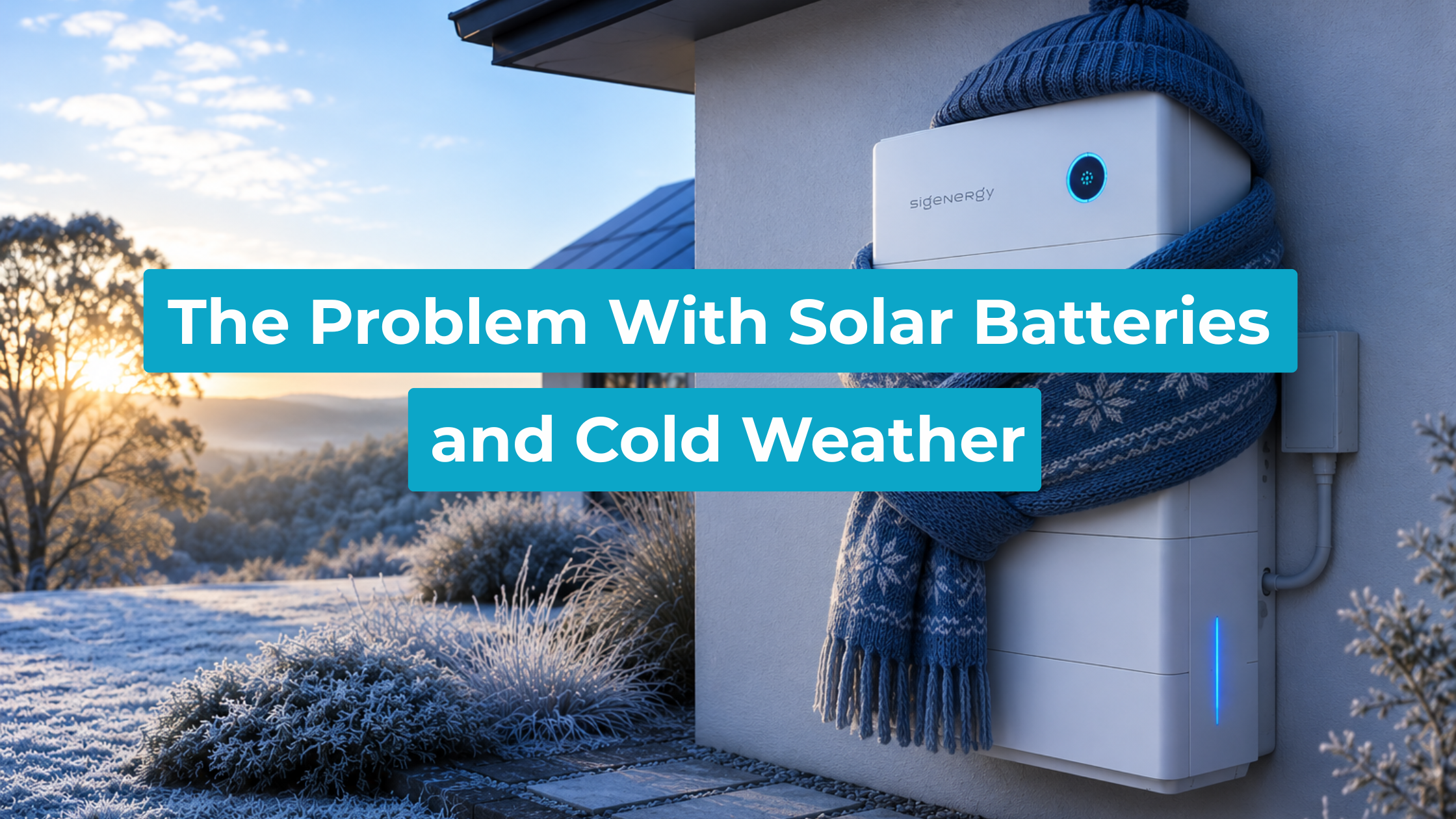
The Problem With Solar Batteries and Cold Weather
On the coldest mornings, a solar battery can lose up to half its usable energy. It isn’t broken. That’s cold weather at work.
Cold slows the chemistry, slows charging, and trims what you can actually use. It rarely damages a good battery. It can leave a cheaper one stalling when you need it most. The fix comes down to two things. Pick a battery built for the cold. Put it in the right spot.
This article covers:
- Why cold weather affects solar battery performance
- What happens to charging when temperatures drop
- Whether it really matters in NSW and the ACT
- How to protect your battery through winter
- How the SigenStor is built to handle it
Why does cold weather affect solar battery performance?
It comes down to chemistry.
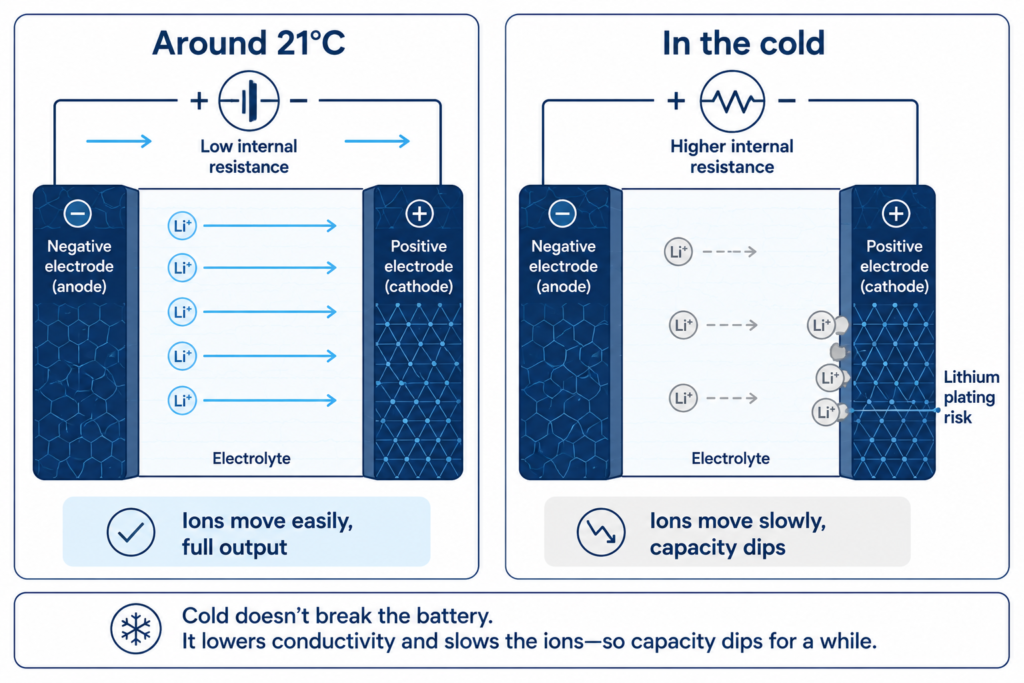
A lithium battery holds an electrolyte that lets lithium ions move between the electrodes. That movement is how it charges and discharges. Cold lowers the electrolyte’s conductivity. The ions move slower. Internal resistance climbs.
The result is a temporary drop in capacity. Your battery still works. It just can’t deliver as much for a while. Batteries perform best at around 21°C. Below that, output starts to ease off.
Some figures put the drop at 20 to 50 per cent once it falls below freezing, though Australian conditions are usually milder than that.
Here’s the part most people miss. Discharging in the cold is mostly fine. Charging is the real problem.
What happens to charging when it gets cold?
Lithium batteries don’t like charging in the cold.
Below about 0°C, charging can make lithium build up on the cell surface instead of storing properly. This is called lithium plating. It can permanently damage the battery, and in bad cases it becomes a safety risk.
So the battery protects itself. The Battery Management System (the BMS) slows or stops charging until the cells warm up. Discharging usually keeps working at lower temperatures.
That’s a sensible safeguard. It also creates a catch. A cheaper battery with no heater just waits for the day to warm up. In a cold snap, it might not charge fast enough, or at all.
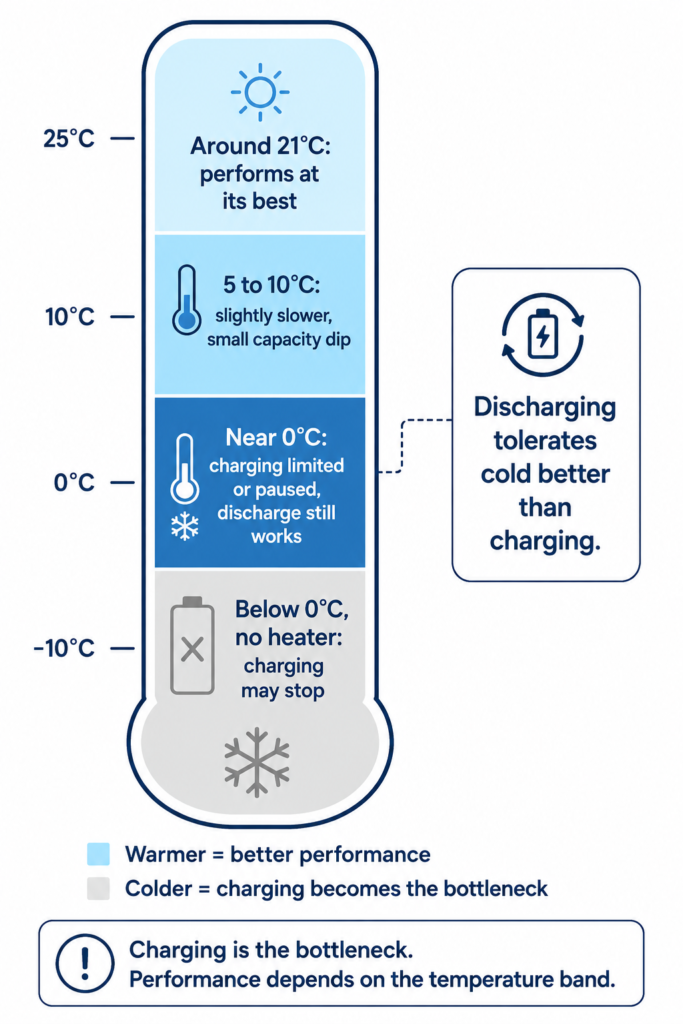
| Temperature | What your battery does |
|---|---|
| Around 21°C | Performs at its best |
| 5 to 10°C | Charges and discharges a little slower, slight dip in usable capacity |
| Near 0°C | Charging limited or paused to protect the cells, discharge still works |
| Well below 0°C, no heater | Charging may stop until the battery warms up |
Does cold weather actually matter for batteries in NSW and the ACT?
Australian winters are mild next to Canada or the northern United States. Cold alone rarely damages a quality battery here.
That doesn’t mean it’s a non-issue.
The ACT and the NSW highlands get real frosts. Mornings near or below zero are normal in winter. Outdoor and garage installs feel it most.
There’s a second problem stacked on top. Winter solar generation drops sharply. One Australian example saw a system make 2,256 kWh in December and just 1,002 kWh the following June, less than half. Shorter days. Lower sun. More cloud.
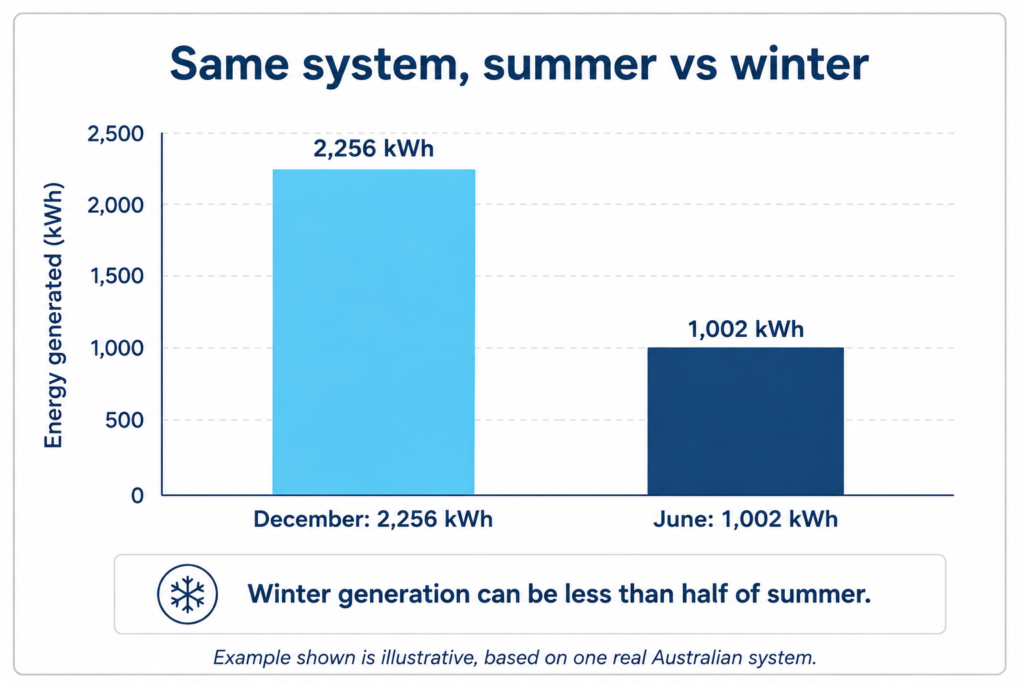
So two things happen at once. Your panels make less. Your battery may charge slower. Meanwhile your home draws more power for heating and hot water. A battery that can’t fill in winter is a real cost, not just an annoyance.
How do you protect a solar battery from the cold?
Good news. Most of this is solved at the design stage.
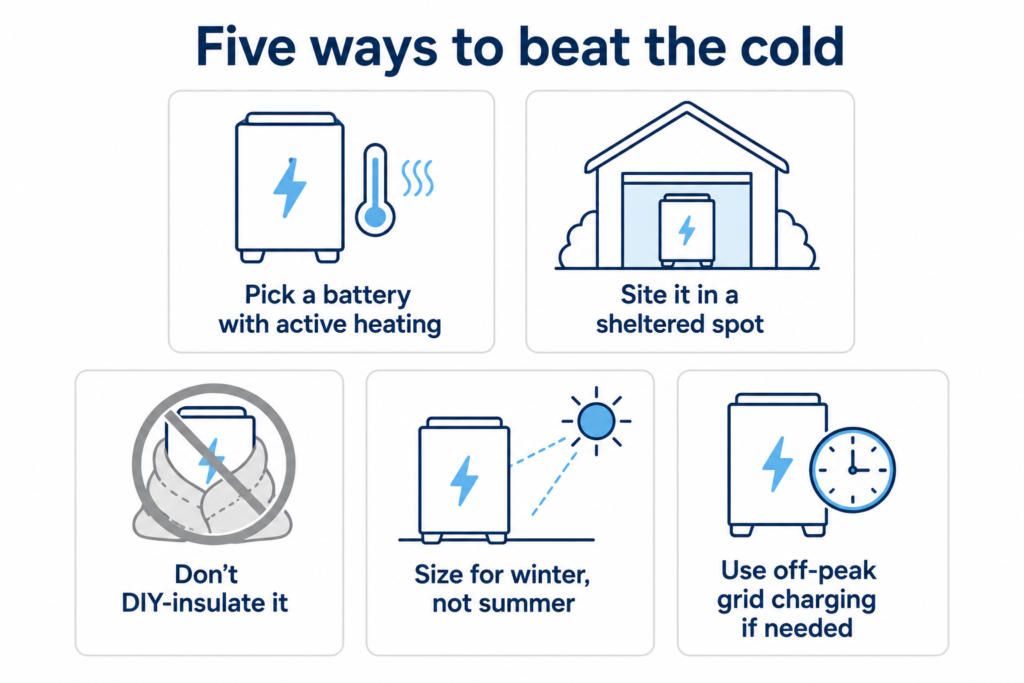
- Choose a battery built for the cold. Look for active heating and a wide operating temperature range. This is the single biggest factor.
- Site it well. A garage or sheltered spot beats a fully exposed wall. Any battery installed outdoors needs an IP rating of at least IP65. Most clear that comfortably but it is worth checking.
- Don’t wrap it yourself. DIY blankets or covers can trap heat and cause overheating or faster wear. Manufacturers warn against it.
- Size for winter, not summer. Use winter sun hours, not annual averages. A large battery needs enough solar to actually fill it.
- Check your charging options. Some systems can top up from the grid in cheap off-peak windows, which helps when solar is short.
Get these right and a cold morning becomes a non-event.
What makes the SigenStor different in the cold?
The SigenStor is built for this exact problem.
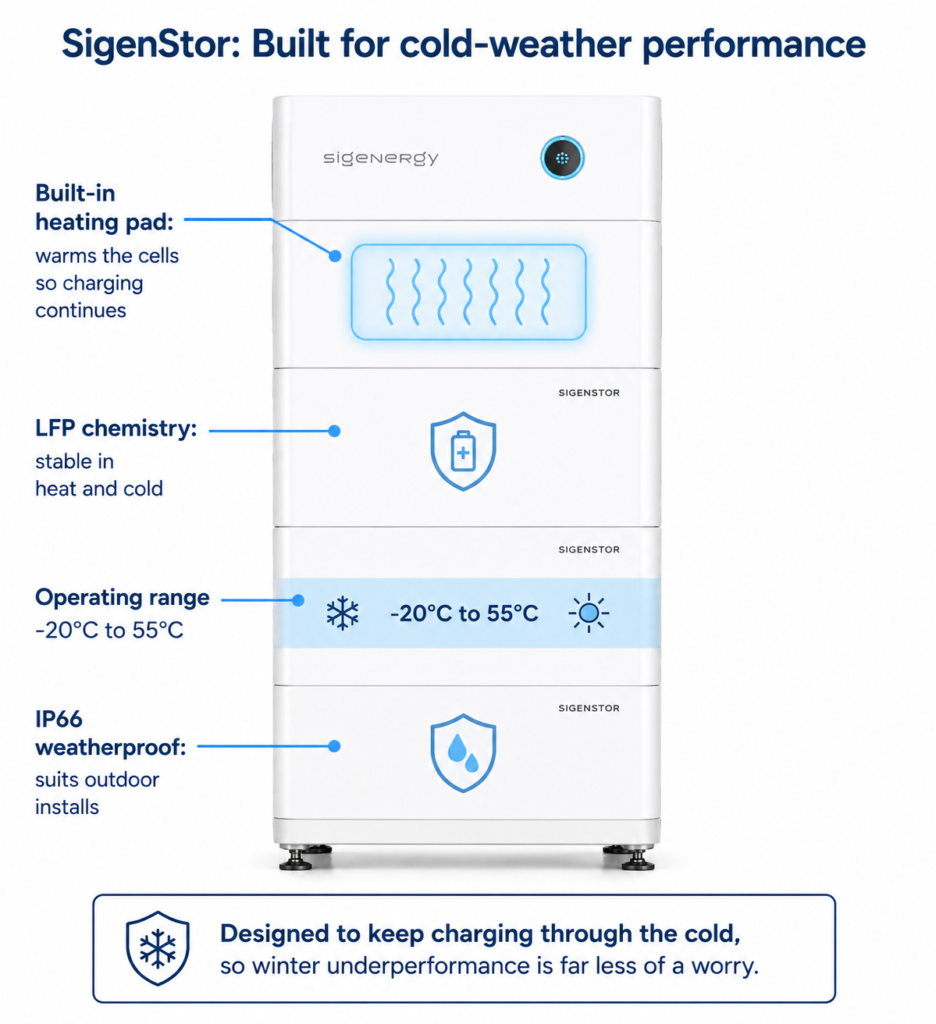
It uses LFP (lithium iron phosphate) chemistry, which is stable and handles temperature well. Each battery module has a built-in heating pad. When the cells get too cold, the heater switches on, warms them to a safe level, usually in under two hours, then charging carries on. It runs automatically in the background, and you can set your own heating times if you want to. You don’t lift a finger.
Its rated operating range runs from -20°C to 55°C. That covers an Australian winter comfortably, including frosty mornings in the ACT and southern NSW. For outdoor installs, it carries an IP66 weatherproof rating.
The numbers back it up. Storage is rated down to -25°C. The battery and energy controller each carry a 10-year warranty.
Want to keep reading? Learn about how to take advantage of the three free hours of power here.
Frequently Asked Questions
How does cold weather affect solar battery performance?
Cold slows the chemistry inside the battery. Capacity dips for a while, and charging slows or pauses to protect the cells. Discharging usually keeps working. A battery with active heating avoids most of this.
What temperature is too cold for a solar battery?
Charging becomes a problem at around 0°C and below, which is when a good battery’s heater steps in. Discharging tolerates lower temperatures. Exact limits vary by battery, so check the datasheet.
Can the SigenStor solar battery operate in freezing temperatures?
Yes. Its built-in heating pad and -20°C to 55°C operating range are made for sub-zero mornings, so it keeps charging when many batteries would pause.