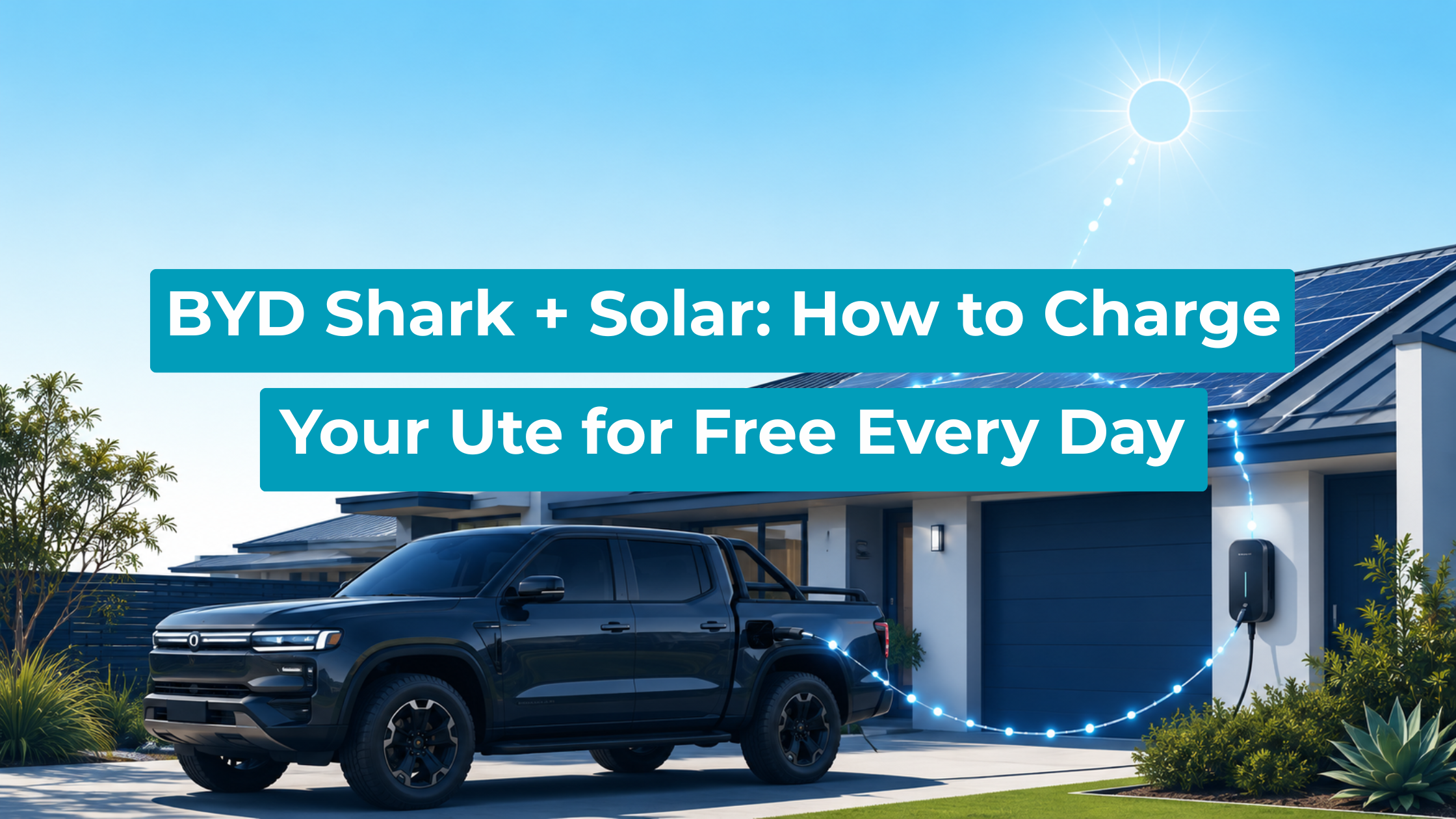
BYD Shark + Solar: How to Charge Your Ute for Free Every Day
Petrol prices are out of your hands… a decision overseas, a supply issue, a spike in demand, the price goes up and you pay for it.
For most Australians, there’s not much they can do except watch the numbers climb every time they pull into a servo.
The BYD Shark 6 changes that. It is a plug-in hybrid ute. Most days, it runs on electricity. The petrol engine is just backup.
Charge that electric side off your roof, and the cost lands close to zero.
Here is what you are working with:
- It runs on electricity first, then petrol when the battery drops
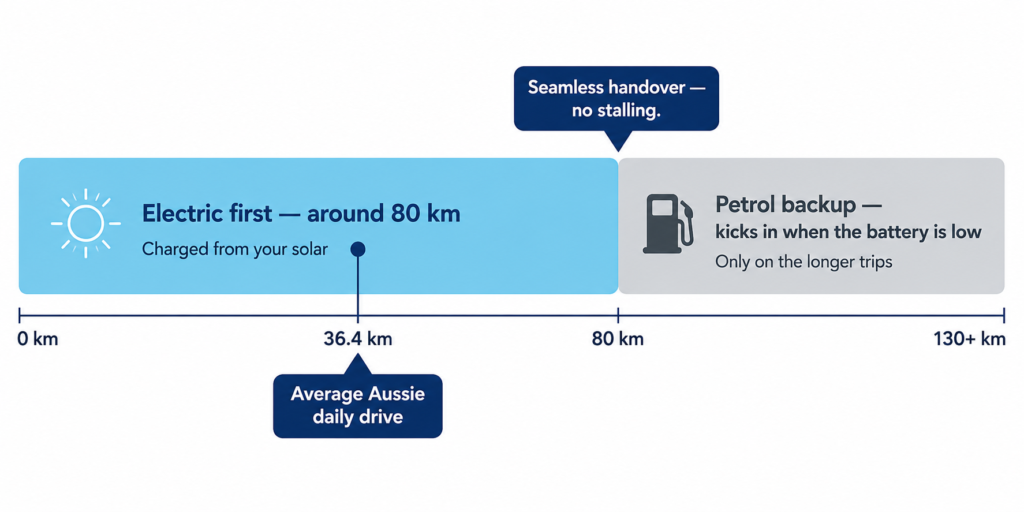
- The electric battery is 29.58 kWh and covers around 80 km on its own, according to the (BYD Shark 6 specifications)
- The average Aussie drives just 36.4 km a day
- A 6.6 kW solar system makes far more than that drive needs
So most of your driving can run on sunshine your roof already caught. The petrol tank waits in reserve for the long hauls.
This article covers it all:
- How the hybrid works and why solar suits it
- How charging at home actually plays out
- How many panels you need and how to set it up
- How the free power window from July 2026 fits in
- How the ute runs your tools and campsite
- Where this idea makes less sense
By the end, you will know if you can charge a BYD Shark with solar at your place.
How Does the BYD Shark Hybrid System Work?
It is a plug-in hybrid. Two power sources. Used in order.
- It runs on the 29.58 kWh battery first, driving like a pure EV for the first 80 km or so
- When that runs low, a 1.5L turbo petrol engine takes over
- The engine mostly works as a generator, not a direct drive
- Combined range is around 670 km
That order is the whole trick. Your daily driving comes off the battery. That is the part you fill from your roof. Petrol only earns its keep on the longer trips.
The handover is smooth. No stalling. No grinding to a halt. The battery empties, the engine picks up. That range anxiety you get with a full EV? Gone.
It also explains why a hybrid beats a full electric ute on solar:
- The 29.58 kWh battery refills from one good day of rooftop surplus. A big electric ute could take days
- Most days you only use part of it, so you rarely start from empty
- The petrol backup means you never have to oversize your solar for the odd road trip
Can You Charge a BYD Shark With Solar at Home?
Yes. For most homes, the sums work.
- The Shark takes a single-phase AC charge at up to 7 kW through a standard Type 2 plug
- A decent rooftop system nearly matches that in the middle of the day
- Charge while the sun is high and you fill the ute with power you would otherwise sell back for cents
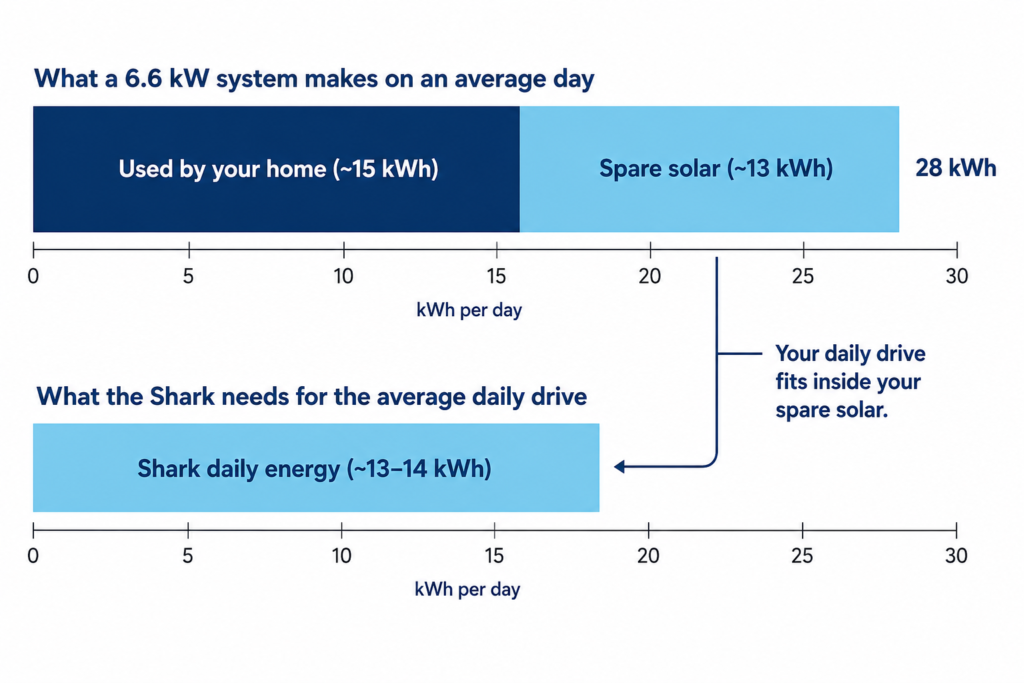
Run the daily maths:
- A 6.6 kW system makes around 25 to 30 kWh on an average day, more in summer, less in winter
- Your house takes a chunk, leaving maybe 13 kWh spare
- The Shark uses around 13 to 14 kWh to cover the average 36.4 km drive [This is an inference based on battery capacity and real-world range, not a manufacturer-stated efficiency figure]
So a normal day’s drive fits inside a normal day’s spare solar. Petrol stays in reserve for anything more.
The honest catch? It gets tight on a 6.6 kW system once the house takes its share. Dishwasher, air con, kettle through the middle of the day. Your surplus shrinks fast.
Want to charge for free and run the house? Go 10 kW or larger. The bigger the array, the more days you fill the ute for nothing.
How Much Solar Do You Need to Charge a BYD Shark?
Two things decide it. System size. And a smart charger.
System size first:
- A 6.6 kW array, around 15 to 18 panels, covers the average drive on a good day
- A 10 kW system or bigger, with quality panels like AIKO, gives you proper surplus for the ute, the house, and a battery
- The bigger the array, the less you touch the grid
How much solar you need comes down to how far you drive and how much your home uses by day. An empty house banks more spare power than one running appliances all afternoon. Same roof, different result.
Now the smart charger. This is the bit people skip.
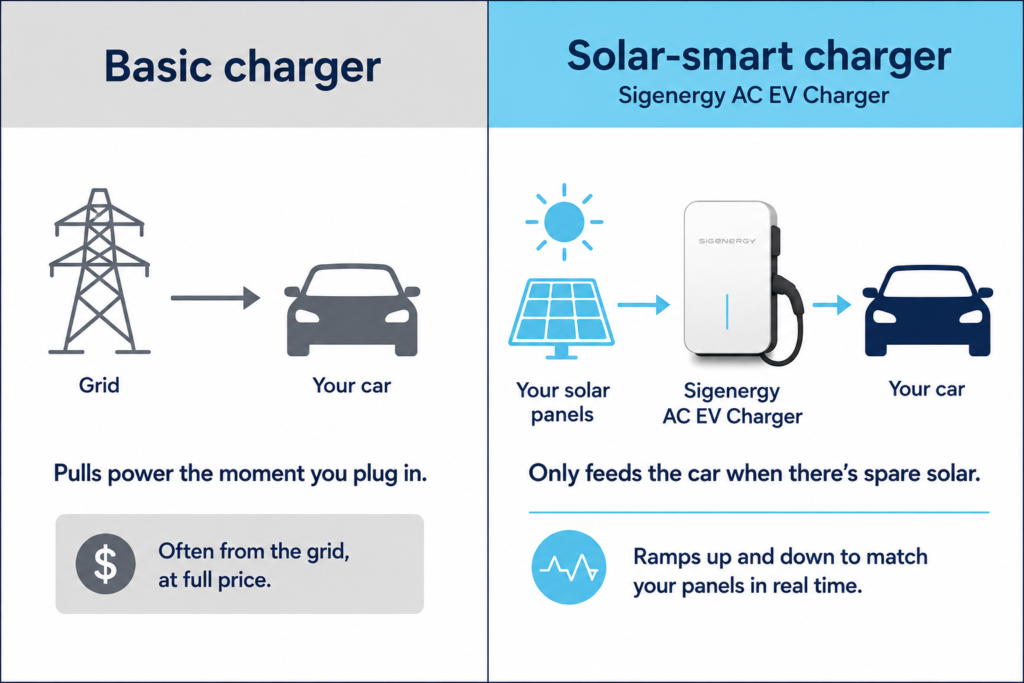
- A basic charger grabs power the second you plug in. Often from the grid. At full price
- A home EV charger that talks to your solar only feeds the car when there is spare power
- The Sigenergy AC EV Charger is a single-phase 7.4 kW unit. It can add about 20 to 25 km of range an hour. It dials its output up and down to match your panels in real time
That is the whole difference. Free sunshine, or a power bill. On a patchy day it eases off under clouds and ramps back up when the sun returns. You always sip the surplus.
We break down how it fits together in our Sigenergy AC EV Charger review
How Do You Set the BYD Shark to Charge on Solar?
The controls are built in. It is close to hands-off.
Find these on the touchscreen under Settings, then Energy:
- Scheduled charging: set a start and finish time so it charges through the sun, roughly 9am to 3pm
- Target charge level: set a lower target at home, so you lean on electric driving and let solar refill the battery instead of burning petrol
- MAX EV mode: uses up the electric charge before the engine steps in, squeezing every solar kilometre
- Strong regenerative braking: claws back energy when you slow down, stretching your range further
There is a battery bonus too. The Shark uses a lithium iron phosphate battery. It shrugs off frequent partial top-ups, which is exactly what daily solar charging is. No wear worries. BYD backs it with an 8 year or 160,000 km warranty. Daily solar top-ups sit well inside that.
One thing to watch. The Shark’s built-in scheduled charging is designed for BYD’s own AC gear. Pair that timer with a non-BYD charger and it can trip up. Running a third-party smart charger? Set the car to charge instantly and let the charger handle the solar matching.
How Does the July 2026 Free Electricity Window Help?
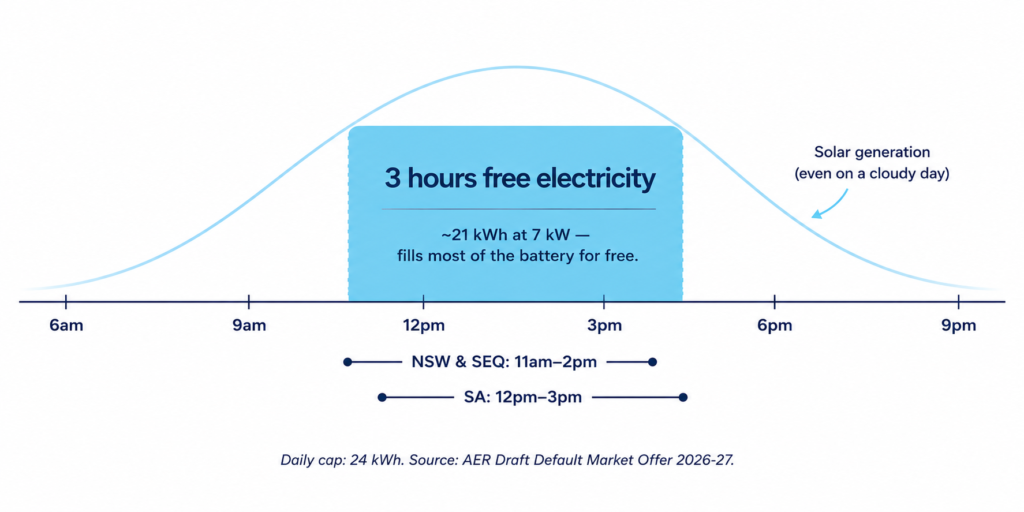
From 1 July 2026, the Solar Sharer Offer kicks in. Retailers with 1,000 or more customers must offer an opt-in plan with three hours of free electricity a day, lined up with peak solar.
The shape of it:
- The window is 11am to 2pm in NSW and South East Queensland, 12pm to 3pm in South Australia
- The daily cap is 24 kWh
- This is confirmed by the Australian Energy Regulator’s Draft Default Market Offer 2026-27
For a Shark owner, this is your safety net on grey days:
- Charge at 7 kW for the full three hours and you pull about 21 kWh
- That fills most of the battery for nothing, even when the panels are quiet
- Stack it on your rooftop surplus and free solar charging starts to look very doable
So the weather no longer holds you hostage. Cloudy day? The free window covers you. Sunny day? Your panels do the work and the window stays up your sleeve.
Our guide to the Solar Sharer Offer shows how to make the most of it.Pairing it with storage? We cover that in Can Getting an EV Actually Protect You From the Fuel Crisis? A good solar battery EV combination lets you stash cheap daytime power and charge the ute overnight for nothing. Handy if you are out driving while the sun is up.
Can the BYD Shark Power Your Tools and Campsite?
This is the fun part. The Shark has Vehicle-to-Load built in. It turns the ute into a mobile power station.
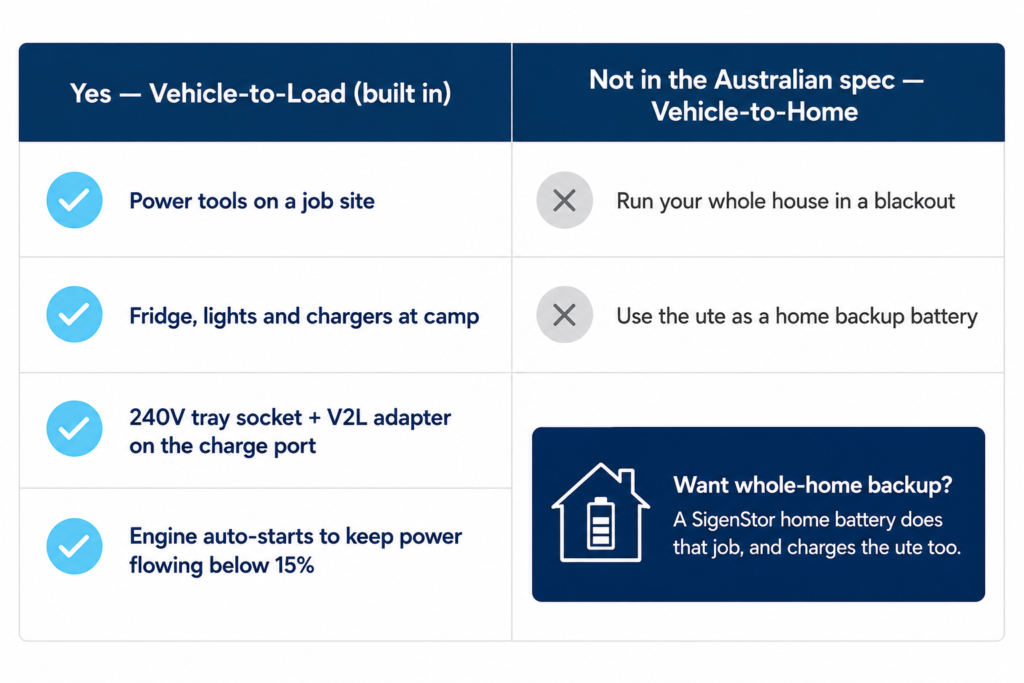
- Power comes from a 240V socket in the tray and a V2L adapter on the charge port
- Enough to run power tools, a fridge, lights, and chargers at once
- The battery needs to be above 15% to discharge
- Run low while you use it? The petrol engine fires up on its own to keep the power flowing, as long as the ignition is on
That last point is the off-grid clincher. It is a hybrid. Your tools and your campsite do not go dark when the battery drains. The engine quietly tops it up. Petrol only when you need it.
So the power you charged for free off your roof can run a job site the next day. Or keep the fridge and lights going at camp.
One limit, straight up. In the Australian version, the Shark does Vehicle-to-Load. It powers your appliances directly. It does not do Vehicle-to-Home. So it cannot run your whole house in a blackout. Want that? A proper home battery like the SigenStor is the right tool. It teams up with solar to charge the ute too.
Why We Design Around Sigenergy
The real win is control. The Sigenergy charger, battery and solar run as one customisable system, using AI to read your home and conditions in real time, so you set the priorities and the smarts handle the rest, sending every spare kWh to the ute, the battery or the house exactly where you want it. That is why we now design exclusively around Sigenergy. One connected system, tuned to your home, getting the most from every drop of solar you make.
Who Is Solar EV Charging in Australia Right For?
This setup’s a no-brainer if:
- You drive under about 80 km on a typical day
- You live somewhere sunny
- You have solar, or you are planning to install it
For that driver, an electric ute on solar in Australia can mean close to zero running cost day to day. Petrol only shows up on the long trips.
It is a weaker fit if:
- You rack up big distances, because then the petrol engine does more of the lifting
None of that kills the idea. It just means going in with your eyes open.
Here at Lenergy we design solar, battery and EV setups for Aussie homes, and we can tell you whether your roof and your driving actually add up to free charging. Send us a message and we’ll give it to you straight.
Frequently Asked Questions
Does the BYD Shark still use petrol if I charge it with solar?
Only when you drive past the electric range. The Shark runs on its battery first, so a normal day under 80 km can be all electric and all solar. The petrol engine only steps in on the longer trips once the battery is low. Most owners burn very little fuel day to day.
Can I charge a BYD Shark with solar if I already have a 6.6 kW system?
Usually yes, on an average day, once you add a smart charger that only pulls the spare solar. The drive most Aussies do each day fits inside the surplus a 6.6 kW system makes. Want year-round room, or a battery too? A bigger system makes it more reliable.
Will daily solar charging wear out the battery faster?
No. The Shark runs a lithium iron phosphate battery, built to handle frequent partial top-ups exactly like daily solar charging. BYD covers it with an 8 year or 160,000 km warranty. Charging off the sun every day sits well inside normal use.
Is now a good time to set this up, or should I wait?
There is a solid reason to move before winter and before 1 July 2026. The Solar Sharer Offer hands you a daily free electricity window from that date. Have a smart charger ready and you jump on it straight away. Sort the solar and charger now and you charge on sunshine right through the next summer.