Why the AEMC’s Pricing Proposal Is Bad News for Solar Owners
The Australian Energy Market Commission (AEMC) wants to change how electricity network costs are charged to Australian households, shifting more of the cost into a flat daily charge you pay regardless of how much power you use. Solar and batteries still would remain the best option however this hits those who are smart with their energy consumption the hardest. This tariff reform could significantly decrease the value of your investment. Here is what this article covers:
- What the AEMC tariff reform actually proposes
- Whether this is actually a solar tax for Australian households
- Who gets hurt the most
- What it means for solar feed-in tariff changes and battery storage savings
- What you should do before the final report lands in June 2026
What Is the AEMC Tariff Reform and Why Does It Matter?
The AEMC launched its Electricity Pricing for a Consumer-Driven Future review in July 2024. The review looks at how Australians pay for the poles and wires that make up the electricity grid.
At the moment, a large part of your electricity bill is based on how much power you use. Use more, pay more. Use less, pay less. For solar owners, that system works in your favour. Every unit of energy your panels produce and you use yourself is a unit you do not have to buy from the grid.
The AEMC wants to change that. Their proposal would:
- Shift more of the grid’s costs into a higher flat daily charge. Think of this like a Netflix subscription, your daily power subscription fee is going up, whether you use power that day or not. (we detail this further below)
- Reduce the portion of your bill that is based on how much power you use
- Introduce dynamic pricing during peak demand periods (when lots of households draw power at the same time, typically weekday evenings, the cost per kilowatt-hour would rise. During quieter periods it would fall. The idea is to encourage households to shift their energy use away from busy times.)
The AEMC argues this is fairer because solar owners currently use the grid less, which means they contribute less to shared infrastructure costs. Households without solar end up covering more of those costs. The commission calls this a cross-subsidy and wants to fix it.
In April 2026, the AEMC released modelling claiming the reforms could deliver up to $6 billion in network savings over 15 years, per the AEMC media release published 23 April 2026. They say most households would save $40 to $80 per year on bills by 2040.
The public response was strongly negative. Over 2,700 submissions were received. The overwhelming majority opposed the proposal.
Should I switch to battery storage in Australia given these changes?
For most solar households, yes. Battery storage lets you self-consume more of your solar energy instead of exporting it at low feed-in rates or buying it back at high grid rates. If the AEMC reform proceeds and fixed charges increase, the value of self-consumption relative to grid dependence becomes even more important. Acting sooner rather than later also means your system builds up savings at current rates before any pricing changes take effect.
What Will Actually Change on Your Electricity Bill?
Every electricity bill has two basic charges. Understanding both is key to understanding why this reform hurts solar owners.
The first is the daily supply charge. This is a flat fee you pay every single day just to be connected to the grid. It does not matter if you use a lot of power or a little. You pay it regardless.
The second is the usage charge. This is what you pay per kilowatt-hour of electricity you actually draw from the grid.
Here is what the AEMC reform would do to each:
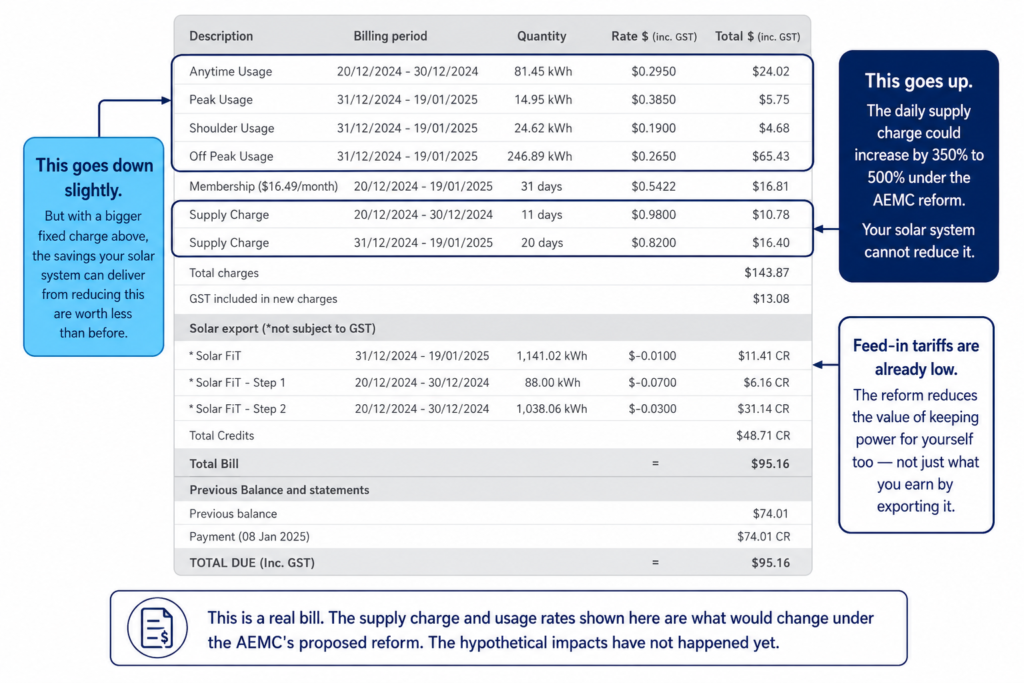
- The daily supply charge goes up — significantly. Modelling by analyst Tristan Edis at Green Energy Markets suggests the network portion of this charge could increase by 350% to 500% depending on your state
- The per-kWh usage charge goes down slightly, because some of that cost has shifted into the fixed charge instead
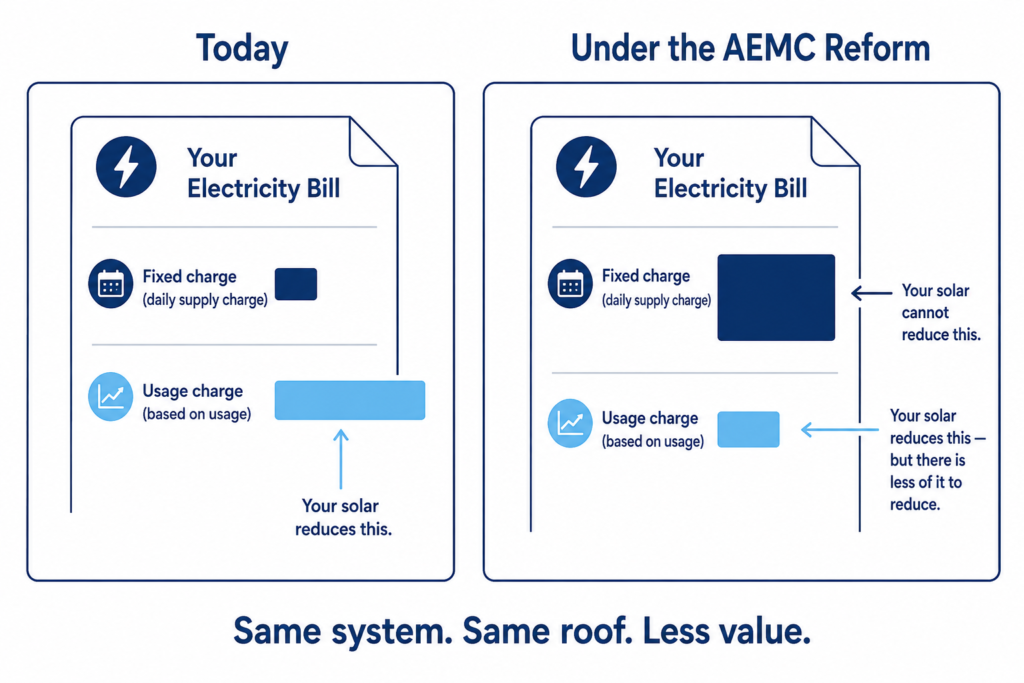
For a household without solar, those two movements can roughly cancel each other out. For a solar household, they do not:
- A lower per-kWh rate means every unit of solar energy you use yourself saves you less money than it does today
- The higher daily supply charge is there every day no matter how much your panels produce
- The more self-sufficient your solar system makes you, the less the lower usage rate helps you and the more the higher fixed charge stings you
The bill below is a real example of what these two charges look like today. The hypothetical changes above have not happened yet, but this is exactly where you would see them if they did.
There is another group this reform quietly punishes.
Think about the household that turns the heater down and puts on an extra jumper in winter. The one that bought energy efficient appliances specifically to keep their bills down. The retiree who is home all day and watches every kilowatt-hour because they are on a fixed income. These households have done everything right. They use less, so they pay less. That is how the current system works.
Under the AEMC’s proposed changes, that careful behaviour is worth less:
- A larger share of your bill is fixed, so using less saves you less
- The financial reward for buying that efficient washing machine or turning the heater down shrinks
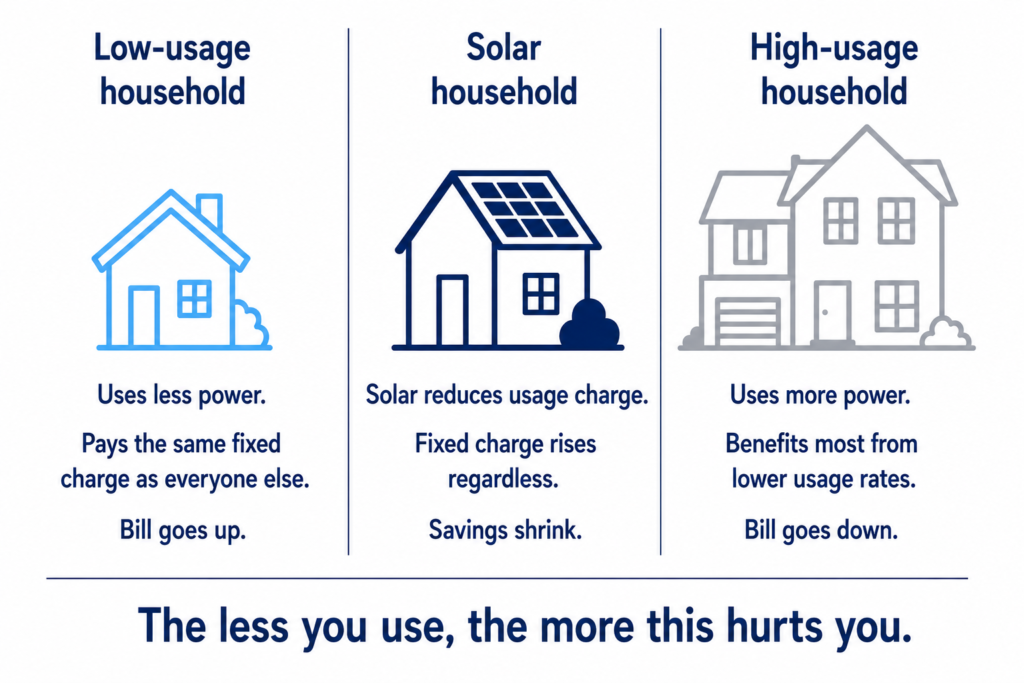
- The household that uses twice as much power as you gets a bigger benefit from the lower per-kWh rate than you do
It hits anyone who has been careful with their energy use and in doing so, quietly removes the incentive to stay that way. If using less saves you little more than using a lot, why bother? The reform does not just fail to reward efficiency. It indirectly encourages the opposite.
Is This a Solar Tax? Here Is What the AEMC Solar Tariff Reform Means in Practice
The word ‘solar tax’ is not the AEMC’s language, and technically it is not a tax. What it is, is a significant increase to the flat daily charge on your bill. Unlike your usage charge, that flat rate is not something your solar system can reduce.
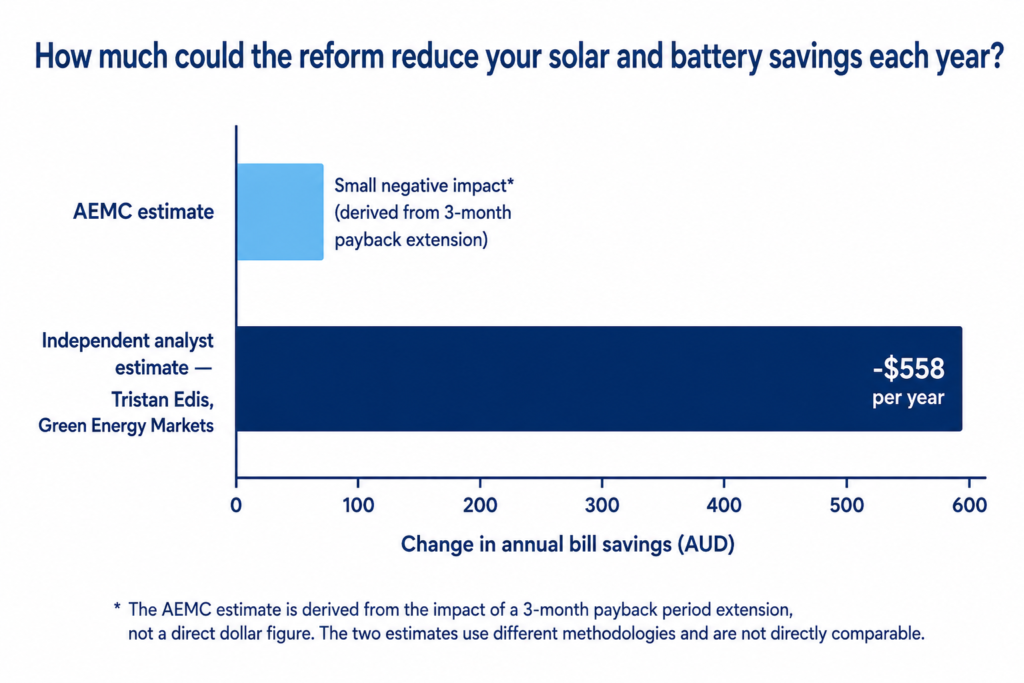
The AEMC’s own modelling suggests the impact is modest:
- Solar payback period stretches by about three months, from roughly 4.4 years to 4.7 years
- A 10kW solar and 20kWh battery system still accumulates around $27,000 in savings over 10 years
Independent analyst Tristan Edis put the damage much higher:
- A median household in the Ausgrid network would lose $558 per year in bill savings from their solar and battery system
- On average, the financial benefit of a solar and battery system would be reduced by roughly a quarter to a third
- For many households that would push the payback period beyond the typical 10-year battery warranty period
Are They Taxing Solar in Australia? Who Gets Hit the Hardest
Solar and battery owners
If you have invested in a solar and battery system, the AEMC tariff reform hits you in two ways:
- The value of self-consuming your solar drops as more of your bill moves into a fixed charge
- The AEMC’s dynamic pricing means drawing from the grid during peak periods costs more and if your battery is not fully charged, you have no way to avoid it
- Dynamic pricing only delivers savings if your devices respond to price signals automatically. For most households it is just a higher bill at the times when people actually need power
Low-usage and low-income households
The impact is not limited to solar owners. Any household that uses relatively little electricity would face higher bills under the fixed-charge model. That includes:
- Retirees in smaller homes
- Renters who cannot install solar and already manage their usage carefully
- Apartment dwellers with limited appliances
- Households that have worked hard to cut their consumption
A fixed charge takes the same dollar amount from everyone, regardless of how much power they use. Low-usage households pay proportionally more. The Institute for Energy Economics and Financial Analysis (IEEFA) found potential annual increases of $127 to $217 or more for low-income and low-usage profiles before any protections are applied.
The AEMC’s modelling includes a character called ‘Nina the Florist’, a small business with modest electricity consumption. Her bill could be up to $810 higher per year by 2040. The commission points to consumer protections as a safeguard, but critics argue those protections are not guaranteed.
The death spiral risk
There is a broader structural problem. If wealthier households respond to higher fixed charges by maximising their battery storage and cutting grid use:
- The pool of customers paying for shared grid costs shrinks
- The remaining customers, with fewer options, carry more of the load
- That pushes costs up further and drives more households to reduce their grid use
- The cycle keeps going
Without a per-kWh pricing signal to moderate behaviour, overall electricity consumption could rise, meaning more infrastructure is needed, not less.
What the Solar Feed-In Tariff Reform Means for Energy Companies Charging Solar Owners
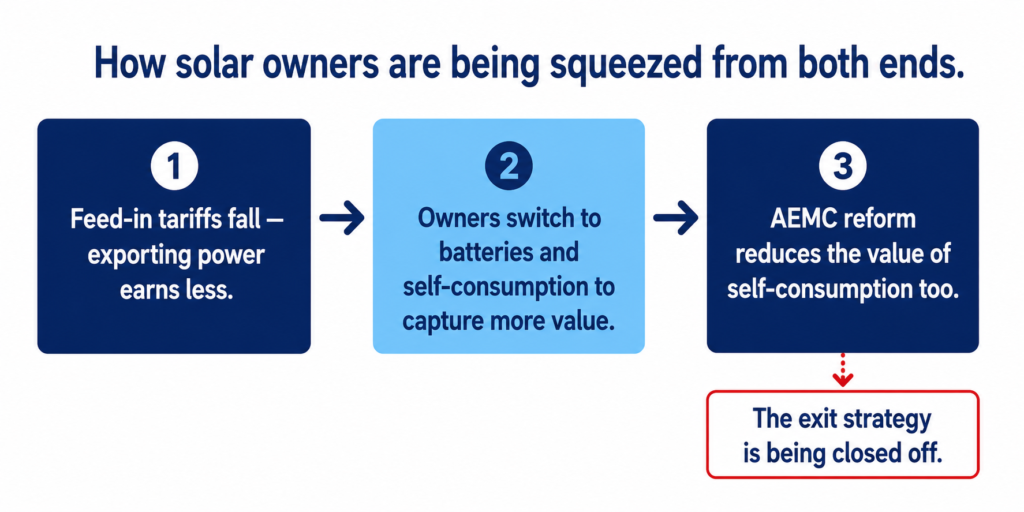
Australia’s peak renewable energy industry body, the Smart Energy Council, released a statement in April 2026 calling for the AEMC to pause the reform. Their core argument is that energy companies charging solar owners more, while also reducing what those owners earn through solar export tariffs, sends completely the wrong signal for the energy transition.
Their key concerns:
- The modelling raises more questions than it answers
- Households that invested in solar based on the current rules would be penalised
- The AEMC assumes retailers will not pass higher network costs on to customers in full, which the Smart Energy Council says has no real-world basis
- The AEMC expects more Australians to invest in solar and batteries while proposing rules that make those investments financially less attractive
Nexa Advisory analysed all 2,700 public submissions and found the vast majority opposed the fixed-charge approach. Nexa CEO Stephanie Bashir described it as a backward step that would undermine home battery programs and slow solar uptake across the country.
The Clean Energy Council and multiple consumer advocacy groups made similar arguments. No one in the industry is keen on this reform.
What Should You Do Given These Price Changes?
The AEMC’s final report is due in June 2026 and has not yet been released. With electricity prices rising and feed-in tariffs continuing to fall, the direction of travel is clear.
If you already have solar or a battery:
- Your savings are not about to collapse overnight
- Changes would be phased in gradually over several years
- Maximise self-consumption now — use more of your solar directly rather than exporting it
If you are thinking about installing solar or a battery:
- The financial case for acting now is stronger than acting later
- Systems installed today lock in savings at current rates before any changes take effect
- Government battery rebate programs are available now and may not last
You can monitor the AEMC project page at aemc.gov.au for the final report when it is released.
Frequently Asked Questions
Is the AEMC tariff reform actually a solar tax?
The AEMC does not call it a tax, but the effect on solar owners is similar. Shifting more of the bill into a fixed daily charge reduces the financial reward for self-consuming solar energy. Your system still saves you money, but less of it. Critics including the Smart Energy Council have described the reform as penalising households that invested in solar based on the current rules.
How much could my solar savings actually be reduced?
Independent modelling by analyst Tristan Edis at Green Energy Markets found that a median household in the Ausgrid network would lose $558 per year in bill savings from their solar and battery system. On average, the financial benefit of a solar and battery system would be reduced by roughly a quarter to a third. For many households that would push the payback period beyond the typical 10-year battery warranty period.
Why is my solar bill still high if I have panels?
There are a few reasons. Feed-in tariffs have been falling for years, so if you export power to the grid you earn less than you used to. The cost of electricity you import from the grid has also risen sharply, so any gap in your solar coverage costs more to fill. And if your household uses power in the evenings after the sun goes down, you are drawing from the grid at higher time-of-use rates. A battery system addresses all three of these problems by letting you store and use your own solar energy rather than depending on the grid.
When would any changes actually appear on my bill?
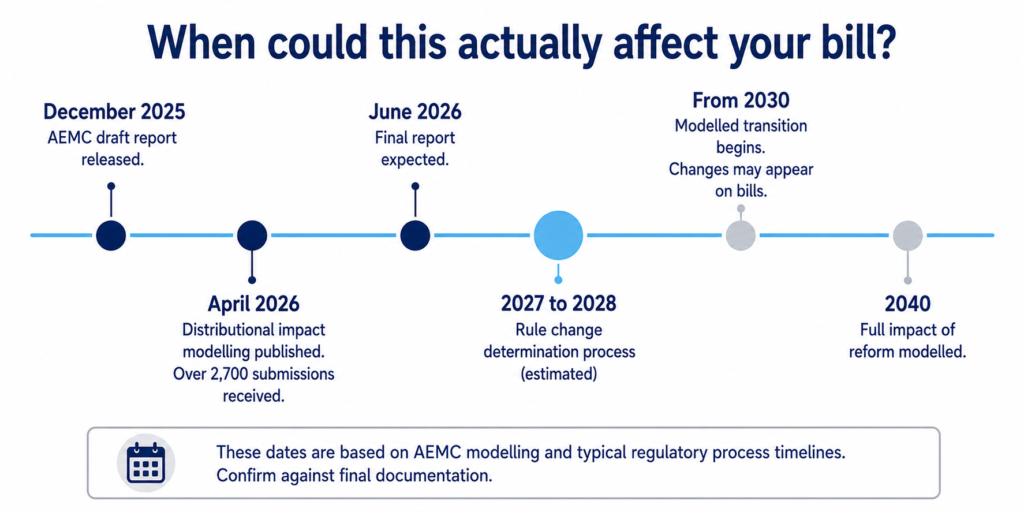
Not before 2030 at the earliest. According to the AEMC’s own distributional impact analysis and media release, both published 23 April 2026, the modelled transition begins in FY2030 and extends over ten years, with the full impact modelled out to 2040. Before any bill changes occur, the June 2026 final report still needs to be published, followed by a separate rule change determination process. The rule change process alone typically takes one to two years after the final report.