5 Things To Do If You Are Considering Solar
More than four in ten Australian homes now have rooftop solar. So you are not a guinea pig.
If you are considering solar panels in Australia and have no idea where to start, that is the most common place to be. Hundreds of companies. Thousands of products. Prices all over the place, and not everyone has had a good experience.
These five steps all happen before you speak to anyone selling solar. Going through them will have you well prepared to approach an installer confident that you know enough to make sure you get a quality install that actually achieves your goals.
- Work out what you actually use
- Check your roof, switchboard and export limit
- Understand the money
- Vet the installer, not the company
- Read the quote properly
What should you do first if you are considering solar?
Pull twelve months of bills.
You want three numbers. Your highest daily usage. Average daily use. Consider how much of that lands in daylight versus after dark.
That last one matters most. Solar only pays when you use what you make. Self consumption, meaning power you generate and use yourself instead of exporting it. Feed-in tariffs now sit around 0 to 5 cents a kWh while you buy power back at 25 to 45 cents. Exporting is feeding it back for next to nothing.
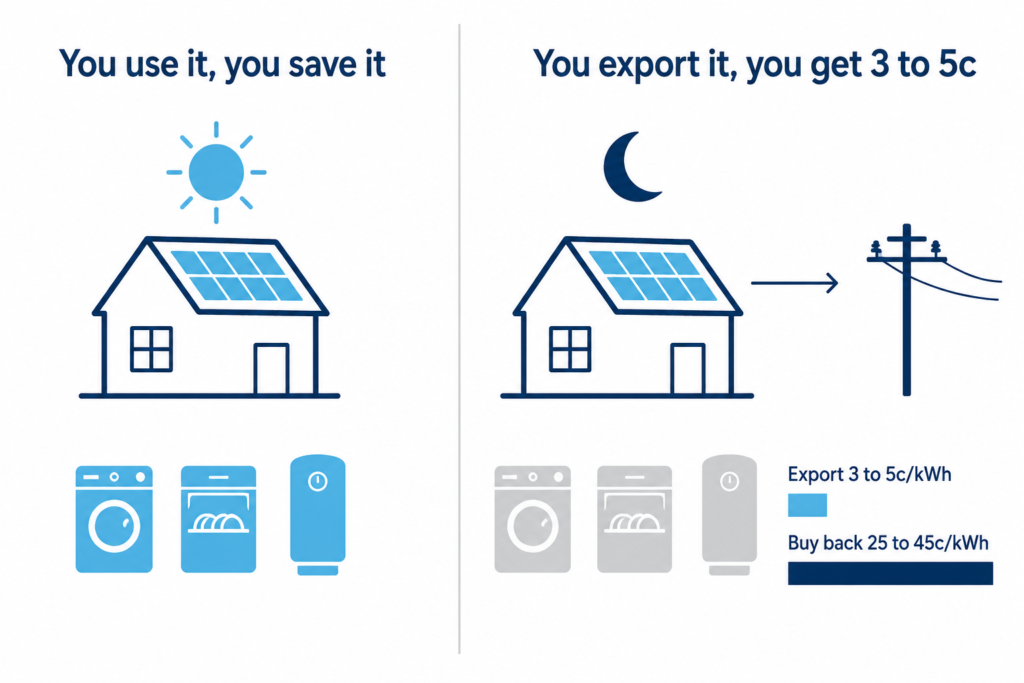
If you’re looking for a system to eliminate your bill fully you want to account for the days where your usage is highest and size around that.
Then run SunSPOT, the free government-backed calculator at energy.gov.au. It estimates size, cost, savings and payback, and it does not ask for your phone number.
Consider what you want to achieve with your system, not everyone is looking for a system that will protect you in a zombie apocalypse, some will just want to lower your electricity bills. Account for changes to your consumption profile that might come such as, an EV, a battery, heat pump hot water. Size a system to suit where you are headed.
A note on batteries, with current rebates and feed in tariffs it nearly always makes sense to install a battery when getting a solar system. Read more about this here.
Is your roof suitable for solar?
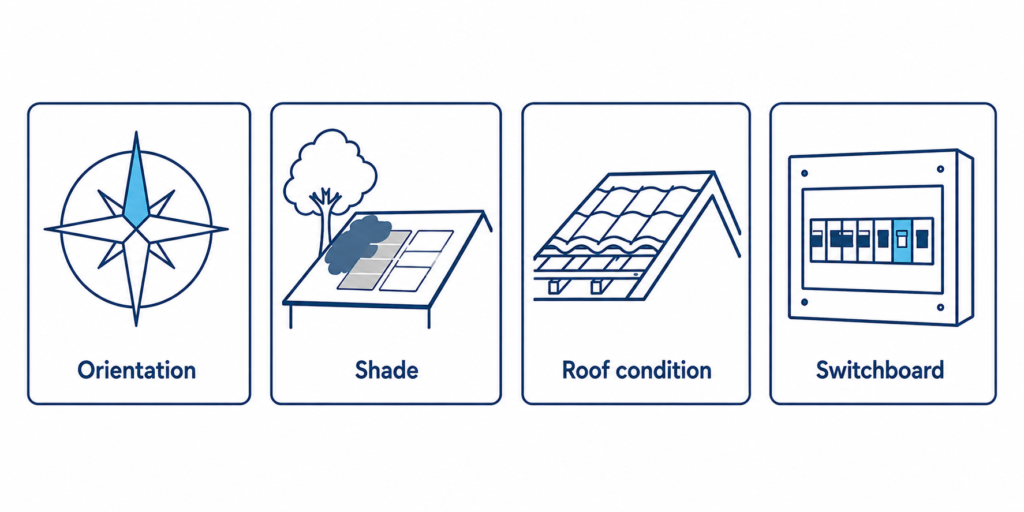
North-facing is best in Australia. East and west still work, with a bit less output across the year.
Then look at what gets in the way. Trees, aerials, the neighbour’s roofline. Shade on one panel can drag down a whole string of them, which is why some homes need optimisers or microinverters.
Check the roof itself. Panels last 25 years or more, so the roof needs to as well. Older switchboards often need upgrading before anything can be connected.
What rebates can you actually get?
The federal rebate is not a cheque. It runs through Small-scale Technology Certificates, or STCs, which your installer claims and deducts from your quote before you ever see it. Certificates trade around $33 to $38 each. Read our most recent update one the rebate works here.
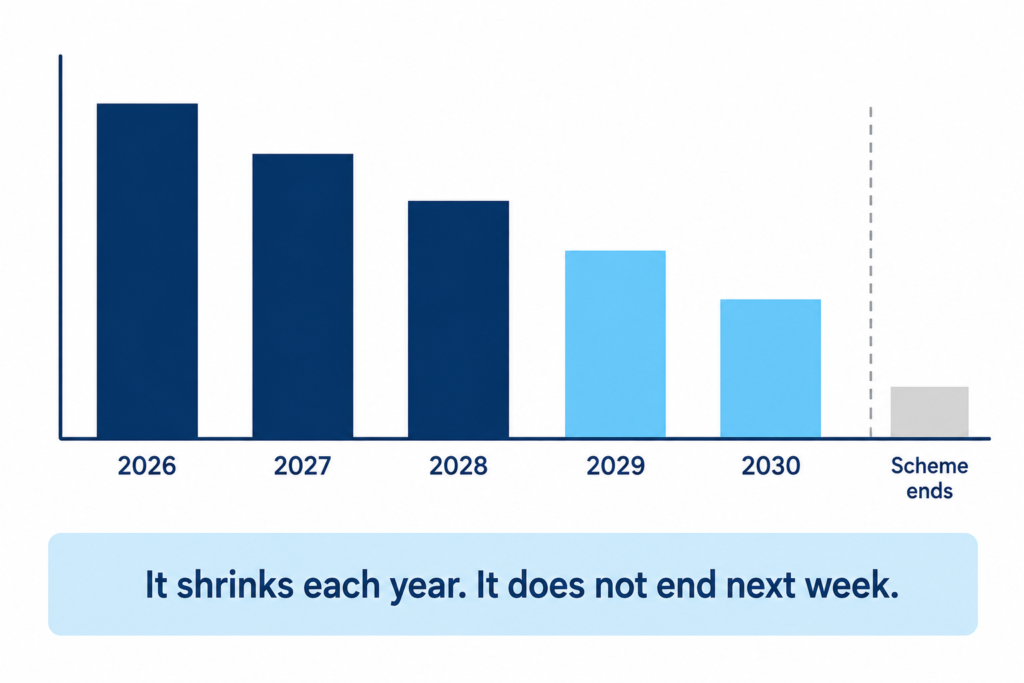
That discount shrinks each year until the scheme ends in 2030. Shrinks, not disappears. Anyone telling you the rebate ends next week is trying to force the sale.
State support sits on top:
- NSW. Interest-free loans up to $15,000 for solar and battery through approved suppliers.
- ACT. Zero-interest loans for batteries under the Sustainable Household Scheme.
- Queensland. Narrower, and largely aimed at renters.
How do you check a solar installer is legitimate?
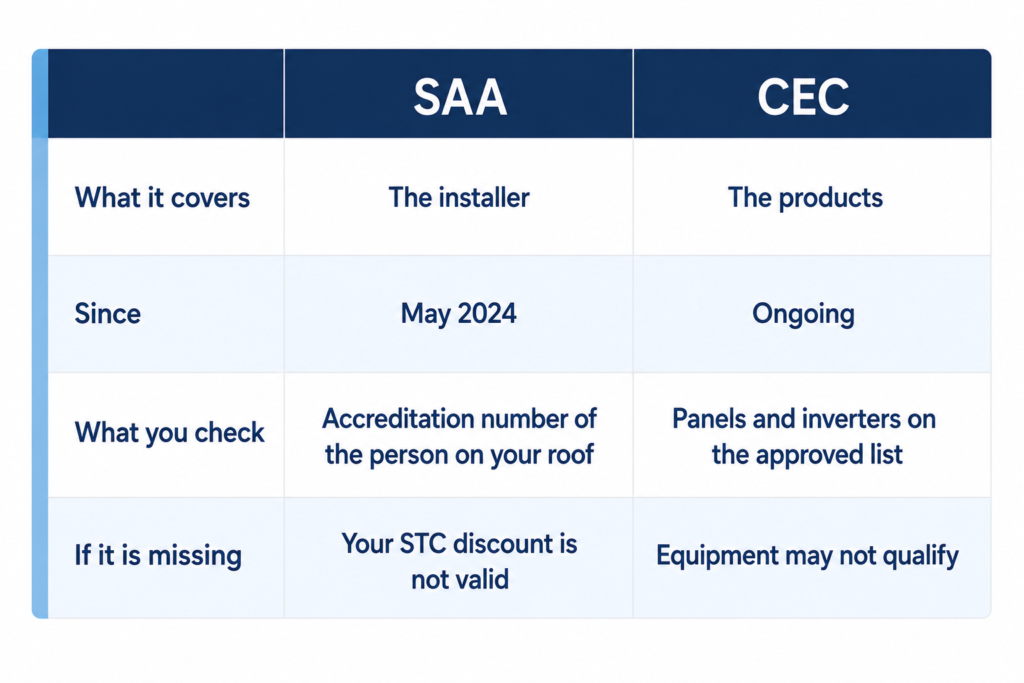
Accreditation belongs to the person, not the business. That is the part most people miss.
Solar Accreditation Australia took over installer accreditation from the Clean Energy Council in May 2024. The CEC still runs the approved products list for panels and inverters, so both names remain in play, doing different jobs. Your installer needs current SAA accreditation or your STC discount is not valid.
Ask for the number. Check it on the SAA site yourself. Takes a minute.
Then check the seller against the New Energy Tech Consumer Code approved list. It is voluntary, so absence is not damning, though presence is a fair signal.
Get three quotes. Insist on a site visit. A quote drawn from satellite images misses switchboard capacity, roof access and shading, and those come back later as variations.
What should be in the quote before you sign?
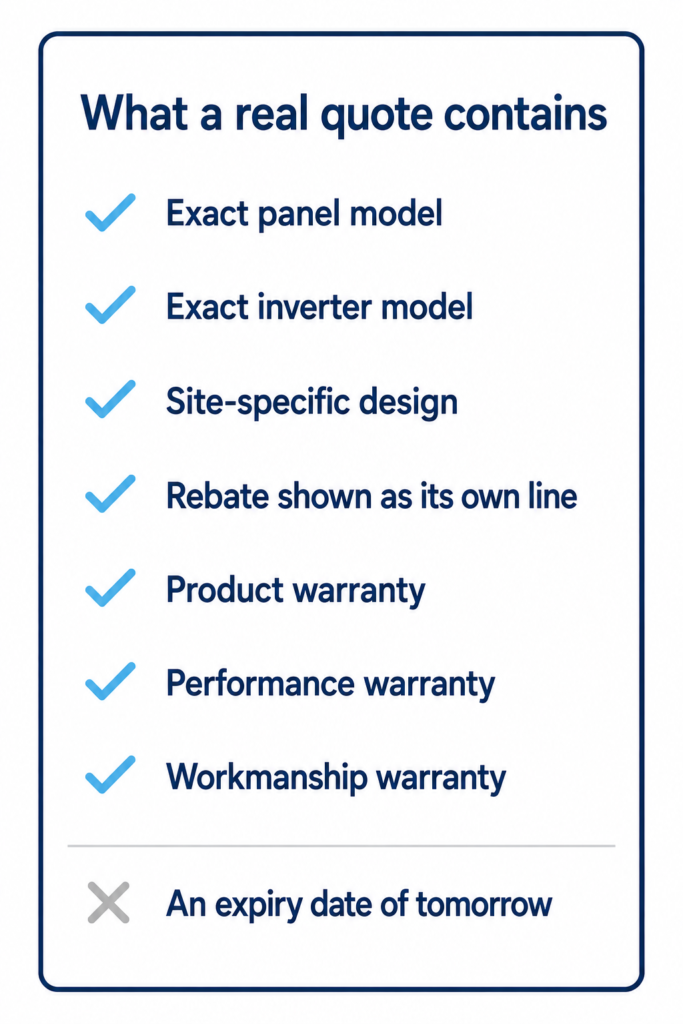
A price is not a quote. A quote is a document you can check.
It names the exact panel and inverter models. It shows a site-specific design. It lists the rebate as its own line. It sets out three separate warranties: product, performance and workmanship. Workmanship is often only one to two years, but quality installers such as ourselves will have up to a 10 year workmanship warranty.
A good company will design a system that works for you and will treat the sales experience as one that educates you on your options and will be willing to answer every question you might have.
Read next: Mistakes to avoid when buying a solar battery
Frequently Asked Questions
How do I know if my home is suitable for solar panels in Australia?
Orientation, shade and roof condition decide it. North-facing with clear sun is ideal, east and west still work. If your roof is near the end of its life or your switchboard is old, sort that first. A site visit answers all three properly. A satellite quote does not.
What solar rebates and incentives are available for Australian homeowners in 2026?
The federal STC discount applies nationally and comes off your quote automatically. NSW offers interest-free loans up to $15,000. The ACT and Queensland run their own schemes.
How do I choose a reliable solar installer in Australia?
Check the individual installer’s SAA accreditation number on the SAA website. Check out their worst reviews. Look for the company on the NETCC approved seller list. Get three quotes, insist on a site visit, and treat pressure to sign today as a reason not to.
Do these steps apply to a business or a larger system?
Mostly, yes. The federal scheme currently caps eligible systems at 100kW, though the Clean Energy Regulator has flagged plans to lift that toward 1MW, which would open it up to larger commercial and community installations.