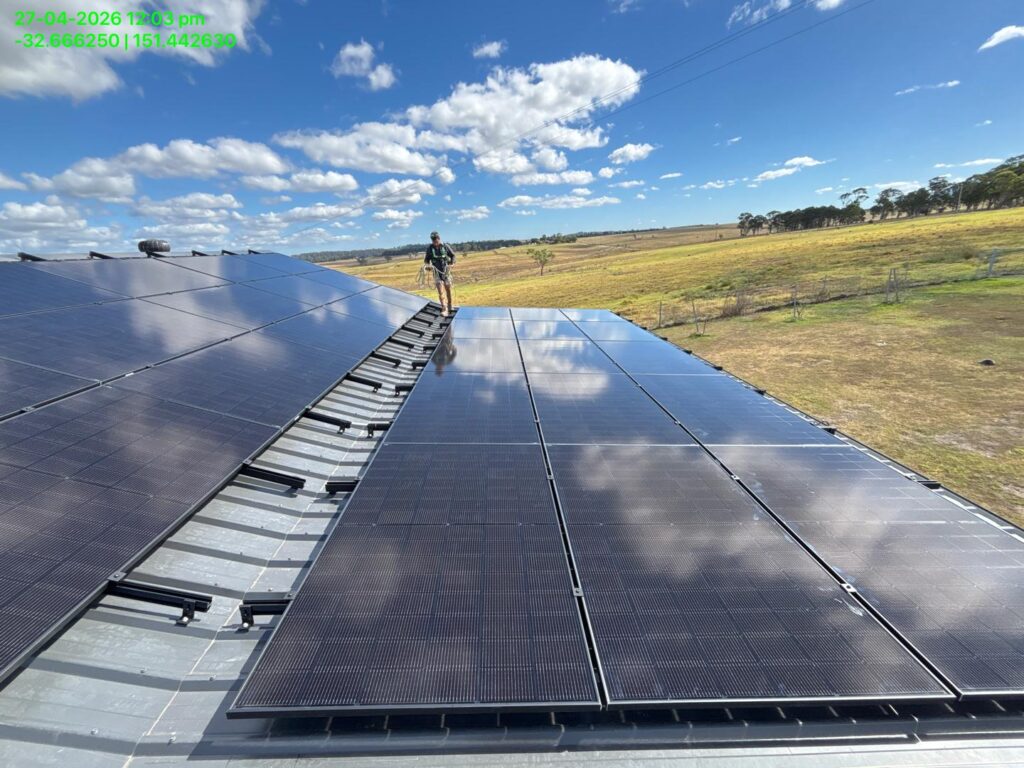
What’s actually holding your solar panels to your roof?
It’s called racking. The rails, brackets and roof interfaces that carry your panels through 25 years of Australian weather. Most homeowners never think about it. Until something goes wrong.
Choosing the right solar panel mounting system in Australia matters more than most homeowners realise, and Clenergy, ranked the number one solar mounting brand in Australia for 2025 by market analyst SunWiz, is built to get it right.
This guide covers:
what solar racking is and why it matters
how to choose a mounting system, and why Clenergy leads
the best racking for ColorBond, tile and other Aussie roofs
how racking handles harsh Australian conditions
what the warranty actually covers, now confirmed at 25 years
how to know your solar installation is done right
What Is Solar Racking and Why Does It Matter?
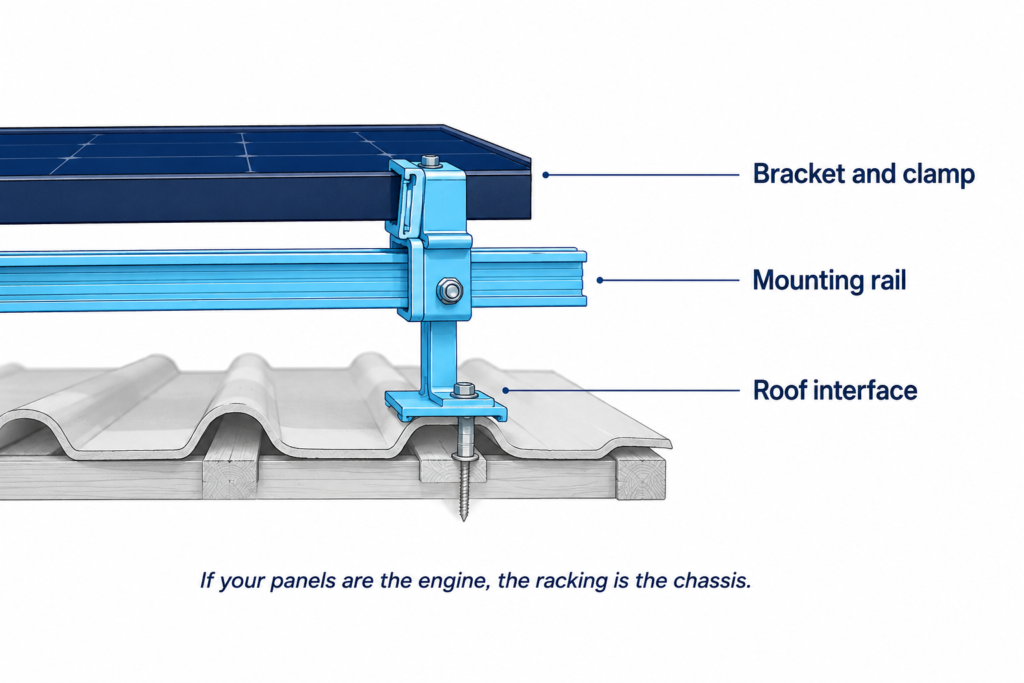
A typical solar racking setup consists of three parts:
solar mounting rails that run across the roof
brackets and clamps that grip each panel
roof interfaces that fix it all down through the tiles or metal sheet
If your panels are the engine, the racking is the chassis. It does the structural work and gets none of the glory. Skimp on it and the costs show up later:
water can leak in around each roof penetration
panels can shift or lift in strong wind
cheap solar panel brackets can corrode early near the coast
the extra solar system roof load needs hardware that can carry it
How to Choose a Solar Panel Mounting System in Australia
Nearly every solar installer in Australia has a go-to racking brand they trust. Ours is Clenergy, and here is why:
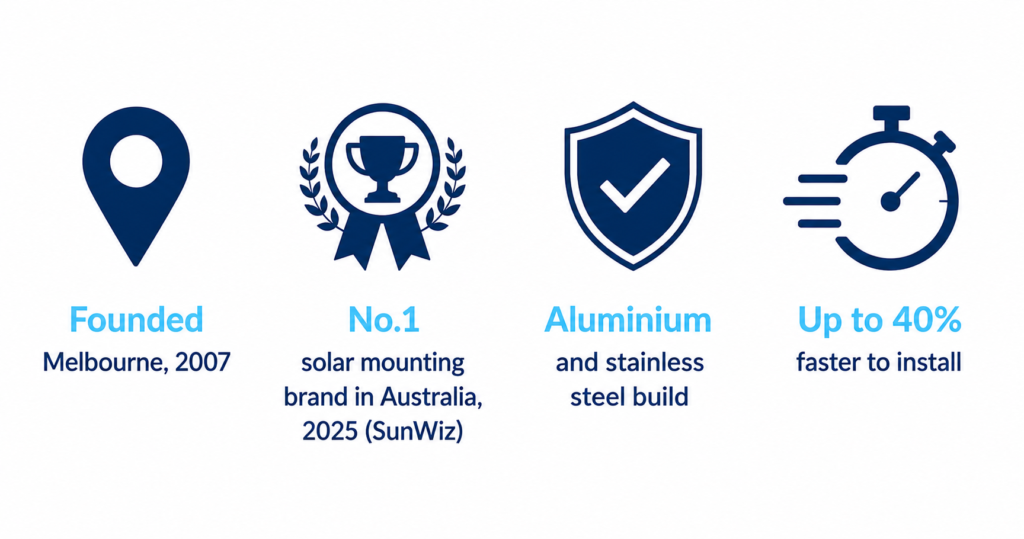
founded in Melbourne in 2007, now selling in more than 50 countries
ranked the number one solar mounting brand in Australia for 2025 by market analyst SunWiz
built from tough anodised aluminium racking and stainless steel
parts that click together, which Clenergy says can cut install labour by up to 40 percent
Why does installer-friendly hardware matter to you? For a few practical reasons:
less time on your roof means less mess and fewer mistakes
quality solar mounting hardware in Australia holds up over decades
a solar installer in Australia who knows the system fits it right the first time
What Solar Mounting System Is Best for ColorBond and Tile Roofs?
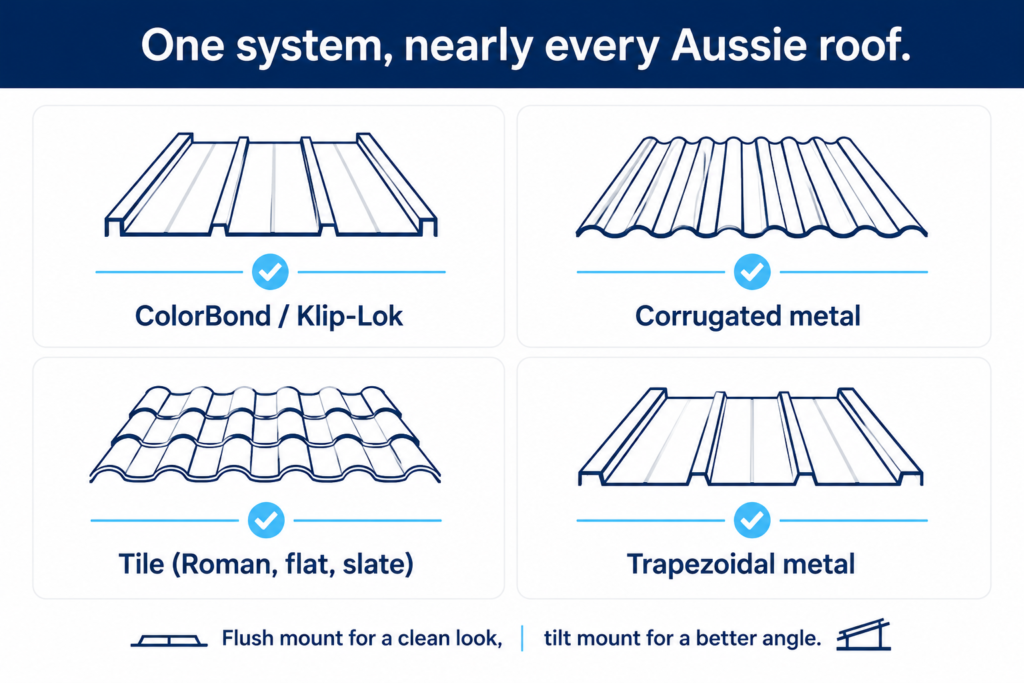
One of Clenergy’s biggest strengths is that the same system suits nearly every Australian roof. Only a small interface part changes to match yours. It covers:
ColorBond and other steel roofs, including Klip-Lok and corrugated profiles
tile roofs, including Roman, flat and slate, for solar tile roof mounting
all of these roof types are backed by the same 25-year Clenergy product warranty
A few things worth knowing when you roof mount solar panels in Australia:
on a ColorBond roof, the right solar brackets clamp to the ribs with minimal roof penetration
on tile, the interface lifts a tile and bolts into the rafter below, then seals
you can choose a flush mount for a clean look or a tilt mount to improve the angle
Roof angle changes how much power you make, so read our guide on roof orientation, pitch and shading before you settle on a layout.
How Solar Racking Holds Up to Australian Conditions
Australian weather is hard on rooftop hardware, from coastal salt to inland heat to cyclonic wind. Clenergy is built for it:
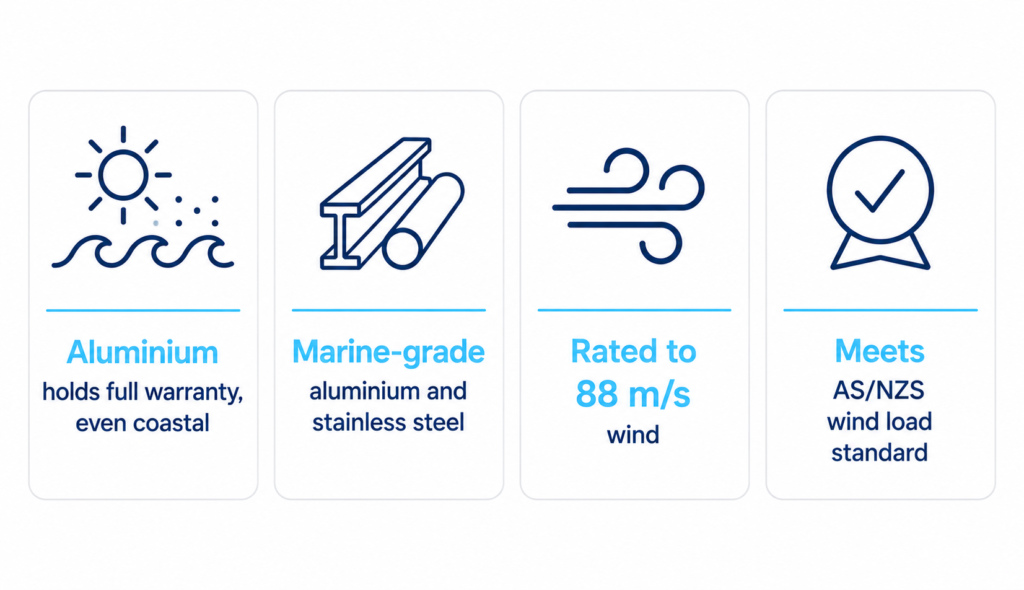
aluminium parts warranted for the full 25 years, even in harsh coastal air
a galvanised steel option for tougher environments
wind-rated solar mounting said to handle up to 88 metres per second
engineered to meet the AS/NZS wind load standard
Where you live changes what you need:
coastal homes in NSW face salt corrosion, so component choice matters
high-wind and storm-prone areas need properly rated, well-fixed racking
Two different warranties come up here, and it helps to keep them apart. First, your roof warranty:
every install needs roof penetrations or clamps, and poor workmanship there can cause leaks and put a roof or building warranty at risk
done correctly, by an accredited installer using proper flashing and sealing, your roof stays sound
always ask how your installer handles roof penetration and waterproofing
Second, the Clenergy product warranty:
Clenergy Australia warrants its PVezRack SolarRoof and SolarTerrace racking for 25 years, per the product warranty last updated 10 July 2024
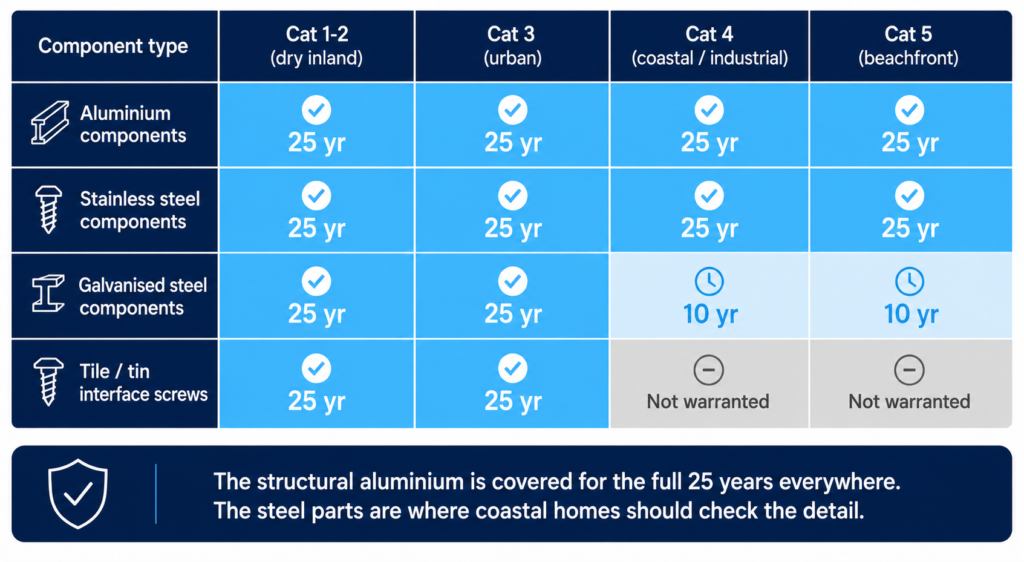
aluminium and stainless steel components are covered for the full 25 years across all corrosivity categories
Category 1 and 2: low corrosion, think dry inland areas
Category 3: medium, general urban and suburban
Category 4: high, near the coast or industrial areas
Category 5: very high, beachfront and salt-heavy marine air
in the harshest coastal corrosivity zones, some galvanised steel and screw components carry shorter cover, so coastal homeowners should check which parts apply
cover holds only if the system is installed by an accredited installer and maintained as required, such as annual fastener checks
So the headline is simple: the official Australian warranty is 25 years for the core racking, with shorter cover only on specific steel parts in the most corrosive coastal categories. Ask your installer for the warranty document so you can see exactly what applies to your roof and your area.
Getting Your Solar Installation in Australia Right
A great solar installation in Australia comes down to the install as much as the gear. To know your solar racking is installed correctly:
check your solar installer is accredited with Solar Accreditation Australia
ask which racking brand and variant suits your roof, and ask for the warranty document
ask how they handle roof penetration, flashing and the roof load
look for neat, even rows of panels with tidy cable management
Is quality racking worth a little extra? For most homes, yes:
it is a small part of the total cost but carries a big share of the long-term risk
it matters most for coastal homes, complex roofs and long-term owners
the thing to avoid is cheap, unrated racking with no Australian standards compliance
Your racking is also the foundation for everything else on the roof. Whether you are adding solar battery storage in Australia now or planning EV charger installation down the track, it all sits on the mounting system.
If you are looking to find out whether your home is ready for a solar system, you can read more here.
Frequently Asked Questions
How long does solar racking last on an Australian roof?
Quality racking like Clenergy is built to outlast the panels. The official Clenergy Australia product warranty covers the racking for 25 years, and the aluminium and stainless parts are rated for the full term across every corrosivity category. In the harshest coastal zones, some steel components carry shorter cover, so check which parts apply to your address.
Does solar racking affect my roof warranty?
It can, if it is done badly. Every install needs roof penetrations or clamps, and poor workmanship there can cause leaks and put a roof or building warranty at risk. Done properly by an accredited installer with correct flashing and sealing, your roof stays sound. Always ask how your installer manages roof penetration and waterproofing.
What solar mounting system is best for ColorBond roofs?
For ColorBond and other steel roofing you want a system with brackets that clamp securely to the roof ribs and keep roof penetrations to a minimum. Clenergy’s Klip-Lok and corrugated interfaces are designed for exactly this, which is part of why it suits so many Australian homes. Your installer should match the right interface to your specific roof profile.
How do I know if my solar racking is installed correctly?
A few quick checks tell you a lot:
the installer can explain how they sealed every roof penetration
the installer is accredited with Solar Accreditation Australia
the rows of panels are neat and even, with tidy cable management
you have the racking warranty document and know what it covers
Is now a good time to install solar, or should I wait?
For most homeowners, the sooner your system is generating, the sooner it cuts your bills, so waiting rarely pays off. The main exception is if you plan to replace your roof in the next year or two. In that case, do the roof first, so the racking goes onto sound material and does not have to come off again later.
Petrol prices are out of your hands… a decision overseas, a supply issue, a spike in demand, the price goes up and you pay for it.
For most Australians, there’s not much they can do except watch the numbers climb every time they pull into a servo.
The BYD Shark 6 changes that. It is a plug-in hybrid ute. Most days, it runs on electricity. The petrol engine is just backup.
Charge that electric side off your roof, and the cost lands close to zero.
Here is what you are working with:
It runs on electricity first, then petrol when the battery drops
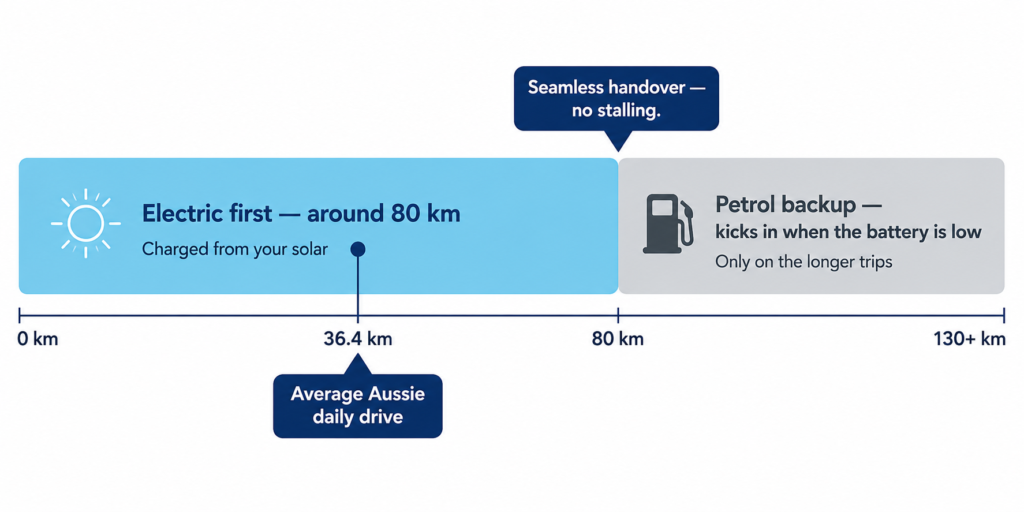
The electric battery is 29.58 kWh and covers around 80 km on its own, according to the (BYD Shark 6 specifications)
The average Aussie drives just 36.4 km a day
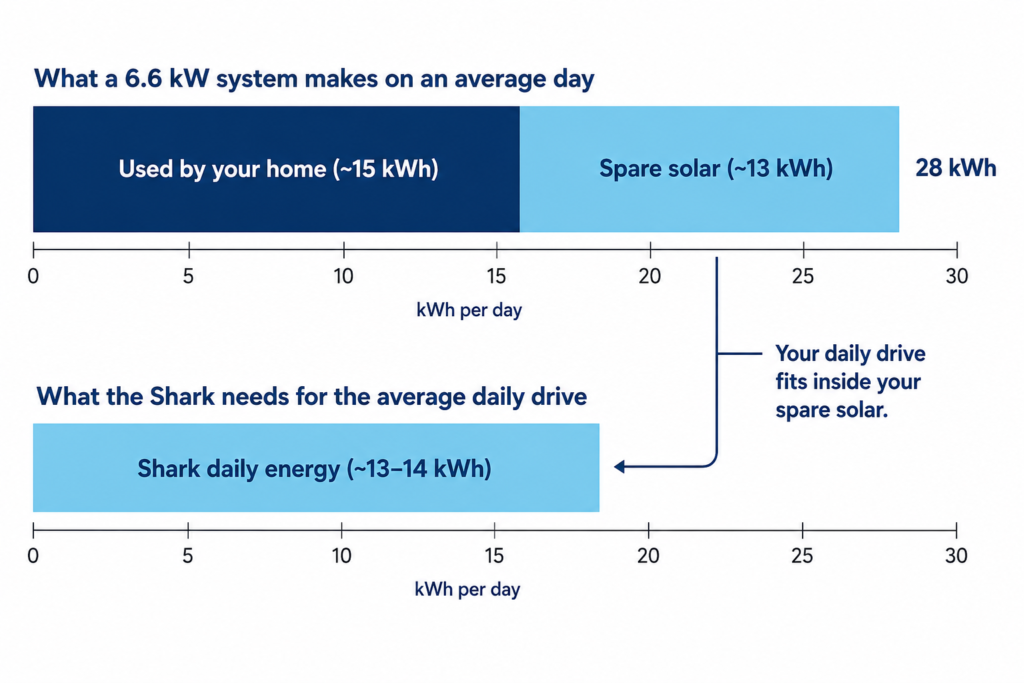
A 6.6 kW solar system makes far more than that drive needs
So most of your driving can run on sunshine your roof already caught. The petrol tank waits in reserve for the long hauls.
This article covers it all:
How the hybrid works and why solar suits it
How charging at home actually plays out
How many panels you need and how to set it up
How the free power window from July 2026 fits in
How the ute runs your tools and campsite
Where this idea makes less sense
By the end, you will know if you can charge a BYD Shark with solar at your place.
How Does the BYD Shark Hybrid System Work?
It is a plug-in hybrid. Two power sources. Used in order.
It runs on the 29.58 kWh battery first, driving like a pure EV for the first 80 km or so
When that runs low, a 1.5L turbo petrol engine takes over
The engine mostly works as a generator, not a direct drive
Combined range is around 670 km
That order is the whole trick. Your daily driving comes off the battery. That is the part you fill from your roof. Petrol only earns its keep on the longer trips.
The handover is smooth. No stalling. No grinding to a halt. The battery empties, the engine picks up. That range anxiety you get with a full EV? Gone.
It also explains why a hybrid beats a full electric ute on solar:
The 29.58 kWh battery refills from one good day of rooftop surplus. A big electric ute could take days
Most days you only use part of it, so you rarely start from empty
The petrol backup means you never have to oversize your solar for the odd road trip
Can You Charge a BYD Shark With Solar at Home?
Yes. For most homes, the sums work.
The Shark takes a single-phase AC charge at up to 7 kW through a standard Type 2 plug
A decent rooftop system nearly matches that in the middle of the day
Charge while the sun is high and you fill the ute with power you would otherwise sell back for cents
Run the daily maths:
A 6.6 kW system makes around 25 to 30 kWh on an average day, more in summer, less in winter
Your house takes a chunk, leaving maybe 13 kWh spare
The Shark uses around 13 to 14 kWh to cover the average 36.4 km drive [This is an inference based on battery capacity and real-world range, not a manufacturer-stated efficiency figure]
So a normal day’s drive fits inside a normal day’s spare solar. Petrol stays in reserve for anything more.
The honest catch? It gets tight on a 6.6 kW system once the house takes its share. Dishwasher, air con, kettle through the middle of the day. Your surplus shrinks fast.
Want to charge for free and run the house? Go 10 kW or larger. The bigger the array, the more days you fill the ute for nothing.
How Much Solar Do You Need to Charge a BYD Shark?
Two things decide it. System size. And a smart charger.
System size first:
A 6.6 kW array, around 15 to 18 panels, covers the average drive on a good day
A 10 kW system or bigger, with quality panels like AIKO, gives you proper surplus for the ute, the house, and a battery
The bigger the array, the less you touch the grid
How much solar you need comes down to how far you drive and how much your home uses by day. An empty house banks more spare power than one running appliances all afternoon. Same roof, different result.
Now the smart charger. This is the bit people skip.
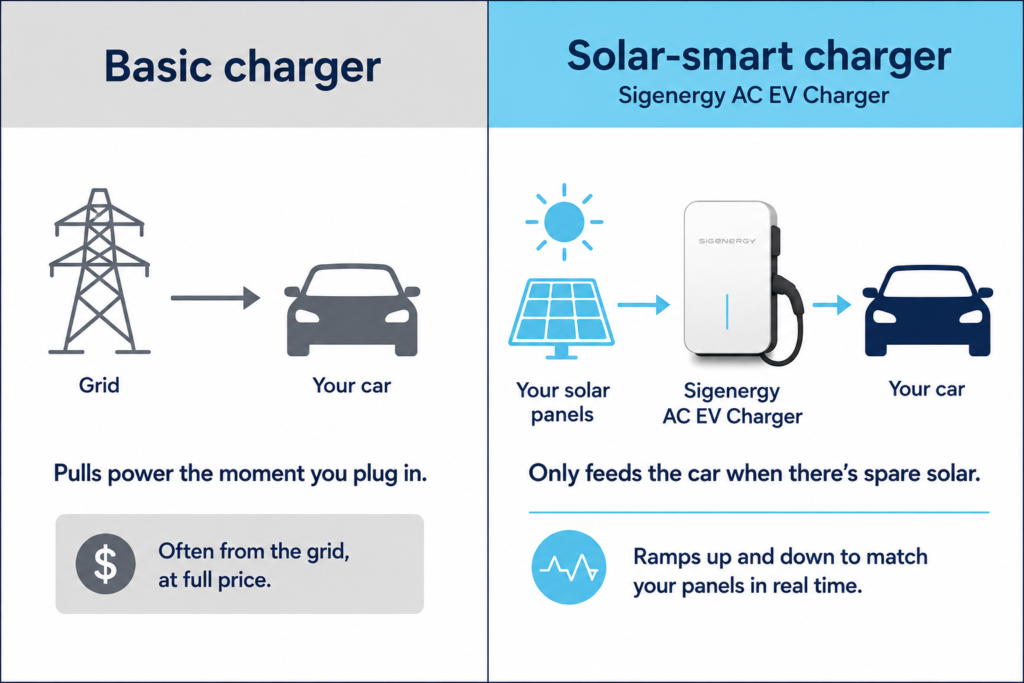
A basic charger grabs power the second you plug in. Often from the grid. At full price
A home EV charger that talks to your solar only feeds the car when there is spare power
The Sigenergy AC EV Charger is a single-phase 7.4 kW unit. It can add about 20 to 25 km of range an hour. It dials its output up and down to match your panels in real time
That is the whole difference. Free sunshine, or a power bill. On a patchy day it eases off under clouds and ramps back up when the sun returns. You always sip the surplus.
The controls are built in. It is close to hands-off.
Find these on the touchscreen under Settings, then Energy:
Scheduled charging: set a start and finish time so it charges through the sun, roughly 9am to 3pm
Target charge level: set a lower target at home, so you lean on electric driving and let solar refill the battery instead of burning petrol
MAX EV mode: uses up the electric charge before the engine steps in, squeezing every solar kilometre
Strong regenerative braking: claws back energy when you slow down, stretching your range further
There is a battery bonus too. The Shark uses a lithium iron phosphate battery. It shrugs off frequent partial top-ups, which is exactly what daily solar charging is. No wear worries. BYD backs it with an 8 year or 160,000 km warranty. Daily solar top-ups sit well inside that.
One thing to watch. The Shark’s built-in scheduled charging is designed for BYD’s own AC gear. Pair that timer with a non-BYD charger and it can trip up. Running a third-party smart charger? Set the car to charge instantly and let the charger handle the solar matching.
How Does the July 2026 Free Electricity Window Help?
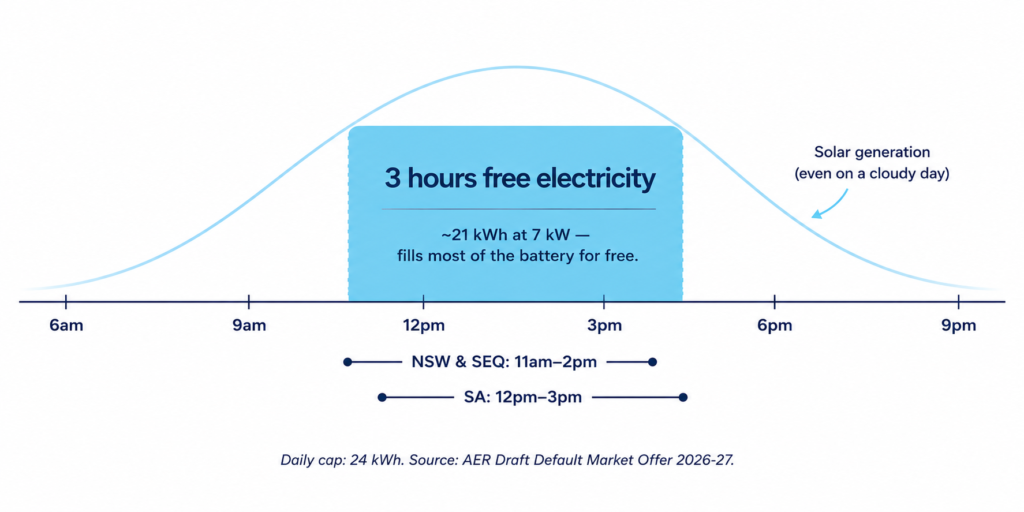
From 1 July 2026, the Solar Sharer Offerkicks in. Retailers with 1,000 or more customers must offer an opt-in plan with three hours of free electricity a day, lined up with peak solar.
The shape of it:
The window is 11am to 2pm in NSW and South East Queensland, 12pm to 3pm in South Australia
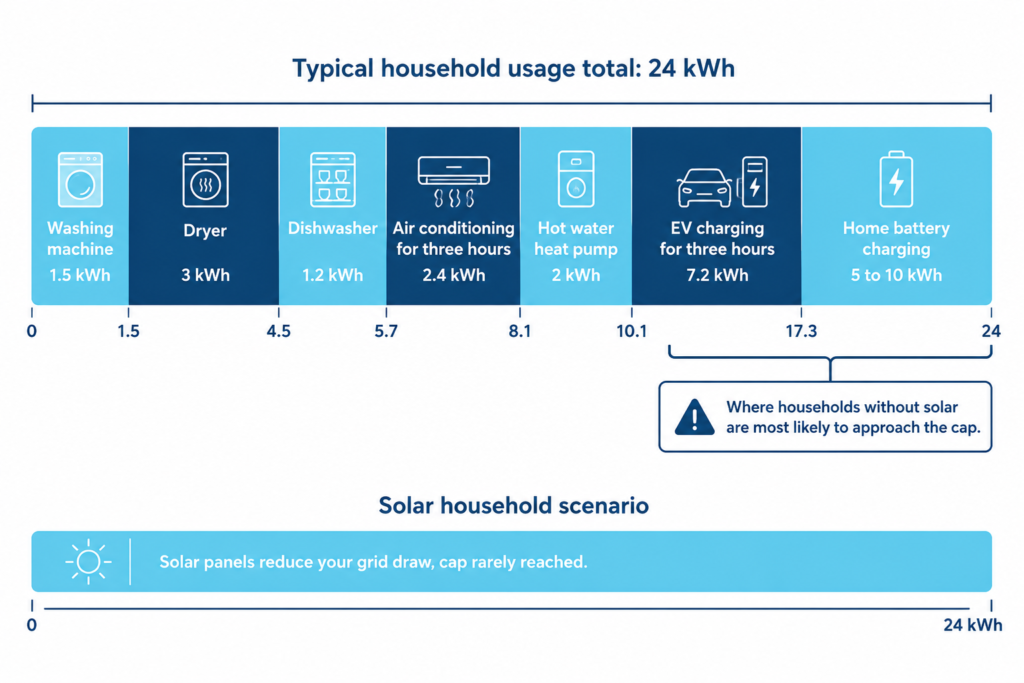
The daily cap is 24 kWh
This is confirmed by the Australian Energy Regulator’s Draft Default Market Offer 2026-27
For a Shark owner, this is your safety net on grey days:
Charge at 7 kW for the full three hours and you pull about 21 kWh
That fills most of the battery for nothing, even when the panels are quiet
Stack it on your rooftop surplus and free solar charging starts to look very doable
So the weather no longer holds you hostage. Cloudy day? The free window covers you. Sunny day? Your panels do the work and the window stays up your sleeve.
Our guide to the Solar Sharer Offer shows how to make the most of it.Pairing it with storage? We cover that in Can Getting an EV Actually Protect You From the Fuel Crisis? A good solar battery EV combination lets you stash cheap daytime power and charge the ute overnight for nothing. Handy if you are out driving while the sun is up.
Can the BYD Shark Power Your Tools and Campsite?
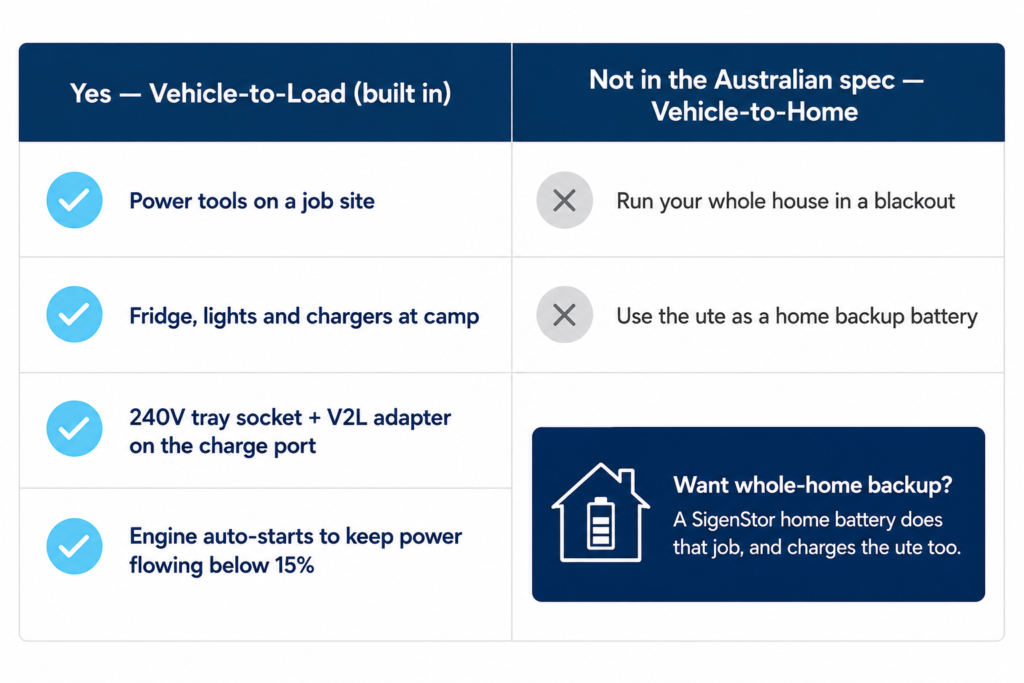
This is the fun part. The Shark has Vehicle-to-Load built in. It turns the ute into a mobile power station.
Power comes from a 240V socket in the tray and a V2L adapter on the charge port
Enough to run power tools, a fridge, lights, and chargers at once
The battery needs to be above 15% to discharge
Run low while you use it? The petrol engine fires up on its own to keep the power flowing, as long as the ignition is on
That last point is the off-grid clincher. It is a hybrid. Your tools and your campsite do not go dark when the battery drains. The engine quietly tops it up. Petrol only when you need it.
So the power you charged for free off your roof can run a job site the next day. Or keep the fridge and lights going at camp.
One limit, straight up. In the Australian version, the Shark does Vehicle-to-Load. It powers your appliances directly. It does not do Vehicle-to-Home. So it cannot run your whole house in a blackout. Want that? A proper home battery like the SigenStor is the right tool. It teams up with solar to charge the ute too.
Why We Design Around Sigenergy
The real win is control. The Sigenergy charger, battery and solar run as one customisable system, using AI to read your home and conditions in real time, so you set the priorities and the smarts handle the rest, sending every spare kWh to the ute, the battery or the house exactly where you want it. That is why we now design exclusively around Sigenergy. One connected system, tuned to your home, getting the most from every drop of solar you make.
Who Is Solar EV Charging in Australia Right For?
This setup’s a no-brainer if:
You drive under about 80 km on a typical day
You live somewhere sunny
You have solar, or you are planning to install it
For that driver, an electric ute on solar in Australia can mean close to zero running cost day to day. Petrol only shows up on the long trips.
It is a weaker fit if:
You rack up big distances, because then the petrol engine does more of the lifting
None of that kills the idea. It just means going in with your eyes open.
Here at Lenergy we design solar, battery and EV setups for Aussie homes, and we can tell you whether your roof and your driving actually add up to free charging. Send us a message and we’ll give it to you straight.
Frequently Asked Questions
Does the BYD Shark still use petrol if I charge it with solar?
Only when you drive past the electric range. The Shark runs on its battery first, so a normal day under 80 km can be all electric and all solar. The petrol engine only steps in on the longer trips once the battery is low. Most owners burn very little fuel day to day.
Can I charge a BYD Shark with solar if I already have a 6.6 kW system?
Usually yes, on an average day, once you add a smart charger that only pulls the spare solar. The drive most Aussies do each day fits inside the surplus a 6.6 kW system makes. Want year-round room, or a battery too? A bigger system makes it more reliable.
Will daily solar charging wear out the battery faster?
No. The Shark runs a lithium iron phosphate battery, built to handle frequent partial top-ups exactly like daily solar charging. BYD covers it with an 8 year or 160,000 km warranty. Charging off the sun every day sits well inside normal use.
Is now a good time to set this up, or should I wait?
There is a solid reason to move before winter and before 1 July 2026. The Solar Sharer Offer hands you a daily free electricity window from that date. Have a smart charger ready and you jump on it straight away. Sort the solar and charger now and you charge on sunshine right through the next summer.
Three changes to the ACT Sustainable Household Scheme are coming on July 1st 2026. The major one raises the Home Energy Loan cap to $20,000, so if you’ve been putting off a home battery, this helps cover one.
The updates will also tighten EV eligibility and add e-cargo bikes to the scheme.
One thing that still trips people up: solar panels aren’t covered. The changes to the ACT Sustainable Household Scheme 2026 didn’t bring them back.
What are the ACT Sustainable Household Scheme changes from 1 July 2026?
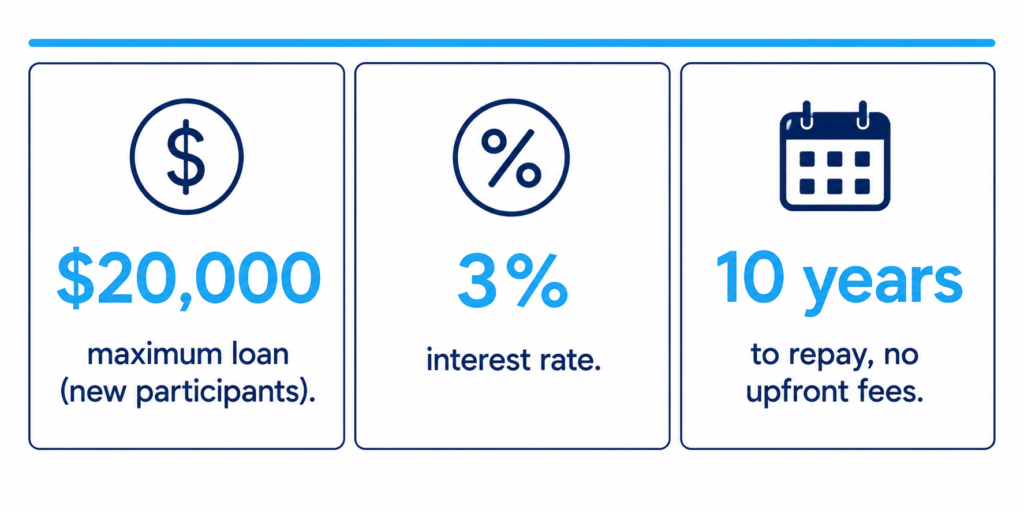
New participants can borrow up to $20,000, up from $15,000. Existing customers stay capped at $15,000.
The EV price threshold drops to $60,000, so some dearer models no longer qualify.
Electric cargo bikes join the scheme from September 2026, with the final rules still being confirmed.
What is the ACT Sustainable Household Scheme?
The ACT Sustainable Household Scheme is a low-cost loan program that helps Canberra households pay for energy-saving upgrades. It offers a 3% fixed rate loan with up to a 10 year repayment term and no upfront fees, so you can spread the cost of a big upgrade over time.
The ACT Sustainable Household Scheme eligible products now include:
Battery storage
EV chargers
Reverse cycle heating and cooling
Hot water heat pumps
Electric stovetops
Ceiling insulation
You apply through an approved installer rather than directly, and you attend a short workshop first. The scheme supports home electrification across Canberra suburbs and the ACT’s plan to reach net zero emissions by 2045.
ACT Sustainable Household Scheme solar exclusion: is solar still covered?
Solar panels are no longer eligible under the standard scheme. They were removed in 2025, so you can no longer borrow for panels the way you once could. If you are wondering why solar panels are excluded from the ACT Sustainable Household Scheme, the short answer is that the scheme has shifted its focus toward storage and electrification, where the grid now needs the most help.
There is one exception. Concession card holders can still access solar support through the ACT Home Energy Support Program, which offers a zero-interest loan of up to $10,000 plus a rebate of up to $5,000. For everyone else, solar panels are excluded, even though batteries that store solar power are firmly in.
Can I still get a battery under the ACT Sustainable Household Scheme?
Yes. Battery storage is one of the most popular upgrades in the scheme, and demand has climbed fast. Battery applications jumped from around 10% of all applications to more than half in a single year.
The old $15,000 cap often forced a compromise on size. The ACT Sustainable Household Scheme $20,000 loan changes that. The extra headroom lets you size a battery to match your evening usage and add an EV charger under the same loan. A Sigenergy SigenStor battery is a strong fit here, and it pairs neatly with a home EV charger for households that drive electric. A Canberra battery storage loan in 2026 can now stretch across both.
How could a battery help your power bill?
Picture a Canberra home charging its battery from rooftop solar through the day, then running the fridge, lights and heating from stored power all evening. That shifts one of your biggest daily loads off the most expensive part of the day.
A battery also keeps the essentials running during a blackout, so a storm no longer means a dark, cold house. Pair the scheme loan with the federal Cheaper Home Batteries Program rebate and the upfront cost drops further again.
How do you get started?
The scheme runs through approved installers, not direct applications, and you attend a short workshop first. The simplest path is to have a system designed around your home and budget, then apply with those numbers ready.
Frequently Asked Questions
Is solar still covered under the ACT Sustainable Household Scheme?
No. Solar panels were removed from the standard scheme in 2025. Concession card holders can still get solar support through the ACT Home Energy Support Program.
What is the maximum loan under the ACT Sustainable Household Scheme?
From 1 July 2026 new participants can borrow up to $20,000. Existing scheme customers stay capped at $15,000.
What is the interest rate on the ACT Sustainable Household Scheme loan?
Most households pay a 3% fixed rate, with up to 10 years to repay and no upfront fees.
Does the ACT Sustainable Household Scheme cover EV chargers in 2026?
Yes. EV chargers remain an eligible product, alongside battery storage, heat pumps and other electric upgrades.
What is the ACT Home Energy Support Program?
It is a separate ACT program for concession card holders. It offers a zero-interest loan of up to $10,000 plus a rebate of up to $5,000, and it still includes solar panels.
Are electric cargo bikes covered under the ACT Sustainable Household Scheme?
They will be, from September 2026. Standard e-bikes are not included, and the final eligibility rules are still being confirmed.
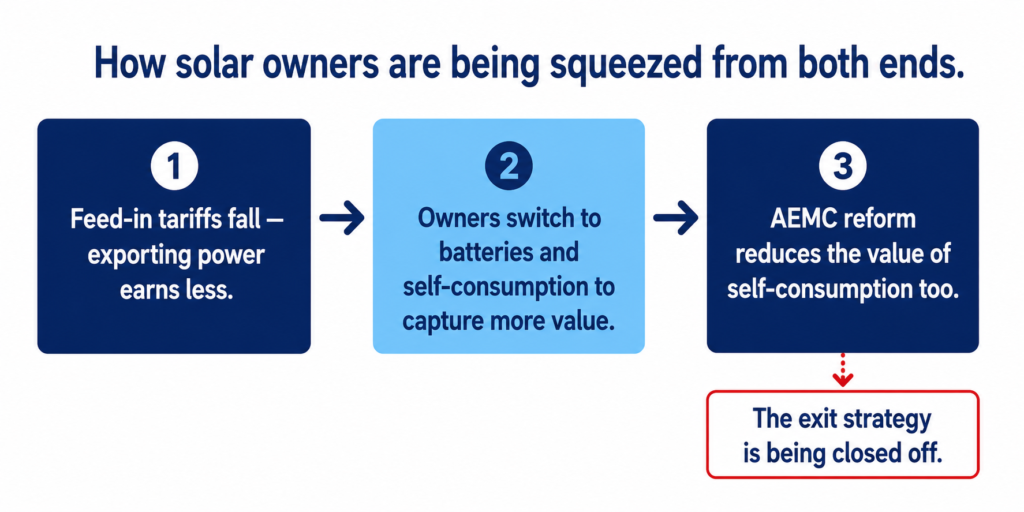
The Australian Energy Market Commission (AEMC) wants to change how electricity network costs are charged to Australian households, shifting more of the cost into a flat daily charge you pay regardless of how much power you use. Solar and batteries still would remain the best option however this hits those who are smart with their energy consumption the hardest. This tariff reform could significantly decrease the value of your investment. Here is what this article covers:
What the AEMC tariff reform actually proposes
Whether this is actually a solar tax for Australian households
Who gets hurt the most
What it means for solar feed-in tariff changes and battery storage savings
What you should do before the final report lands in June 2026
What Is the AEMC Tariff Reform and Why Does It Matter?
At the moment, a large part of your electricity bill is based on how much power you use. Use more, pay more. Use less, pay less. For solar owners, that system works in your favour. Every unit of energy your panels produce and you use yourself is a unit you do not have to buy from the grid.
The AEMC wants to change that. Their proposal would:
Shift more of the grid’s costs into a higher flat daily charge. Think of this like a Netflix subscription, your daily power subscription fee is going up, whether you use power that day or not. (we detail this further below)
Reduce the portion of your bill that is based on how much power you use
Introduce dynamic pricing during peak demand periods (when lots of households draw power at the same time, typically weekday evenings, the cost per kilowatt-hour would rise. During quieter periods it would fall. The idea is to encourage households to shift their energy use away from busy times.)
The AEMC argues this is fairer because solar owners currently use the grid less, which means they contribute less to shared infrastructure costs. Households without solar end up covering more of those costs. The commission calls this a cross-subsidy and wants to fix it.
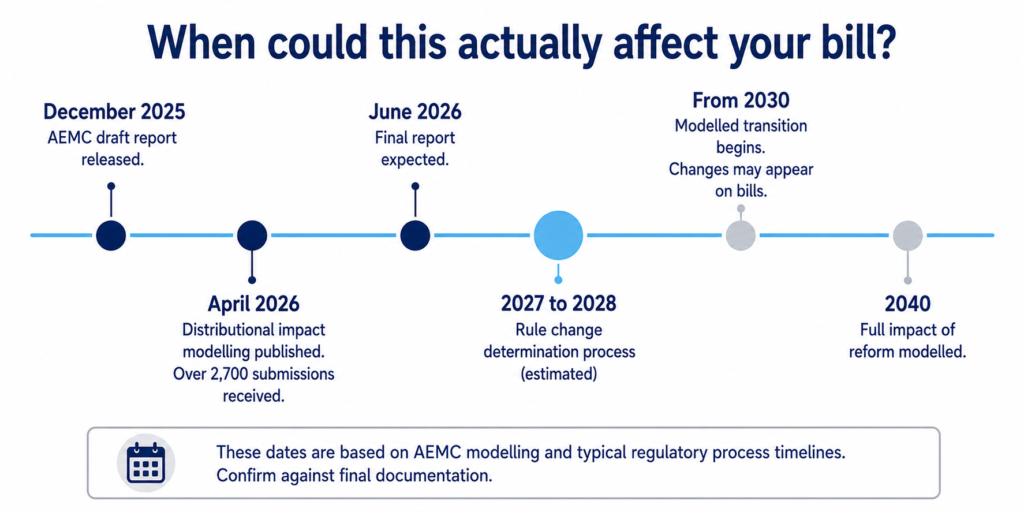
In April 2026, the AEMC released modelling claiming the reforms could deliver up to $6 billion in network savings over 15 years, per the AEMC media release published 23 April 2026. They say most households would save $40 to $80 per year on bills by 2040.
The public response was strongly negative. Over 2,700 submissions were received. The overwhelming majority opposed the proposal.
Should I switch to battery storage in Australia given these changes?
For most solar households, yes. Battery storage lets you self-consume more of your solar energy instead of exporting it at low feed-in rates or buying it back at high grid rates. If the AEMC reform proceeds and fixed charges increase, the value of self-consumption relative to grid dependence becomes even more important. Acting sooner rather than later also means your system builds up savings at current rates before any pricing changes take effect.
What Will Actually Change on Your Electricity Bill?
Every electricity bill has two basic charges. Understanding both is key to understanding why this reform hurts solar owners.
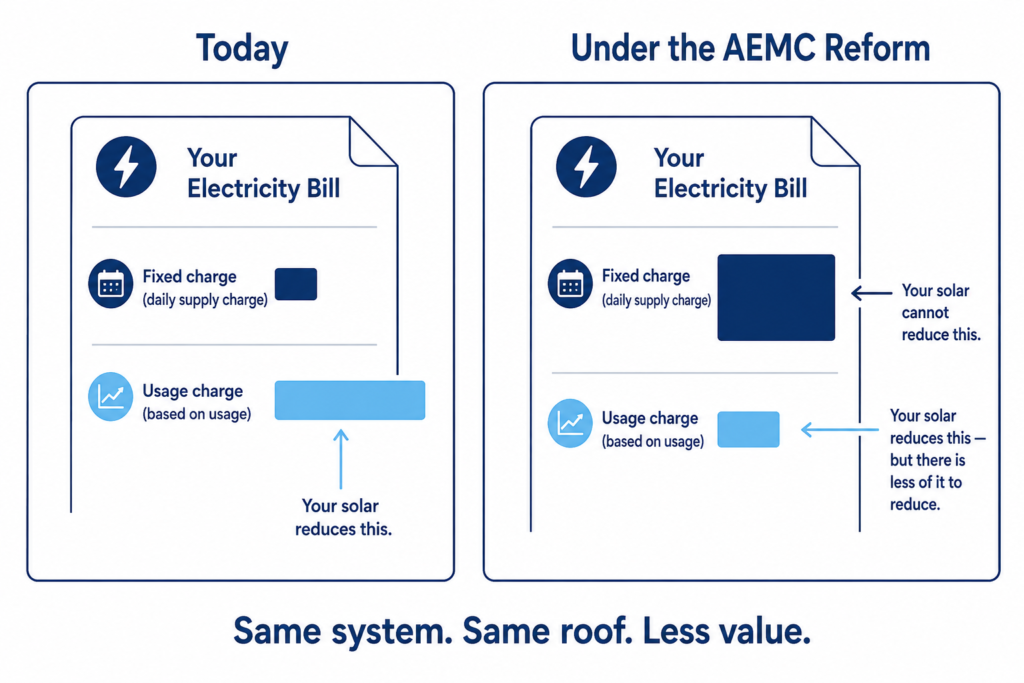
The first is the daily supply charge. This is a flat fee you pay every single day just to be connected to the grid. It does not matter if you use a lot of power or a little. You pay it regardless.
The second is the usage charge. This is what you pay per kilowatt-hour of electricity you actually draw from the grid.
Here is what the AEMC reform would do to each:
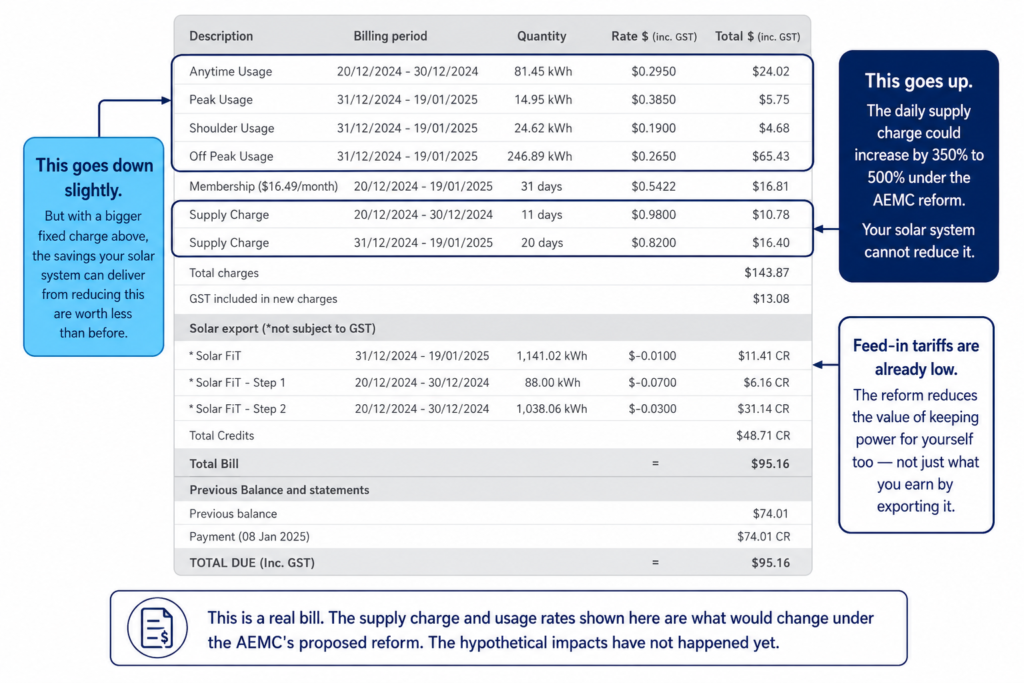
The daily supply charge goes up — significantly. Modelling by analyst Tristan Edis at Green Energy Markets suggests the network portion of this charge could increase by 350% to 500% depending on your state
The per-kWh usage charge goes down slightly, because some of that cost has shifted into the fixed charge instead
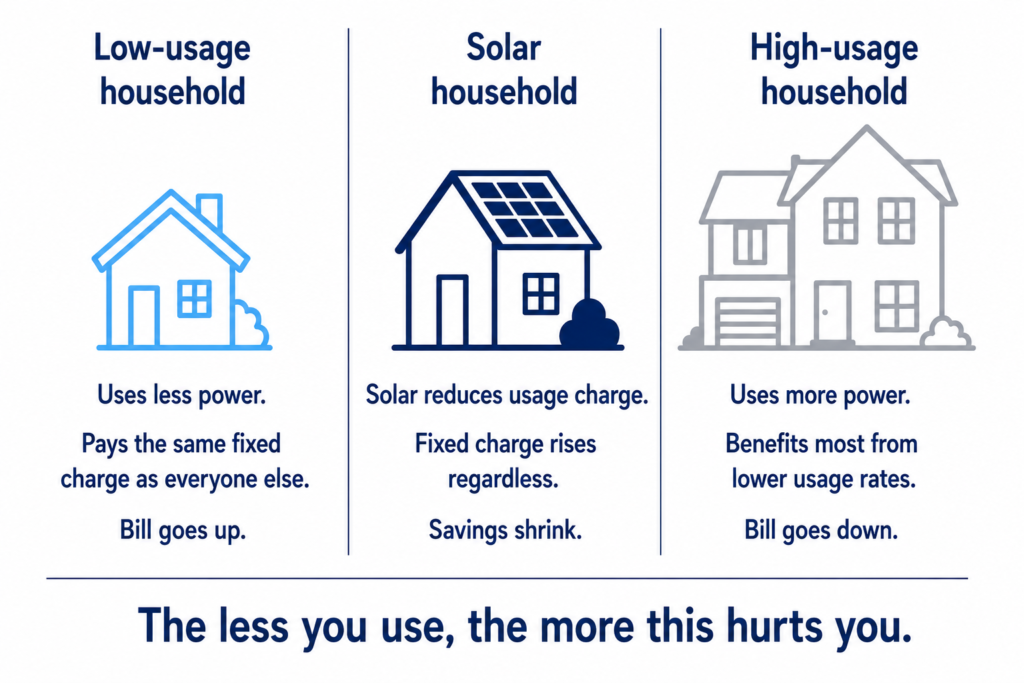
For a household without solar, those two movements can roughly cancel each other out. For a solar household, they do not:
A lower per-kWh rate means every unit of solar energy you use yourself saves you less money than it does today
The higher daily supply charge is there every day no matter how much your panels produce
The more self-sufficient your solar system makes you, the less the lower usage rate helps you and the more the higher fixed charge stings you
The bill below is a real example of what these two charges look like today. The hypothetical changes above have not happened yet, but this is exactly where you would see them if they did.
There is another group this reform quietly punishes.
Think about the household that turns the heater down and puts on an extra jumper in winter. The one that bought energy efficient appliances specifically to keep their bills down. The retiree who is home all day and watches every kilowatt-hour because they are on a fixed income. These households have done everything right. They use less, so they pay less. That is how the current system works.
Under the AEMC’s proposed changes, that careful behaviour is worth less:
A larger share of your bill is fixed, so using less saves you less
The financial reward for buying that efficient washing machine or turning the heater down shrinks
The household that uses twice as much power as you gets a bigger benefit from the lower per-kWh rate than you do
It hits anyone who has been careful with their energy use and in doing so, quietly removes the incentive to stay that way. If using less saves you little more than using a lot, why bother? The reform does not just fail to reward efficiency. It indirectly encourages the opposite.
Is This a Solar Tax? Here Is What the AEMC Solar Tariff Reform Means in Practice
The word ‘solar tax’ is not the AEMC’s language, and technically it is not a tax. What it is, is a significant increase to the flat daily charge on your bill. Unlike your usage charge, that flat rate is not something your solar system can reduce.
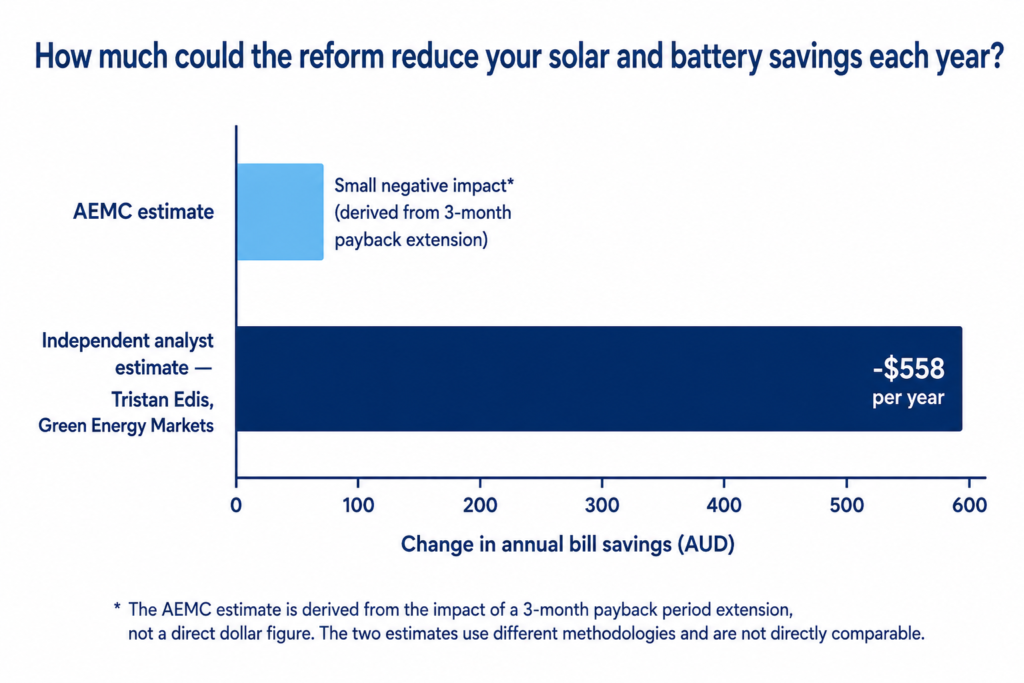
The AEMC’s own modelling suggests the impact is modest:
Solar payback period stretches by about three months, from roughly 4.4 years to 4.7 years
A 10kW solar and 20kWh battery system still accumulates around $27,000 in savings over 10 years
Independent analyst Tristan Edis put the damage much higher:
A median household in the Ausgrid network would lose $558 per year in bill savings from their solar and battery system
On average, the financial benefit of a solar and battery system would be reduced by roughly a quarter to a third
For many households that would push the payback period beyond the typical 10-year battery warranty period
Are They Taxing Solar in Australia? Who Gets Hit the Hardest
Solar and battery owners
If you have invested in a solar and battery system, the AEMC tariff reform hits you in two ways:
The value of self-consuming your solar drops as more of your bill moves into a fixed charge
The AEMC’s dynamic pricing means drawing from the grid during peak periods costs more and if your battery is not fully charged, you have no way to avoid it
Dynamic pricing only delivers savings if your devices respond to price signals automatically. For most households it is just a higher bill at the times when people actually need power
Low-usage and low-income households
The impact is not limited to solar owners. Any household that uses relatively little electricity would face higher bills under the fixed-charge model. That includes:
Retirees in smaller homes
Renters who cannot install solar and already manage their usage carefully
Apartment dwellers with limited appliances
Households that have worked hard to cut their consumption
A fixed charge takes the same dollar amount from everyone, regardless of how much power they use. Low-usage households pay proportionally more. The Institute for Energy Economics and Financial Analysis (IEEFA) found potential annual increases of $127 to $217 or more for low-income and low-usage profiles before any protections are applied.
The AEMC’s modelling includes a character called ‘Nina the Florist’, a small business with modest electricity consumption. Her bill could be up to $810 higher per year by 2040. The commission points to consumer protections as a safeguard, but critics argue those protections are not guaranteed.
The death spiral risk
There is a broader structural problem. If wealthier households respond to higher fixed charges by maximising their battery storage and cutting grid use:
The pool of customers paying for shared grid costs shrinks
The remaining customers, with fewer options, carry more of the load
That pushes costs up further and drives more households to reduce their grid use
The cycle keeps going
Without a per-kWh pricing signal to moderate behaviour, overall electricity consumption could rise, meaning more infrastructure is needed, not less.
What the Solar Feed-In Tariff Reform Means for Energy Companies Charging Solar Owners
Australia’s peak renewable energy industry body, the Smart Energy Council, released a statement in April 2026 calling for the AEMC to pause the reform. Their core argument is that energy companies charging solar owners more, while also reducing what those owners earn through solar export tariffs, sends completely the wrong signal for the energy transition.
Their key concerns:
The modelling raises more questions than it answers
Households that invested in solar based on the current rules would be penalised
The AEMC assumes retailers will not pass higher network costs on to customers in full, which the Smart Energy Council says has no real-world basis
The AEMC expects more Australians to invest in solar and batteries while proposing rules that make those investments financially less attractive
Nexa Advisory analysed all 2,700 public submissions and found the vast majority opposed the fixed-charge approach. Nexa CEO Stephanie Bashir described it as a backward step that would undermine home battery programs and slow solar uptake across the country.
The Clean Energy Council and multiple consumer advocacy groups made similar arguments. No one in the industry is keen on this reform.
What Should You Do Given These Price Changes?
The AEMC’s final report is due in June 2026 and has not yet been released. With electricity prices rising and feed-in tariffs continuing to fall, the direction of travel is clear.
If you already have solar or a battery:
Your savings are not about to collapse overnight
Changes would be phased in gradually over several years
Maximise self-consumption now — use more of your solar directly rather than exporting it
If you are thinking about installing solar or a battery:
The financial case for acting now is stronger than acting later
Systems installed today lock in savings at current rates before any changes take effect
Government battery rebate programs are available now and may not last
You can monitor the AEMC project page at aemc.gov.au for the final report when it is released.
Frequently Asked Questions
Is the AEMC tariff reform actually a solar tax?
The AEMC does not call it a tax, but the effect on solar owners is similar. Shifting more of the bill into a fixed daily charge reduces the financial reward for self-consuming solar energy. Your system still saves you money, but less of it. Critics including the Smart Energy Council have described the reform as penalising households that invested in solar based on the current rules.
How much could my solar savings actually be reduced?
Independent modelling by analyst Tristan Edis at Green Energy Markets found that a median household in the Ausgrid network would lose $558 per year in bill savings from their solar and battery system. On average, the financial benefit of a solar and battery system would be reduced by roughly a quarter to a third. For many households that would push the payback period beyond the typical 10-year battery warranty period.
Why is my solar bill still high if I have panels?
There are a few reasons. Feed-in tariffs have been falling for years, so if you export power to the grid you earn less than you used to. The cost of electricity you import from the grid has also risen sharply, so any gap in your solar coverage costs more to fill. And if your household uses power in the evenings after the sun goes down, you are drawing from the grid at higher time-of-use rates. A battery system addresses all three of these problems by letting you store and use your own solar energy rather than depending on the grid.
When would any changes actually appear on my bill?
Not before 2030 at the earliest. According to the AEMC’s own distributional impact analysis and media release, both published 23 April 2026, the modelled transition begins in FY2030 and extends over ten years, with the full impact modelled out to 2040. Before any bill changes occur, the June 2026 final report still needs to be published, followed by a separate rule change determination process. The rule change process alone typically takes one to two years after the final report.
There are now federal government grants for sports clubs covering solar panels, batteries, LED lighting, and other energy upgrades, worth between $25,000 and $100,000 per club. Round 1 of the sports club energy grants 2026 program opens on 11 June and closes on 8 July, giving clubs less than four weeks to apply. If your club wants to be in the running, preparation needs to start now.
Energy bills are one of the biggest overhead costs for community sporting clubs. Lighting fields and courts, running canteens, heating and cooling change rooms all add up fast. These grants for community sporting clubs are designed to help reduce energy bills for sports clubs and make facilities more resilient to the extreme weather events that have been cancelling games and damaging infrastructure across the country.
This article explains:
what the program covers
who is eligible
how much your club could receive
and what you need to do to get an application across the line.
What Are the Government Sports Club Energy Grants Available in 2026?
Game On: Teaming Up for Climate Action is a federal program administered by the Department of Climate Change, Energy, the Environment and Water (DCCEEW). It has a total pool of $35.3 million in community sports club grants across two funding rounds, with $17.6 million available in Round 1.
The program is part of a broader $50 million, four-year government commitment to help community sport decarbonise and adapt to climate risk. It sits alongside the $100 million Community Energy Upgrades Fund (which targets local government facilities) and can be combined with the Cheaper Home Batteries Program and Clean Energy Finance Corporation financing. That means the total value of solar and battery grants available to a club could go well above $100,000.
According to the DCCEEW program page, up to 500 clubs nationally are expected to benefit across both rounds.
How Much Sports Club Solar Funding Can Your Club Access?
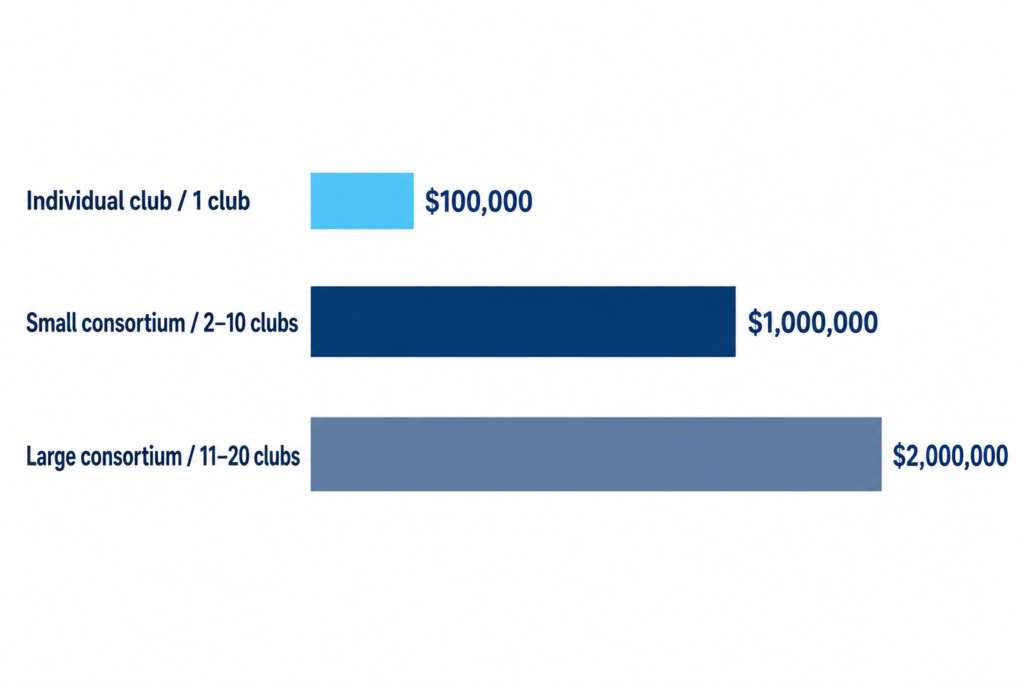
Individual clubs can apply for sports club solar grants between $25,000 and $100,000. The grant can cover up to 100% of eligible project costs, so clubs are not required to match the funding dollar for dollar.
Clubs can also apply as a consortium, which significantly increases the ceiling for local sports club funding:
2 to 10 clubs applying together can access up to $1 million total (up to $100,000 per club)
11 to 20 clubs can access up to $2 million total (up to $100,000 per club)
If your club shares grounds with another club, or if you are affiliated with a regional sporting association that could coordinate a joint application, the consortium pathway is worth serious consideration. One important caveat: clubs that participate in Round 1 as a consortium member are locked out of applying in Round 2, so make sure the consortium is the right fit before committing.
Which Community Sports Clubs Are Eligible for These Grants in Australia?
To be eligible for these community sports club grants in Australia, a club must be a not-for-profit organisation with a focus on grassroots participation. According to the DCCEEW program guidelines, clubs need:
An Australian Business Number (ABN)
An Australian bank account
A proper legal structure such as an incorporated association
Affiliation with a state or national sporting body
For-profit entities, unincorporated groups, and venues where gaming or licensed operations are the primary function are generally excluded, though there are some carve-outs in the guidelines worth checking if your club runs a bar or bistro as part of a broader community facility.
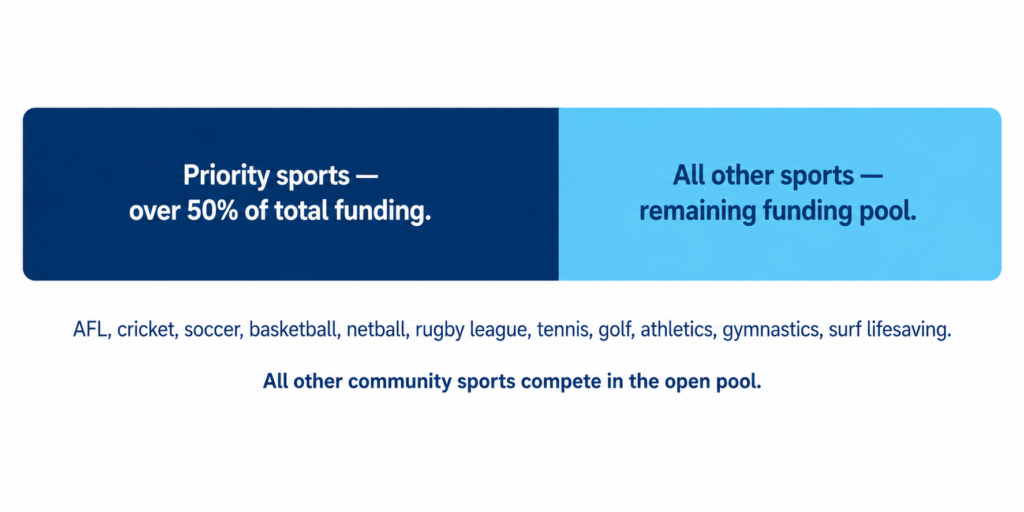
Does Your Sport Get Priority Funding?
More than 50% of the total federal grants for sports clubs is reserved for clubs from 11 priority sports codes:
AFL, cricket, soccer, basketball, netball, rugby league, tennis, golf, athletics, gymnastics, and surf lifesaving
Clubs from other sports are still eligible for solar grants for sporting clubs, but they compete in a separate pool for the remaining funding. If your club is in a priority code, your application has a structural advantage, which is another reason to get moving before Round 1 closes.
What Energy Upgrades for Sports Clubs Does the Grant Cover?
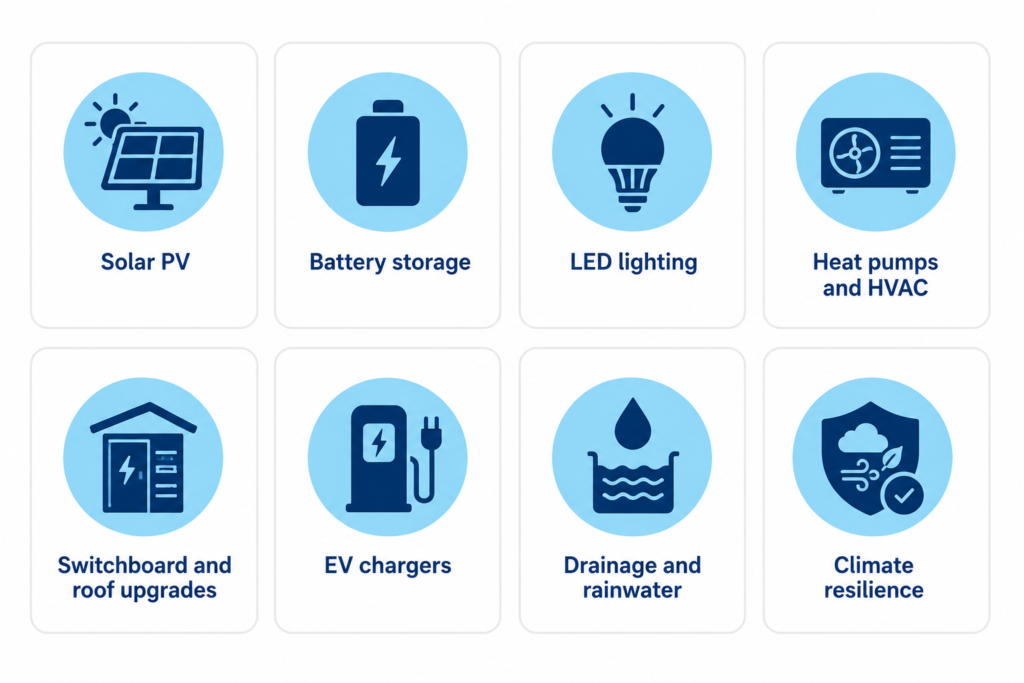
The grant is focused on building energy efficient sports facilities through electrification, renewable energy, and climate resilience upgrades. According to Smart Commercial Energy, a solar energy advisory firm that has analysed the program guidelines in detail, eligible projects for grants for club facility upgrades include:
Solar PV systems (typically 30 to 70kW for club facilities)
Battery storage systems
LED lighting upgrades
Heat pumps, HVAC, and insulation
Switchboard upgrades and roof strengthening to support solar
Shade structures, drainage, and rainwater harvesting
EV charger grants for clubs are also available through this program, covering the cost of EV charging infrastructure
Disaster-resilient features and climate risk assessments
Why Sports Club Battery Grants Are Worth Pursuing Alongside Solar
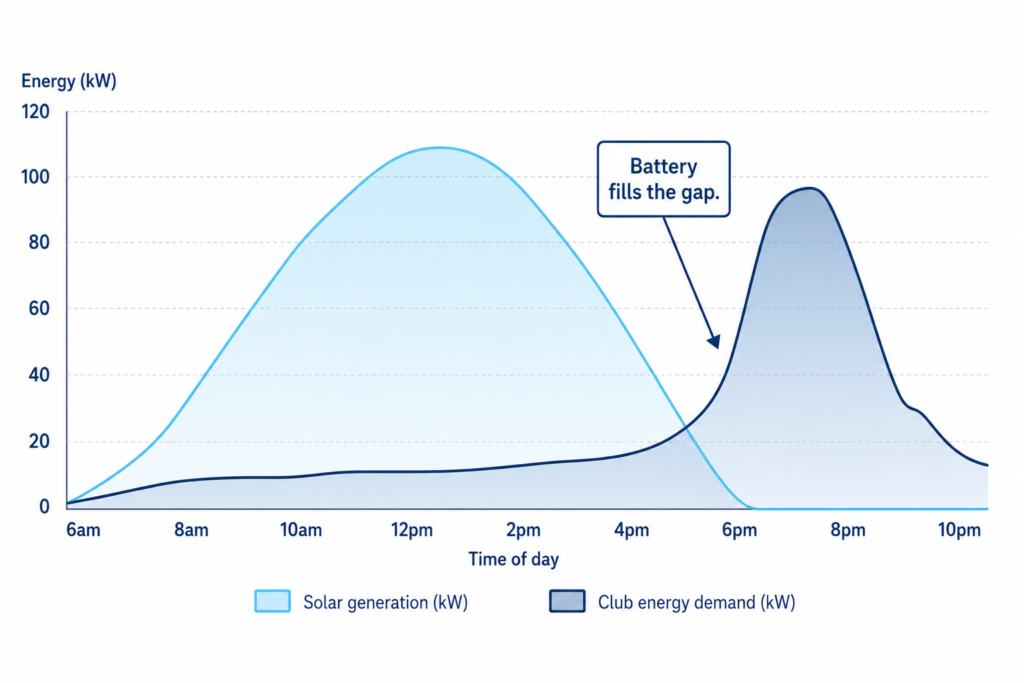
Sports clubs have a different energy usage pattern to most buildings. The heaviest demand hits at night, when field and court lighting is running for training sessions and games. A solar-only system helps with daytime usage in the canteen, office, and refrigeration, but it does not solve the evening load problem on its own.
Adding a battery means the energy generated during the day gets stored and used when the club actually needs it most. For clubs with large evening lighting loads, combining solar and battery grants in Australia through this program can make a much bigger dent in the energy bill than solar alone. It can even keep the lights on when a blackout hits.
What the Sports Club Energy Grants Cannot Pay For
There are some clear exclusions. The grant will not cover:
Staff wages or administration costs
Routine maintenance or repairs
Cosmetic items
Sporting equipment
Any work that has already started before the grant agreement is signed
That last point is critical. Do not start any works before you have a signed grant agreement in place, or the costs will be ineligible.
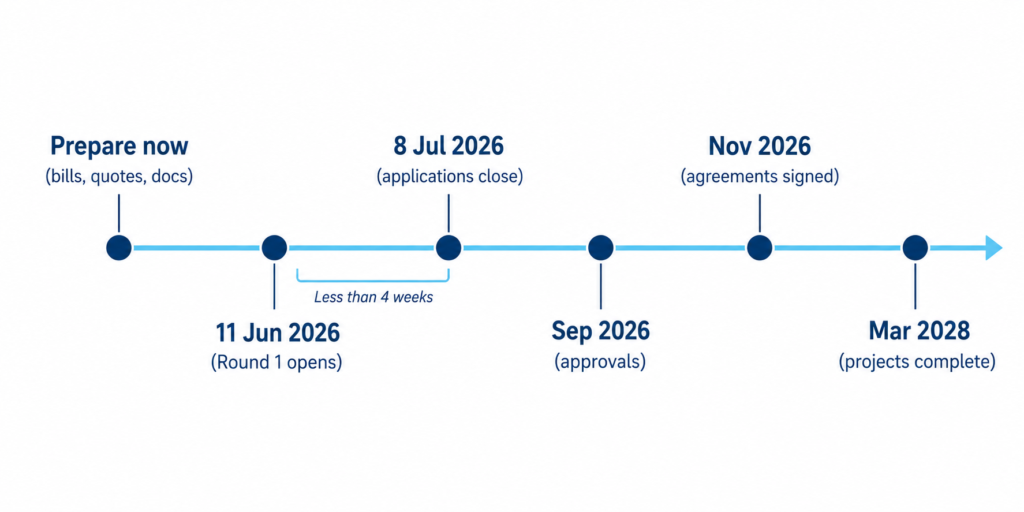
What Is the Timeline for Sports Club Energy Efficiency Grants in Round 1?
Round 1 opens: 11 June 2026
Round 1 closes: 8 July 2026
Assessments: August 2026
Approvals: September 2026
Grant agreements signed: November 2026
Projects must be completed by: March 2028
The application window is narrow, just under four weeks. That is not enough time to scramble for quotes and paperwork once the portal opens. Clubs that are ready on day one are in a much stronger position than those still gathering information in the final week.
How Do You Apply for Sports Club Energy Grants Australia?
Knowing how to apply for sports club grants is half the battle. Applications are submitted through GrantConnect (grants.gov.au). The Final Guidelines will be published there when Round 1 opens on 11 June. Per the DCCEEW program page, draft guidelines are already available, so clubs can review these now to understand the assessment criteria and start preparing.
Strong applications for community facility energy upgrades address three things clearly:
Energy impact: how much will this upgrade reduce your sports club electricity savings compared to current bills?
Community benefit: how do the savings flow back into your club through lower registration fees, more junior programs, or better equipment?
Project feasibility: can your club actually deliver this, and do you have the quotes and site authority to prove it?
To be ready before the portal opens, start pulling together:
At least four recent energy bills
Proof of site authority such as a lease or land ownership documents
Letters of affiliation from your state or national sporting body
Professional quotes from accredited installers
Consortium support letters if applicable
The DCCEEW is also engaging Program Support Providers, third-party organisations funded by the government to help clubs through the process. Contact the program team at GameOn@dcceew.gov.au to find out more.
Energy upgrades through this program deliver three clear benefits for community clubs:
Lower energy bills.
Energy costs for a typical club can run into tens of thousands of dollars a year
A solar and battery system sized at 30 to 70kW can make a serious dent in that figure
More money for what matters.
Savings can go back into junior programs
Better equipment for members
Lower registration fees for families
Better resilience.
Improved insulation, backup battery power, drainage, and shade structures all help
Talk to Lenergy Before You Apply
Here at Lenergy we design solar, battery and EV setups for Australian facilities and we can help your club build a strong, grant-ready proposal with the right system design and accredited quotes. Send us a message and we can help work with you to get the job done.
Frequently Asked Questions
Can a small community club with limited admin capacity still apply for these grants?
Yes. The program does not require a full-time administrator to manage the process. The DCCEEW is working with Program Support Providers specifically to help clubs that do not have dedicated staff for grant applications. Getting an energy audit and professional quotes from an accredited installer does most of the technical heavy lifting, and the application itself is submitted through GrantConnect. The key is starting early because the application window is short and the preparation work takes time.
Our club leases its grounds from the council. Can we still apply?
Possibly, but you will need to establish site authority. The grant guidelines require applicants to demonstrate that they have the right to carry out the proposed works on the site. For clubs on leased council land, that typically means getting written permission from the council as the landowner. This is worth sorting out before the portal opens on 11 June, because it can take time to get the right sign-off from a local government.
What happens if our club misses Round 1?
Round 2 of the program is expected to run in the 2027 to 2028 financial year, with a further $17.6 million in community facility energy upgrades funding available. Missing Round 1 is not the end of the road. That said, clubs that apply in Round 1 and are successful get their projects underway much sooner and the savings start from an earlier date. If you are close to ready, it is worth pushing to get your application in for Round 1 rather than waiting.
Is now a good time for our club to act on sports club energy grants 2026?
Yes. The application window opens in less than two weeks from the time of writing and closes just four weeks after that. Only 500 clubs nationally will receive funding across both rounds combined, and Round 1 has $17.6 million to allocate. Clubs that have their energy bills, quotes, and supporting documents ready before 11 June are in the strongest position. If you have not already reached out to an accredited installer for a quote and site assessment, that is the most important thing you can do right now.
If you’ve been worried about an AGL price increase in July 2026, or bracing for another energy price hike in Australia, here’s the good news: for most Australians, electricity prices are actually going down this July, not up. The Australian Energy Regulator (AER) confirmed its final decision on 26 May 2026, and benchmark electricity prices are falling in NSW, South East Queensland and South Australia. Victoria is also cutting prices. Western Australia is the one exception.
After several years of rising bills, this is a real shift. The main reason prices are dropping is that home batteries and large-scale battery storage have flooded the market, cutting the cost of electricity at the wholesale level. Renewables now make up more than half of Australia’s national grid generation.
This article covers exactly what’s changing from 1 July 2026 by state, by retailer, and in plain terms. You’ll learn why bills are falling in most places, what’s still going up inside your bill, what the new Solar Sharer Offer is, and whether going solar and battery is still worth it when prices are heading down.
Is There an AGL Price Increase in July 2026 — or Are Bills Actually Falling?
For most customers of AGL, Origin and EnergyAustralia, there is no electricity bill increase in July 2026. The opposite is true in most states.
These three retailers are required by law to cap their standard “standing offer” prices at or below the AER’s Default Market Offer (DMO), a benchmark price the regulator sets every year. When the DMO falls, their standard prices must follow.
Here’s what’s changing by state from 1 July 2026:
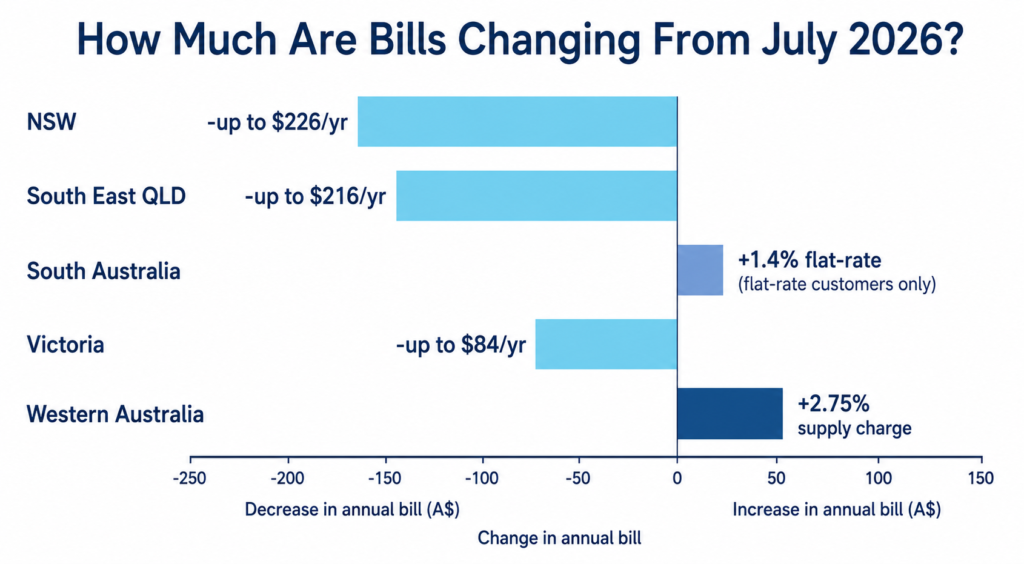
NSW: Bills falling by approximately $58–$226 per year depending on your area
South East Queensland: Bills falling by approximately $216 per year, the biggest drop of any DMO state
South Australia: Mixed. Flat-rate customers may see a small rise of around 1.4%. Time-of-use customers fare better
Victoria: Bills falling by approximately $84 per year, set by Victoria’s own regulator rather than the AER
Western Australia: Bills rising by 2.75% on the fixed daily supply charge, the one state going the other way
One important thing to know: fewer than 10% of households are actually on a standard standing offer. Most people are on a market offer, which is a competitive plan their retailer sold them. The DMO drop doesn’t automatically change what you pay, but it does reset the reference point retailers use to price their plans. If you haven’t reviewed your plan recently, now is a good time to compare energy providers in Australia and see if you’re getting a fair deal.
Why Is There No Major Energy Price Hike in Australia This Year?
The short answer: batteries and renewables have made electricity cheaper to produce.
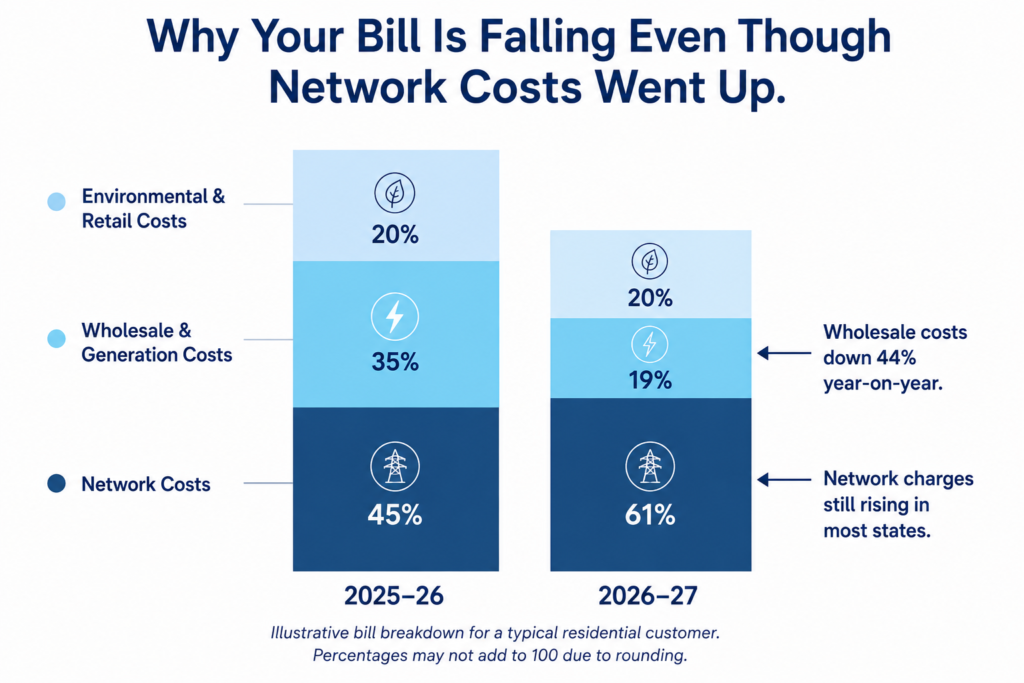
Wholesale electricity, which is the raw cost of generating power before it reaches your home, fell 44% year-on-year in the final quarter of 2025. Renewable energy hit a record 51% of national grid generation in that same period. Large-scale batteries are now helping set the wholesale price in roughly one third of all trading intervals, replacing expensive gas and coal generators that used to run every evening when demand peaked.
Energy Minister Chris Bowen credited home batteries directly, saying they are “flattening the peak” by storing cheap solar power during the day and releasing it at night. That means gas and coal plants get called on less often, which saves everyone money.
So why did anyone think electricity rates in 2026 might go up? Because one part of your bill, network charges, did go up almost everywhere. Network costs cover the poles, wires and infrastructure that carry electricity to your home. They make up 39–54% of a typical bill. Here’s what network costs did in 2026–27:
Ausgrid (NSW): up approximately 10%
Endeavour Energy (NSW): up approximately 11%
Energex (SE QLD): up approximately 12%
SA Power Networks: up approximately 10%
AusNet Services (VIC): down approximately 9%, the national exception
Network costs going up while overall bills go down sounds contradictory. It’s not. The wholesale price fell so sharply that it more than covered the network increases in most states. In South Australia, the network rise ate up more of the savings, which is why SA customers on flat-rate plans see a smaller benefit or a small rise.
The AER also changed the rules this year so the DMO must be based on “efficient costs”, meaning the lowest network tariffs available to retailers. That means retailers can no longer inflate the benchmark with padded estimates.
What Is the Solar Sharer Offer — and Should You Switch?
From 1 July 2026, AGL, Origin and EnergyAustralia are all required to offer a tariff called the Solar Sharer Offer to eligible customers. It’s opt-in, and you need a smart meter to access it.
Here’s how it works:
Free electricity for three hours every day during peak solar generation hours
In NSW and SE QLD: free from 11am to 2pm
In SA: free from 12pm to 3pm
24 kWh daily cap on the free electricity, with normal rates applying after that
Available to anyone with a smart meter, regardless of whether you have solar panels
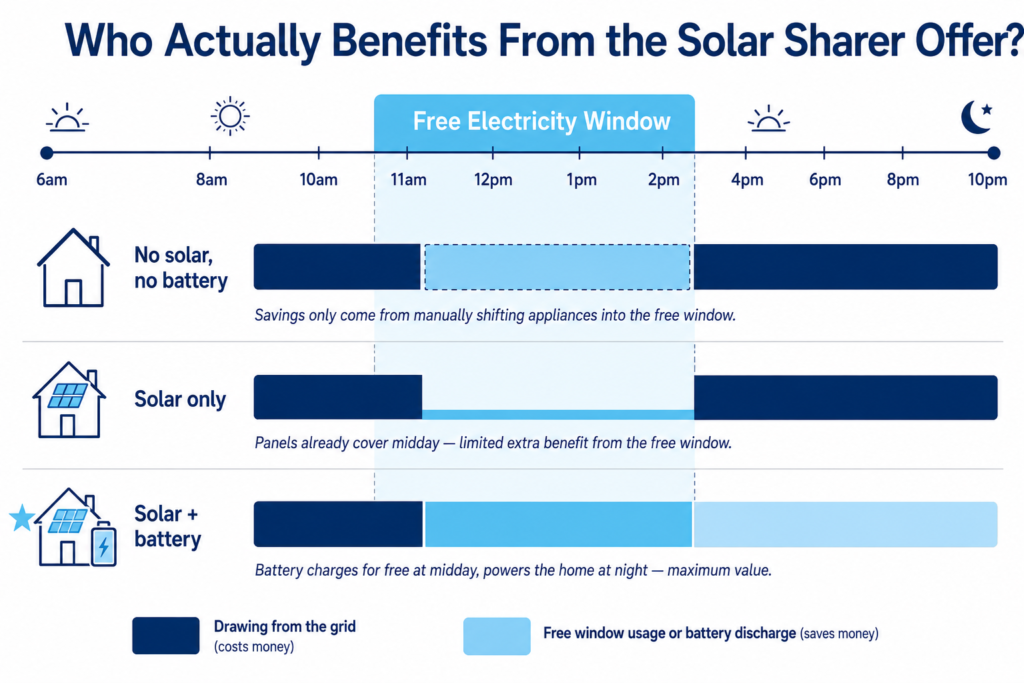
The catch is that this offer doesn’t save you money automatically. The savings only show up if you shift your usage into the free window by running your dishwasher, EV charger, air conditioner or hot water system between 11am and 2pm using an appliance timer.
For solar households without a battery, the benefit is limited. Your panels are already covering most of your midday power use, so the free grid electricity doesn’t add much. For households with a battery, it’s a different story. A battery can store up to 24 kWh of free electricity even on a cloudy day and discharge it in the evening when rates are higher. That’s where the real value is.
Victoria and WA don’t have the Solar Sharer Offer yet, but Victoria is expected to get it soon. Similar free-midday plans are already available in Victoria for smart meter holders who want to get started early.
What Other Changes Are Coming to Your Bill From July 2026?
Beyond the price changes and the new Solar Sharer Offer, several new consumer protections take effect from 1 July 2026 for all AGL, Origin and EnergyAustralia customers:
Retailers can only raise prices once per year, with mid-contract increases no longer allowed
Account establishment fees are being removed
Special meter read fees and re-energisation fees are being eliminated
Retailers must offer at least one free payment method
New tariff caps have been introduced, limiting not just annual costs but individual line items like daily supply charges and usage rates
That last change matters if you want to compare energy providers in Australia. For the first time, you can compare AGL, Origin and EnergyAustralia on a like-for-like basis. Supply charge versus supply charge. Usage rate versus usage rate. Previously, the way retailers structured their pricing made direct comparison difficult.
If you’re thinking about whether to switch energy provider in Australia, the new tariff caps make it significantly easier to work out which plan is actually cheaper for your usage pattern. The government’s free comparison tool at energymadeeasy.gov.au is the place to start.
Should You Still Go Solar and Battery Even If Electricity Rates in 2026 Are Falling?
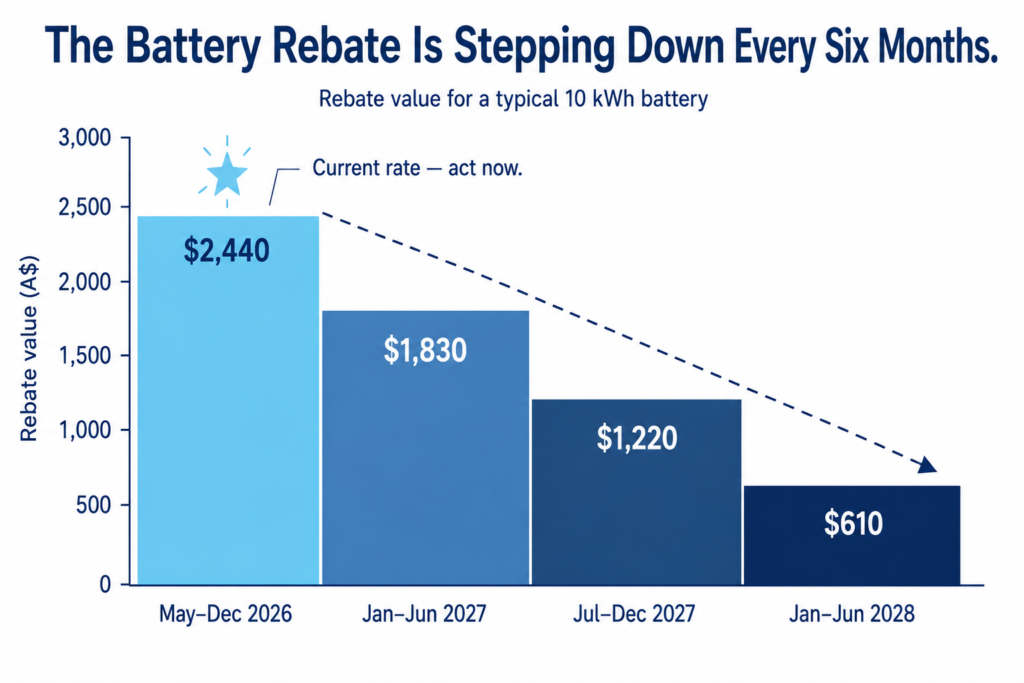
The Federal Cheaper Home Batteries Program currently provides approximately 30% off the upfront cost of an eligible home battery system. According to the Department of Climate Change, Energy, the Environment and Water (DCCEEW), the rebate works out to:
$2,440 off a 10 kWh battery
$4,438 off a 20 kWh battery
$6,463 off a 30 kWh battery
The scheme is uncapped and not means-tested. There’s no income limit and no national cap on how many systems can claim it. The rebate does decrease every six months though. The current rate applies from May to December 2026. From January 2027, the discount steps down so acting now means you will be able to get the highest discount possible.
Falling wholesale prices don’t make batteries less valuable. They make batteries more valuable, because the energy system is increasingly built around rewarding households that can store cheap daytime solar and avoid expensive grid power in the evenings. The new Solar Sharer Offer reinforces this by handing battery owners up to 24 kWh of free midday electricity every day to store and use later.
Here at Lenergy we design solar, battery and EV setups for Aussie homes. Wondering whether the battery rebate still applies at the full rate for your situation? Send us a message and we’ll give it to you straight.
Frequently Asked Questions
Is my power bill going up in July 2026?
For most Australians, no. Benchmark electricity prices are falling in NSW, South East Queensland, Victoria and, for many tariff types, South Australia. Western Australia is the exception, with a small increase to Synergy’s fixed daily supply charge. Whether you personally see a lower bill depends on your state, your tariff type, and which plan you’re on with your retailer. If you’re on a market offer that hasn’t been updated recently, your plan may not reflect the new lower benchmark automatically. That’s a reason to compare energy providers in Australia and check whether switching saves you more.
Why are electricity prices falling if I keep hearing that network costs are rising?
Both things are true. Network charges, which cover the cost of poles and wires, went up 10–12% in most states. But wholesale electricity costs fell 44% year-on-year as renewable energy hit record levels and large-scale batteries started replacing gas and coal in peak periods. The wholesale fall was large enough to outweigh the network rise in NSW, QLD and VIC. In SA, the network increase absorbed more of the savings, which is why flat-rate SA customers may see a small rise instead. The network cost pressures are real and ongoing. Households with solar and batteries reduce how much grid power they use, which insulates them from those rises regardless of what the headline rate does.
What is the Solar Sharer Offer and do I need a battery to use it?
The Solar Sharer Offer is a new tariff that AGL, Origin and EnergyAustralia must offer from 1 July 2026 to customers with smart meters. It provides three hours of free grid electricity per day, from 11am to 2pm in NSW and SE QLD and from 12pm to 3pm in SA, with a 24 kWh daily cap. You don’t need a battery to access it, but the savings are limited without one. If you have a battery, it can store up to 24 kWh of free electricity even on overcast days and use it in the evening when rates are higher. Without a battery, the benefit comes from shifting appliance use such as EV charging, hot water and dishwashers into the free window using timers.
Is the federal battery rebate still worth it when electricity prices are going down?
Yes. The rebate is based on the upfront system cost, not on the current electricity rate. It provides around $2,440 to $6,463 off a typical home battery depending on size. The discount decreases every six months, with the rate stepping down from January 2027. Only one rebate is available per property. Falling electricity prices and the new Solar Sharer Offer both increase the value of battery storage, because the grid now rewards households that store cheap daytime power and avoid peak-rate grid electricity at night. Acting in 2026 captures both the higher rebate and the better-structured tariff environment.
Is now a good time to switch energy provider in Australia?
It is worth reviewing your plan immediately. The AER’s own data shows that customers still on a standing offer could save up to 13% by moving to a competitive market offer. New tariff caps from July 2026 make it easier than ever to compare energy providers in Australia on a fair basis. Use the government’s free tool at energymadeeasy.gov.au to compare AGL rate changes against what Origin, EnergyAustralia and other retailers are offering in your area. If you haven’t reviewed your plan in the last 12 months, there’s a reasonable chance a better option exists.
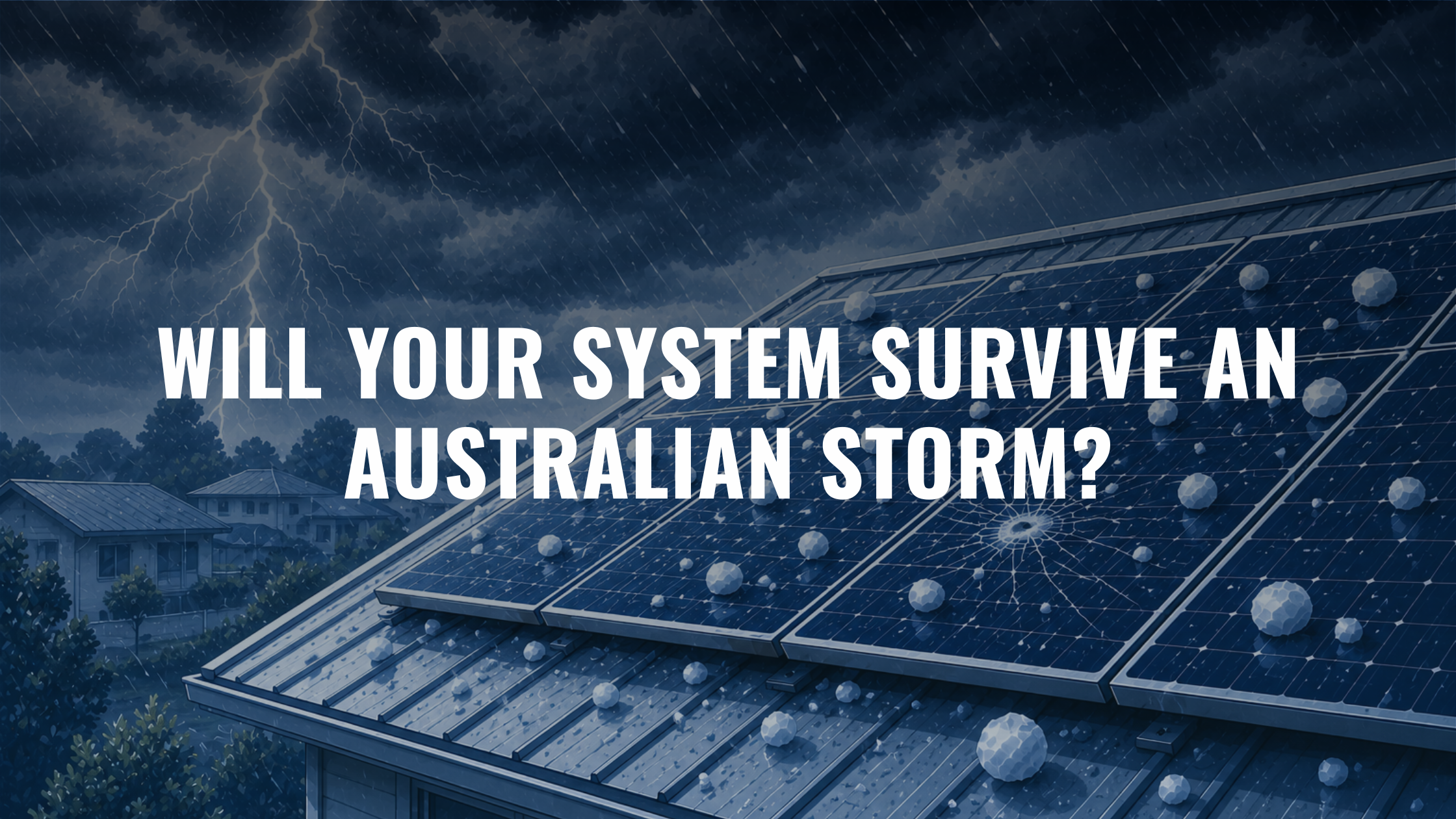
Australia’s hailstorms can and do destroy solar panels, but most systems come through storm season without any damage at all. The risk is real in certain parts of the country and at the more extreme end of the scale. With the right panels and a bit of forward planning, it is a risk you can manage before it ever becomes a problem.
If you live in southeast Queensland, inland NSW, or anywhere along Australia’s hail corridor, this is worth reading before storm season arrives.
This article covers what the Australian testing standards require, what real storms have shown about how panels hold up, why some hail damage does not show up for months, and what to do before and after a major event.
Do Solar Panels Have to Be Hail-Resistant in Australia?
Yes. Every solar panel sold in Australia must meet a standard called IEC 61215. This requires panels to survive being hit by 25mm hailstones travelling at roughly 83 km/h, across multiple points on the panel surface. A 25mm stone is about the size of a 50-cent coin. This has been thoroughly tested in real world situations and it means panels are built to handle the kind of hail most Australians see in a typical storm.
The problem is that some parts of Australia get storms that go well beyond that. In November 2025, two supercell storms hit southeast Queensland and produced hailstones up to 9cm across. According to ABC News, those two storms alone generated 28,250 insurance claims. In the town of Pratten near Toowoomba, nearly every property reported damaged solar panels.
Standards Australia has acknowledged that updating the national minimum standard is a multi-year process. Many manufacturers have not waited. They have moved ahead voluntarily by testing their panels to a tougher standard called the Swiss VKF HW4, which uses 40mm hailstones at significantly higher impact energy.
AIKOpanels were among the first in the world to pass the VKF HW4 standard. They use 3.2mm tempered glass, compared to the 1.6mm glass in some standard panels. In a high-risk area, that extra thickness makes a real difference.
Where in Australia Is Hail Risk Highest?
Not every part of the country carries the same risk. The areas where severe hail is most likely include:
Southeast Queensland, particularly the Darling Downs, Lockyer Valley, and Brisbane’s western suburbs
Inland NSW, including the Hunter Valley, Central Tablelands, and the New England region
Parts of Victoria, including Melbourne’s outer eastern and northern suburbs during spring and early summer
The ACT, which recorded a damaging hailstorm in January 2020
The 2020 Brisbane event produced hailstones as large as 140mm. The November 2025 storms produced similar conditions.
If your home is in or near any of these areas, choosing panels that go beyond the IEC minimum is the sensible call.
What Happens When Hail Hits a Solar Panel?
The damage you can see
Large hailstones can crack or shatter the glass, break the solar cells inside, dent the aluminium frame, and in extreme cases rip panels off the roof entirely. If this happens:
Turn off the AC isolator first, then the DC isolator
Do not go up on the roof while the system is live
Check for cracked or smashed panels from ground level only
Call a licensed technician before doing anything else
Voltage can still be present in a damaged system and poses a real safety risk.
The damage you cannot see
This is the part most homeowners miss. When hailstones hit a panel hard enough, they can crack the solar cells inside without breaking the glass on the surface. The panel looks perfectly fine. The inverter might not show any fault for days or even weeks.
Over time, those internal cracks cause problems:
Hotspots form, which are areas of concentrated heat in the damaged cells
Power output drops gradually
The backsheet can burn in serious cases
Moisture can get in and speed up the deterioration
The only reliable way to find this kind of damage is through a specialist inspection called electroluminescence (EL) imaging, which shows the internal cell structure. A visual check from the ground will not find it.
If your area has been through a significant storm and your output has dropped in the weeks after, that is worth getting checked properly.
Does Home Insurance Cover Solar Panel Hail Damage?
In most cases, yes. Solar panels are generally treated as part of the building structure and covered under standard home and contents policies. That said, policies vary, so before storm season it is worth checking:
That hail is listed as a covered peril in your policy
What the replacement value limit is and whether it reflects current system costs
Whether the policy pays full replacement cost or a depreciated value
Take photos of your panels before storm season. Write down the make, model, and serial numbers, and keep a record of your installer. A well-documented claim is a much faster and smoother process.
One thing insurance does not cover is gradual performance loss from microcrack damage that builds up over time. There is no single storm event to point to, so there is no claim to make. The protection against that kind of slow damage is choosing quality panels upfront and getting an inspection after any significant storm.
What Should You Do After a Hailstorm?
Right after the storm
Shut the system down: AC isolator off first, then DC
Do a visual check from the ground only
Look for cracked or shattered panels
If you see damage, call a licensed solar technician before anything else
If the panels look fine, check your inverter for fault codes or error lights
Most modern monitoring apps show you exactly what the system is doing. The mySigenapp for Sigenergy systems shows live output and flags faults directly.
In the days after
Keep an eye on your daily generation compared to what you were producing before the storm. Most apps give you a clear history. If output has dropped noticeably under similar weather conditions, that is a sign something needs a closer look.
If you experience an intense hailstorm and notice a significant drop in how much your solar system generates in the following days, it is worth booking a professional inspection even if everything looks normal. The cost of an inspection is well below the cost of finding out a year later that your panels have been silently degrading.
How Do You Choose Hail-Resistant Solar Panels?
In hail-prone areas, the question is not just whether a panel meets the IEC minimum. Every panel sold in Australia has to. The question is how much further it goes beyond that.
When comparing panels, look for:
Certification to the Swiss VKF HW4 standard or an equivalent enhanced hail rating
Glass thickness of 3.2mm or above
Specific certification details on the panel model being quoted, not just the brand name
AIKO panels were among the first in the world to achieve VKF HW4 certification. For homes in southeast Queensland, inland NSW, and parts of Victoria, that level of certification provides real protection in the storms that matter.
It is also worth thinking about how panel resilience connects to the rest of your system. If you have a solar battery at home, its value depends entirely on your panels working. A storm that takes out your array also takes out your backup power.
Talk to Lenergy
Here at Lenergy we design solar, battery, and EV setups for Aussie homes. Not sure which panels are the right fit for your roof and your risk profile? Send us a message and we’ll give it to you straight.
FAQ
Will my solar panels survive a hailstorm?
Most panels handle typical hail without damage. Australian standards require all panels to survive 25mm hailstones at 83 km/h, and many modern panels perform well above that. The risk increases significantly above 35 to 40mm, and parts of southeast Queensland, inland NSW, and Victoria regularly see stones larger than that. In those areas, choosing panels certified to the Swiss VKF HW4 standard provides a meaningful step up in protection.
Can hail damage solar panels without cracking the glass?
Yes. Hailstones can cause microcracks in the silicon cells beneath the surface without breaking the glass itself. These are invisible to the eye and may not trigger inverter faults straight away. Over time, the cracks spread and form hotspots, reducing power output and in serious cases creating a fire risk. The only reliable way to detect this damage is through electroluminescence imaging by a qualified technician.
Does my home insurance cover hail damage to solar panels?
In most cases, yes. Solar panels are generally treated as part of the building structure and covered under home and contents policies. Check that your policy lists hail as a covered peril, confirm the replacement value limit reflects current system costs, and document your system with photos and serial numbers before storm season. Gradual performance degradation from microcrack damage is not covered by insurance claims.
Is now a good time to upgrade to hail-resistant panels?
If you are planning a new system or replacing an existing one, building in hail resistance from the start makes practical sense, particularly in high-risk regions. The cost difference between a standard-rated and a premium-rated panel is modest compared to the cost of replacing a system after a severe event. With federal battery rebates currently available, combining a quality panel with battery storage is worth looking at now.
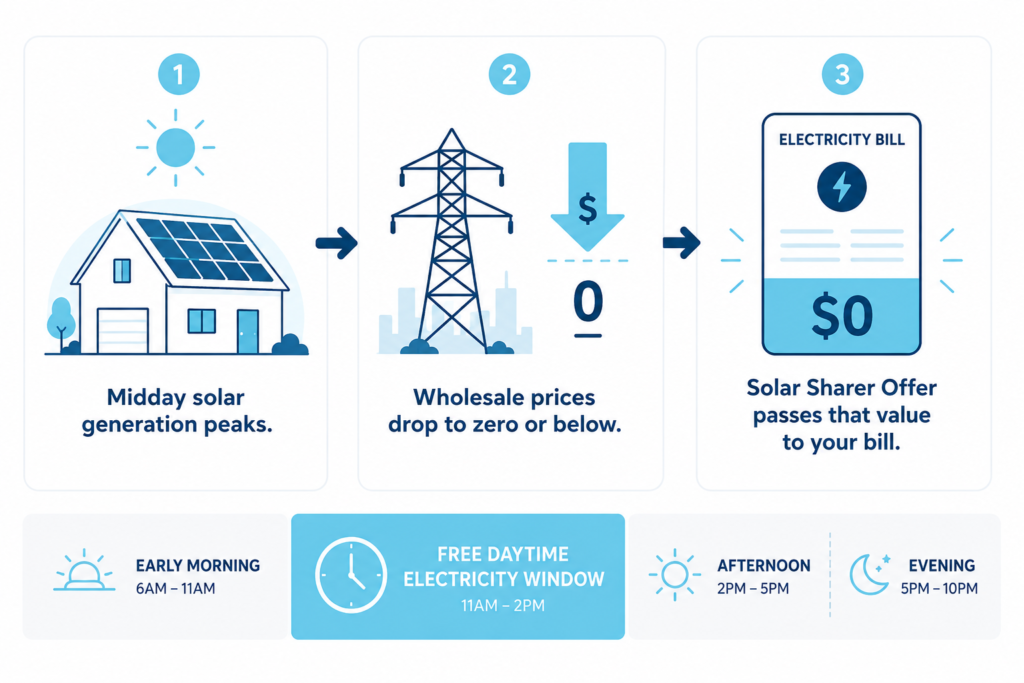
From 1 July 2026, energy retailers in NSW, South Australia, and South-East Queensland must give households at least three hours of free electricity every day. No solar panels required. No need to own your home. You just need a smart meter and to opt in through your retailer to have access to free daytime electricity .
The scheme is called the Solar Sharer Offer. It works by passing on the benefit of cheap midday solar power, which has always existed on the wholesale market but never made it to your bill, directly to households. Since it was first announced in November 2025, one significant change has been made to the design. This article covers what that change is, how the scheme works in practice, and how to get the most out of it.
What Is the Solar Sharer Offer?
Australia has more than 4.3 million rooftop solar installations. On a clear midday, those systems push so much electricity into the grid that the market cannot absorb it at normal prices. Wholesale electricity rates go negative. However, households on standard tariffs never see any of that benefit.
The Solar Sharer Offer changes that. From 1 July 2026, energy retailers must provide at least three hours of free daytime electricity per day, timed to coincide with peak solar output. The free window will sit around midday, with the exact hours tailored to local conditions. As a rough guide, expect something like 11am to 2pm or noon to 3pm.
To access it:
You need a smart meter (most Australian homes already have one)
If you do not have one, most retailers will install it at no charge
You opt in through your energy retailer when the scheme launches
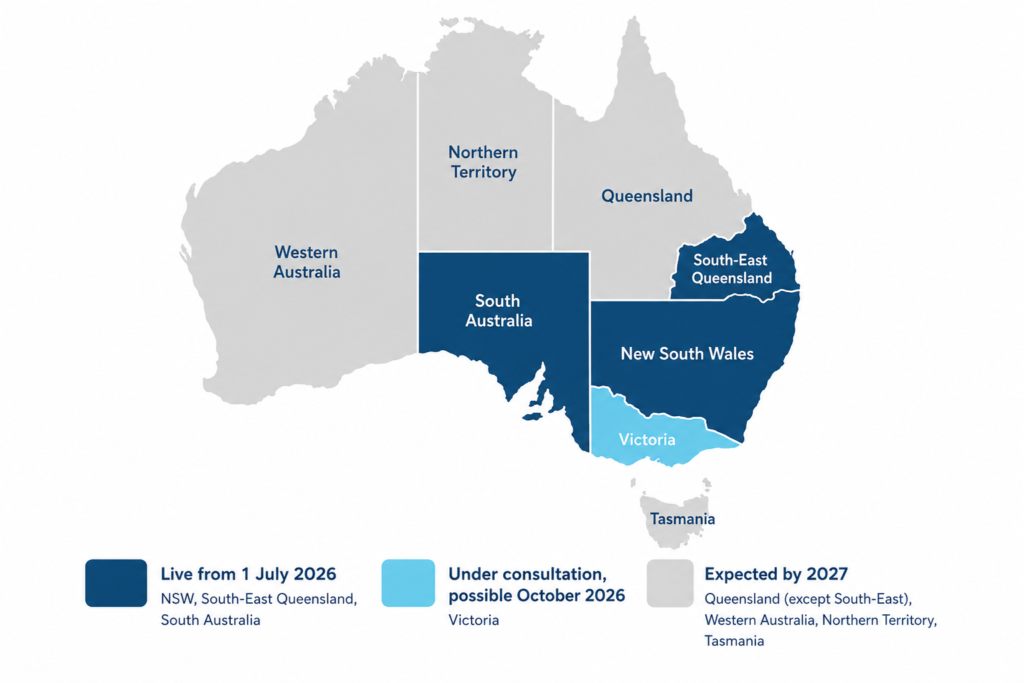
Which States Are Included in the Solar Sharer Offer from July 2026?
The July 2026 launch covers three states:
New South Wales
South-East Queensland
South Australia
These are the states governed by the federal Default Market Offer framework. Victoria is under consultation, with some reports pointing to a possible expansion from October 2026. Other states are expected to follow by 2027.
If you are in Victoria, the ACT, or another state not yet covered, check with your retailer. Several retailers including AGL, Red Energy, GloBird Energy, and OVO Energy have already been offering similar free daytime electricity plans voluntarily, so an equivalent option may already exist on the market for you.
What Changed After the Public Consultation?
When the Solar Sharer Offer was first announced, the headline was simple: three hours of free daytime electricity every day, no strings attached. Then the government ran a public consultation from November to late November 2025, receiving 76 submissions from retailers, network businesses, consumer groups, and state governments. One significant change came out of that process.
Per the Department of Climate Change, Energy, the Environment and Water (DCCEEW), a reasonable use cap of 24 kWh per day was added to the scheme. The government’s stated reason is to keep the Solar Sharer Offer financially sustainable for retailers and fair for everyone on the grid.
To put 24 kWh in perspective:
It is roughly the total daily electricity use of an average five-person household, based on residential consumption benchmarks published by the Australian Energy Regulator (AER) in December 2020 and cited by DCCEEW in setting the cap level
Running a washing machine, dryer, dishwasher, air conditioning, hot water, and more during the free window would get you close
Most households will not reach it on a typical day
The regulations for the scheme were finalised and published on 5 March 2026 as amendments to the Electricity Retail Code.
Does the 24 kWh Cap Affect Solar Households?
For most homes with rooftop solar, the cap is not something you will notice. On a sunny day, your panels are already covering a big chunk of your midday electricity use, which means you are drawing less from the grid during the free window than you might expect.
The situations where you might approach the cap are:
Cloudy winter days when your panels are generating less than usual
Charging a large home battery and an EV from the grid at the same time
Households with very small solar systems running high loads during the window
Even if you do exceed the cap, you just revert to standard daytime rates for the remainder of that period. You are not penalised, and daytime rates are still cheaper than evening peak rates, so shifting your load to midday is still worth doing.
For households without solar who were hoping to charge a large battery heavily during the free window, the cap matters more. The scheme was not designed for that kind of use, and the cap reflects that.
How Much Can Free Daytime Electricity Actually Save You?
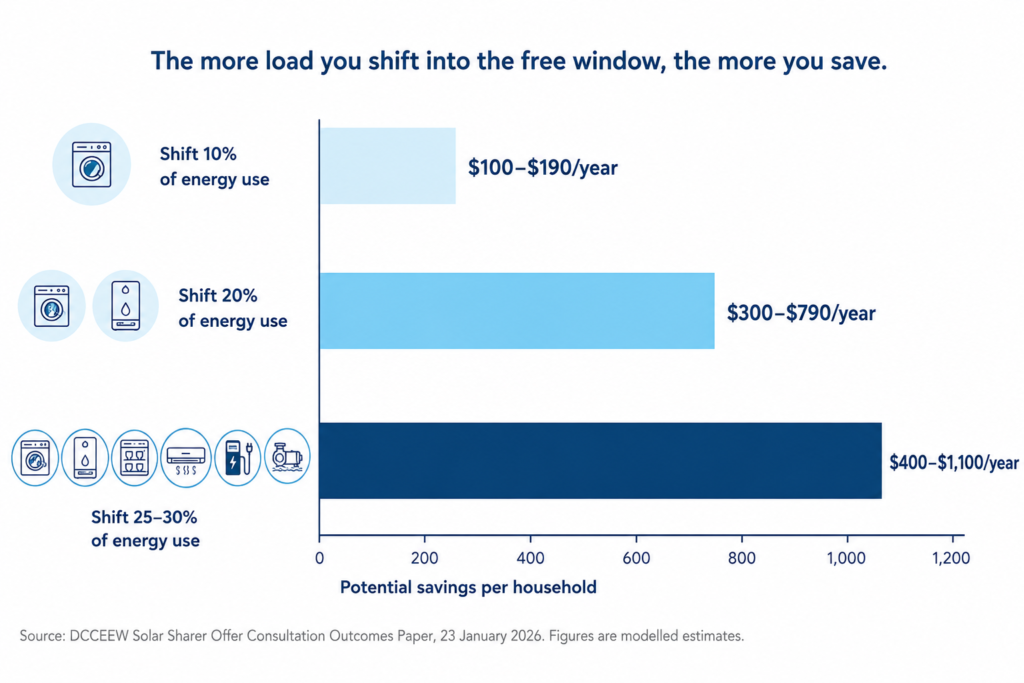
TThe DCCEEW published savings estimates in their consultation outcomes paper on 23 January 2026. The range depends on how much of your energy use you can move into the free window:
Shift 10% of your energy use (one major appliance per day): save $100 to $190 per year
Shift 20% (add a dryer or set your hot water to heat during the day): save $300 to $790 per year
Shift 25 to 30% (also add a pool pump, EV charging, or dishwasher): save $400 to $1,100 per year
These are modelled estimates based on average tariff rates and household usage profiles. Your actual savings will depend on your current plan, your household size, and how consistently you can shift load into the free period each day.
What Does the Solar Sharer Offer Mean for Homes With Solar and Batteries?
This is where free daytime electricity becomes most useful for households that have already invested in solar and battery storage.
During the free window, you can charge your home battery from the grid at no cost. On days when your solar is not generating as much as usual, shorter winter days or overcast mornings, the Solar Sharer Offer lets you top up your battery without paying for it. That stored energy then powers your home through the late afternoon and evening, when grid electricity is at its most expensive.
For households with an EV, the free window is a straightforward charging opportunity. If your car is at home during the day, scheduling it to charge during the free daytime electricity period rather than overnight cuts a real cost out of your weekly routine.
Systems like the Sigenergy home energy platform can automate this scheduling so your battery and EV charging prioritise the free window without you having to manage it manually. That kind of automation is what makes the Solar Sharer Offer most powerful in practice.
Who Gets the Most Out of Free Daytime Electricity?
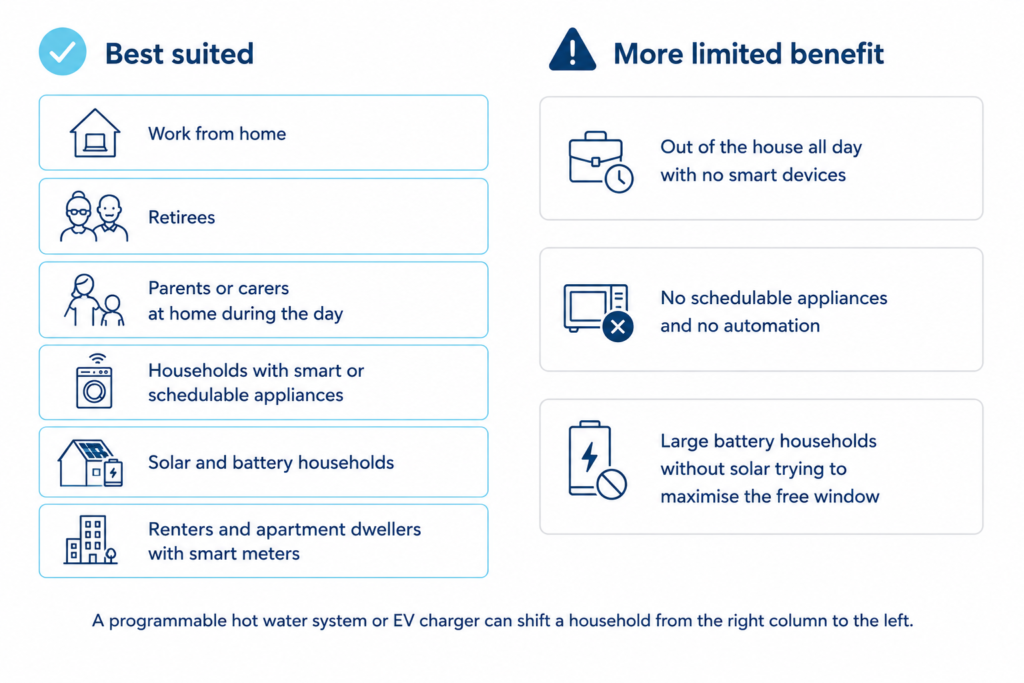
The scheme works best for people who are home during the day or who have appliances that can be set on a timer. That includes:
People who work from home
Retirees
Parents or carers at home during the day
Households with smart appliances that can be scheduled
If you are out of the house all day and have no smart devices, the benefit is more limited. Without automation, the free daytime electricity window passes without much use. A programmable hot water system or EV charger can still capture it while you are out, but you need that capability in place first.
Until now, renters and apartment dwellers have largely been locked out of the benefits of Australia’s solar boom. The Solar Sharer Offer changes that. You do not need panels on your roof or your name on a mortgage. Free daytime electricity is available to anyone with a smart meter who opts in through their retailer, which means renters and apartment dwellers can engage with the energy market in a meaningful way for the first time.
How to Sign Up and Make the Most of the Solar Sharer Offer
When the scheme launches on 1 July 2026, contact your energy retailer to opt in. Before then, do two things:
Confirm your home has a smart meter. If it does not, contact your retailer now to arrange installation
Check whether your high-draw appliances, hot water system, pool pump, washing machine, EV charger, can be set to run on a timer during the free window
Once you are enrolled, treat the free window as a daily resource. The households that save the most will be those who actively schedule their energy use around it rather than signing up and forgetting about it.
Here at Lenergy, we design solar, battery, and EV setups for Australian homes. If you want to understand how the Solar Sharer Offer fits into the picture for your place, whether you already have a system or are thinking about getting one, we can work through the numbers with you and tell you straight what makes sense. Getting the most from free daytime electricity is partly about the policy and partly about having the right setup in place to capture it. Send us a message and we’ll give it to you straight.
FAQ
How does the Solar Sharer Offer work for renters?
Renters can access free daytime electricity under the Solar Sharer Offer as long as their home has a smart meter. You do not need rooftop solar or to own the property. Contact your energy retailer to opt in once the scheme launches on 1 July 2026. The main practical limitation for renters is that smart appliances and schedulable devices, such as programmable washing machines or EV chargers, make a bigger difference than the scheme alone. Even without those, running high-draw appliances manually during the free window delivers real savings over a year.
Will the free daytime electricity window be the same every day?
The window will be at least three hours long each day and will sit during peak solar generation periods, typically around midday. Exact hours may shift slightly by season or region and will be confirmed by your retailer when you sign up. The design allows for adaptability over time per the DCCEEW’s stated principles, but the window is not expected to change frequently once established.
Is now a good time to invest in solar and batteries given the Solar Sharer Offer?
The Solar Sharer Offer strengthens the case for solar and battery storage rather than replacing it. Free daytime electricity covers part of the day. A solar and battery system gives you free or near-free electricity across a much larger portion of your day, and lets you use the free window to top up storage at no cost on low-generation days. If you were already considering solar and batteries, the Solar Sharer Offer adds another layer of value on top of what the system itself delivers.
What happens when I go over the 24 kWh daily cap?
Once you exceed the cap during the free window, additional electricity reverts to your standard tariff rate for that period. There is no penalty and no interruption to supply. The transition is seamless. For most households, particularly those with solar, reaching 24 kWh of free daytime electricity drawn from the grid within a three-hour window is unlikely on an average day.
Do I need to do anything before 1 July 2026 to be ready?
Two things are worth doing now. First, confirm whether your home has a smart meter. If it does not, contact your retailer to arrange installation ahead of the launch date. Second, if you have schedulable appliances, hot water systems, pool pumps, or EV chargers, check whether they can be set to a specific time window and familiarise yourself with how to do it. When the Solar Sharer Offer launches, you want to be capturing free daytime electricity from day one.
Energy bills are not getting easier to ignore. For most Australian households, the cost of running a home on grid power has become one of the more frustrating line items in the budget and it is largely outside your control. The 2026–27 Federal Budget, delivered on 12 May 2026, speaks directly to that frustration, with 370,000 batteries installed through the Cheaper Home Batteries program they are projecting 2 million by 2030. The government confirms continued support for solar and home batteries, signals significant changes to how household energy systems will interact with the grid, and makes some adjustments to EV tax incentives that are worth understanding before you make a decision.
Here is what the federal budget actually contains, what it means for you, and where the timing matters.
Is the Cheaper Home Batteries Program Still Available in 2026?
The most directly relevant measure for anyone considering a home battery is the continuation of the Cheaper Home Batteries Program. It provides an upfront discount of around 30 percent on eligible battery systems through the Small-scale Technology Certificate (STC) scheme, reducing what you pay on the day of installation. This recently dropped in May and will continue to do so every six months
The uptake since the program launched in July 2025 has been astronomical. According to Budget Paper No. 2, more than 370,000 home batteries have been installed under the program, adding over 10 gigawatt hours of storage capacity. The government is projecting 2 million Australian households will have a home battery by 2030.
This budget allocates $14.6 million to maintain safety inspections of installations as the program scales. The rapid growth has brought a rise in substandard installations by installers cutting corners. Government-funded oversight is a direct response to that problem and will hopefully help to raise the quality of battery installations.
Can Your Solar and Battery System Earn Money Under the New Energy Market Reforms?
The federal budget announces the most significant reforms to the National Electricity Market (NEM) since the 1990s. According to the government’s own budget documents, these reforms will “for the first time allow household solar and battery systems to directly participate in the market.” Many households already participate indirectly through Virtual Power Plants and aggregators, but the NEM has largely treated household systems as invisible in wholesale market terms. These reforms, backed by the $97.2 million National Consumer Energy Resources Roadmap and a new National Technical Regulator, are designed to change that, enabling household batteries and future vehicle-to-grid technology to engage more directly with wholesale price signals and grid services. The government’s own modelling estimates better coordination of household solar, batteries, and V2G could cut national system costs by over $7 billion by 2050.
The practical benefits will phase in over time as rules and standards are updated. A system you install today is well positioned to take advantage of those changes as they arrive.
Alongside this, a further $15.9 million strengthens the Australian Energy Regulator, improving transparency around feed-in tariff rates and retailer conduct.
How Are the EV Fringe Benefits Tax Changes Affecting Australians in 2026?
The popular Fringe Benefits Tax exemption for electric vehicles is being scaled back. Currently, eligible EVs through a novated lease or salary packaging arrangement are fully exempt from FBT. The budget transitions this as follows, per Budget Paper No. 2:
The full FBT exemption continues for eligible EVs up to $75,000, provided the arrangement starts before 1 April 2029.
From 1 April 2027, a permanent 25% FBT discount (not full exemption) applies to eligible EVs above $75,000.
From 1 April 2029, the 25% discount applies to all eligible EVs regardless of price.
Existing arrangements are grandfathered at the rate that applied when they started.
EVs on salary packaging remain considerably more attractive than petrol equivalents, particularly when paired with home solar that makes your fuel cost close to zero. The window to lock in the full exemption is open, but it has an end date.
The federal budget also commits $40 million to kerbside and regional EV charging infrastructure, directly addressing the practical gap for homeowners outside major cities.
What Solar and Battery Funding Did the 2026–27 Federal Budget Cut?
Not everything in this budget is positive for the energy sector. The government is pulling back from two programs that were specifically designed to build a domestic solar and battery manufacturing industry in Australia.
The Battery Breakthrough Initiative (BBI) was a $500 million program designed to seed local battery manufacturing and reduce Australia’s reliance on overseas supply chains. The budget cuts it to $142 million, a reduction of around $358 million. ARENA has already stopped accepting new applications.
Solar Sunshot was a $1 billion ARENA program launched in 2024 under the Future Made in Australia agenda, aimed at commercialising Australian solar innovations and building local supply chains for solar panel manufacturing. Its uncommitted funding has also been trimmed.
The government’s stated reason is that industry uptake was slower than forecast, leaving funds uncommitted. Critics have pointed out the problem with that logic: cutting programs because growth is slow rather than using the programs to accelerate it. It is a bit like cancelling a training plan because you have not seen results yet.
In practical terms for homeowners today, the impact is limited. There are no major solar panel or battery brands currently being manufactured at scale in Australia, so the products available to you are not affected. Prices for imported panels and batteries continue to fall regardless.
The longer term concern is different. These programs were Australia’s main lever for building sovereign manufacturing capability in solar and batteries, the kind of industrial policy that has worked in the US through the Inflation Reduction Act and in Europe. Walking back from that ambition makes it harder for Australia to reduce its dependence on overseas supply chains over time. Industry groups have called it a retreat from the Future Made in Australia agenda, or as some have put it, “Future Made Somewhere Else.”
For a homeowner making a decision today, this is background context rather than a reason to pause. The technology on the market right now is excellent and continues to fall in price. The rebates and reforms covered above are unaffected.
What Does the 2026–27 Federal Budget Mean for Homeowners Considering Solar and Batteries?
Every measure in this budget, the battery program, the market reforms, the EV transition, the regulator funding, points toward the same outcome. The government is building the rules and financial incentives for Australian households to become less dependent on centralised energy systems and global fuel markets. The phrase “energy sovereignty” appears throughout the official federal budget papers for a reason.
For homeowners who act in the next one to two years, the timing is good. The Cheaper Home Batteries Program discount is available now. The FBT window for EVs is still open. The market reforms that will allow your system to earn revenue are being built in the background. Households that install quality systems now are best placed to benefit as those frameworks mature.
Get Advice Tailored to Your Home and Energy Situation
Understanding what the federal budget means is one thing. Knowing what it means for your specific home, your energy usage, and your finances is another. Here at Lenergy we design solar, battery and EV setups for Aussie homes – keen to know what makes sense for yours? Send us a message and we’ll give it to you straight.
Frequently asked questions
Is the Cheaper Home Batteries Program still available in 2026? Yes. The program is active and the federal budget confirms it is continuing. It provides an upfront discount of around 30 percent on eligible battery systems installed alongside solar, delivered through the Small-scale Technology Certificate scheme. The discount level dropped in May 2026 and will continue to step down every six months as battery costs fall. If you are considering a battery, the discount available today is higher than it will be in six months.
What batteries are eligible for the discount? Eligibility is based on battery capacity and whether the system is paired with a solar installation. The specific eligibility criteria are managed through the Clean Energy Regulator.
How do the EV FBT changes affect my novated lease? If you are currently in an eligible EV novated lease arrangement, nothing changes. Your existing arrangement is grandfathered at the rate that applied when it started. If you are considering a new arrangement, EVs priced under $75,000 retain the full FBT exemption provided the arrangement starts before 1 April 2029. EVs priced above $75,000 will move to a 25 percent FBT discount rather than full exemption from 1 April 2027. In either case, EVs remain significantly more tax-advantaged than petrol vehicles under salary packaging.
When will the energy market reforms actually affect me as a solar owner? The reforms are being implemented progressively. The government is working with states and territories to update the National Electricity Market rules and establish new technical standards through the National Technical Regulator. The full framework for households to participate directly in wholesale markets will phase in over the next few years. If you install a quality solar and battery system now, it will be compatible with these changes as they arrive. You do not need to wait for the reforms to be complete before investing.
Is now a good time to buy solar and batteries? The short answer is yes, for most homeowners. The Cheaper Home Batteries Program discount is available now and will step down over time. Installation costs for solar panels continue to fall but the rebate trajectory means waiting does not necessarily save you money. The energy market reforms being built now will make systems installed today more financially productive over time. The main reason to pause would be if your roof, usage, or financial situation is not ready, not because the policy environment is uncertain.
If you have been watching the solar battery rebate closely over the past few months, you already know the story: there was a scramble to get systems commissioned before 1 May 2026, and a lot of homeowners missed that window. Maybe your installer ran behind. Maybe stock ran short. Maybe you were still getting quotes when the deadline passed.
The rebate has dropped and the rules have changed. It is, however, still a substantial discount for homeowners who are done watching their electricity bills climb and want to do something about it.
In this article, you’ll learn:
What changed on 1 May 2026 and why the government made the change
How much the rebate is now worth in dollar terms for a typical home battery
How the new tiered structure works and which battery sizes it favours
Whether you can stack a NSW state incentive on top of the federal rebate
Who is eligible and how the discount actually reaches you at purchase
Whether this is still worth pursuing for your situation
What Actually Changed about the Battery Rebate on 1 May 2026
The federal solar battery rebate runs through the Small-scale Renewable Energy Scheme (SRES), which is administered by the Clean Energy Regulator. Under this scheme, eligible home batteries earn Small-scale Technology Certificates, or STCs, which are traded on the market and passed back to the homeowner as an upfront discount at the point of purchase.
Before 1 May 2026, each usable kilowatt-hour of battery capacity earned 8.4 STCs. After 1 May, that dropped to 6.8 STCs for the first 14 kWh of capacity. At an STC market price of around $37 per certificate (after admin costs), that shift reduced the rebate value from roughly $311 per kWh to around $252 per kWh — a reduction of about 19%.
The government also introduced a tiered structure that reduces the STC factor for larger batteries:
Battery capacity from 0 to 14 kWh earns 100% of the STC factor.
Battery capacity from 14 to 28 kWh earns 60% of the STC factor.
Battery capacity from 28 to 50 kWh earns 15% of the STC factor, and the rebate caps at 50 kWh usable capacity.
The reason for the change is straightforward. According to ABC News, the Cheaper Home Batteries Program launched in July 2025 and saw more than 266,000 home battery installations in under nine months. The original $2.3 billion budget was depleted in roughly six months, largely because the flat-rate rebate design encouraged homeowners to install the largest battery possible to maximise the discount. The government topped up the program with nearly $5 billion and redesigned the structure to favour smaller, appropriately sized systems and extend the scheme through to 2030.
What the Rebate Is Worth in Dollars Now
The post-May rebate still represents a meaningful reduction in upfront cost, and the amount you receive depends on which tier your battery’s usable capacity falls into.
Batteries up to 14 kWh receive 100% of the STC factor — the full rebate rate. At approximately $252 per usable kWh, a 10 kWh battery in this tier attracts roughly $2,520 off the upfront cost.
Batteries between 14 and 28 kWh receive the full rate on the first 14 kWh, then 60% of the STC factor on capacity above that. A 20 kWh battery, for example, earns the full rate on the first 14 kWh and 60% on the remaining 6 kWh, producing a combined discount of around $4,654.
Batteries between 28 and 50 kWh receive the full rate on the first 14 kWh, 60% on the next 14 kWh, and 15% of the STC factor on capacity above 28 kWh. The rebate caps at 50 kWh of supported capacity, and systems above 100 kWh are not eligible at all.
The STC factor that determines your rebate value declines every six months through to 2030. The table below shows the schedule and estimated value per kWh for the first tier (0–14 kWh), as published by the Clean Energy Regulator:
Year
Period
STCs per kWh
Estimated value per kWh*
2026
Jan–Apr
8.4
$311
2026
May–Dec
6.8
$252
2027
Jan–Jun
5.7
$211
2027
Jul–Dec
5.2
$192
2028
Jan–Jun
4.6
$170
2028
Jul–Dec
4.1
$152
2029
Jan–Jun
3.6
$133
2029
Jul–Dec
3.1
$115
2030
Jan–Jun
2.6
$96
2030
Jul–Dec
2.1
$78
*Estimated value per kWh applies to the first 14 kWh of usable capacity at full STC rate. STC market price fluctuates — figures are indicative only.
To show how the tiered structure affects different system sizes, here are three examples based on the current May–December 2026 rate of $252 per kWh at full factor:
10 kWh battery — sits entirely within the first tier (0–14 kWh) at 100% of the STC factor. Estimated rebate: approximately $2,520.
30 kWh battery — the first 14 kWh attracts 100% of the factor ($3,528), the next 14 kWh attracts 60% ($2,117), and the remaining 2 kWh attracts 15% ($76). Estimated rebate: approximately $5,721.
50 kWh battery — the first 14 kWh attracts 100% ($3,528), the next 14 kWh attracts 60% ($2,117), and the remaining 22 kWh attracts 15% ($831). Estimated rebate: approximately $6,476.
Below are real examples of the change in the value of the battery rebate:
These figures are based on the current STC market price, which fluctuates. Your installer will confirm the actual rebate amount at the time of quoting.
If You Are in NSW: The VPP Incentive Can Stack on Top of the Battery Rebate
New South Wales residents have access to a separate state-level incentive through the NSW Virtual Power Plant (VPP) Incentive, administered under the Peak Demand Reduction Scheme. This is unaffected by the May federal changes.
When you connect a compatible battery to a VPP — a network of household batteries that can collectively supply energy to the grid during peak periods — you become eligible for an incentive payment worth up to around $1,500, depending on your battery size and the VPP provider you choose.
Participating providers include Globird, AGL, Amber, EnergyAustralia, Origin, and others. The incentive amount varies by provider and battery capacity, so it is worth comparing options before signing up.
Batteries must be between 2 and 28 kWh usable capacity to be eligible. The incentive is explicitly stackable with the federal rebate, meaning you can receive both. Claiming works in three steps: choosing a participating VPP provider, signing their contract and nomination form, and completing an online form during the cooling-off period to receive the payment.
The NSW VPP Incentive is separate from anything the federal government offers. If your battery was installed after June 2025, you are eligible to apply — the earlier version of the incentive (November 2024 to June 2025) cannot be claimed again, but the current version has no link to the federal May changes.
Who Is Eligible for the Federal Rebate
The federal Cheaper Home Batteries Program has no means test and no application process for the homeowner. Eligibility applies to:
Homeowners, small businesses, and community facilities.
Batteries that appear on the Clean Energy Council’s approved product list.
Systems installed by a Clean Energy Council-accredited installer.
Batteries with a usable capacity of 5 to 100 kWh.
On-grid batteries that are VPP-capable at the time of installation (though enrolment in a VPP is not required).
One battery per electricity meter (NMI).
The battery must be paired with a solar PV system — either a new system installed at the same time or an existing one already on your roof.
The discount reaches you through your installer. Your accredited installer claims the STCs on your behalf and applies the value as an upfront reduction on your invoice. You do not see the certificates or deal with the market — the rebate appears as a line item that reduces what you owe at the point of purchase.
What If You Were Caught in the Solar Battery Rebate Transition?
A number of homeowners had contracts or deposits in place before 1 May but whose systems were not commissioned by 30 April. The critical date for rebate assessment is commissioning, not when the contract was signed or deposit paid.
If your system was delayed past the cutoff, you receive the post-May rebate rate rather than the pre-May one. Supply shortages of certain battery brands were a contributing factor in many late completions, and some installers requested additional payments to cover the rebate shortfall.
A fixed-price contract generally holds regardless of timing delays, unless the contract includes a specific variation clause that accounts for scheme changes. If an installer has asked you to pay more than your original agreed price, it is worth reviewing your contract terms and, if needed, seeking advice from your state’s consumer protection agency.
Is It Still Worth Installing a Battery Now?
If the May drop has taught us anything, it is that rebate values do not stand still, and waiting rarely works in a homeowner’s favour. What matters is whether the rebate, combined with falling battery prices and rising grid costs, still produces a reasonable outcome for your household. Solar Choice estimates annual bill savings of $700 to $1,500 depending on usage patterns and location, and with the STC factor continuing to decline every six months through to 2030, installing sooner locks in more value than waiting.
A Note on Installation Quality
The Clean Energy Regulator inspected 1,278 solar battery installations following the initial rush and found that over 60% had workmanship issues, primarily with labelling. While most were not classified as unsafe, the finding is a reminder that the quality of the installation matters as much as the quality of the equipment.
Choose an accredited installer, ask for references, and verify the installer is accredited by Solar Accreditation Australia (SAA). Regulator warnings about substandard work have increased since the program launch, and the discount on your battery is worth nothing if the system is not installed correctly. For a comprehensive breakdown of these findings read more here.
Talk to Lenergy About Your Situation
Every household arrives at this decision from a different starting point. Whether you already have solar and are adding a battery, or you are considering a full system from scratch, the right setup depends on how you use energy and what you are trying to achieve.
The Lenergy team works with Australian homeowners to find systems that make sense for their actual situation, not just the best outcome on paper. If you would like to understand what the current rebate means for your home, and whether the economics stack up for where you are, reach out to the team at lenergy.com.au to start the conversation.
Frequently Asked Questions
Has the solar battery rebate ended? No. The federal Cheaper Home Batteries Program is still active and running through to 2030. The rebate dropped in value on 1 May 2026, but it remains open to eligible homeowners, small businesses, and community facilities.
How much is the rebate worth now for a typical home battery? For a 10 kWh battery, the rebate is approximately $2,520 off the upfront cost. For a 14 kWh battery, it is approximately $3,528. These figures are based on the current STC market price and will vary slightly at the time of installation.
What if my battery was installed after 30 April 2026? If your system was commissioned on or after 1 May 2026, it is assessed under the post-May rebate structure. The commissioning date is the relevant date, not when you signed the contract or paid a deposit.
Can I claim both the federal rebate and a NSW state incentive? Yes. The NSW Virtual Power Plant Incentive is explicitly stackable with the federal Cheaper Home Batteries Program rebate. The NSW incentive is worth up to approximately $1,500 depending on your battery size and VPP provider. Batteries must be between 2 and 28 kWh usable capacity to be eligible.
Do I need to apply for the federal rebate myself? No. Your accredited installer claims the STCs on your behalf and passes the value back to you as an upfront discount on your invoice. The rebate appears as a reduction in what you pay rather than a separate payment.
What battery size makes the most sense under the new rebate structure? The rebate is most generous for batteries up to 14 kWh, where the full STC factor applies. Between 14 and 28 kWh, the factor drops to 60%, and between 28 and 50 kWh it drops further to 15%. The right size for your household depends on your energy usage — the rebate structure is designed to align with typical residential needs rather than to incentivise oversizing.
Does the battery need to be connected to a VPP to be eligible for the federal rebate? No. On-grid batteries must be VPP-capable at the time of installation, but enrolment in a VPP is not required to receive the federal rebate. Connecting to a VPP is a separate step that unlocks the additional NSW state incentive if you are in New South Wales.
Will the rebate keep declining? Yes. The STC factor reduces every six months through to the end of 2030, when the program closes. The rate of decline is faster than it was under the original scheme design. Installing sooner locks in a higher rebate value, though falling battery hardware prices will partially offset the reduction over time.
If there’s a tree near your roof, a chimney, or a neighbouring building that catches the afternoon sun, it’s reasonable to wonder whether this shade could undermine the value of investing in a solar system. The good news is that shading doesn’t have to be a dealbreaker. Factored in properly during the design process, most shading problems can be managed effectively. Left unaddressed, the same shading can cause solar panels to quietly underdeliver for the next 25 years.
In this article, you’ll learn:
Why shading causes disproportionately large losses in a solar system
The different types of shading and which ones cause the most damage
How shading affects panels physically over time, not just electrically
What technology options exist to protect your system’s output when shading can’t be avoided
How to assess whether shading is a problem for your roof before you commit to a design
Whether shading on your property is a reason to reconsider solar or simply a design challenge to solve
Why Does Shade Have Such a Big Impact on Solar Panels Output?
To understand why shading can be a problem, you need to know a little about how solar panels are wired together. Panels in a standard array are connected in a series string, which means the electrical current flows through each panel in sequence before reaching the inverter. The current through that entire string is limited by the weakest panel in it, the one receiving the least sunlight.
Think of it like a pipe carrying water. If you partially block the pipe at any single point, the flow through the entire pipe drops to match the blockage, not just the section past it. A shadow on one panel doesn’t just reduce that panel’s output. It reduces the output of every panel connected to the same string.
It gets worse at the cell level. A standard solar panel contains multiple cells wired together in the same way. Research from Renewable Energy and Efficient Electric Power Systems, a widely referenced solar engineering textbook, found that shading just one cell out of 36 in a single panel can reduce that panel’s output by up to 75 percent. In a string-wired system, that drag extends across the whole array.
Modern panels include bypass diodes, typically three per panel, that help manage this problem. When a cell group is shaded, its bypass diode activates and routes current around it, preventing the shaded cells from bottlenecking the whole string. The trade-off is that the bypassed cell group stops contributing to output entirely, and the panel’s voltage drops by roughly a third for each diode that activates. It limits the damage, but it doesn’t eliminate it.
What Are the Different Types of Shading and Which Ones Cause the Most Damage?
Not all shading is equal. The source, duration, and intensity of shade all affect how much damage it does to your system’s output, and understanding the difference helps you know what to look for on your own property.
Hard shading comes from fixed, opaque objects like chimneys, evaporative coolers, neighbouring buildings, or raised roof features. It blocks sunlight completely and forces bypass diodes to activate. This type of shading tends to affect the same cells at the same time every day, which creates a problem beyond just lost output. Bypass diodes were designed to activate occasionally, not continuously. When a fixed obstruction forces a diode to work every sunny day, the heat generated by that repeated activation eventually causes the diode to fail. A failed diode can go one of two ways: it either causes a permanent partial loss of output from that cell group, or it short-circuits and creates a hotspot that poses a fire risk. In severe cases, sustained hard shading can void the panel manufacturer’s warranty entirely.
Diffuse shading comes from sources like tree branches, leaves, or light cloud cover. It reduces the amount of light reaching the cells without necessarily triggering bypass diodes, which means the losses are more gradual and spread across the panel rather than concentrated. It is generally less damaging than hard shading, but it still adds up over time, particularly in Australia where the irradiance lost to shading represents real generation that can’t be recovered.
Seasonal shading is one of the most commonly overlooked problems at the design stage. The sun’s arc across the sky changes substantially between summer and winter. A tree or neighbouring roofline that casts no shadow on your panels in December may shade them heavily during winter mornings or afternoons when the sun sits lower in July. This type of shading is invisible during a summer site visit and requires deliberate analysis across the full year to identify.
Temporary shading from bird droppings, dust, leaves, or debris has a similar obstructive effect to hard shading at the cell level, however it can be addressed through regular cleaning. It’s worth factoring into your maintenance expectations, particularly in areas with high dust, coastal grime, or heavy tree cover.
How Much Output Can Shading Actually Cost You?
The figures are more confronting than most people expect. A shadow covering a hand-sized area of a single panel can reduce that panel’s output by 30 to 75 percent, depending on where it falls and how the panel’s bypass diodes respond. At the system level, shading-affected residential installations commonly see annual output reductions of 5 to 25 percent compared to what the same system would produce without shading.
The financial impact compounds across the life of the system. A 10 percent reduction in annual output on a well-sized residential system doesn’t sound catastrophic in isolation, however across 25 years it represents a significant amount of generation that never happened and savings that were never realised. In Australia, where solar irradiance is high and the gap between what you pay to import power and what you’re paid to export it continues to widen, every percentage point of lost output has real dollar value attached to it.
The chart below shows the estimated annual production from a real Lenergy client design. The homeowner came to us concerned that their existing solar system had stopped functioning properly, and after assessment we identified that a large tree to the west of the property had grown significantly since the original installation and was now casting shade across the array. This data was modelled using Pylon, the shading analysis software our team uses during system design, with the array positioned on the north-east face of the roof. To mitigate the impact of the shading, the system was oversized so that even with the losses accounted for, the household’s energy needs are still met. The dark blue section of each bar represents generation lost to shading each day, while the light blue section shows actual solar production reaching the inverter. In May, the system loses 3.66 kWh per day to shading against a production figure of 19.9 kWh per day, with the winter months showing the greatest losses as the lower sun angle extends the tree’s shadow further across the array. This is exactly the kind of analysis that turns a shading problem from something invisible into something you can design around.
If you want to see real data on how shading would affect a system designed for your property, reach out to the Lenergy team and we can model it for you.
What Technology Options Exist When Shading Can’t Be Avoided?
The first and best response to shading is to design around it. A thorough site assessment that models shade across different times of day and across all seasons should be a standard part of any installation process. Most professional installers will use their own shading software, such as Pylon, to model exactly how shade will affect the specific system they are designing for your roof. SunSPOT, developed by UNSW for the Australian Photovoltaic Institute with Australian Government support, also offers a free tool for assessing your roof’s solar potential including shading analysis if you want to do some initial investigation yourself. Where trees are the problem, trimming or removing the offending vegetation before installation is always preferable to managing the consequences after the fact.
When shading genuinely can’t be avoided, the design needs to account for it. The first step is grouping shaded panels onto their own separate string so they don’t drag down the output of unshaded panels connected to the same inverter. This won’t recover the lost output from the shaded panels themselves, but it protects the rest of the array from being affected.
Where that’s not sufficient, module-level power electronics are the solution. These are devices that attach to individual panels and allow each one to operate independently of the others, effectively eliminating the string bottleneck problem entirely.
Power optimisers, made by companies including SolarEdge and Tigo, attach to each panel and continuously adjust its output to maximise what that individual panel can produce regardless of what the panels around it are doing. They feed into a central string inverter, which keeps the overall system cost lower than a fully distributed approach. For most homes dealing with partial or seasonal shading, power optimisers recover the majority of lost generation at a cost that makes financial sense across the life of the system.
Microinverters, such as those made by Enphase, take a different approach by replacing the central inverter entirely. Each panel gets its own inverter, making every panel fully independent. The performance outcome is similar to power optimisers in most shading scenarios, but the hardware cost is considerably higher. For homes with severe or complex shading across multiple roof sections, the additional investment can be justified. For most residential shading situations, the performance difference between microinverters and power optimisers is small enough that the cost gap is difficult to justify on return on investment grounds alone.
How to Assess Whether Shading Is a Problem for Your Roof
The most important thing to understand about shading is that it changes across the day and across the year. A single site visit on a clear summer afternoon tells you very little about what your roof looks like in July when the sun is lower in the sky, shadows fall longer and in different directions.
When you’re getting quotes, ask every installer to provide a shading analysis that covers the winter solstice as well as current conditions. A reputable installer will do this using their design software. If a quote comes back without any shading assessment, that’s worth questioning.
Think carefully about trees. A eucalyptus or other large tree that currently sits clear of your roof line may not stay that way. Over a 25-year solar system lifespan, significant vegetation growth can create shading problems that didn’t exist at installation. If there are mature trees near your property that have room to grow toward your roof, raise it explicitly with your installer and ask them to model worst-case growth scenarios.
Also consider your neighbours. A single-storey home next door today may not stay that way. While you can’t design for every possible future change, understanding which parts of your roof are most exposed to potential shading from adjacent properties is useful context when deciding where to position your primary array.
Shading analysis is not an optional add-on to the quoting process. It is a core part of designing a system that performs as expected across its lifetime. A system designed without it is a system designed on assumptions, and those assumptions have a way of costing money over 25 years.
Is Shading a Reason to Rule Out Solar Panels?
For the vast majority of homes, no. Shading is a design consideration, not a disqualifier. The homes where shading genuinely makes solar unviable are those where the roof is so heavily and permanently shaded that no viable array position exists and a ground mount isn’t an option. That’s a small minority of properties.
For every other situation, the question isn’t whether shading rules out solar. It’s whether the system has been designed to account for it thoroughly. A home with a chimney casting a shadow across part of the roof, a neighbouring building that shades the western edge in the afternoon, or a large tree to the north can still host a well-performing solar system. It just needs a design that reflects those conditions rather than ignoring them.
The homes that end up disappointed with their solar systems are rarely the ones with obvious shading problems. They’re the ones where shading was visible during the site assessment and nobody modelled it properly, or where the installer positioned panels without accounting for where shadows fall in winter.
For properties where shading is severe enough to significantly limit solar generation, there is another option worth knowing about. Force-charging allows a battery to draw electricity directly from the grid during specific windows when there is an oversupply of renewable energy, typically between 11am and 2pm. Retailers including OVO Energy and GloBird currently offer plans that make this electricity free during those windows, meaning you can fill a battery at no cost even if your panels aren’t generating enough to do it themselves. For a heavily shaded home that previously couldn’t justify a battery on solar generation alone, force-charging changes the equation entirely. This solution is increasingly becoming the primary answer to the problem of shade, read more in our article: Can You Force-Charge a Battery from the Grid? What You Need to Know.
Getting this right is straightforward when you work with an installer who takes the assessment seriously. Ask to see the shading analysis. Ask what the modelled output looks like in winter versus summer. Ask whether the system design accounts for tree growth. Those three questions will tell you a great deal about the quality of the design you’re being sold.
Talk to Lenergy About Shading and Your System Design
Every property is different. The trees, structures, and roof features on your block create a shading profile that’s unique to your home, and the right system design depends on understanding that profile thoroughly before a single panel goes up.
The Lenergy team assesses shading as a core part of every system design, not an afterthought. If you’re wondering whether shading on your property is going to be a problem, or you want to understand what a system designed around your specific conditions could deliver, reach out to the Lenergy team and start the conversation.
Frequently Asked Questions
Does shade mean solar isn’t worth it for my home? In most cases, no. Shading is a design challenge, not a reason to rule out solar. A system designed with your specific shading conditions in mind, using the right technology and panel placement, can still deliver strong results. The key is making sure shading is assessed and accounted for before installation, not discovered afterward.
How much can shading reduce my solar system’s output? A shadow covering a small area of a single panel can reduce that panel’s output by 30 to 75 percent, depending on where it falls. At the system level, shading-affected installations commonly see annual output reductions of 5 to 25 percent. A useful working estimate is to assume 50 percent production loss for any period a panel is shaded.
What is a bypass diode and what happens when it fails? A bypass diode is a small component built into solar panels that routes current around shaded cell groups, preventing them from bottlenecking the whole string. When a fixed obstruction forces a bypass diode to activate repeatedly every day, the heat generated can cause it to fail. A failed diode either causes permanent partial output loss or creates a hotspot that poses a fire risk. Sustained hard shading can also void your panel warranty.
What is the difference between hard shading and diffuse shading? Hard shading comes from fixed opaque objects like chimneys or neighbouring buildings and forces bypass diodes to activate. Diffuse shading comes from sources like tree branches or light cloud cover and reduces output more gradually without necessarily triggering diodes. Hard shading is generally more damaging, particularly when it affects the same cells repeatedly.
What are power optimisers and how do they help with shading? Power optimisers attach to individual panels and allow each one to maximise its own output independently of the others, eliminating the string bottleneck problem. They feed into a central string inverter, keeping system costs lower than a fully microinverter-based approach. For most residential shading situations, they recover the majority of lost generation at a cost that makes sense across the life of the system.
Are microinverters better than power optimisers for shading? In most residential shading scenarios the performance difference is small. Microinverters make every panel fully independent and carry a higher hardware cost. Power optimisers achieve a similar outcome in most shading situations at a lower price point. For severe or complex shading across multiple roof sections, microinverters may be worth the additional investment. For most homes, the return on investment case for paying the premium is difficult to make.
How do I know if shading will be a problem for my roof? Ask your installer for a shading analysis that covers the winter solstice, not just current conditions. Most professional installers use design software such as Pylon to model exactly how shade will affect your system across the year. SunSPOT also offers a free online tool for initial assessment. Think carefully about trees and neighbouring structures, and how they might change over the 25-year life of your system.
Can I do anything about shading after my system is already installed? Yes. Adding power optimisers or microinverters to an existing system is possible in many cases and can recover lost generation from shading. Trimming or removing offending vegetation is often the most cost-effective first step. A solar monitoring service like Solar Analytics can help you understand exactly how much output you’re losing and where before deciding on the best course of action.
A recent government audit has found that more than six in ten solar battery installations inspected in Australia have fallen short of the required standard. Some media coverage has run hard with that number, and on the surface it is easy to see why. The reality is more nuanced. There are genuine problems in how some systems are being installed, and they are worth understanding; however, there is also important context around what the numbers actually mean that tends to get lost in the headlines. Critically, the problems identified are almost entirely the result of poor workmanship rather than faulty products, which means they are preventable if you choose the right installer from the start.
In this article, you’ll learn:
What the Clean Energy Regulator’s inspection data actually shows, including what “substandard” means in practice
The specific installation faults that are showing up most often across the country
What the risks are if these faults go undetected in your home
How to vet an installer before you sign anything
What to check after your system has been installed
Where does the real risk in a solar battery installation come from, and how do you avoid it?
What Did the Clean Energy Regulator Actually Find?
The Clean Energy Regulator (CER) is the federal government body responsible for overseeing Australia’s renewable energy schemes, including the Small-scale Renewable Energy Scheme (SRES). As part of that role, it conducts physical inspections of solar battery installations across the country.
As of 20 March 2026, the CER had conducted 1,278 inspections of solar battery systems installed since 1 July 2025. Of those, 60.8% were rated substandard, meaning they had technical non-compliance issues but were considered safe to remain operating. A further 1.2% were rated unsafe and required immediate attention. Only 32.3% were rated adequate.
It is worth understanding what “substandard” means here. It does not mean the battery is about to catch fire or that the system is not generating value for the homeowner. It means the installation contains faults that do not meet Australian Standards or the CER’s inspection checklist, even if the system is currently functioning. These are faults that need to be rectified, and in some cases they create risks that are not immediately visible.
Importantly, the CER found no issues with the battery products themselves. Every fault identified came down to installation practices and workmanship, not the technology being installed.
Over 266,000 solar batteries have been installed nationally since July 2025, representing 7.7 GWh of capacity. Much of this growth has been driven by the federal government’s Cheaper Home Batteries Program, which provides roughly a 30% discount on installed battery costs. Demand has outpaced the program’s original estimates by a significant margin, and the speed of rollout appears to have put pressure on installation quality.
What Faults Are Coming Up Most Often?
The CER’s inspection checklist covers more than 90 items across Australian Standards, safety requirements, and installation guidelines. When inspectors reviewed over 70,000 individual checklist items across inspected systems, 93.1% complied, 5.5% needed improvement, and 1.4% required rectification. The catch is that even a small percentage of non-compliant items across a 90-plus point checklist is enough to push a whole system into the substandard category.
The most common issues fall into two broad categories.
The first is labelling. Missing or incorrect warning labels at switchboards, unlabelled backed-up circuits that remain energised when the grid goes down, and missing emergency services (ES) labels on meter boxes are the most frequently cited problems. These might sound like insignificant oversights, but they are not. An electrician carrying out future work on your switchboard, or a firefighter attending your home in an emergency, needs to know which circuits remain live when the grid is down. An incorrectly labelled system creates real risk for the people who interact with it later.
The second category covers wiring and electrical protections. This includes loose connections, incorrectly configured or missing residual current devices (RCDs), insufficient mechanical or fire protection, overcurrent protection issues, and failures to maintain neutral continuity. The unsafe-rated installations the CER identified involved loose wiring with signs of heat damage in pre-assembled systems, electrical work not meeting Australian Standards, and failure to maintain neutral continuity for circuits on alternative supply. These are the faults that carry genuine risk of electric shock or fire.
Queensland has recorded notably higher rates of substandard installs over other states, though the issue is not confined to any single region. All five states included in the audit data have been affected.
What Are the Risks If These Issues Are Not Fixed?
The CER’s classification of 60.8% of systems as “substandard but safe to operate” is an important distinction. These are not systems on the verge of failure. They are systems with compliance gaps that need to be addressed, and in most cases the installer is responsible for doing that. Those gaps matter and they need to be fixed, but they are a different category of problem from the 1.2% of systems rated outright unsafe.
From a safety perspective, loose wiring connections that show early signs of heat damage can deteriorate further. Incorrectly configured RCDs may fail to trip when a fault occurs. Backed-up circuits that are not clearly labelled create hazards for any tradesperson or emergency responder who works on the system in the future, often years after the installation is forgotten.
From a financial and legal perspective, there are several compounding risks. Rectification costs are the installer’s responsibility, however if problems surface later and are difficult to attribute clearly, the resolution is not always straightforward. Faults that are not rectified could affect the validity of your home insurance, impact the manufacturer’s warranty on the battery, and affect the property’s value at the point of sale. Small-scale Technology Certificates (STCs) issued for non-compliant installations could also be reviewed under CER compliance powers.
From a performance standpoint, a substandard installation may mean your system is not operating at its designed capacity, reducing the financial return you expected from the investment.
How to Vet an Installer Before You Commit to a Solar Battery
The CER’s Executive General Manager Carl Binning has said publicly that “unsafe and non-compliant work will be identified, and we won’t hesitate to use our compliance powers.” The regulator has already demonstrated this, permanently suspending at least one trading entity from the SRES scheme. However, the most effective protection is not relying on enforcement after the fact. It is choosing the right installer from the start.
Here is what to look for and ask before you sign anything.
Verify the installer is accredited by Solar Accreditation Australia (SAA). SAA accreditation means the installer has met a minimum standard of training and agrees to operate under a code of conduct. You can check accreditation status directly on the SAA website.
Ask to see photos of previous installations. A clean install, with enclosed cabling, properly labelled switchboards, and neat conduit runs, is visible evidence of workmanship. An installer who is proud of their work will show you.
Confirm that the battery product being installed is on the CEC-approved products list. This list is maintained by the Clean Energy Council and is a baseline requirement for STCs to be claimed.
Get more than one quote, and treat any quote that is substantially cheaper than the others as a signal worth investigating rather than a bargain. The rapid growth in installations has unfortunately attracted operators who are chasing the rebate rather than building a legitimate business.
What to Check After Your Solar Battery Has Been Installed
Even with a reputable installer, it is worth knowing what a properly completed installation should include. The CER introduced mandatory photo requirements from 1 March 2026, requiring installers to submit geotagged, timestamped photos of mandatory labels as part of their claim. This is a layer of accountability, but the homeowner still benefits from knowing what to look for at handover.
At the point of handover, check that all labels are in place on your switchboard, meter box, and backed-up circuits. The labels should clearly identify which circuits remain energised when the grid is offline. Ask your installer to walk you through this before they leave.
Check the cable runs. Cables should be enclosed in conduit or metal ducting, not run loose along walls or through roof spaces without protection. Exposed cabling is both a fire risk and an indicator of workmanship quality.
Ask for your handover documentation, which should include the certificate of electrical compliance, the battery manufacturer’s warranty document, and any system monitoring login details. If your installer is reluctant to provide these, that is a problem worth addressing before the job is signed off.
If you have concerns about an existing installation, the CER’s Solar Battery Inspections Checklist is publicly available and gives you a clear picture of what an adequate installation looks like.
Where Does the Real Risk in a Solar Battery Installation Come From, and How Do You Avoid It?
The audit findings have been picked up by some media outlets as evidence that home batteries are a risky proposition. However, what the data shows is that homeowners need to be smart about how they choose their installer, not that the investment itself is flawed.
The CER is working with Solar Accreditation Australia (SAA) on installer education and is using its enforcement powers to remove non-compliant operators from the scheme. It has been a big year for the industry and it is under more scrutiny now than ever.
A home battery is a long-term asset, warrantied for ten years in most cases, and the installation quality on day one follows the system for its entire life. The CER’s findings are a reminder that the brand on the battery matters less than the hands that installed it. A properly accredited, quality-focused installer makes this a sound investment. Someone cutting corners on labelling, cable protection, or electrical safety makes it a liability. Whilst super cheap prices can be appealing up front the impact a low quality install can have is not worth the risk.
Speak to the Lenergy Team
Every home is different, and so is every installation. The right battery size, the right product, and the right approach to protecting your investment all depend on your specific situation, your existing solar setup, how your home uses power, and what you want to achieve.
The Lenergy team works with Australian homeowners and businesses to design and install solar, battery, and EV charging systems that are built to last. If you want to understand what a quality installation looks like, or if you have questions about an existing system, we’re happy to talk it through.
Reach out to the Lenergy team to start the conversation.
Frequently Asked Questions
What does “substandard” mean in the CER’s inspection results?
In the CER’s classification system, a substandard installation is one that has technical non-compliance issues but is considered safe to remain operating in the short term. The faults still need to be rectified by the installer, and they may create risks over time or in specific circumstances, such as when a tradesperson carries out future work on the system.
Are the batteries themselves the problem?
No. The CER’s inspection data found no issues with battery products. Every fault identified came from installation practices and workmanship. The batteries are performing as designed; the problems are in how they have been connected, protected, and labelled.
How many solar batteries have been installed in Australia since July 2025?
As of the CER’s March 2026 data, over 266,000 solar battery systems have been installed nationally since 1 July 2025, representing a combined capacity of 7.7 GWh. Much of this growth has been driven by the federal government’s Cheaper Home Batteries Program.
What are the most common installation faults?
The most common faults are labelling failures: missing or incorrect warning labels at switchboards, unlabelled backed-up circuits, and missing emergency services labels on meter boxes. The second most common category involves wiring and electrical protections, including incorrectly configured RCDs and insufficient mechanical or fire protection.
Can a substandard installation affect my home insurance or battery warranty?
It can. A non-compliant installation may affect the validity of your home insurance if a claim relates to the battery system, and could impact the manufacturer’s warranty depending on the specific terms. You should check the current version of your warranty documentation directly with the manufacturer, as terms vary and change over time.
What is Solar Accreditation Australia and why does it matter?
Solar Accreditation Australia (SAA) is the body responsible for accrediting solar and battery installers in Australia. SAA accreditation means the installer has met a minimum standard of training and agrees to operate under a code of conduct. Engaging an SAA-accredited installer is a baseline requirement for STCs to be claimed under the SRES, making it an essential credential to verify before you commit to anyone.
What should I receive at handover after a battery installation?
At minimum, you should receive a certificate of electrical compliance, the battery manufacturer’s warranty documentation, and system monitoring credentials. Your installer should also walk you through the labelling on your switchboard and explain which circuits remain energised when the grid is offline.