Will Data Centres Make Your Power Bill Go Up?
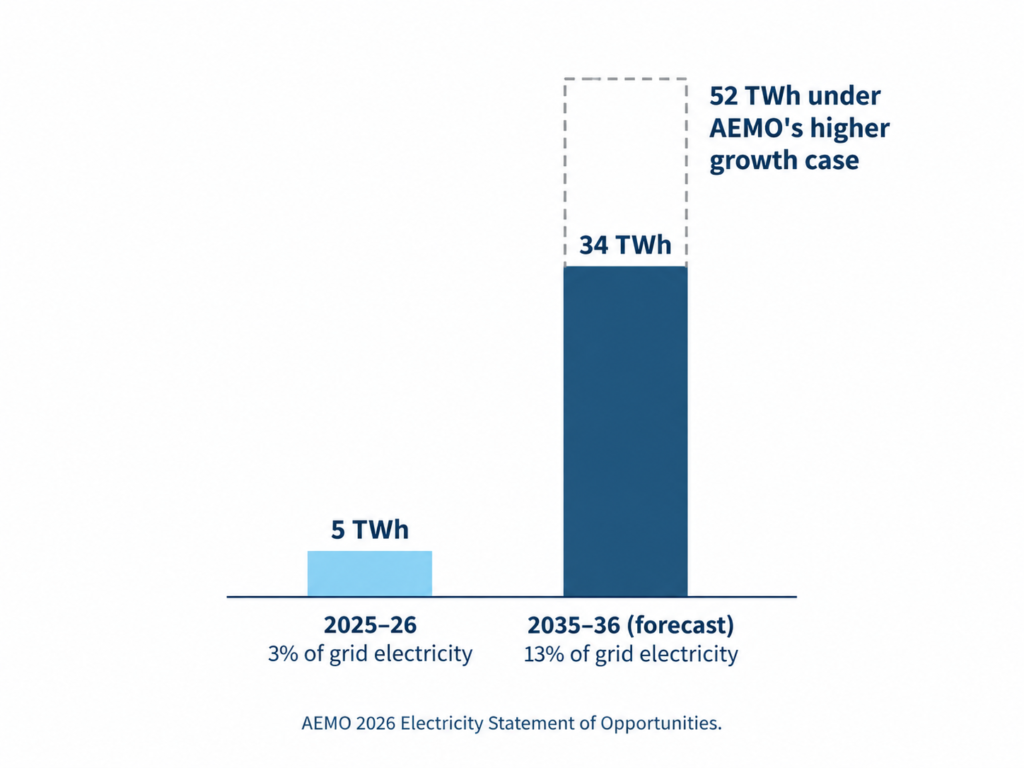
Australia’s data centres are about to use nearly seven times more electricity than they do today, going from around 5 TWh a year to 34 TWh by 2035–36. So will data centres push up your power bill? They might, and it’s being decided right now in rooms you’re not in. A roof full of panels and a battery change how much you need to buy at all.
Here’s what this article covers:
- How much power data centres actually use
- Whether that cost lands on households
- Why solar alone cannot run a data centre
- What any of it means for your roof
Why are data centres suddenly an energy story?
The number of proposed data centres has exploded. The AEMO counted 225 known data centre projects under development, up from 97 a year earlier.
In NSW, network connection enquiries reached up to 28 GW as of July, with about 13 GW in advanced discussions. The NSW Government notes that 13 GW alone is more than the state’s average daily demand.
Connection enquiries are lodged at maximum possible capacity, not expected use. AEMO found more than 40% of data centre projects proposed since 2025 have already dropped out or gone backwards. The pipeline is big and it is uncertain.
How much electricity does a data centre actually use?
AEMO’s 2026 Electricity Statement of Opportunities forecasts data centre consumption in the National Electricity Market rising from around 5 TWh in 2025–26 to 34 TWh in 2035–36. That takes them from roughly 3% of grid electricity to 13%.
That is the middle case. AEMO also modelled stronger growth reaching about 52 TWh over the same period.
The shape of the load matters as much as the size. AEMO says mature data centres run at about half their connection capacity and operate constantly, with only minor increases during working hours. Flat, day and night.
Will data centres push my power bill up?
That depends on decisions being made right now, and those decisions aren’t finished.
Here’s the risk if it goes badly. New demand arrives, new generation fails to keep pace, and everyone competes for the same electricity. The Clean Energy Finance Corporation estimates wholesale prices would be 26% higher in NSW and 23% higher in Victoria by 2035 under that scenario. Wholesale prices reach retail bills eventually.
Network costs work the same way. The proposed 800 MW Bundey project in South Australia needs four substations and multiple new transmission lines on its own. If the rules stay silent on who funds that, it spreads across every customer.
So the real question isn’t whether data centres use a lot of power. It’s who gets made responsible for the supply and the infrastructure that use requires.
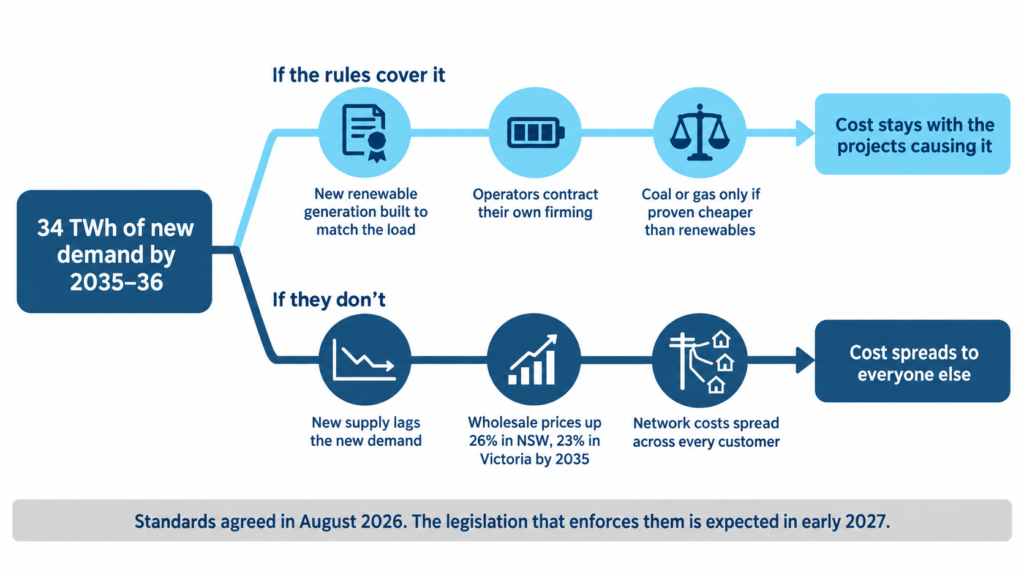
Governments are working on it. The AEMC recommended in July that new data centres prove they are backing new renewable generation, contract their own firming capacity, and register with AEMO so it can see what’s coming.
National Cabinet signed off in late August on standards requiring operators to invest in new renewable generation, with flexibility for state-owned electricity assets. Queensland and the Northern Territory took that as meaning they could decide how data centres in their states are powered. Federal Energy Minister Chris Bowen rejected that two days later, saying the standards will apply “with no exceptions and no carve-outs”. A state-owned company wanting to use coal or gas would have to prove to the Commonwealth it is cheaper than renewables.
Bowen calls data centres “electricity whales” that “eat” energy, and puts the stakes in bill terms. Under an open slather approach in Queensland, he says, wholesale prices would be 13% higher.
Worth noting that AEMO published its forecast the day before the National Cabinet met. The 34 TWh assumes none of these obligations exist.
Legislation is expected in early 2027. Until then, none of this is settled.
Can solar power a data centre?
Partly, and only during daylight. A data centre draws close to the same load at 3am as at midday, so solar on its own leaves most of the day uncovered.
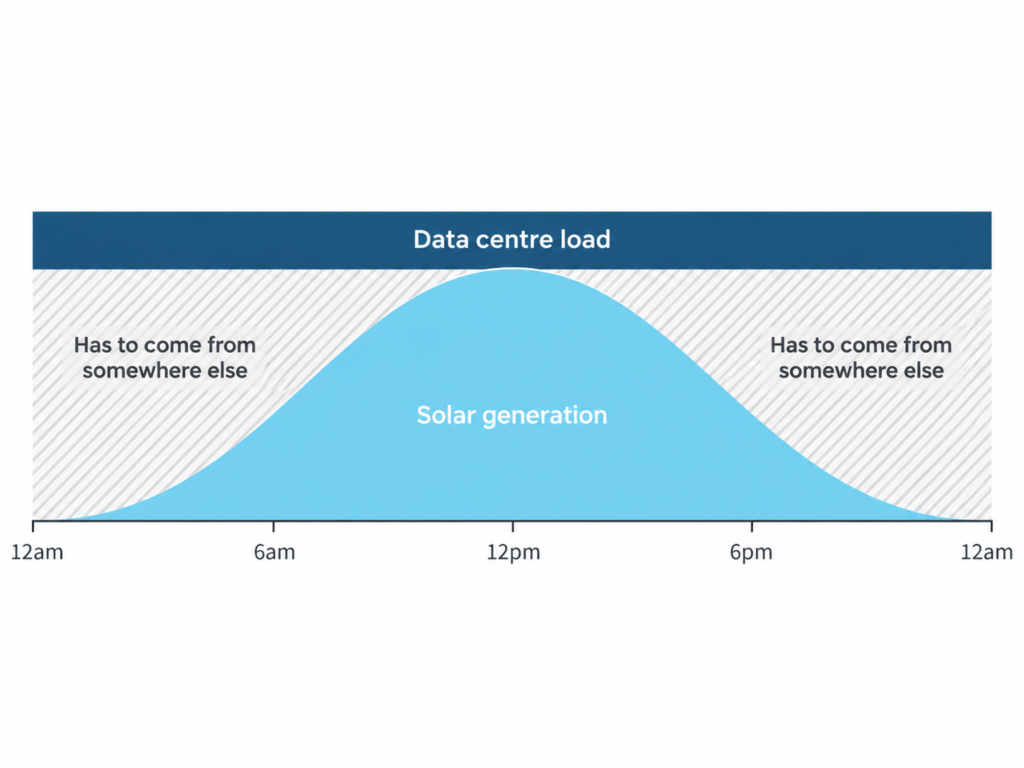
Solar plus storage is the workable version. New solar and wind backed by batteries is what the Clean Energy Council has proposed data centres be required to contract, on terms of 15 to 20 years, by signing with a project directly, going through a retailer, or building the generation themselves. The length is the point. Renewable projects struggle to get finance without a long contract from a buyer who will still be there in fifteen years. Batteries then shift the midday surplus into the evening.
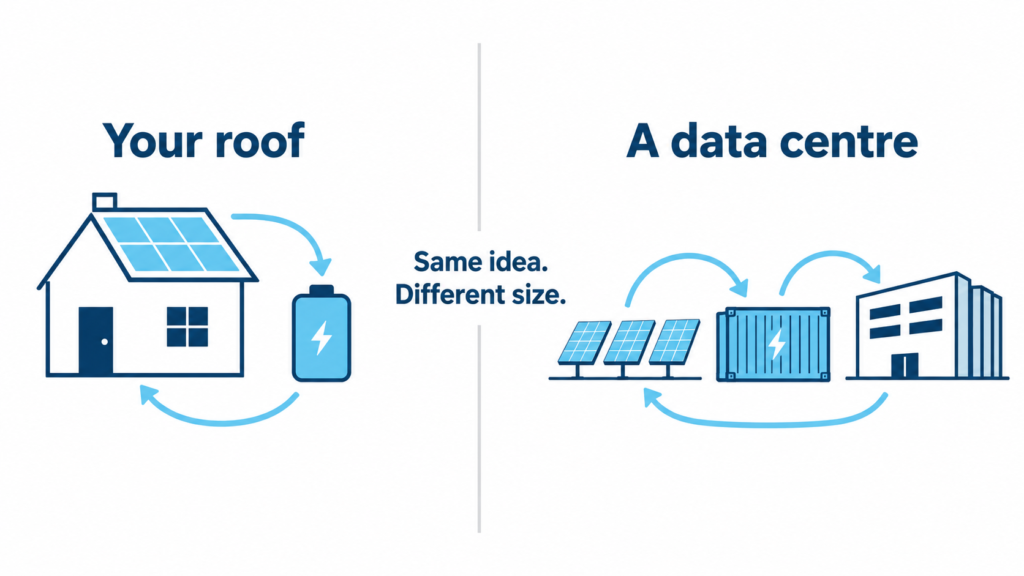
Same principle as a house with panels and a battery, several thousand times larger.
What does this mean for your own house?
You don’t get a vote on any of this. Rules, connection queues, wholesale prices, none of it is yours to decide.
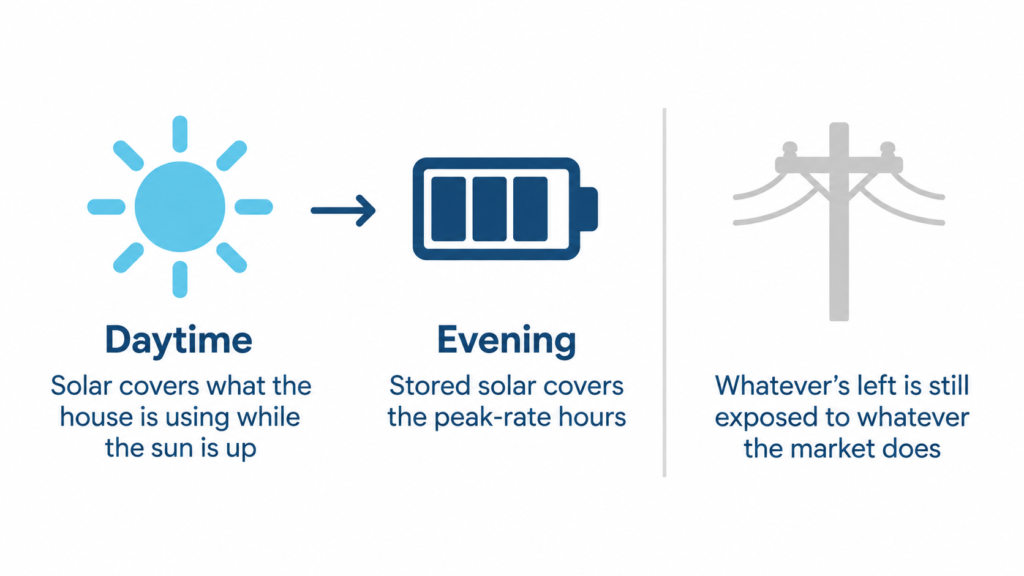
What you do decide is how much you buy. Right now your electricity comes from a retailer, and the retailer sets the rate. Solar and batteries give you energy independence. Your panels cover the house during the day, the battery covers the evening, and the power you use is power you generated. Whether wholesale prices go up or not, you’re protected.
Australian households added 2.4 GW of battery storage, or 7.4 GWh, as at March 2026. Households are doing at small scale what data centres are now being asked to do at large scale.
Look, it doesn’t stack up for every home. Low daytime use, heavy shading or a short stay all change the answer. Click here to find out whether your home is ready for solar.
Frequently Asked Questions
Do data centres use a lot of electricity?
Yes. AEMO puts current use in the NEM at around 5 TWh a year, about 3% of grid electricity, growing to roughly 13% by 2035–36.
Will AI make my power bill go up?
Possibly, and it depends on rules still being finalised. If new generation and storage keep pace, the effect on household bills should be limited. If not, modelling suggests wholesale prices rise and that reaches your bill.
Can solar run a data centre at night?
No. Overnight supply has to come from storage, hydro, or other firm capacity the operator contracts.
Are data centres going to be forced to use renewable energy?
That’s the direction. National Cabinet has signed off on standards, and the federal government says data centres will need to back their load with 100% renewable energy plus firming. A state-owned energy company can apply to use something else, but has to prove it’s cheaper. Legislation is expected in early 2027.
How do I protect myself from rising electricity prices?
The only lever fully in your control is buying less from the grid.
Read next: Are AGL, Origin and Energy Australia prices going up this year?