Solar Batteries for Businesses NSW: PDRS Discounts Explained
From September 1st, a NSW business can cut the upfront cost of a battery by around 20 to 40%. For the first time Solar batteries for businesses in NSW are now properly covered by a state scheme.
How much comes off depends on the size of your battery, the installer you pick, and whether new solar goes in alongside it.
Here is what this article covers:
- What changed for NSW businesses on 1 September
- What the discount is actually worth
- Whether your business qualifies
- Why adding solar makes the discount bigger
- What federal support you can combine it with
- How the discount reaches you, and the one form that has to be signed first
- Why you should not bank on 40%
What changed for NSW businesses on 1 September?
The Peak Demand Reduction Scheme, or PDRS, is a NSW government scheme. It pays for anything that cuts electricity demand during peak periods, like a hot summer afternoon. It has been running since September 2021.
Batteries under the scheme were mostly just for households until now.
From 1 September 2026, that opened up. Eligible businesses, including commercial and industrial operations, can get an upfront discount on a new battery through government-accredited suppliers.
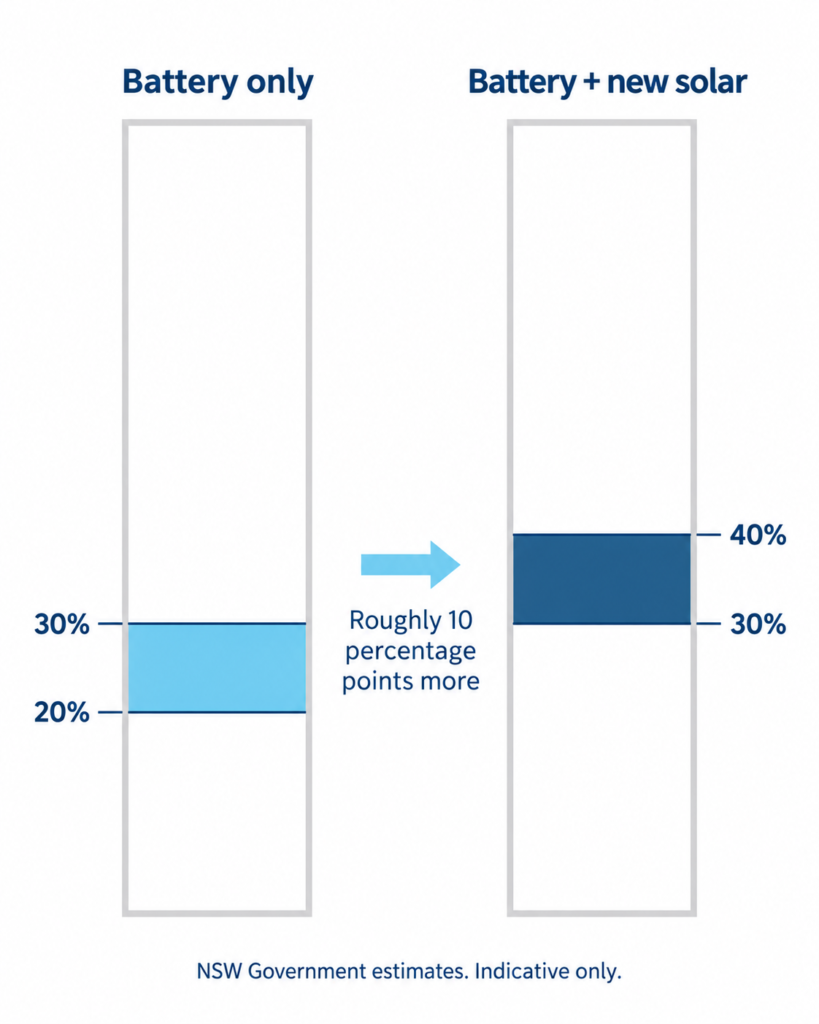
Two size bands cover it. Batteries from 20 kWh to 200 kWh (the rules call this BESS4). Batteries from 200 kWh up to 30 MWh, or 30,000 kWh (BESS5).
Bigger battery, bigger discount. The amount scales with size.
A 20 to 50 kWh battery suits smaller operations like restaurants, takeaway shops and convenience stores. The upper end is built for factories and large industrial sites.
Homes and data centres are excluded. Apartment buildings got their own version of the discount on the same day, covered in What the New PDRS Rules Means for Solar Batteries.
How much can a NSW business save on a battery?
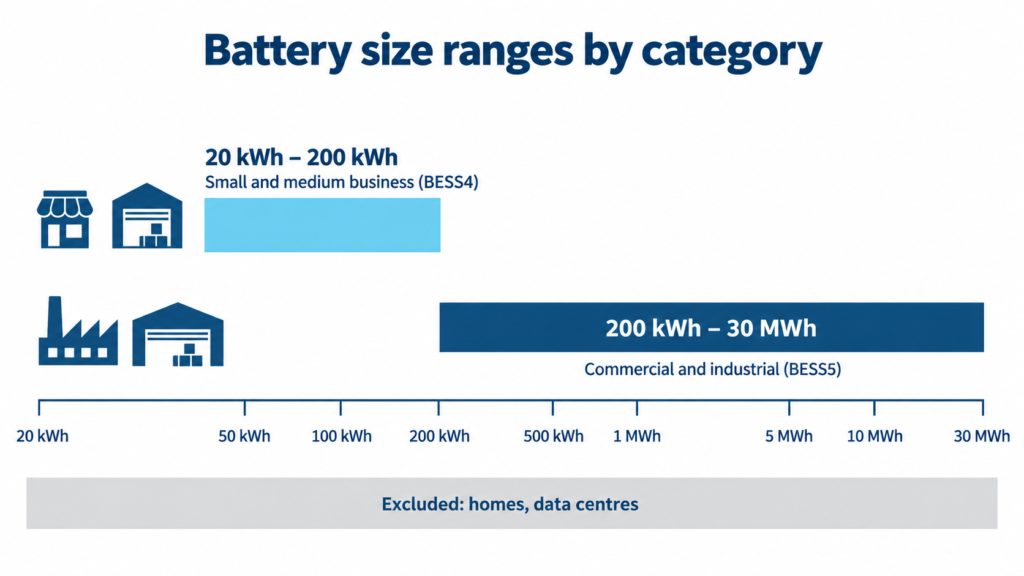
Around 20 to 30% off a battery installed on its own. Around 30 to 40% when it goes in with new or additional solar.
The NSW Government provided two examples with the announcement. A small business at grocery store scale, at around $37,000 off. A medium business at dairy farm scale, at around $355,000 off.
Neither example comes with a battery size attached. Treat them as a sense of scale, not a quote for your own site.
The discount amount provided above is indicative only, there are many factors that will impact the final cost such as: the installer you choose, where your site is and what it costs to get there, the battery model, how your building is designed and whether it needs additional electrical work first, the administrative cost of securing the discount, and the margin your installer charges.
How does the small business battery incentive (BESS4) work?
BESS4 is for small and medium businesses. Shops, warehouses, offices, farms. It doesn’t apply to homes or data centres.
To qualify:
- The site can’t have already used BESS4 or BESS5
- The battery needs to be sized between 20 kWh and 200 kWh
- The battery has to be on the Clean Energy Council’s list of approved batteries
- An SAA accredited installer has to do the work
- You need to obtain the required planning approval
- It must be installed on or after 1 September 2026
In this band you also make a minimum payment towards the cost yourself. The discount won’t cover the whole job.
How does the commercial and industrial battery incentive (BESS5) work?
BESS5 is for bigger batteries, from 200 kWh up to 30 MWh. This one is built for factories, large warehouses and industrial sites, not homes.
To qualify:
- The site can’t be a home or a data centre
- The site can’t have already used BESS4 or BESS5
- The battery needs to be tested and pass required fire safety standards
- A licensed installer has to do the work. You can check a licence on the Service NSW website
- You need to obtain the required planning approval
- It must be installed on or after 1 September 2026
There’s no minimum payment in this band. Even if the battery is bigger, the incentive only counts up to the first 10 MWh.
Why does adding solar make the discount bigger?
The scheme pays more when a battery goes in with new solar. A battery charged off your own roof does more to cut peak demand than one charged off the grid.
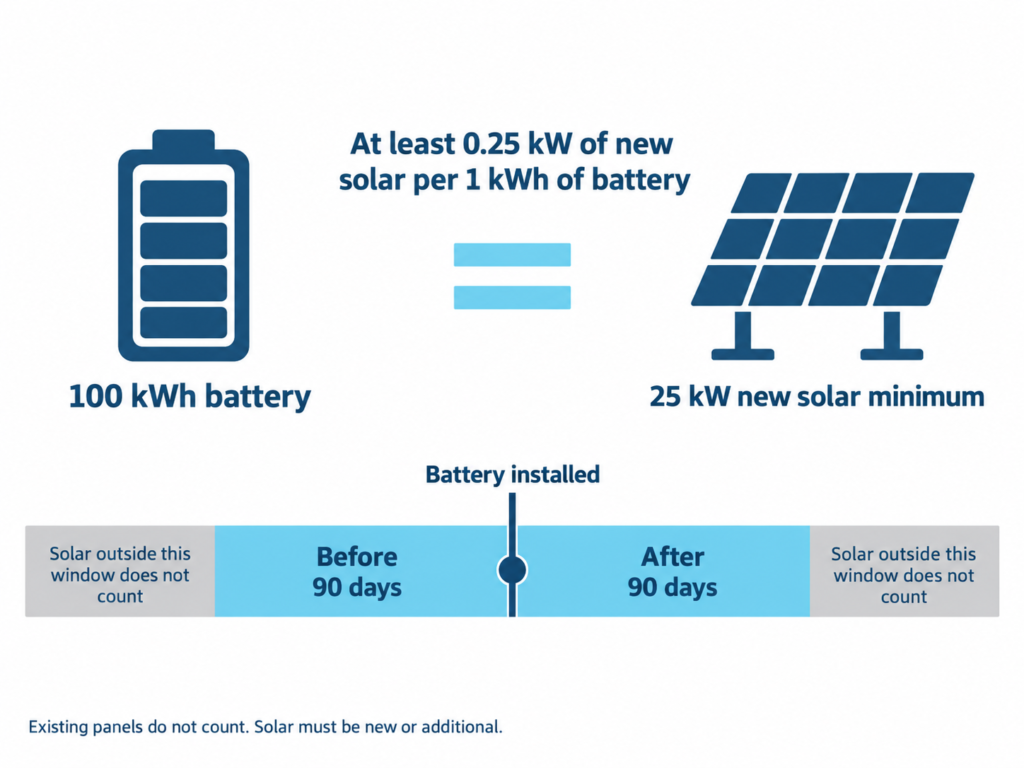
The solar has to be new or additional. Panels already on your roof don’t count. If you have solar today and want the higher discount, you need to add more.
How much more depends on your battery. You need new solar equivalent to at least 25% of its capacity, installed within 90 days before or after. So a 100 kWh battery needs at least 25 kW of new solar.
That takes your discount from the 20 to 30% band up to the 30 to 40% band. New solar also lifts your self consumption through the day, which is when most businesses use the bulk of their power.
Can it be combined with federal support for commercial solar?
Yes. NSW has confirmed the battery discount can be stacked with the Australian Government’s discounted rooftop solar scheme for commercial buildings, under the Small-scale Renewable Energy Scheme.
The Small-scale Renewable Energy Scheme will expand its limit from 100 kW to 1 MW systems, intended to start 1 October, cutting eligible commercial solar costs by around 20%. Read more about that here.
How do you get the discount on solar batteries for businesses?
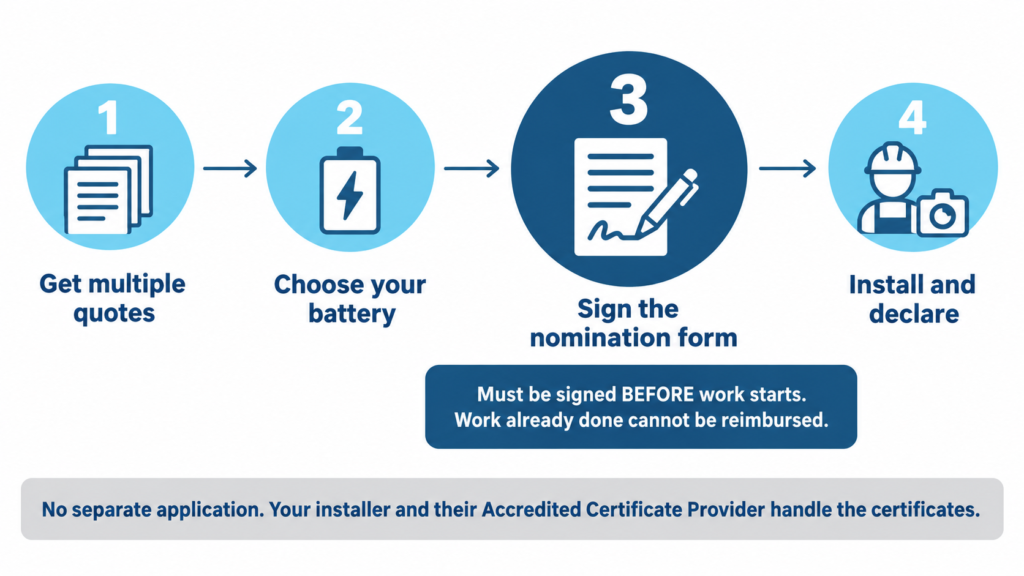
There is no separate application to fill in.
Accredited Certificate Providers, businesses licensed by IPART to create certificates under the scheme, generate the Peak Reduction Certificates and pass the value back to you as a discount on your install. Your installer either is one, or partners with one.
The practical steps look like this.
Get multiple quotes. Ask each installer directly whether they offer this discount and whether it is included in the number they have given you.
Choose a battery. Not every model is eligible, and not every installer offers the same discount on the same model.
Sign the nomination form. Now, this is the part to get right. The form has to be signed and returned before installation begins. Work already completed will not be reimbursed. Signing late means losing the discount entirely.
Then the install goes ahead. Afterwards you sign a Post Implementation Declaration confirming the requirements were met, and your installer photographs the work as proof.
Commercial installs also take time. Site assessment, electrical upgrades, network and planning approvals, equipment lead times. If you want a battery running before next summer’s peak, the design work starts well before then.
If something goes wrong later, start with your installer. If that doesn’t resolve it, the Accredited Certificate Provider named on your nomination form is next. IPART administers the scheme and sits above both.
Why shouldn’t you assume you’ll get 40% off?
Because these are certificates, not a fixed rebate.
Their value moves with the market. Every provider charges a different fee.
The 20 to 40% figure is a government estimate across a range of system sizes. It is not a promise attached to your quote. The government says so itself, and its own advice is to compare quotes from several installers who offer the discount. Prices for the same equipment vary more than most people expect: Why Do Solar Companies Charge Different Prices For The Same Products?
Now, the honest part. A battery does not suit every business. If your site runs mostly through daylight hours, sits on a flat tariff with no demand charge, and rarely loses power, the numbers may not stack up even with a discount on the table. Some sites are better off putting the money into solar alone.
Minister for Climate Change and Energy Penny Sharpe put the intent plainly: “NSW wants more batteries, and these changes will help more people cut their power bills, whether they are running a business or living in an apartment.”
Get the figures for your own site before you decide.
Read next: What the New PDRS Rules Means for Solar Batteries
Frequently Asked Questions
What is the Peak Demand Reduction Scheme and how does it apply to businesses?
The PDRS is a NSW government scheme running since September 2021. It rewards anything that cuts electricity demand during peak periods. From 1 September 2026, eligible NSW businesses can use it to get an upfront discount on a battery between 20 kWh and 30 MWh.
How much of a discount can NSW businesses get on commercial battery storage?
Around 20 to 30% off a battery on its own, or around 30 to 40% when new solar goes in with it. In dollar terms, the government has cited about $37,000 for a small business such as a grocery store, and about $355,000 for a medium business such as a dairy farm. The government calls these figures indicative.
Do I need to install solar panels to be eligible for the PDRS battery discount?
No. A battery on its own qualifies. New solar simply increases the discount, provided it is equivalent to at least 25% of the battery’s capacity and installed within 90 days before or after it.
How do I get the battery discount for my business in NSW in 2026?
Through your installer. There is no separate application. Get several quotes, confirm the discount is included, then sign the nomination form before any installation work starts. Signing after work has begun means the discount is lost.