

Can a CEC-Approved Battery Lose Approval After Installation?
On 15 September 2026, seven battery models lost their spot on the approved products list. A CEC approved battery is not approved for life. The listing is a live status. It can be suspended, and it can be pulled.
If your battery was installed before the suspension date, you are fine. The system keeps running. The rebate stays yours. The people who need to pay attention are the ones who have paid a deposit and are still waiting on an install date.
This article covers:
- What a CEC battery suspension actually is
- Why it is not a safety recall
- What happened with the seven Neovolt models
- Where your rebate stands
- How to check your own battery in two minutes
What does a CEC battery suspension actually mean?
The Clean Energy Council keeps the approved products list. Sitting on that list is how a battery qualifies for the federal rebate through Small-scale Technology Certificates, or STCs. That is the discount your installer takes off the quote up front, covered in more detail in how the battery rebate changed in May.
Two things can happen to a listing.
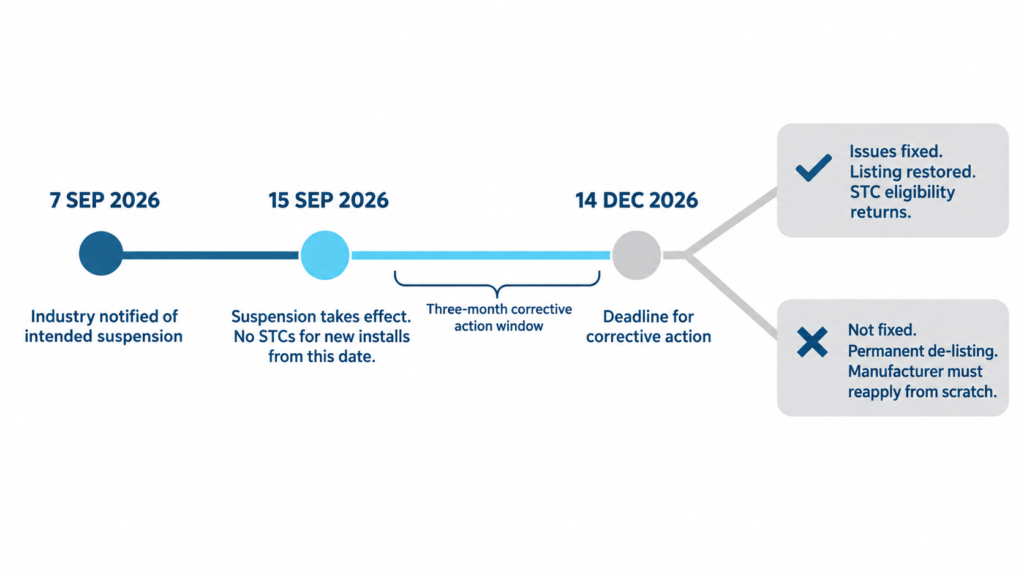
A suspension is temporary. The manufacturer gets up to three months to fix the problem. Sort it out and the listing comes back.
A de-listing is permanent. The product is removed and the manufacturer applies again from scratch.
The CEC calls it a dynamic list. Think of approval less like a certificate on the wall and more like a registration. It has to stay current.
Is a CEC suspension the same as a safety recall?
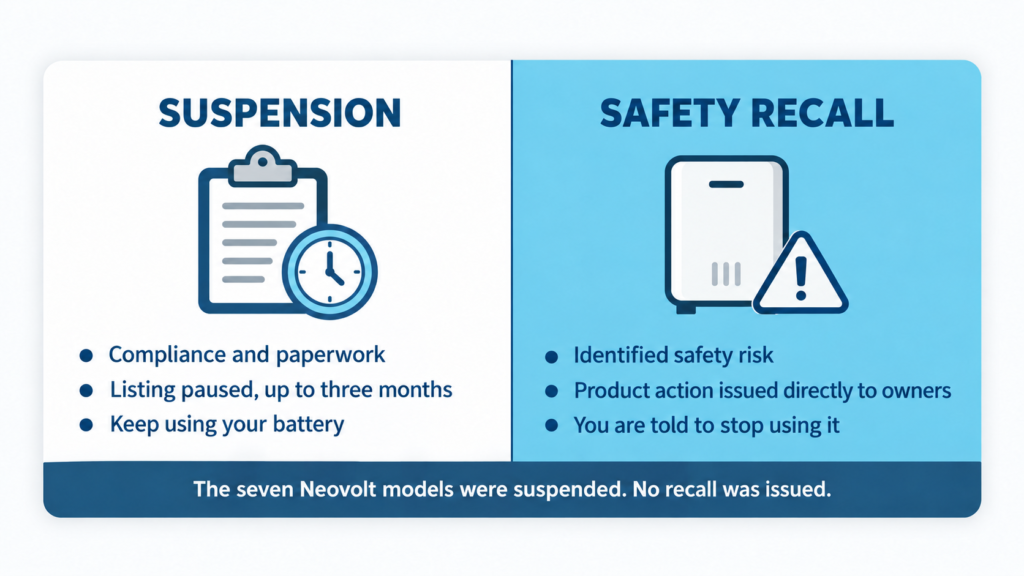
No. They are separate things, and the difference matters.
Most suspensions come down to paperwork. A test certificate expires. A label does not match the documents on file. A manufacturer is slow answering questions.
A recall is a safety action. If a product is recalled, you are told to stop using it. Nobody is telling Neovolt owners to do that.
Why were seven Neovolt models suspended?
Bytewatt Technology, trading as Neovolt, had seven models flagged. BW-BAT-9.6P, plus variants I through VI. Industry was notified on 7 September 2026. The suspension took effect on 15 September 2026.
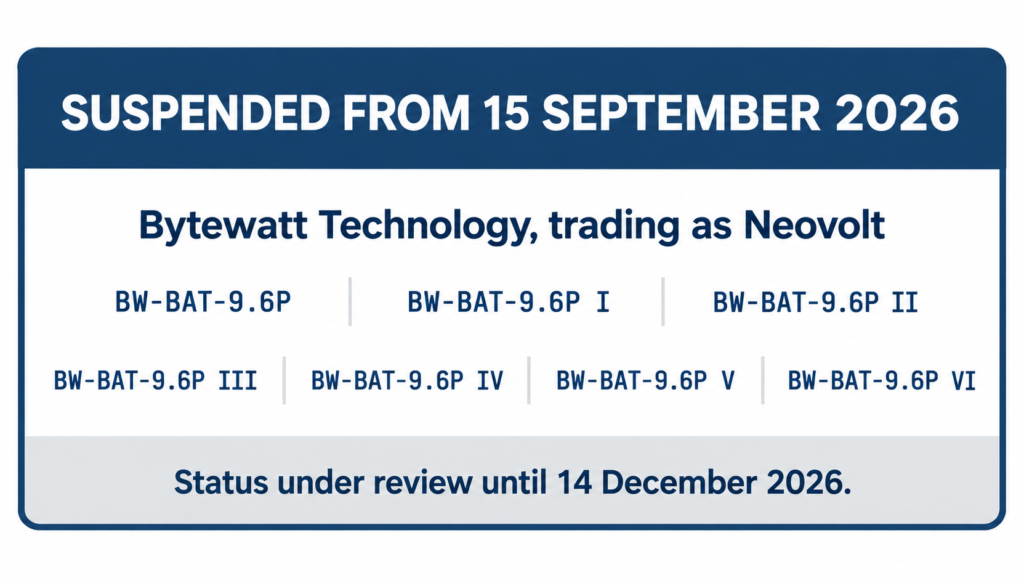
The CEC gave three reasons. The IEC 62619 certificate used to approve variants I to VI is no longer valid. Nameplate labels on units supplied in Australia did not match the testing and certification documents originally provided. The manufacturer could not clearly distinguish which imported variants were which.
The CEC stated the decision was not based on a product recall or any identified safety issue.
Bytewatt has until 14 December 2026 to complete corrective action. Fix it and the suspension lifts. Miss it and the models are de-listed for good.
Does a CEC suspension affect a battery that is already installed?
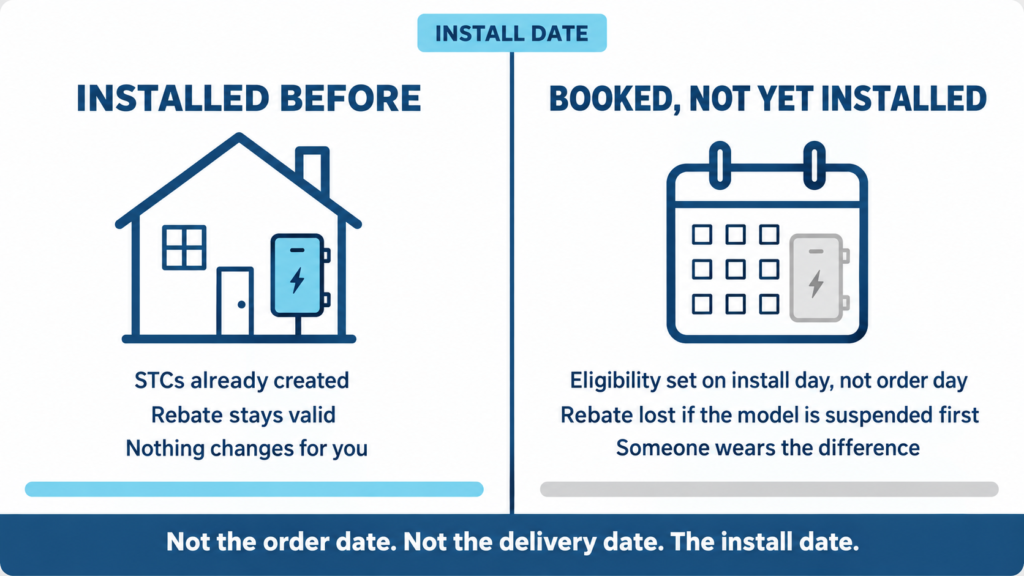
No. Rebate eligibility is set on the installation date. If your install was completed before the suspension took effect, your STCs were already created and they stay valid.
Your battery does not stop working. Your warranty sits with the manufacturer, and a listing change does not cancel it.
One caveat worth knowing. The Clean Energy Regulator holds a separate power to deem products ineligible where they were listed using false or misleading information.
What if you have ordered a battery but have not been installed yet?
This is where it hurts.
Eligibility runs off the install date. Not the order date. Not the delivery date.
Say you paid a deposit in August, with the rebate already taken off your quote. Your install is booked for October. If the model is suspended in the meantime, that rebate is gone on install day. Someone has to wear the difference.
Networks can refuse the product too. Some distributors rely on the CEC list for connection approval. State schemes lean on the same list, as covered in what the new PDRS rules mean for solar batteries.
So ask your installer to confirm the exact model number is on the current list before install day. Not the brand. The model number.
How do you check if your battery is still CEC approved?
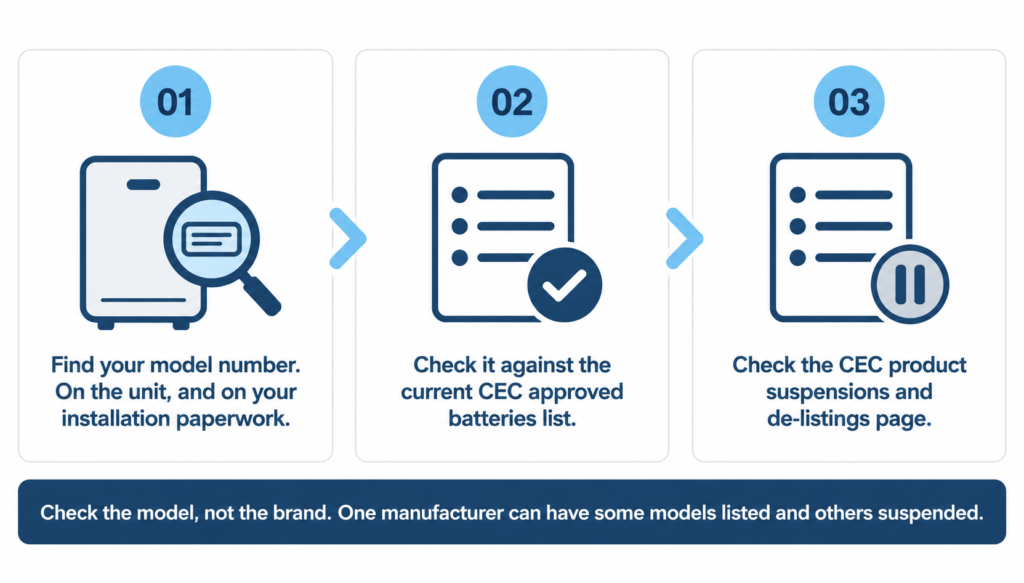
Find the model number. It is printed on the unit and listed on your installation paperwork.
Match it against the current CEC approved batteries list, then check the product suspensions and de-listings page.
Check the model, not the brand. A manufacturer can have some models listed and others suspended at the same time. Neovolt is the proof.
Now, a cheap battery quote is cheap for a reason. Something has been left out of the price. Neovolt sat up to nearly a third below comparable known brands, and seven suspended models are what that discount looks like when it catches up with you. Valid certification and local support cost money. If a quote undercuts everything else by thousands, that gap is the thing to ask about. Read more about the problem with cheap battery quotes here.
Two questions before you sign, whether you are in NSW, the ACT or Queensland. Who backs the warranty here in Australia? How long has this exact model held its listing?
Read next: Sigenergy vs GoodWe Battery: The Key Differences
Frequently Asked Questions
What does it mean when a battery is suspended from the CEC approved products list?
It means the product has temporarily lost its listing while the manufacturer fixes a compliance problem. During the suspension the model cannot be used for new STC rebate claims. The manufacturer has up to three months. Fix it and the listing returns. Miss the window and the product is permanently de-listed.
Will I lose my solar rebate if my battery loses CEC approval after installation?
No. Eligibility is determined on the installation date. Certificates created for a completed install stay valid if the product is suspended later. The risk sits with people who have ordered but not yet been installed.
How long does a manufacturer have to fix issues before permanent CEC delisting?
Up to three months from the date the suspension takes effect. For the Neovolt models suspended on 15 September 2026, that window closes on 14 December 2026.
Is a suspended battery still safe to use?
A suspension is a compliance action, not a safety recall. In the Neovolt case the CEC stated the decision was not based on a recall or any identified safety issue. If a genuine safety problem is found, a recall is issued separately and you would be told directly.

