

Solar for Renters: Are Plug-In Systems the Answer?
Solar for renters has sat in the too-hard basket for years. No roof of your own. No say over what goes on it. No simple way to cut a bill that keeps climbing.
That is starting to shift. Every state and territory has now agreed to work with the Commonwealth to make plug-in solar and batteries legal in Australia.
Nothing is legal yet. No product is on the shelf. There is real work to get through first.
Still, this is the first firm commitment from the people who can actually change the rules.
This article covers:
- What the energy ministers have agreed to
- How plug-in solar works, and why it suits renters
- When it could become legal here
- What a system might save you
- What still has to be sorted out
What have the energy ministers actually agreed to?
Climate Change and Energy Minister Chris Bowen announced this important update for renters.
Lots of renters and people who live in apartments have raised with me that it’s not easy to get the benefits of solar and batteries. And they are right. I am really pleased that the states and territories have all agreed to work with us to make “plug in” solar and batteries legal in Australia. This will open up new choices for renters and people in apartments. There’s a lot more work to do but this is a huge step towards more cost of living relief for renters.
This is a good step in the right direction to opening up a pathway for renters to have easy access to the savings solar provides.
There is plenty of work ahead, as Bowen says himself, but the direction is the right one.
What is plug-in solar, and how does it work?
Plug-in solar, also called balcony solar, is about as simple as solar gets.
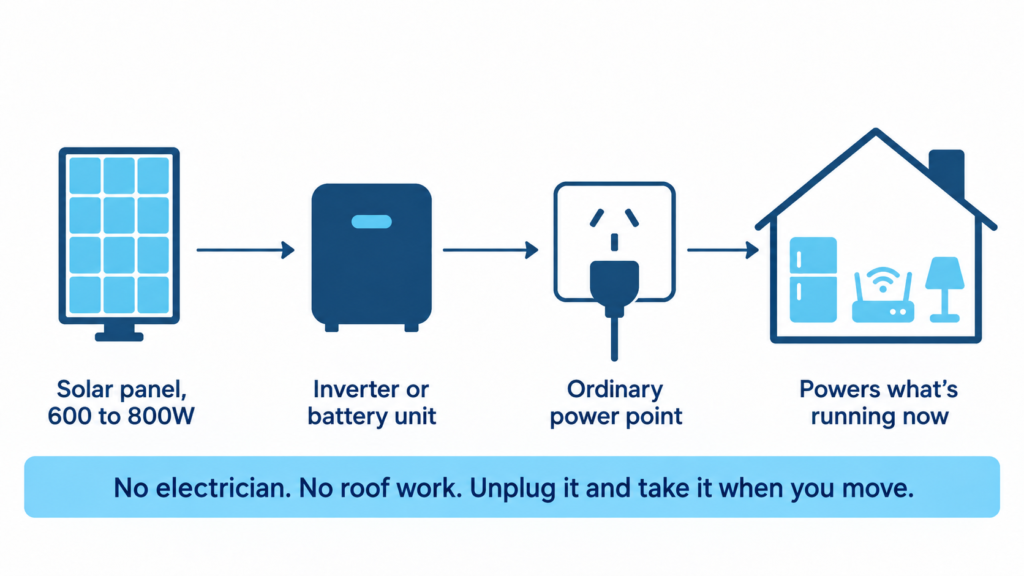
You get a compact panel, or a pair, rated around 600 to 800 watts. It connects to a small inverter or battery unit. That unit plugs into an ordinary power point.
An inverter is the box that converts power from a panel into the type of electricity your appliances can actually use. Every solar system has one.
No sparky. No roof work. No holes in someone else’s house.
The power feeds into your home circuit and offsets your usage while the sun is up. Fridge, router, standby load, whatever is running. It gets served by the panel first, so you buy less from the grid.
Moving out? Unplug it and take it with you. That is the part that makes it work for renters.
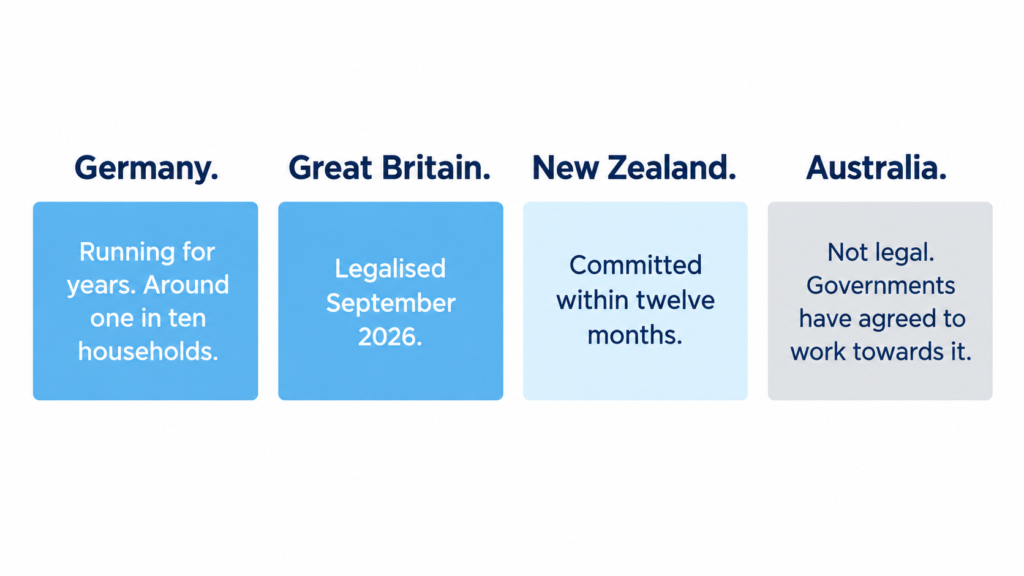
This is not new technology. Germany has been running it for years, with roughly one in ten households now using a system. Great Britain legalised plug-in solar in September 2026. New Zealand has committed to doing the same within twelve months.
We covered the hardware in detail last time, including Sigenergy’s SigenMate 2700 Ultra, a plug-in battery already selling in Europe and not available here.
When will plug-in solar be legal in Australia?
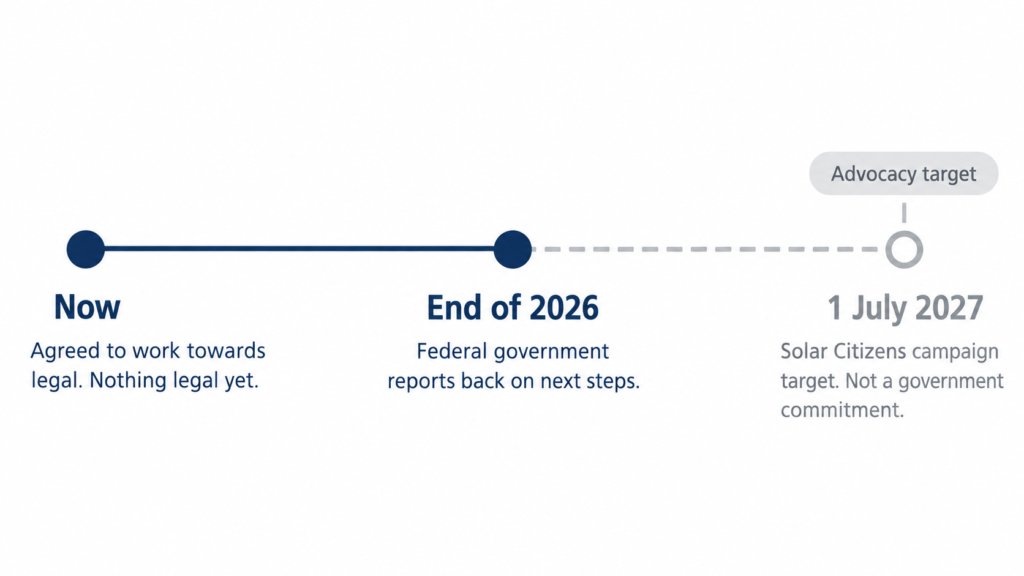
No exact date has been set.
The federal government has committed to working with the states and territories to identify what is needed for safe use, then report back on next steps by the end of 2026.
That report is the next real milestone. It is not legalisation. It is the piece of work that spells out what legalisation would take.
Advocacy group Solar Citizens is pushing for a firm legal date of 1 July 2027. That is their ask, not a government commitment. Worth keeping those apart when you see mid-2027 quoted.
How much could a plug-in system save a renter?
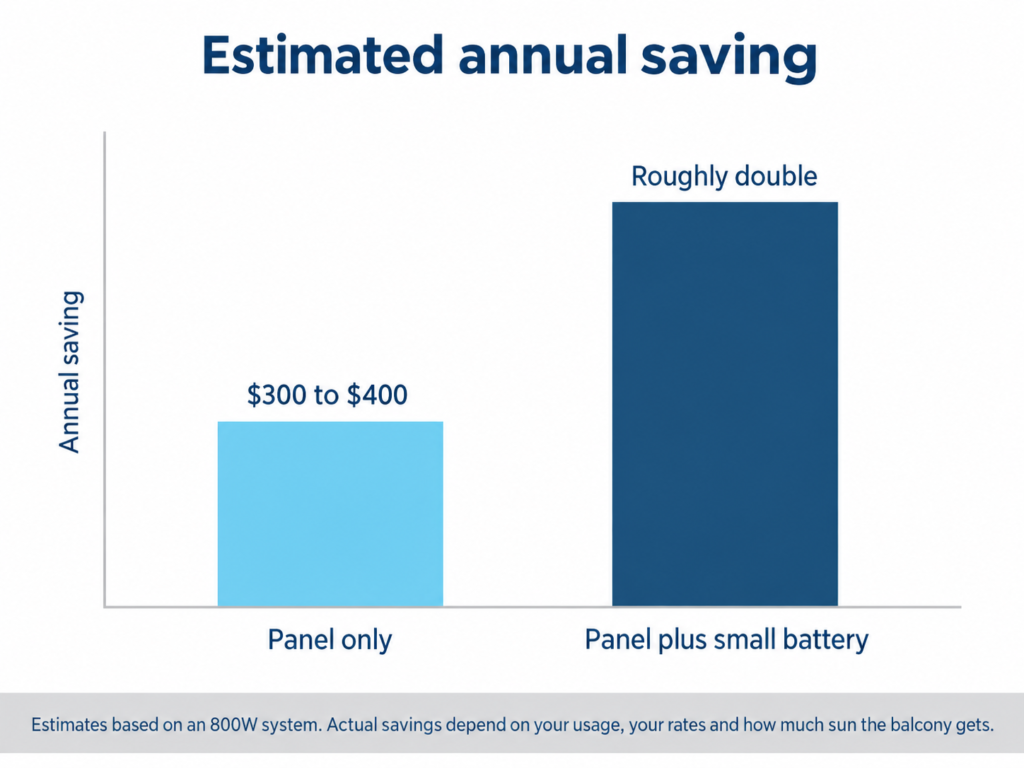
Say you run an 800 watt setup on a balcony that gets decent sun. Reported estimates put the savings at roughly $300 to $400 a year. Add a small plug-in battery and that figure roughly doubles, because you store the cheap daytime power instead of feeding it back for next to nothing.
Systems overseas cost up to $1,300. Payback sits somewhere between four and ten years depending on whose numbers you read.
Now, is this a replacement for a proper rooftop system? No. An 800 watt panel is a fraction of a standard install. It will not run your house, and for some homes the maths will not stack up.
For a renter paying full retail on every kilowatt hour, though, a few hundred dollars a year back in your pocket is not nothing.
Bowen has also stated that plug-in systems meeting the safety standards would be covered by the existing Cheaper Home Batteries Program and the Small-scale Renewable Energy Scheme. Details have not been worked through.
What still has to be sorted out?
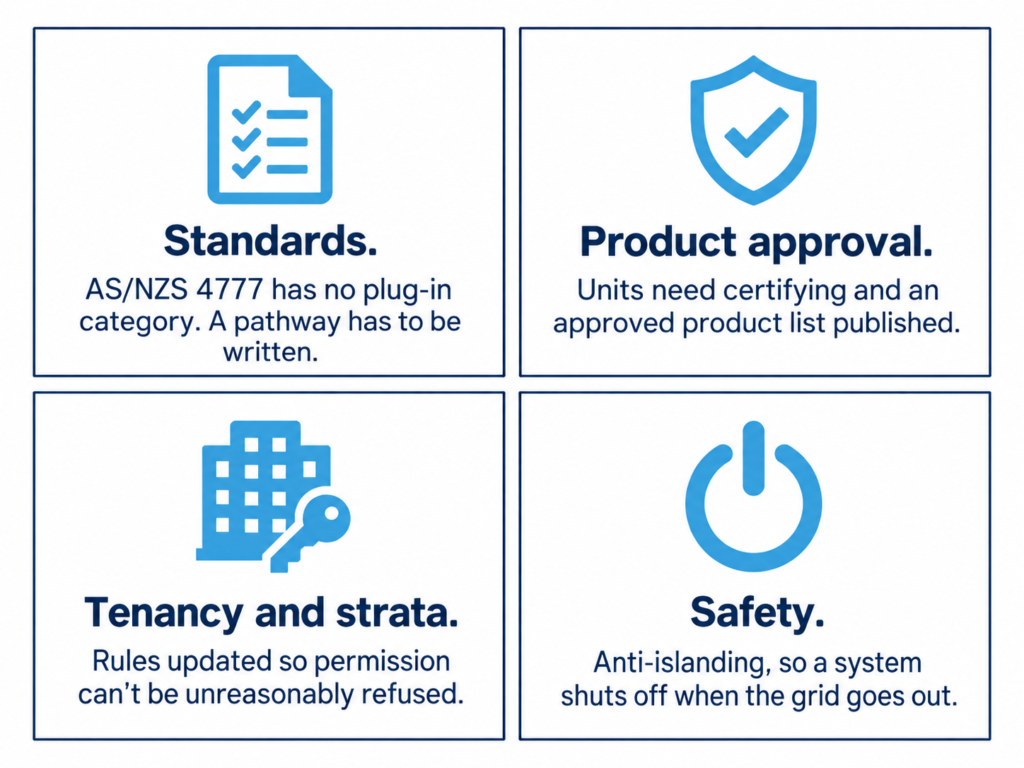
Four things, roughly.
Standards. AS/NZS 4777 governs grid-connected inverters and has no plug-in category at all. A pathway has to be written into it.
Product approval. Someone has to certify these units and publish an approved product list, the way rooftop gear is handled now.
Tenancy and strata. Rules need updating so a landlord or an owners corporation cannot unreasonably refuse.
Safety. Anti-islanding is the main one. That is the function that shuts a system down when the grid goes out, so nobody working on the line gets hurt.
Whyis it taking so long to get all this sorted? Glen Morris, who sits on the Standards Australia committees covering this equipment, argues the blocker was never safety. Europe sorted the technical side years ago. The real problem is that nobody in this country had the authority to say yes. Standards bodies wait on regulators. Regulators wait on standards. Networks will not connect a device that is not on a list.
That deadlock is exactly what the ministers’ agreement is meant to break.
What can renters do in the meantime?
Three things are worth a look while the rules catch up.
Talk to your landlord. Plenty of owners will consider solar and a battery on a rental, particularly with the rebates currently on offer.
Check your electricity plan. If you are wanting some tips on how to choose a retailer you read about it in our recent article here.
If you are in an apartment, a shared system is already possible, and more incentives are coming.
None of these is plug-in solar. Each chips away at the same problem from a different angle.
Read next: Queensland’s solar for renters rebate explained
Frequently Asked Questions
What is a plug-in or balcony solar system and how does it work?
It is a compact solar panel, usually 600 to 800 watts, connected to a small inverter or battery unit that plugs into a normal power point. No electrician and no roof work. The power offsets whatever your home is using at the time, so you draw less from the grid. It is not fixed to the building, so it moves with you.
Do renters need landlord permission to install plug-in solar panels?
There is no answer to that yet, because no plug-in system is legal to use here. Tenancy and strata rules are one of the specific things the governments have said they need to work through. A freestanding unit sitting on a balcony raises different questions to anything bolted to a wall, and that distinction has not been settled.
When will plug-in solar systems be legal and available in Australia?
No date has been set. The federal government is due to report back on next steps by the end of 2026. Solar Citizens is campaigning for legal status by 1 July 2027, though that is a campaign target rather than a government commitment.

