Author: Donna Wentworth

Cheaper Home Battery Program Reduction: What It Means for You in 2026

On 13 December 2025, the Australian Government announced major adjustments to the Cheaper Home Battery Program (CHBP) — a national subsidy designed to make battery storage more accessible for Australian households and small businesses.

Following unexpectedly high demand and rapid uptake, the program’s original $2.3 billion budget is being expanded to $7.2 billion over the next four years. The expansion is expected to support more than 2 million battery installations and deliver around 40 gigawatt-hours of new storage capacity by 2030.

To ensure the scheme remains financially sustainable and continues offering fair support across a range of battery sizes, the government will introduce a revised tiered rebate structure and updated STC (Small-scale Technology Certificate) factors from 1 May 2026.

This article outlines:

  • Why the rebate is changing
  • What the new structure will look like
  • How different battery sizes will be affected
  • What these changes mean for households planning an installation

All information is drawn directly from official government updates and public statements, including reporting from ABC News and the Department of Climate Change, Energy, the Environment and Water.

Why is the Federal Battery Rebate Changing?

Chris Bowen in front of Parliament House, the Minister for Climate Change and Energy for Australia

When the Cheaper Home Battery Program launched in July 2025, it came with a $2.3 billion budget and a clear goal: to help more Australians access battery storage by offering an upfront rebate on eligible systems. The response was immediate and strong. Within six months, most of the original rebate funds had already been claimed.

Federal Energy Minister Chris Bowen described it as “a program of success and strength,” noting the enormous enthusiasm from households and small businesses. However, ABC News reported that the level of demand allegedly raised concerns from within the solar and battery industries, with some warning of a potential “boom-bust cycle” if the scheme wasn’t adjusted to manage long-term sustainability.

In response, the government moved quickly. As part of the December 2025 mid-year budget update, an additional $5 billion was allocated to the scheme, bringing the total to $7.2 billion over four years. This expansion is expected to enable more than 2 million battery installations across the country by 2030, with a projected 40 gigawatt-hours of additional energy storage coming online.

However, the scale of that ambition also required structural changes. According to the government, the revised rebate model is designed to:

  • Keep discounts aligned with falling battery costs over time
  • Maintain fairness across small, medium and large battery systems
  • Ensure support remains available until 2030, as originally promised

With those goals in mind, the government will introduce a new tiered rebate structure and adjust the STC factor — the mechanism used to calculate battery subsidies — beginning 1 May 2026.

What Changes Are Being Made to the Rebate?

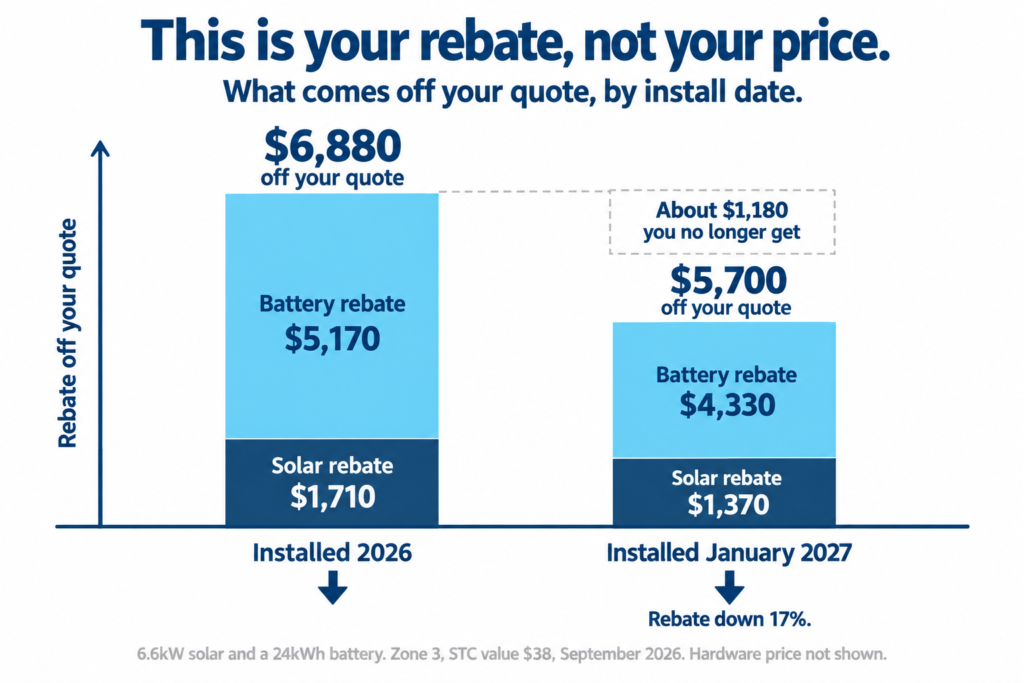
To make the Cheaper Home Batteries Program more sustainable over the long term, the government is updating how the battery rebate is calculated. From 1 May 2026, the program will shift to a tiered support model that varies depending on the size of the battery and the date it’s installed. These changes are designed to keep the discount at around 30% for a range of battery sizes, align with falling battery prices, and ensure the rebate remains available through to 2030.

Two key changes will take effect from 1 May 2026, subject to regulations being finalised:

1. STC Factor Reductions Over Time

The rebate is delivered through the creation of Small-scale Technology Certificates (STCs), which are issued based on the usable kilowatt-hour (kWh) capacity of the battery. The number of STCs a system is eligible for is determined by the STC Factor.

From May 2026, the STC Factor will:

  • Decline more frequently (every 6 months instead of annually)
  • Decline at a steeper rate, reducing the rebate amount over time

You can see the full schedule of proposed STC factor reductions below:

Cheaper Home Battery Program - STC Tier value until 2030

Source: Australian Government – Department of Climate Change, Energy, the Environment and Water

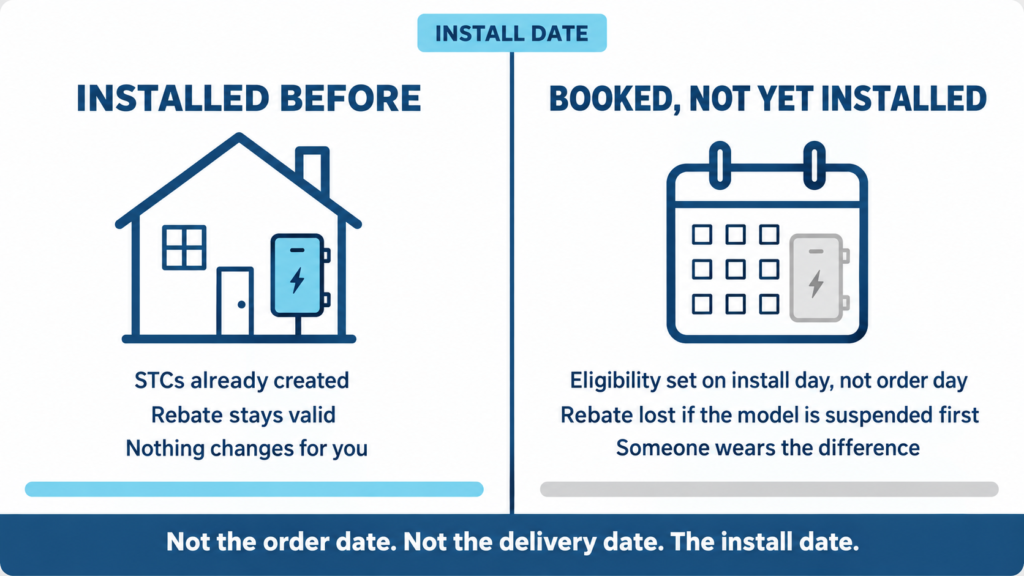
The rebate you’re entitled to is based on the STC factor at the time your battery is installed — not when you apply or receive a quote. This means timing your installation could make a significant difference in rebate value.

2. Tiered Support Based on Battery Size

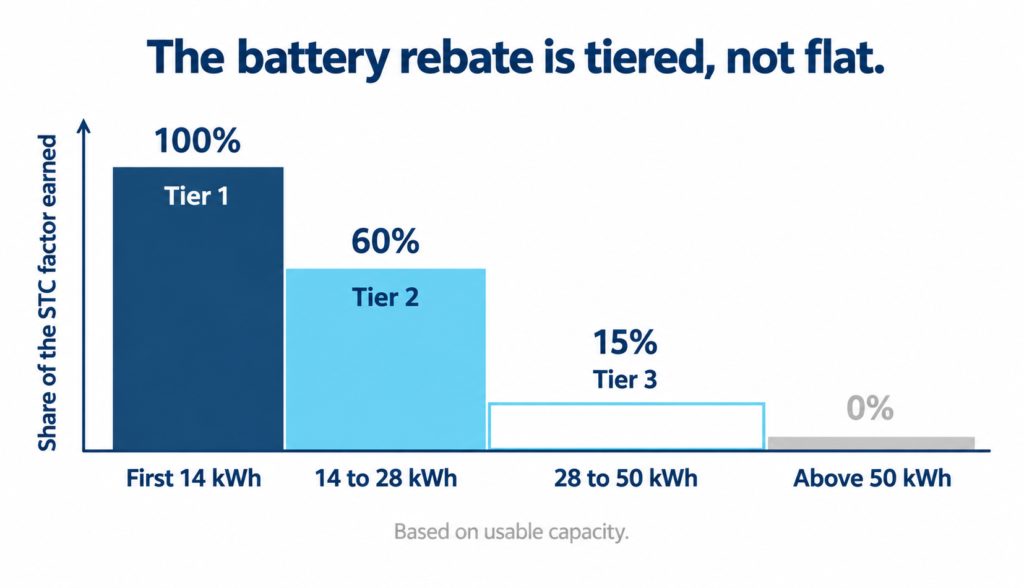
Currently, all eligible systems up to 100kWh receive the same STC factor per kWh. Under the new structure, the rebate will scale down as battery size increases, applying different percentages of the STC factor across three tiers:

  • 0–14kWh (inclusive):
    Full 100% of the STC factor applies
  • >14kWh to 28kWh (inclusive):
    60% of the STC factor applies
  • >28kWh to 50kWh (inclusive):
    15% of the STC factor applies
  • >50kWh to 100kWh:
    No additional rebate (capped at 50kWh of supported capacity)

This means if you installed a 98kWh battery system, you would get STCs on the first 50kWh and nothing on the remainder. If you Installed a 110kWh system then you would not be eligible for any rebates (as it would be over the permissible 100kWh limit).

This approach keeps the rebate proportional, discouraging over-sizing purely to maximise subsidy value while still supporting medium and large systems with some discount.

These changes, according to Energy Minister Chris Bowen, are designed to ensure the program continues to deliver value “right up to 2030 like we promised at the last election.”

How Does Battery Size Affect the Rebate?

Let’s say you install a 30kWh battery:

A diagram of showing the tiered STC rating of the Cheaper Home Battery Program
  • The first 14kWh gets 100% of the STC factor
  • The next 14kWh gets 60% of the STC factor
  • The final 2kWh gets 15% of the STC factor

If you install a 12kWh battery, the entire system qualifies for the full 100% STC rate — which may make smaller systems especially appealing for homeowners looking to maximise rebate value.

Why This Matters

Under the current system, all batteries up to 100kWh receive the same rebate rate per kWh — regardless of size. But under the new structure, larger systems will see their rebate taper off significantly. The government’s goal is to align support with typical residential needs and avoid over-subsidising systems that exceed household usage.

At the same time, this still allows homes with larger energy demands to claim a partial rebate on bigger systems — just with a steeper drop-off after 28kWh.

The new rules aim to ensure fairness, prevent overspending, and stretch the program’s budget to support more households over time.

Plan With the Cheaper Home Battery Program Timeline in Mind

The Cheaper Home Batteries Program has already helped more than 160,000 Australian households access battery storage, with the vast majority of those installations in suburbs and regional areas. Now, with a larger budget and a tiered structure in place, the scheme is set to continue — but in a more targeted, tapered format.

If you’re considering a battery for your home or business, it’s important to understand both the timing and the sizing implications:

  • The install date determines what STC factor applies
  • The system size determines how much of that factor you receive

While support will still be available through to 2030, the most generous terms are front-loaded, favouring earlier and smaller installations. That doesn’t mean you should rush — but it does mean planning matters.

To see how these changes could impact your installation — or to get tailored advice based on your energy usage and goals — reach out to our team. We can help you size your battery appropriately, explore eligible systems, and lock in your rebate while the current rates still apply. Contact Lenergy today to find out what your battery rebate could look like before the changes take effect.

Adding a Battery to Your Solar: AC vs DC Coupling

Ever tried to make sense of how to add a battery to your solar system… and ended up with more questions than answers? You’re not alone. If you’re here, you’re probably trying to figure out how a battery actually fits into your existing solar setup — or whether you need to plan differently for a new install. And then someone throws around terms like “AC vs DC”, and it starts to sound more like a physics class than a home energy upgrade.

Solar panels generate direct current (DC) electricity, whereas household appliances operate on alternating current (AC). Batteries also store energy in DC form. So, somewhere between your roof and your appliances, something needs to convert, control, and manage the flow of power.

This is where the difference between AC and DC coupling comes in — and why choosing the right setup matters for efficiency, compatibility, and cost.

What Does It Mean to Add a Battery to Your Solar System?

When you install a solar system, your panels generate electricity during the day — but that energy only helps you while the sun’s shining. A battery changes that. It stores the excess solar energy your panels produce so you can use it later, like at night or during a blackout.

The challenge however, is that solar panels produce DC (direct current) electricity. Whereas your home runs on AC (alternating current) electricity. That’s why every solar system includes an inverter — to convert solar DC into usable AC.

Batteries also charge and discharge DC electricity, which means you need a system in place to manage how the power flows between your panels, your battery, your appliances, and the grid. That’s where AC and DC coupling comes into play.

There are two main ways to connect a battery to your solar system:

  • DC Coupling, where your solar panels and battery share a single hybrid inverter.
  • AC Coupling, where the battery and solar system each have their own inverter and work more independently.

Choosing between the two depends on whether you already have solar installed, how much flexibility you need, and whether efficiency or ease-of-retrofit matters more.

What’s the Difference Between AC and DC Electricity?

To understand how batteries connect to your solar system, you need to know the basics of AC and DC power — and why the difference matters.

A diagram showing the difference between AC couple battery systems and DC coupled battery systems

DC (Direct Current) electricity is the type of power that solar panels generate. It’s also how batteries store energy. The current flows in one direction, which makes it ideal for generating and storing energy.

AC (Alternating Current) electricity is what powers your home and the grid. It changes direction rapidly (50 times per second in Australia — that’s 50Hz), which makes it better for travelling long distances across power lines.

Since most household appliances are built to run on AC power, and solar panels produce DC, an inverter is essential. It converts the DC power from your panels into AC so your home can use it.

Batteries also need conversion.

Because batteries store power in DC and your home runs on AC, any system that includes a battery needs a way to manage those energy conversions — both when storing and using that power. The method used to handle this — whether through a shared or separate inverter — has a direct impact on how efficient the system is, how much it costs to install, and how flexible it will be in the future.

How Does DC-Coupled Battery Storage Work?

In a DC-coupled system, your solar panels and battery share a single hybrid inverter. This is often called a “one box” or “all in one” solution because it combines the functionality of a solar inverter and a battery inverter into a single unit.

Here’s how it works:

  1. DC from solar panels flows directly into the hybrid inverter.
  2. The inverter sends that DC either:
    • To your battery (still as DC) for charging, or
    • Through conversion to AC to power your home.
  3. When you need power at night, the battery discharges its DC energy, and the hybrid inverter converts it into AC for your household use.
  4. Some hybrid inverters can also convert AC from the grid back into DC to charge your battery — although this isn’t always standard.

Because the system avoids extra conversion steps (like turning DC into AC, then back to DC), DC coupling is generally more efficient. There are fewer “energy stops” along the way, which means less power is lost in translation.

But there’s a trade-off. DC-coupled systems rely on specific hybrid inverters that are only compatible with certain battery brands or models. If you’re installing both solar and battery at the same time, that’s usually fine. But if you’re planning to add a battery later, or want flexibility to upgrade, DC coupling may limit your options.

How Does AC-Coupled Battery Storage Work?

An AC-coupled system treats your battery as a separate unit — with its own inverter. This is known as a “two box” solution: one inverter for your solar panels and another for your battery.

Here’s what happens in an AC-coupled setup:

  1. DC power from the solar panels is sent to the solar inverter, where it’s converted into AC for use in your home.
  2. If your home doesn’t use all that energy, the battery’s inverter then converts some of the AC back into DC to store it.
  3. Later, when you need that stored power, the battery discharges as DC — and the battery inverter turns it into AC for your home.

Because the power is converted multiple times (DC → AC → DC → AC), AC-coupled systems are slightly less efficient than DC-coupled ones. Each step creates small energy losses.

That said, AC coupling has some clear advantages:

  • It’s ideal for retrofitting a battery onto an existing solar system.
  • It’s more flexible, because the battery system works independently of the original solar inverter. This means you can mix and match brands more easily.
  • It can also provide redundancy — if your solar inverter fails, the battery inverter can still function independently.

Some AC-coupled batteries, like the Tesla Powerwall 3, come with a built-in inverter. Others, such as Sungrow, require a separate battery inverter to be installed alongside them.

two side by side comparisons of a Tesla Powerwall 3 which text saying "in-built inverter" and a Sungrown battery with an inverter installed above with text highlighting this

DC-Coupled Batteries: Pros and Cons

DC-coupled systems make a lot of sense — especially if you’re installing solar and battery together from day one. Here’s a clear breakdown of the main advantages and drawbacks:

Pros

  • Higher Efficiency: Because there are fewer conversions between DC and AC, more of your solar energy is stored and used. That translates into better performance.
  • Lower Upfront Cost (for new systems): You only need one hybrid inverter, which reduces equipment and installation costs for new builds.
  • Bypasses Grid Inverter Limits: With only one inverter handling both solar and battery, you avoid Distributed Network Service Provider (DNSP) limits on total inverter capacity. This is especially useful in areas with tight restrictions (e.g. 5kW limits in parts of South Australia).

Cons

  • Compatibility Limits: Hybrid inverters usually only work with specific battery brands or models. That can lock you in — or limit your future upgrade options.
  • Not Ideal for Retrofits: If you already have solar installed with a standard inverter, switching to a hybrid system for DC coupling often means replacing your existing inverter — which adds cost and complexity.
  • Single Point of Failure: With only one inverter managing everything, if it fails, both your solar and battery go offline.

In short, DC coupling is efficient and streamlined — but it’s best suited for new solar + battery installs, not retrofits.

AC-Coupled Batteries: Pros and Cons

AC-coupled systems shine when you’re adding a battery to an existing solar setup — but they come with their own trade-offs. Here’s a look at where they excel, and where they fall short.

Pros

  • Easy to Retrofit: Already have solar? AC coupling lets you add a battery without replacing your current inverter.
  • Brand Flexibility: Because the battery system runs independently, you’re not locked into a specific inverter–battery combo. This opens up more product options.
  • Redundancy: With separate inverters for solar and battery, one can keep working if the other fails — handy for resilience and backup.

Cons

  • Lower Efficiency: Power gets converted multiple times — DC to AC, then back to DC to charge the battery, and then AC again to power your home. That creates small energy losses.
  • Higher Installation Cost (for new systems – Solar + a Battery): You’ll need two inverters — one for solar, one for the battery — which adds to the cost.
  • Inverter Capacity Limits: Some DNSPs count your solar and battery inverters together toward grid limits. So if your solar inverter is 6kW and your battery has a 5kW inverter (like the Tesla Powerwall 2), you might hit a 10kW cap per phase and be told no.

In summary, AC coupling is perfect for adding a battery to an existing solar system — just be aware of potential network limitations and slightly reduced efficiency.

Solar panels installed by Lenergy on top of tin roof with the sun reflecting off

Which Setup Is Right for You?

Choosing between AC and DC coupling isn’t about which one is “better” — it’s about which one suits your situation.

Here’s our simple rule of thumb:

If you’re installing solar and a battery together:

DC coupling is usually the smarter choice.
You’ll get higher efficiency, lower overall cost, and a simpler, all-in-one setup with a hybrid inverter. Just keep in mind the brand compatibility — your battery and inverter will likely need to be matched.

If you already have solar and want to add a battery:

AC coupling is typically the easier and more flexible option.
You can keep your existing solar inverter, choose from a wider range of batteries, and avoid replacing gear that’s still working well.

That said, it’s worth checking one important thing before you decide: your local network’s inverter limits. Some DNSPs limit the total inverter capacity per phase — and that might affect whether an AC-coupled battery is even allowed on your system. In those cases, a DC-coupled system may offer a workaround.

If you’re planning a new solar-plus-battery setup, DC coupling offers streamlined efficiency. If you’re retrofitting a battery, AC coupling is likely more cost-effective and flexible. Either way, understanding these options puts you in control of your energy future — and helps you avoid expensive mistakes.

Still not sure which setup fits your home best?

At Lenergy, we’ve helped hundreds of Australian homeowners navigate their battery options with honest, jargon-free advice. Whether you’re adding storage to an existing system or starting from scratch, we’ll walk you through it — no pressure, just clarity.

Will the Federal Battery Rebate Run Out in 2026?

The Federal Battery Rebate, otherwise knows as the Government’s $2.3 billion Cheaper Home Batteries Program offers roughly 30% off battery storage systems to Australian households. When it launched in July 2025, no one predicted batteries would start flying off warehouse shelves at the pace it did and energy retailers like Origin are warning: we could hit the rebate cap by mid-2026.

In this article, you’ll get a clear breakdown of:

  • What’s driving this spike in battery installs
  • How close we really are to the rebate running dry
  • What could happen next — and what that means for you

What Is the Federal Battery Rebate and Why Is It So Popular?

If you’ve looked into adding a solar battery lately, you’ve probably heard about the Cheaper Home Batteries Program (CHBP) — a federal rebate launched in July 2025 to help more Australians afford energy storage.

The rebate covers roughly 30% off the cost of an eligible home battery system (up to 50kWh). For most households, that equates to $2,000–$4,000 back, depending on the battery brand, size, and your energy setup.

The response has been massive.

  • In the program’s first month alone, 19,592 batteries were installed.
  • By early September, that figure had climbed to 43,500+ installations, averaging around 888 installations per day.
  • By November, Energy Minister Chris Bowen reported 136,000 batteries installed since July — more than double the typical yearly total before the rebate.

One chart shared by The Today Show showed some of the most active states in the first month — with NSW and QLD leading, followed closely by VIC and SA.

A screenshot from the Today Show with a graph showing the Federal battery rebate uptake of solar battery installations in July 2025

So what’s behind this rush?

For many homeowners, it comes down to affordability and timing:

  • Batteries have become significantly cheaper over the past two years.
  • Add roughly 30% rebate on top, and the payback period has dropped for most households.
  • With power prices rising and feed-in tariffs falling, many people now see a battery as the best way to self-use their solar energy and reduce peak-time grid reliance.

How Fast Are the Funds Being Used?

When the federal government announced the Cheaper Home Batteries Program with a $2.3 billion budget, it was pitched as a long-term incentive — running until 2030, however, this timeline now looks extremely optimistic.

According to SolarQuotes, an analysis which examined Clean Energy Regulator data and installation trends:

  • Over 90,000 systems had been processed for rebate claims as of 31 October 2025, with more pending.
  • That early wave of installs had already chewed through around $678 million in just four months.
  • At that pace, the entire $2.3 billion could be exhausted in 13–14 months — pointing to a mid-2026 cutoff.

Energy Minister Chris Bowen said 125,000 households had installed batteries by mid-November, not just the 90,000 that had been fully processed for certificates. That’s a 21% higher figure, and it changes the maths.

SolarQuotes’ revised analysis, using Bowen’s higher number, suggests the rebate could be fully allocated by June 2026 — or as early as May if demand keeps accelerating.

That projection is backed by Origin Energy, who warned battery installs had surged to up to 1,800 per day in some periods, and that the funding “will probably run out by the middle of next year on this kind of run rate”.

The driving force is not just the rebate itself, but also:

  • A shift in homeowner behaviour — people want to keep their solar energy instead of exporting it for a few cents.
  • Falling battery prices and rising energy bills.
  • A growing awareness of blackout protection, especially in summer.

Another key factor accelerating the depletion of funds is the increasing average size of battery systems. Since the rebate is calculated based on usable battery capacity, the shift from an assumed average of 17kWh to more than 20kWh per system means larger payouts per installation than initially projected.

This combination of high uptake and growing system sizes has led some analysts to conclude that the program’s 2030 end date is unlikely to be realised without further government intervention.

Penny Sharpe and Chris Bowen Ministers of Energy standing in front of a solar panels

Could the Federal Battery Rebate Be Extended or Adjusted?

It’s possible — however not guaranteed.

The federal government hasn’t yet announced any top-up or structural changes to the Cheaper Home Batteries Program. However, with uptake far exceeding early expectations, both energy experts and industry groups are now openly calling for action.

Potential outcomes to look out for

Reducing the Cap per Household?

One suggestion from SolarQuotes is to cut the maximum eligible battery size for the rebate — not to shrink rebates for typical households, but to slow down uptake at the top end.

Currently, you can claim a rebate for up to 50kWh of usable storage — far more than most homes need. Reducing that cap to 25kWh could stretch the funding further while still covering 99% of residential use cases.

The upside? More households could benefit.

The risk? It might discourage larger households or early adopters wanting future-proofed systems — particularly those aiming for full off-grid capability or participating in VPPs.

More Rules, More Problems?

Some experts warn against over-complicating the program.

If policymakers try to engineer the “perfect” battery rollout through stricter sizing, inverter pairing rules, or eligibility tests, they risk:

  • Slowing installs
  • Creating confusion
  • Opening new loopholes for dodgy operators to exploit

As SolarQuotes analyst Ronald Brakels points out: “Making the scheme more complex can do more harm than good… We may get better results just by requiring installers to inform homeowners of drawbacks.”

What’s Most Likely?

Given the federal battery rebates popularity — and its positive impacts on grid reliability and household bills — some form of adjustment or extension seems politically smart. However, until it’s announced, homeowners are in a race against the funding clock.

If you’re weighing up whether a battery makes sense for your home — with or without the rebate — you can get in touch with Lenergy for straightforward advice. We’re available to answer questions, explain how the rebate works, and help you explore what’s suitable based on your usage.

Do Solar Panels Work in Colder, Cloudier Climates?

If you’ve ever asked that question — especially from somewhere like the Southern Highlands, Goulburn or Canberra — you’re not alone. It’s one of the most common hesitations people have when considering solar. Maybe you’ve heard that solar panels“only works in the sun,” or that cloudy weather means zero output. And if you’re investing thousands into a system, you want to be sure it will actually deliver.

Here’s the good news: solar panels do work in colder and cloudier climates. And in many cases, they perform better than you might expect.

At Lenergy, we’ve helped hundreds of homeowners across NSW and beyond install solar in a wide range of conditions — from frosty to fog. We’ve seen how different weather affects performance, and we’ve designed systems to suit homes just like yours.
In this article, you’ll learn how cloud cover, temperature, and rain really affect solar output — and what that means for your panels and battery performance. We’ll break down common myths, share installer insights, and help you decide whether solar is still a smart investment in your location.

Do Solar Panels Still Work on Cloudy Days?

Yes — solar panels still generate electricity on cloudy days, just not at full capacity.

It’s a common misconception that solar only works in full, direct sunlight. In reality, panels are activated by sunlight when it hits the solar panels, the photovoltaic (PV) cells within the panels absorb the light energy, which still passes through clouds. That means even on overcast days, your system keeps producing — just at a reduced rate.

Here’s what to expect:

  • Partly cloudy days: Output may drop by 10–25% depending on how dense and frequent the clouds are.
  • Heavily overcast days: Output can dip by up to 50%. On particularly dark, stormy days, it may drop even further.

But this isn’t the full picture.

Modern solar systems are designed with these fluctuations in mind. Your solar inverter adjusts dynamically to capture whatever sunlight is available — and will scale production back up instantly when the sun reappears, even briefly.

In fact, on days with patchy clouds, intermittent bursts of sunshine (called “edge-of-cloud” events) can sometimes boost output above normal levels for short periods.

And remember, solar production is a long game. What matters most is annual generation, not individual cloudy days. If your home receives a decent amount of sunlight across the year — even if it’s seasonal — your system can still be financially and environmentally worthwhile.

What Happens to Solar Panels Output on Rainy Days?

Rainy days affect solar panels in much the same way as overcast ones — by reducing the amount of light that reaches the panels. But rain also brings a surprising bonus.

Let’s break it down:

  • During rain: Solar production typically slows down due to heavier cloud cover. Output may fall by 40–80%, depending on how dark the skies get.
  • After rain: Once the clouds clear, panels can perform better than before — because the rain naturally washes away dust, dirt, and pollen that build up over time. Cleaner panels = better efficiency.

So yes, you’ll get slower solar output during the rain. But unlike snow or extreme weather (which aren’t concerns in most Australian regions), rain doesn’t block light entirely, and it actually helps maintain panel performance in the long run.

From a system design perspective, solar installers factor in local weather patterns when sizing your array. If your region has regular rain in winter, your installer may recommend slightly higher capacity or a battery to ensure you’ve got backup energy on low-output days.

It’s also worth knowing that solar monitoring apps help you track this in real time. You’ll be able to see how your system performs through different seasons — and spot the post-rain boost when it comes.

4 separate moch iphone screens showing the Tesla Monitoring app which helps track power from a solar and battery system

Can Solar Batteries Still Charge Without Full Sunlight?

Yes — your solar battery can still charge on cloudy or rainy days. Just not as quickly.

This is one of the biggest misunderstandings about solar storage. Many people assume if the sun isn’t out, the battery sits idle. But that’s not true. As long as your panels are generating some electricity — and they usually are — that energy can be directed to charge your battery.

The key difference is in charging speed:

  • Sunny days: Your battery might fully charge by mid-afternoon.
  • Cloudy/rainy days: Charging is slower, and your battery may only fill partially.

That’s where battery sizing and system design matter. A good installer will configure your setup so that even partial charging gives you meaningful backup — particularly during peak evening hours when power is most expensive.

It’s also why stored energy becomes more valuable in bad weather. On a stormy evening when solar production is low, your battery gives you a buffer — reducing how much you draw from the grid.

So while clouds slow down charging, your battery doesn’t stop working — and on balance, it’s still doing its job of reducing grid reliance and protecting you from high prices.

Does Cold Weather Help or Hurt Solar Panels?

This might surprise you — cold weather can actually improve solar panel performance.

It’s not heat that generates electricity in solar panels — it’s sunlight. And like most electronics, solar panels operate more efficiently in cooler temperatures. So, while the amount of sunlight is what determines how much power you get, the temperature affects how efficiently your panels convert that light into electricity.

On a cold, sunny winter’s day, panels often perform better than they do on scorching summer afternoons. That’s because:

  • High temperatures can decrease panel efficiency
  • Cooler conditions reduce resistance in electrical components, making them more effective.

So if you’re worried your region’s lower average temperatures make solar a bad idea, rest easy: sunlight is the real driver, not heat.

How Does Heat Impact Solar Panels and Batteries?

Hotter doesn’t mean better when it comes to solar.

In fact, excessive heat can reduce solar panel efficiency and shorten the lifespan of your battery if it’s not installed properly.

For solar panels:

  • Most panels are rated for optimal performance at 25°C.
  • For every degree above that, efficiency can drop by around 0.3% to 0.5%.
  • On a hot summer day (say, 40°C), panel output can decline by 5–10%, even with full sun.

For solar batteries:

Lithium-ion batteries also prefer cooler, stable conditions.

  • The ideal operating range is 10°C to 30°C.
  • Prolonged exposure to 40°C+ can degrade performance and reduce lifespan.
  • Without proper installation — especially in direct sun or poorly ventilated garages — your battery could heat up quickly during summer.

That’s why ventilation and shading matter. A reputable installer will mount your battery in a shaded or insulated spot, like a southern-facing wall or under an eave, and ensure there’s airflow to help regulate internal temperature.

A Sigenergy solar battery installed under cover to protect from elements such as the heat from direct sunlight

So while heat doesn’t break your system, it’s something to be aware of — and good design helps manage it.

Is Solar Worth It in the Southern Highlands, Goulburn, or Canberra?

Yes — even in cooler, cloudier inland areas like the Southern Highlands, Goulburn, and Canberra, solar can still deliver solid results.

These regions experience a mix of seasonal fog, rain, and clear skies. While overcast conditions will reduce daily output, solar panels don’t need heat to work — just light. In fact, they often perform better on crisp, sunny winter days thanks to improved efficiency in cooler temperatures.

The key is to size your system appropriately and manage expectations around seasonal variation. With energy prices rising and modern systems built to perform across a range of conditions, solar is still a smart investment in these parts of NSW.

What Should You Look for in a Solar System for Colder or Cloudier Areas?

If you live in a region where cloud cover or cooler weather is more common, the type of system you choose — and how it’s designed — becomes even more important.

Optimise system orientation and tilt

  • North-facing panels are ideal.
  • A steeper tilt can help capture winter sun.
  • Avoid shading from trees, buildings, chimneys or antennas.

Consider microinverters or DC optimisers

These help each panel work independently — ideal for patchy clouds or uneven light. They also let you track performance panel-by-panel.

A diagram showing how micro inverters work in relation to solar panels and providing electricity to a home.

Add a battery if you can

A battery helps store power for use during cloudy evenings or grid outages — even if it doesn’t fully charge every day.

Keep your panels clean

Rain helps, but in damp climates, it’s smart to schedule a professional panel clean every 1–2 years for best performance.

Is Solar a Smart Investment in a Cooler Climate?

Yes — solar is still a smart long-term investment, even if you live in a colder or cloudier part of Australia. With the right system design and expectations, solar can still deliver real savings — and help you take control of rising energy costs.

Thinking about going solar in a cooler or cloudier part of NSW?
Our team at Lenergy can help you assess your roof, design a system tailored to your conditions, and answer any questions about performance, battery options, or rebates.

5 Tips For Choosing The Right Battery For Your Home

You’ve done your research. You’ve compared brands, watched reviews, maybe even spoken to an installer. And yet — you’re still unsure which solar battery is right for your home. Should you go with a big name like Tesla? Is a modular system better if your energy use might grow? What about blackout protection?

At Lenergy, we’ve helped hundreds of Australian homeowners navigate the battery buying process. From small homes with basic backup needs to high-usage properties with three-phase power, we’ve seen what works — and what causes headaches.

In this article, you’ll learn five straightforward, practical tips that will help you choose a battery that actually suits your home, your habits, and your future plans.

1. How Much Battery Storage Do You Really Need?

This is the first — and arguably most important — question to ask. A common mistake is thinking bigger is always better. In reality, oversizing your battery can add thousands to your upfront cost without giving you meaningful extra savings, unless you have plans to trade your power on a VPP (virtual power plant).

If you’re not wanting to trade your battery power on a VPP, then your battery should match your energy use, not just your energy production. If your home only uses 5–6 kWh in the evening, then you probably don’t need to install a 40 kWh battery. 

A few quick sizing tips:

  • Start by reviewing your power bills to see how much energy you use at night.
  • If your solar panels regularly export a lot of excess power, that’s potential battery fuel.
  • Blackout protection? Consider how much of the home you want covered — just the fridge and lights, or the whole house?
An example of an electricity bill showing the daily usage

For most homes, and based on our own sales data from the past three months, the average battery size installed by Lenergy is around 30 kWh. That suggests many households are thinking ahead — not just about overnight usage, but also blackout coverage, electric vehicles, and future-proofing. If you think your energy use will grow, a modular system gives you flexibility to expand over time.

2. Should You Choose AC or DC Coupling?

This one sounds technical — but it matters more than most people realise, especially if you’re retrofitting a battery to an existing solar system.

So what’s the difference?

  • DC-coupled batteries receive power directly from your solar panels, then convert it once for your home. This is more efficient, with fewer conversion losses — ideal for new systems or when installing everything together.
  • AC-coupled batteries work independently of your solar inverter. They’re a bit less efficient, but they’re far more flexible — this is most common for people adding a battery to an existing system.

Here’s a simple way to think about it:

  • If you’re starting from scratch and want maximum efficiency → DC coupling is better.
  • If you already have solar and want to add a battery → AC coupling is usually easier and more common.
A diagram showing the difference between AC and DC couple battery systems with simple icons and arrows for an accurate depiction of each process.

Most homeowners fall into the second category, which is why options like the Tesla Powerwall 3 are popular — it’s an AC-coupled battery that plays well with most systems, regardless of brand or inverter type.

3. Battery Chemistry and Efficiency

Battery chemistry might not sound exciting — However it plays a big role in how safe, long-lasting, and cost-effective your battery is.

Most home batteries in Australia now use lithium-ion Phosphate technology, but there are two common types:

  • NMC (Nickel Manganese Cobalt): Often used in older or high-energy-density batteries like earlier Tesla models.
  • LFP (Lithium Iron Phosphate): The safer, more stable option — better for heat resistance and longevity.

Why does this matter?

  • LFP batteries typically last longer and are more thermally stable (a big deal in Australian summers).
  • They can also be cycled more frequently with less degradation — giving you better long-term value.

Another key metric is round-trip efficiency — how much of your stored energy you actually get back when using it. Look for batteries with at least 90–95% round-trip efficiency. Anything less means more energy loss and slower payback.

For example, the AlphaESS Smile G3 uses LFP chemistry, a stable, reliable, and thermally safe chemistry that makes it well-suited to Australian homes and summer heat.

4. Warranty, Backup Power & Smarts: Features That Matter

It’s easy to get distracted by flashy features, however when you’re investing thousands in a battery, these three practical areas require your attention:

Warranty

A good battery warranty should last at least 10 years, with some premium brands offering 12-15 years. Beyond the number of years is the cycle count (e.g. 6,000 cycles) and the energy throughput limit (e.g. 20MWh). For the maximum return on a warranty you should considering the below 3 things;
  1. Does it cover full replacement or just performance degradation?
  2. Are labour and transport costs included?
  3. Are there usage conditions (like VPP participation) that affect the warranty?

Keep in mind:

  • You only get the federal battery rebate once. It pays to get it right the first time.
  • If a brand hasn’t been around long — or has few reviews — ask yourself: Will they still be here in five years if something goes wrong?
  • A 10-year warranty from a company that’s only existed for two is not the same as a 10-year warranty from a trusted brand with proven support.

Backup Power

Not all batteries provide blackout protection — and not all backup systems are equal.

  • Some batteries only cover a few key circuits. (like an Alpha ESS system)
  • Others (like the Sigenergy SigenStor) can provide full three-phase backup, which is a game-changer for larger homes or those needing uninterrupted power.
Smart Monitoring

Image of the home screen in the Tesla app which is showing the energy usage of the home and battery output.

A user-friendly app can help you track solar generation, energy use, and battery performance. Bonus points if it includes AI-based optimisation, like the mySigen app with Sigenergy’s SigenStor or Tesla’s app for Powerwall 3. These platforms help you maximise savings by timing battery usage for peak electricity prices or VPP events.

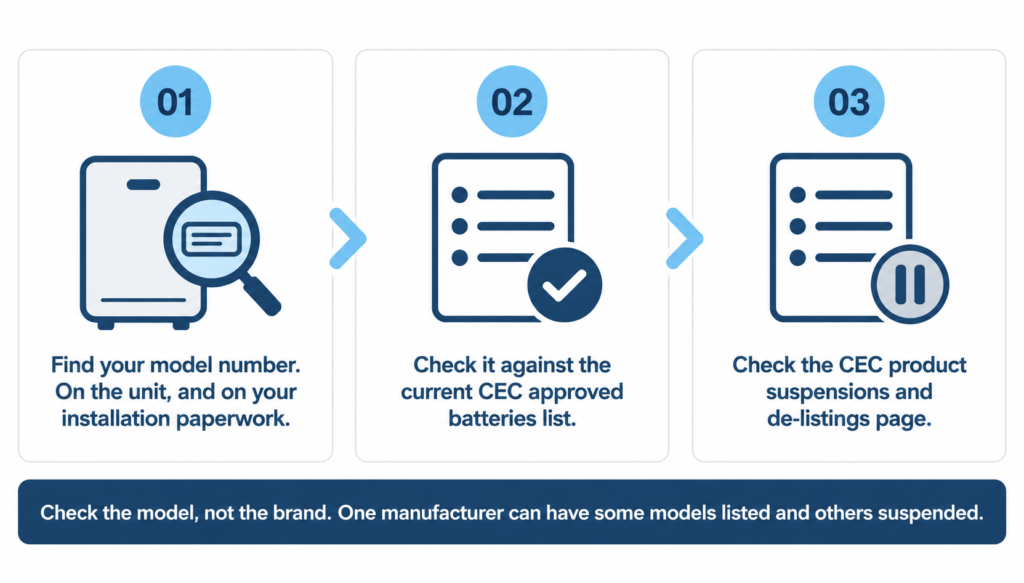
5. Check the CEC Approved Battery List Before You Buy

Before committing to any solar battery, it’s critical to make sure it’s on the Clean Energy Council’s (CEC) list of approved batteries. This isn’t just a quality tick — it’s a requirement for eligibility in many state and federal rebate programs, including the Small-scale Renewable Energy Scheme (SRES).

The CEC approved battery list includes over 1,000 lithium-based batteries that meet strict safety and consumer protection standards outlined in the Australian Battery Safety Guide. These include international compliance standards and additional safeguards to ensure your system operates safely and is eligible for grid connection.

Not on the list? Rule it out.

Top 10 Battery Brands Rated by Aussie Homeowners

When you’re making a big investment like a solar battery, it pays to listen to people who’ve already been through the process. That’s where SolarQuotes comes in — one of Australia’s most trusted solar review platforms, with over 90,000 genuine reviews across installers, panels, inverters, and batteries.

Based on customer feedback collected through their platform, these are the Top 10 battery brands in Australia right now — ranked by overall satisfaction and performance:

  1. Sigenergy
  2. SunGrow
  3. Alpha-ESS
  4. Tesla Powerwall 3
  5. Anker Solix
  6. Tesla Powerwall 2
  7. SolaX Power
  8. BYD
  9. Fox ESS
  10. Goodwe

This ranking is based on independent reviews and ratings collected by SolarQuotes. You can view the full list — and compare even more brands and models — via their SolarQuotes battery comparison table.

Confidence Over Confusion

When you focus on the essentials — sizing, compatibility, chemistry, features, and fit — you’ll end up with a solution that works for your home long after the install is done. However, here’s the part many people overlook: it’s not just about the product specs. It’s about the company behind the battery, too.

From our experience, these are non-negotiables when choosing a battery brand:

  • Solid reviews from both installers and customers
  • Reliable tech support and after-sales service
  • A proven track record in the Australian market

If you’re still comparing options or weighing the pros and cons, or want to understand the broader value batteries offer beyond just storage? Check out our guide on 5 practical reasons to add a battery to your solar system. And if you’re ready to talk specifics, get in touch with Lenergy — we’re happy to walk you through the best options for your home, your usage, and your future plans.

Lenergy staff member, Ziad standing in front of solar panels smiling

Is the AlphaESS SMILE-G3-S5 Really a Good Home Battery — or Just Marketing Hype?

The AlphaESS SMILE-G3-S5 is one of the most feature-rich and cost-effective residential battery systems currently available in Australia. Designed to meet the needs of both on-grid and off-grid households, it offers blackout protection, high PV input capacity, and compatibility with Virtual Power Plants (VPPs).

For homeowners seeking a scalable, reliable, and rebate-eligible energy storage system, the SMILE-G3-S5 stands out for its technical capabilities and local support. AlphaESS is backed by a strong global presence and has been ranked well amongst the best battery brands in the Australian market.

At Lenergy, we work with a wide range of battery brands — and we’ve seen what holds up in real homes, under real conditions. In this article, you’ll learn what makes the SMILE-G3-S5 one of the most trusted, scalable, and VPP-ready energy storage solutions on the Australian market right now.

You’ll also find out when it’s not the right fit — and how to avoid some common mistakes when choosing your installer.

What Is the AlphaESS SMILE-G3-S5 Battery?

The AlphaESS SMILE-G3-S5 is a lithium iron phosphate (LiFePO₄) home energy storage system designed for residential solar applications. It combines a hybrid inverter (DC-coupled) or an AC-coupled option with modular battery storage, allowing homeowners to store excess solar energy for later use, including during blackouts.

AlphaESS SMILE-G3-S5 Battery installed outside of home on concrete wall next to a glass door.

The SMILE‑G3 series includes two models: the S5, which is a 5 kW hybrid (DC‑coupled) inverter, and the B5, which is a 5 kW AC‑coupled variant. The S5 model supports up to 10 kW of PV input, allowing significant solar oversizing relative to its 5 kW inverter rating. The B5 is designed for AC‑coupled installations and typically offers a lower entry cost, but its PV input specifications differ because it does not take DC solar input directly.

The battery stack used in the AlphaESS SMILE‑G3‑S5 system is modular and scalable, with a minimum capacity of 10.1 kWh and expandable up to 60.5 kWh using Alpha’s SMILE‑BAT‑10.1P modules. Each module delivers 10.1 kWh and supports flexible installation configurations, making the system suitable for households with medium to high energy usage. The modular design also allows for staged upgrades over time as energy needs grow.

Notably, the SMILE-G3-S5 includes 5kW UPS-grade backup with blackstart capability, meaning it can restore power independently in the event of an outage. It also offers grid-charging functionality, allowing users to charge the battery from the grid when rates are low.

Why Is AlphaESS a Trusted Battery Brand in Australia?

AlphaESS is a globally recognised energy storage manufacturer with systems installed in over 80 countries. In Australia, it has earned a strong reputation for its technical reliability, flexible system design, and local support infrastructure.

According to rankings by leading independent solar platforms, AlphaESS is consistently rated among the top residential battery brands in the country. In 2025, SolarQuotes ranked AlphaESS as the third-best battery brand in Australia, based on installer feedback and consumer satisfaction. Solar Choice placed it second, citing its combination of affordability, modular capacity, and compatibility with a wide range of residential solar systems.

One of AlphaESS’ strengths in the Australian market is its local warehouse and support presence. The company operates out of Chatswood in New South Wales, with additional warehousing in St Marys, South Australia, and third-party logistics facilities across Victoria, New South Wales, and Western Australia. This distribution footprint enables faster delivery times and improves after-sales service through local technical support teams.

A map of Australia that shows AlphaESS SMILE-G3-S5 areas of service with highlighted dots.

Having multiple Australian-based warehouses also helps reduce delays for warranty claims, parts replacements, and maintenance — a key advantage over brands that rely solely on overseas supply chains.

Any Drawbacks to Watch Out For?

While the AlphaESS SMILE-G3-S5 offers strong technical specifications and competitive pricing, there are some potential drawbacks to keep in mind — particularly when it comes to installation quality.

Installer Variability

Due to its affordability and wide market appeal, the SMILE-G3-S5 is installed by a broad range of providers — not all of whom deliver the same standard of workmanship or support. Unlike premium battery brands that are sold through closed or accredited installer networks, AlphaESS systems are more widely accessible. This increases the risk of substandard installations if consumers choose based solely on price.

To avoid issues such as poor system configuration, delayed support, or missed rebate eligibility, it’s essential to:

  • Choose an installer with proven experience working specifically with AlphaESS systems.
  • Ask to see past installations or verified customer feedback.
  • Confirm that the installer is Clean Energy Council (CEC) accredited and compliant with local VPP or rebate schemes.
Team member from Lenergy in a branded uniform doing work on a switchboard to prepare for an AlphaESS SMILE-G3-S5 installation

Is the SMILE-G3-S5 Right for You?

The AlphaESS SMILE-G3-S5 offers a well-balanced mix of performance, safety, scalability, and affordability — making it a strong contender for homeowners looking to invest in solar battery storage.

Its hybrid and AC-coupled options provide flexibility for both new installations and solar retrofits. The system’s support for high PV input, robust 5 kW backup capability, and modular storage up to 60.5 kWh make it suitable for a wide range of energy needs. Add to that VPP readiness and eligibility for rebate programs, and the value proposition becomes clear.

However, because AlphaESS systems are installed by a broad range of providers, the outcome can vary depending on installer quality. If you’re considering the SMILE-G3-S5, it’s important to work with a knowledgeable, experienced installer who understands system design, VPP setup, and long-term servicing.

At Lenergy, we specialise in technically sound battery installations and can help determine whether the SMILE-G3-S5 is the right fit for your home, usage patterns, and goals. Whether you’re looking to reduce grid reliance, prepare for outages, or join a VPP, this system offers a compelling, future-ready option — provided it’s installed and supported properly.

Female Lenergy staff member standing in front of branded Lenergy sign

Tesla’s Big Announcement: The Next Million Powerwall Rebate

Thinking of installing a Tesla Powerwall 3 but wondering if it’s better to wait?

With solar rebates falling and prices shifting, it’s fair to ask whether 2026 will still offer good value — or if acting sooner is smarter. You might’ve also heard Tesla is rolling out something new for buyers.

Tesla just launched the “Next Million Powerwall Rebate” to mark one million installations worldwide. This rebate offers up to $1,500 per address for homes installing Powerwall 3 systems — and yes, it stacks with the new federal battery rebate in 2026.

In this article, you’ll learn what the rebate includes, who qualifies, and how to time your installation for maximum benefit.

What Is Tesla’s ‘Next Million Powerwall Rebate’?

To celebrate reaching one million Powerwall installations globally, Tesla has launched a new rebate for Australian homeowners. The “Next Million Powerwall Rebate” gives eligible households a rebate when they install the Powerwall 3 or Powerwall 3 Expansion Units. Registrations are currently open for the rebate as of 6 November 2025 up until 31 March 2026 with installations required to be completed between 1 January and 30 September 2026.

Rather than a direct discount, the rebate comes in the form of a Virtual Prepaid Visa Rewards Gift Card.

How Much Can You Get Back — and On What Products?

Under the new rebate, Tesla is offering:

  • $750 per Powerwall 3 or Expansion Unit
  • Up to $1,500 per address

The rebate applies specifically to the Powerwall 3 and its Expansion Units — not earlier models like the Powerwall 2. This means it’s targeted at new installs or system upgrades using Tesla’s latest generation battery.

Can You Combine This with the Federal Battery Rebate?

Yes — Tesla has confirmed that the Next Million Powerwall Rebate can be combined with the federal “Cheaper Home Batteries Program”, that commences on 1 July 2025. That means eligible homeowners can stack two separate rebates:

This stacking opportunity could significantly lower your upfront costs, making the Powerwall 3 a much more accessible option for many households in 2026.

2 Tesla Powerwall 3 Batteries installed on exterior of home next to EV charging and Tesla car

Just make sure you meet the requirements for both — including using a Clean Energy Council (CEC) approved installer for the federal rebate, and registering within Tesla’s timeframes for theirs.

If you’re thinking about installing a Powerwall 3 — or want to know how this rebate stacks with other offers — we’re here to help.

Get in touch with us today to talk through your options.

AlphaESS Battery Review: What You Need to Know Before You Buy

AlphaESS is a global provider of battery storage systems and energy management solutions, with a strong and growing presence in the Australian market. Founded in 2012, the company focuses on integrating advanced battery management (BMS), energy management (EMS), system integration, and cloud monitoring technologies into smart, scalable storage products.

Today, AlphaESS operates in more than 130 countries with over 200,000 systems installed across homes, businesses, and large-scale infrastructure. The company has built a wide global footprint, with over 40 subsidiaries and branches, including key locations in Australia, Germany, China, the UK, Italy, Singapore, and South Africa.

One of AlphaESS’s best-known systems in Australia is the SMILE-G3-S5 — a hybrid, DC-coupled battery designed for residential solar setups. This model includes a 5kW hybrid inverter and supports multiple battery configurations, making it ideal for new installations where efficiency and modularity matter. You can learn more about the SMILE-G3-S5 below:

What Is the AlphaESS SMILE Series?

The AlphaESS SMILE series is an all-in-one energy storage solution designed for homeowners and small businesses looking to use more of their solar power, protect against blackouts, and prepare for energy trends like virtual power plants (VPPs).

Each SMILE system includes:

  • A hybrid inverter (typically 5kW) that handles both solar input and battery storage
  • A modular lithium iron phosphate (LiFePO₄) battery setup
  • Smart monitoring via the AlphaCloud platform

The system is designed to grow with your needs. You can start with a modest capacity and expand up to 30kWh or more, depending on the configuration. The SMILE series supports both DC-coupled and AC-coupled installation types, making it a fit whether you’re starting fresh or adding to an existing solar setup.

Is AlphaESS a Reliable Battery Brand?

When it comes to batteries, reliability isn’t just about what’s on the spec sheet — it’s about how a system performs in real-world conditions, how well it’s supported locally, and whether it holds up over time. So, how does AlphaESS stack up?

Their systems are listed with the Clean Energy Council and are widely used in residential installations. In terms of adoption, AlphaESS batteries have been consistently listed among the top five brands, particularly among Chinese manufacturers according to Sunwiz and PV Magazine, though exact rankings by number of systems versus kWh capacity vary. That doesn’t automatically mean they’re the best — but it does mean they’re proven and widely deployed.

Independent Testing (ITP Renewables)

AlphaESS systems have been tested as part of a long-term battery trial run by ITP Renewables, funded by the Australian Renewable Energy Agency (ARENA). This trial cycles batteries multiple times per day to simulate real-world use over years in a compressed timeframe.

One of Alpha’s early models, the M48100, was included in this program. While it showed some performance restrictions after extended testing, it’s important to note that:

  • This was a first-generation model from more than 7 years ago
  • The current SMILE series is significantly more advanced
  • AlphaESS themselves acknowledged and addressed the limitations found

Since then, the company has made noticeable improvements in battery chemistry, thermal management, and firmware control — and there haven’t been any flagged reliability issues with newer models in public testing reports.

AlphaESS Battery Pros and Cons: An Honest Look

Like any energy storage system, AlphaESS batteries come with trade-offs. They’re popular in Australia, especially with homeowners looking for an all-in-one, cost-effective battery setup — but popularity doesn’t always equal perfection.

A display of the AlphaESS Battery against a while wall

Here’s a clear, honest breakdown of the main advantages and limitations of the AlphaESS SMILE series, based on installer feedback, user reviews, and publicly available data.

ProsCons
Competitive Pricing – Often more affordable than brands like Tesla or Sonnen.Mixed Installer Feedback – Some report slow support response during installs or faults.
All-in-One Design – Built-in hybrid inverter reduces clutter and simplifies installs.Limited Inverter Output – 5kW inverter may not suit large homes or high-usage businesses.
Modular & Scalable – Easily expand battery capacity over time.Early Model Performance Issues – Older units like the M48100 had issues during testing.
VPP Ready – Widely accepted in Virtual Power Plant programs.
Australian Support Office – Based in Chatswood, NSW for warranty and tech queries.

Should You Consider AlphaESS for Your Home or Business?

If you’re comparing battery brands in 2025, AlphaESS deserves a spot on your list — especially if you’re looking for an affordable, all-in-one system that’s ready for VPPs and comes with local support.

The SMILE series in particular hits a sweet spot for many homes and small businesses: it’s modular, scalable, and integrates a hybrid inverter to keep things simple. For new solar installs, the DC-coupled SMILE-G3-S5 is one of the more efficient systems on the market. And for those retrofitting storage onto existing solar, AlphaESS offers AC-coupled options that are flexible and cost-effective.

But it’s not the right fit for everyone. If your home has high peak energy loads or if you want ultra-fast support turnaround, you might want to consider higher-capacity inverters or brands with a more established service network.

At the end of the day, AlphaESS isn’t trying to be a premium brand — it’s aiming to deliver solid performance at a fair price, with systems that are widely accepted across Australian incentive schemes and VPPs.

The takeaway? If you’re price-conscious, looking for a system with local support, and value flexibility, AlphaESS is worth a close look. Just make sure you’re working with an installer who knows how to set it up properly — and who’s transparent about what to expect if you ever need support.

Want help deciding if AlphaESS is right for your setup?

Lenergy can walk you through your options and provide honest, tailored advice

Lincoln from Lenergy standing in front of branded neon sign smiling.

Federal Government Launches Solar Sharing Scheme

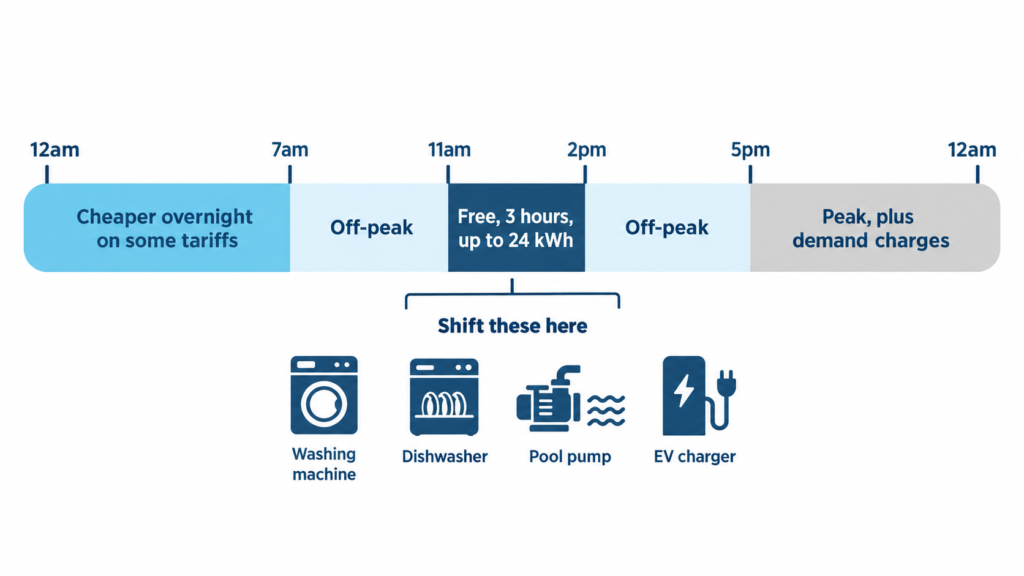
From July 2026, households in New South Wales, South-East Queensland and South Australia will be eligible for at least three hours of free solar electricity each day — even if they don’t have rooftop panels installed. The announcement comes as part of the federal government’s new Solar Sharing scheme, which aims to let more Australians benefit from the country’s abundant solar energy. It applies to homes with smart meters — which includes the majority of Australian households — and could expand to other parts of the country by 2027.

According to The Guardian, the scheme will be enabled by updates to the default market offer — the government-set electricity price cap used in many areas. This will allow energy retailers to offer zero-cost power during periods of high solar generation, typically in the middle of the day.

Households will be encouraged to use this free electricity by shifting the timing of appliances such as washing machines, dishwashers, or air conditioners — or even charging EVs and batteries — into the zero-cost window.

Reducing Solar Waste and Shifting Energy Demand

Energy Minister Chris Bowen said the scheme was about using “every last ray of sunshine” to power homes, helping to reduce waste from excess solar production while lowering energy bills. He added: “This is proof that what’s good for the planet is good for your pocket.”

The government noted that Australia’s more than four million rooftop solar systems often generate more electricity than needed during sunny periods, leading to low wholesale prices and unused energy. The Solar Sharing program aims to smooth electricity demand by shifting it away from peak evening times, easing grid pressure and potentially reducing future infrastructure costs.

Mixed Industry Response to the Solar Sharing Announcement

While some providers like AGL and Red Energy already offer similar midday solar plans, the move has drawn mixed responses. The Smart Energy Council welcomed the program as a cost-of-living support measure. However, the Australian Energy Council criticised the lack of consultation, warning it could impact energy market confidence and disrupt product innovation.

The Australian Energy Regulator will oversee the rollout to ensure customers are treated fairly outside the free electricity window. The government also confirmed it will consult with other states about expanding the program in future years.

Aiko solar panels installed by Lenergy on roof with ample sun in the Southern Highlands

Is the Solar Sharing Scheme A Win for Households with Solar and Batteries Too?

Lenergy sees the new Solar Sharing scheme as a positive for homes with existing solar and battery systems. Why? Because now, you can charge your battery from the grid during the free power window, allowing you to soak up free electricity during the sunniest part of the day — even if your own panels aren’t covering demand.

It also opens the door to scheduling smart energy use. You can set appliances like EV chargers, dryers, washing machines, or hot water systems to run during the three-hour zero-cost period — making better use of your system and reducing your reliance on peak-time grid power.

Thinking about whether solar still makes sense for your home?

Contact the team at Lenergy for an honest chat about your usage, goals, and whether a solar system or battery could still be the right move.

Tesla Powerwall 3 vs Pylontech Force H3X: Which is better?

You’ve probably heard the hype around the Tesla Powerwall 3. It’s well-known, widely marketed, and packed with smart features. Then there’s Pylontech — a strong performer with a growing reputation among Australian installers for reliability and value.

So which one actually makes more sense for your home?

At Lenergy, we’ve installed both systems and helped hundreds of homeowners weigh up this exact decision. We know the questions people ask, the numbers that matter, and the gotchas you don’t find in the glossy brochures.

This article gives you a side-by-side breakdown of the Tesla Powerwall 3 and the Pylontech Force H3X. You’ll learn how they compare on performance, price, compatibility, and more so you can make a confident, well-informed decision about which one (if either) is right for your solar setup.

Why Compare These Two Batteries?

If you’ve been researching solar battery options in 2025, chances are you’ve come across both the Tesla Powerwall 3 and the Pylontech Force H3X. These two batteries come up in conversations with homeowners for a few good reasons:

  • They’re widely available in Australia
  • They offer serious backup potential
  • They support flexible solar system configurations
  • And they’re eligible for current rebates and VPP programs

That said, they’re very different systems.

The Tesla Powerwall 3 is a high-output, all-in-one battery with an integrated hybrid inverter, allowing it to be used in both AC- and DC-coupled systems. It’s often chosen by households looking for strong backup performance, smart home integration, and a clean, consolidated design that minimises wall clutter.

The Pylontech Force H3X also features an integrated inverter, offering flexibility to operate in both AC- and DC-coupled configurations. It’s a modular system, which makes it ideal for homes that want custom sizing, more inverter options, or the ability to start small and expand over time — whether you have a single-phase or three-phase setup.

Pylontech Force H3X display battery installed on white brick wall

So if you’re trying to decide between them, this isn’t about which battery is “better.” It’s about which one fits your home, your usage patterns, and your long-term energy goals.

Capacity, Scalability & Suitability

When it comes to batteries, capacity isn’t just about how big it is — it’s about how well it fits your household’s energy habits, future plans, and available space. Here’s how these two batteries compare.

Tesla Powerwall 3: Fixed Capacity, High Output

The Powerwall 3 offers 13.5kWh of usable capacity in a single unit, with the ability to stack up to 40.5kWh (3 units). This covers most medium to large households — particularly if you’re trying to cover both night-time usage and power outages.

What’s different about the Powerwall 3 is that it includes a fully integrated hybrid inverter, making it suitable for both new solar systems and retrofits. But it’s not modular — if 13.5kWh isn’t quite enough, you’ll need to add to a whole second 13.5kWh battery unit, taking you to 27kWh of storage.

Pylontech Force H3X: Modular and Flexible

The Force H3X is built for customisation. Each battery module delivers 5.12kWh nominal capacity, with 4.864kWh of usable storage. 

You can stack:

Up to 20kWh usable on a single-phase tower

Up to 35kWh usable on a three-phase tower

Multiple towers can be installed together for even larger systems.

This makes it a smart choice if:

  • You’re looking for better value for each kWh of storage
  • You want compatibility with both single-phase and three-phase systems

In short: Powerwall suits those who already have the Tesla ecosystem (EV charging point/car) and are ok with paying a premium price for a premium battery. Pylontech suits those who want flexibility in system sizing at a more affordable price point, or households with either single-phase or three-phase supply looking for full backup or large-scale solar and battery setups. It’s also a proven name in the Australian battery market, with over a decade of local presence and performance.

Performance & Backup Power

When the grid goes down, not all batteries perform the same. Understanding each battery’s output, responsiveness, and blackout support can help you decide which one actually keeps your home running when it matters.

Tesla Powerwall 3: 

The Tesla Powerwall 3 supports up to 20 kWh DC of solar and provides up to 11.5 kWh AC of continuous power per unit, which is extremely high for a residential battery.

This means:

  • You can run most of your home during an outage, including large loads like air conditioners or pool pumps (depending on your setup)
  • You’re less likely to need to manually manage which circuits stay powered during blackouts

Tesla’s Powerwall also comes with a built-in backup gateway, which automatically detects outages and switches to battery power almost instantly. It’s a fully integrated backup solution — no need for external switches or special wiring in most cases.

Pylontech Force H3X:

The Force H3X can be paired with Pylontech’s own inverters, which are available in both single-phase and three-phase models. At the time of writing (November 2025), the single-phase inverters (5kW and 8kW) are already in use, while the three-phase options (10kW, 12kW, and 15kW) are expected to receive CEC approval by the end of 2025.

What this means for you:

  • With Pylontech’s inverters, your backup power is limited to the capacity of the inverter size.
  • These inverters are purpose-built for use with the Force H3X, streamlining setup and monitoring

Inverter & System Type: AC & DC Coupling

One of the biggest technical differences between these two batteries is how they connect to your solar system — and it’s something many homeowners overlook. It affects everything from system design to efficiency, installation costs, and future flexibility.

Tesla Powerwall 3: 

The Powerwall 3 includes a fully integrated hybrid inverter, which makes it capable of both AC- and DC-coupled configurations.

In AC-coupled mode, it can be added to virtually any existing solar setup — making it a simple option for retrofits without changing your current inverter.

In DC-coupled mode, the built-in inverter allows you to connect up to 20kW of solar panels directly to the system. This setup improves efficiency by reducing the number of energy conversion steps and enables tighter integration between your solar and battery.

This dual capability gives the Powerwall 3 added flexibility for both new installations and upgrades.

Pylontech Force H3X: 

The Pylontech Force H3X is designed to support both AC- and DC-coupled configurations, offering flexibility for a wide range of system types. Pylontech’s own inverters are available in single-phase (5kW, 8kW) and three-phase (10kW, 12kW, 15kW) models (pending CEC approval for three-phase as of November 2025).

In a DC-coupled setup, the battery connects to your solar system before the power is converted to AC, offering:

  • Higher overall efficiency
  • Improved energy yield, particularly in new builds or inverter upgrades

In AC-coupled mode, the Force H3X can be integrated into existing solar systems, making it a viable retrofit option — especially with the right inverter setup.

This dual-coupling capability makes Pylontech a versatile choice for both new and existing homes, with more control over sizing and design.

6 Pylontech Force H3X Batteries installed on white wall showing the scalability of output

Warranty, Lifespan & Battery Chemistry

Not all warranties are created equal — and neither are battery chemistries. These details can affect how long your battery lasts, how safe it is, and what kind of support you’ll get if something goes wrong.

Tesla Powerwall 3: LFP Chemistry, High Output

The Powerwall 3 uses Lithium Ferro Phosphate (LFP) chemistry — known for its thermal stability, long cycle life, and enhanced safety. It’s a shift from earlier Powerwall versions, which used NMC chemistry.

LFP batteries are:

  • Less prone to overheating, making them safer in hot environments
  • Capable of more charge/discharge cycles, giving them a longer lifespan

Tesla backs the Powerwall 3 with a 10-year warranty, promising at least 70% capacity retention. Combined with its 30kW peak power output and smart features, it offers a blend of durability and performance that suits most residential setups.

Pylontech Force H3X: LFP Chemistry, Longer Lifespan

The Force H3X uses Lithium Iron Phosphate (LFP) — a chemistry known for:

  • Greater thermal stability (safer in high temps)
  • Longer cycle life, often exceeding 8,000+ cycles

Pylontech backs this with a 10-year warranty too. For homeowners prioritising longevity, LFP is often the preferred option.

Warranties with Pylontech may involve the inverter manufacturer or installer as part of the support chain — so it’s worth asking your installer how warranty claims are handled.

Price & Installation Considerations

For most households, price is a major factor in choosing a battery. Here’s how the Powerwall 3 and Pylontech Force H3X compare on upfront pricing, installation complexity, and rebates.

Tesla Powerwall 3: Premium Price, Simple Install

The Tesla Powerwall 3 installed price in Australia typically ranges from $15,000, depending on your installer, location, and whether it’s part of a full solar package.

Because it’s AC-coupled with a built-in inverter, installation is usually straightforward for both new and retrofit systems. That said:

  • It’s not modular, so you need to add 2 or 3 full units if you want more storage
  • Some installations may still require a back-up switchboard upgrade (but this for just Tesla)

Tesla’s strong brand reputation and integration with solar + EV setups are part of what you’re paying for — however you are paying a premium – Rest assured you are getting a premium battery though.

Pylontech Force H3X: Modular & Cost-Effective

Pylontech pricing is more modular and flexible. With the installation cost sitting around $9,000 to $11,500 for 20-30kWh of storage, depending on:

  • Number of battery modules
  • Inverter brand and size
  • Site-specific wiring or upgrade requirements

You can start smaller — eg. with 5.12kWh — and scale up later, spreading out your investment.

What About Rebates?

Both batteries are eligible for:

  • The federal battery rebate (from July 2025), worth a few thousand dollars depending on your system size

However, only the Tesla Powerwall 3 is eligible for:

  • The NSW VPP incentive, offering up to $1,500 upfront for joining a VPP program

Next Steps: Talk to an Expert

A solar battery is a big investment — and the right choice depends on more than just specs. Your home’s wiring, energy habits, solar system, and future plans all play a role.

If you’re still weighing up your options, or want tailored advice based on your home setup, it’s worth speaking to someone who’s installed both systems and can walk you through the trade-offs clearly.

You can learn more about each battery here:

Or, if you’re ready to ask some questions or get a quote, you can get in touch with Lenergy’s team here.

Lenergy staff member, Ziad standing in front of solar panels smiling

Pylontech Force H3X Battery Review: An In-Depth Look at Pylontech’s Solar Battery

If you’re looking for a high-capacity, high-performance battery that doesn’t just compete with the biggest names in the market — but often beats them on value and capability — the Pylontech Force H3X deserves your attention.

Their new Force H3X battery system is quietly ticking every box that matters: robust backup support, noteworthy safety features, seamless integration with both single and three-phase homes and it’s doing all this at a significantly lower price than most of the big-name competitors.

At Lenergy, we’ve installed a lot of batteries. And lately, we’ve found ourselves turning to the Pylontech H3X more and more. It’s been through the brutal Canberra testing program (one of only two batteries to pass out of 26), includes features others are still catching up to, and comes from a brand with over a decade of experience in energy storage.

In this article, you’ll get a clear look at the Pylontech Force H3X — what it can do, who it’s for and whether it’s the right fit for your home.

What Is the Pylontech Force H3X and Who Is It For?

The Pylontech Force H3X is a modular solar battery storage system designed for Australian homes that want more control over their energy — whether that means reducing bills, riding through blackouts, or simply storing excess solar for later use.

On paper, the H3X matches (and in some cases exceeds) the technical capabilities of far more expensive brands. It’s compatible with both single-phase and three-phase systems, supports full home backup, and includes heated battery modules — making it suitable for colder climates.

It’s designed for people who want:

  • Reliable blackout protection (especially in homes with three-phase power)
  • Safety-first design without compromising on functionality
  • A battery that won’t break the bank but still offers premium-level features
  • Peace of mind from a brand that’s been doing this for more than a decade

Whether you’re adding storage to an existing solar setup or installing a full system from scratch, the Force H3X gives you serious flexibility. And unlike some brands that limit compatibility or require brand-specific inverters, Pylontech’s approach is refreshingly open.

If you value performance, reliability, and value — this battery is worth a closer look.

Pylontech Force H3X stackable modules. 6 batteries lined up, installed on wall producing 120 kWh

What Are the Key Features of the Pylontech H3X?

The Pylontech Force H3X is designed as a modular, high-performance battery solution for homes and small commercial setups that want a flexible, safe, and intelligent energy storage system. It supports both single-phase and three-phase applications — making it suitable for a wide range of Australian households.

Here are the standout features, based on Pylontech’s own specifications:

On-Demand Versatility

The H3X offers a wide power range of 3.6kW to 15kW and capacity options from 10 to 35kWh per group, with up to 6 groups stackable — totalling up to 210kWh. That flexibility makes it suitable for everything from small homes to larger dwellings with higher energy demands.

Integrated Hybrid System (BMS + Inverter + EMS)

Rather than requiring separate components, the H3X integrates its Battery Management System (BMS), Inverter, and Energy Management System (EMS) into a single unit. This design helps reduce installation complexity — with Pylontech claiming a 15-minute installation and commissioning time thanks to its automatic setup.

Safety First Design

The Force H3X is built with safety as a priority, incorporating features such as anti-islanding protection, overcurrent and overvoltage safeguards, DC reverse polarity protection, a built-in DC switch, and an arc fault circuit interrupter (AFCI). It’s also UL9540A certified — one of the most recognised global standards for battery safety testing — offering peace of mind for Australian households.

Exceptional Performance and Longevity

The H3X is engineered for high-efficiency, everyday use, with a 1C charge and discharge rate, 97% round-trip efficiency, and an expected lifespan of over 8,000 cycles. It also supports 100% three-phase load unbalance, making it ideal for powering large homes or appliances evenly across all phases.

Smart Energy Management

The Pylontech Force H3X includes an integrated Energy Management System (EMS) that enables dynamic control of energy flows, real-time fault diagnosis, and remote control of connected systems like PV and heat pumps. It also offers flexible connectivity via Wi-Fi, LAN, or Bluetooth, making monitoring and updates simple and accessible.

Close up view of Pylontech Force H3X battery showing the side panel and smart reader.

How Reliable Is Pylontech as a Brand?

In a market flooded with new battery brands promising the world, Pylontech stands out for one simple reason: it’s not new to this.

Founded in 2009, Pylontech has over 15 years of experience in the energy storage industry and has shipped millions of battery modules globally. It’s one of the few companies that focuses entirely on battery energy storage systems (BESS) — not as a sideline, but as its core business.

This matters because many battery brands come and go — often rebranded products with limited long-term support. Pylontech, on the other hand, has spent more than a decade building a reputation for stable, high-quality storage systems that are widely used in residential, commercial, and utility-scale applications.

Some key signs of brand reliability:

  • Global certifications, including UL9540A (safety), CE, IEC, UN38.3, and others
  • 10+ year track record in battery manufacturing
  • Widespread installer trust — particularly in Australia, where it’s a popular choice among solar professionals
  • Dedicated local support, with a new Sydney office opening in November 2025
  • Ongoing software and firmware updates via Wi-Fi, LAN, or Bluetooth

Pylontech isn’t just competitive on paper — it has the brand stability to match. And that can mean a lot when you’re investing in a battery expected to last a decade or more.

What’s the Price – and Is It Good Value for Money?

Pylontech’s Force H3X offers exceptional value for homeowners looking for a high-capacity, future-ready storage system — without the premium price tag.

Here’s a snapshot of typical system pricing:

  • 20kWh single-phase system — from $9,990
  • 30kWh single-phase system (two stacks) — from $13,950
  • 35kWh three-phase system (one stack, 15kW inverter) — from $12,779

It’s worth noting that the three-phase setup is more cost-effective than its single-phase equivalent at this size, as it only requires one inverter and one stack. Beyond 35kWh, a second stack and inverter are needed, adding over $3,000 to the system cost.

You can also build a complete solar + battery package using Pylontech’s hybrid inverter.

For example:

These numbers make it clear: Pylontech delivers large-scale storage capacity and full system integration at a price point that’s highly accessible — especially for homeowners planning a long-term solar and storage setup.

Front view of a Pylontech Force H3X battery installed on plain white wall. 3-phase hybrid system

A Smart, Scalable Choice for Australian Homes

The Pylontech Force H3X isn’t just a strong battery — it’s setting a new benchmark for what Australians should expect from home energy storage.

It combines:

  • Scalable capacity (up to 210kWh)
  • Flexible backup for both single and three-phase homes
  • Integrated hybrid inverter and smart EMS
  • Global certifications and Australian-ready design
  • And most importantly — exceptional value for money

This is a product from a brand that’s spent over a decade building trust in the global energy storage industry — and it shows. Backed by a growing support presence in Australia and the endorsement of experienced installers, the Force H3X is fast becoming one of the most recommended batteries on the market.

If you’re looking for a reliable, future-ready battery solution that delivers on performance without inflating the price, Pylontech should be at the top of your list.

At Lenergy, we design and install solar and battery systems that are built to perform — and the Pylontech Force H3X is one we recommend with confidence.

Whether you’re looking to upgrade your existing setup or install a full solar and storage solution, our team can help you get the most out of your investment with expert advice and quality installation.

Lenergy staff member, Ziad standing in front of solar panels smiling

Rooftop vs Ground Mount Solar: Which is best?

You’re ready to go solar. You’ve compared panels, read up on payback periods, and now you’re trying to make one last decision: rooftop or ground mount solar ?

It sounds simple, however the choice matters. Where your panels go affects what you pay, how much energy you generate, and what your property looks like once it’s all done.

At Lenergy, we’ve helped hundreds of Australian homeowners make solar decisions that actually suit their home — not just the sales pitch. While rooftop solar is still the best option for most homes, ground mount solar has its place too — especially if your roof isn’t ideal.

In this article, you’ll learn how these two options compare on cost, performance, and maintenance. By the end, you’ll know which one is the smarter move for your situation.

What Is Rooftop Solar?

Rooftop solar is the most common way Australians install solar panels at home. It’s exactly what it sounds like — panels mounted directly onto your existing roof. Rather than being positioned for the “perfect” sun angle, rooftop panels are typically installed to match the direction and pitch of your roof, which keeps installation simpler and more cost-effective.

2 Lenergy branded van parked on driveway next to rooftop solar installation

This setup works so well because it uses space you already have. Instead of taking up part of your lawn or garden, it puts solar to work on an otherwise unused part of your home. That keeps things neat and cost-effective.

At Lenergy, almost every solar system we install is on the roof. Why? Because it just makes sense for most properties. The roof acts as a natural mounting surface, which means fewer materials, less labour, and a lower overall price tag.

Most rooftop systems range from 6.6kW to 20kW, depending on your energy usage and available space. If you’re unsure how big your system needs to be, click below to read our article on what size solar system you need.

There are other upsides, too. Roof panels can actually help cool your home in summer by shading your roof. And in most NSW council areas, rooftop systems don’t need planning approval — so you can get on with it quickly.

Unless your roof is heavily shaded, structurally unsound, or laid out in a really tricky way, rooftop solar is usually the best place to start. 

What Is Ground Mount Solar?

Ground mount solar is exactly what it sounds like: instead of panels going on your roof, they’re installed on frames anchored into the ground somewhere on your property.

The frames can be fixed (set at one angle year-round) or use tracking systems that follow the sun throughout the day. Most residential setups use fixed systems — they’re cheaper, more reliable, and have fewer moving parts to maintain.

A ground mount solar installation in paddock of rural home in Newcastle

To install ground mount solar, you’ll need open space with good sun exposure. That might be a section of lawn, a paddock, or even a cleared area near a shed. But keep in mind: this space becomes dedicated solar land — you won’t be mowing it, planting a garden there, or using it for anything else.

Ground mount systems are more common on rural properties, farms, or homes with shaded or unsuitable roofs. They give you flexibility on panel direction and angle — which can help maximise output if your roof isn’t ideal.

But that flexibility comes at a cost. Installing panels on the ground means more labour, more materials, and often, more planning. We’ll get into that next.

What’s the Cost Difference Between Rooftop and Ground Mount Solar?

Rooftop solar is almost always cheaper. That’s because your roof already provides a sturdy, elevated structure — no need for extra steel, concrete, or trenching. Most of the work goes into attaching the mounting rails and getting the panels up safely.

With ground mount solar, you’re starting from scratch. You’ll need:

  • Posts or footings to anchor the frames
  • Extra mounting materials
  • Earthworks and trenching to run cabling underground
  • Possibly engineering reports or council permits

At Lenergy, a 20kW rooftop solar system typically costs around $20,000, based on $1.00 per watt. That price includes the panels and installation, not a battery.

For the same size system, a 20kW ground mount setup starts from $50,000, based on $2.00 (up to $2.50+) per watt. That also excludes batteries — and doesn’t include trenching, which is often required to run underground cabling between the array and your switchboard. Trenching costs vary depending on how far we need to dig and the size of the cable required, but it can add thousands to the final price.

This higher upfront cost also means a longer payback period. You’re spending more for the same system output, which is why ground mount solar is generally only worth considering when rooftop isn’t a viable option.

Which Performs Better: Rooftop or Ground Mount?

In terms of raw energy production, both rooftop and ground mount systems can perform equally well — as long as they’re installed in ideal conditions. The same panels, the same inverter, the same sunshine — you’ll get similar results.

Ground mount systems can have a slight edge when it comes to positioning. Since you’re not limited by roof shape, pitch, or orientation, you can angle the panels perfectly to maximise sunlight throughout the day. This is especially useful if your roof faces east–west or is partially shaded.

Rooftop systems, on the other hand, make the most of your home’s existing layout. And there’s one benefit many people don’t expect: rooftop panels actually help shade your home. By covering part of your roof, they reduce heat gain in summer — which can lower your cooling costs.

roof top solar installation at a home located in the Southern Highlands

So which one “performs better”? It depends on the site.

If you have a shaded or awkward roof, ground mount might help you squeeze out more solar. But if your roof gets good sun exposure, rooftop solar is just as effective — and far more cost-efficient.

Whichever installation type you go with, performance ultimately comes down to panel quality. That’s why at Lenergy, we use Aiko Neostar 2P panels — not just for their industry-leading efficiency, but for their durability and long-term reliability. With a 25-year product warranty and a 30-year performance warranty, they’re built to last and protect your investment over the long haul. To find out more on Aiko solar panels, see our recent article.

How Does Maintenance Compare Between the Two?

Both rooftop and ground mount systems are built to last — and most quality panels come with 25-year warranties. But there are some practical differences when it comes to upkeep.

Rooftop solar is generally low-maintenance. Once it’s installed, you don’t have to think about it much. The main drawback is accessibility — if a panel needs cleaning or repair, a technician has to work at height, which can add time and cost to the job.

But because the panels are up high, they’re also protected. Kids, pets, lawnmowers, and stray footballs won’t be going anywhere near them. There’s less risk of physical damage.

Ground mount systems, on the other hand, are easier to reach. That makes them more convenient for regular cleaning or inspections — but it also means they need more frequent attention.

One common issue is vegetation. Grass, weeds, or shrubs growing underneath the panels can block sunlight and reduce efficiency. If not managed, overgrowth can also create fire hazards or attract pests. Some homeowners use gravel, concrete pads, or even grazing animals to keep the area clear — but each of these adds extra cost or complexity.

So while ground mount systems are easier to access, they’re also more exposed and require more ongoing effort to maintain properly.

Which Option Is Right for Your Home?

If your roof is in good shape and gets decent sun, rooftop solar is almost always the smarter choice. It’s cheaper to install, faster to set up, and blends neatly into your home without taking up valuable space. For most Australian homes, it ticks every box.

However ground mount solar does have its place.

If your roof is shaded, structurally unsound, or simply too small for the system size you want — ground mount becomes a practical alternative. It’s also a good option if you live on a large block and have unused land that won’t impact your lawn or view. Or.. you might be one of those people who just hate the look of the panels and don’t want them on the roof and would rather pay the higher cost to install them on a ground mount out of sight on their paddock. 

At Lenergy, we install both types — but we’ll always recommend the option that gives you the best value for your property, your energy goals, and your budget.

Lenergy staff member, Ziad standing in front of solar panels

If you’re not sure which setup makes the most sense for your home, get in touch. We’ll talk through your options and give you honest advice based on what’s actually right for you — not just what’s easiest to sell.

Rooftop solar suits most homes — but ground mount systems can be a great alternative when the roof isn’t quite right. If you’re weighing up the options, the team at Lenergy can help you figure out what works best for your setup.